
Advocacy shops across the Philippines, Malaysia, Indonesia, and Singapore are still over-investing in acquisition blasts and under-building the pipeline that actually stabilizes payroll. First gifts are emotionally easy when the news is hot. Second gifts are operational. They require a human system—welcome, proof, ask—that treats mid-tier donors like partners, not ATM cards.
Mid-tier donor stewardship sequences are that system. Mid-tier is not a vanity segment label. It is the operating system between blast and major gift: roughly the RM100–5k band (and PHP / IDR / SGD equivalents your finance team already tracks), where a second gift in 21–45 days often matters more than another thousand cold impressions.
Neuwark Communications builds fundraising ops retainers for progressive and advocacy organizations that need stewardship without panic theater. Soft CTA up front: if your team can acquire but cannot renew, start on Services or Contact with a second-gift scorecard—not another creative brainstorm.
Why mid-tier is the money segment most orgs ignore
Acquisition dashboards look busy. Open rates flicker. New donor counts rise after a scandal or a flood-accountability spike. Then the quiet months arrive and payroll still needs cash. Mid-tier donors—people who already trusted you once with a meaningful gift—are the cheapest revenue you will ever ignore.
Why teams skip them:
- Blasts feel like “campaigning”; calls feel like “admin”
- CRM fields are messy, so nobody owns the welcome
- Creative teams optimize for first-click drama, not screenshot-safe proof
- Leadership asks for volume metrics, not second-gift rate
Flip the incentive. Put second-gift rate next to acquisition on the weekly scorecard. When the board sees that mid-tier renewals fund organizers, the ops budget stops looking optional. For related framing on trust-safe asks, see digital fundraising creative that does not burn trust and the hub on mid-tier donor stewardship sequences for advocacy.
Welcome → proof → second ask in 21–45 days
Treat the first gift as the start of a sequence, not the end of a funnel.
Day 0–2 — Human welcome. A short call or voice note beats an automated receipt. Thank them. Confirm what the gift supports in one concrete sentence. Ask one preference question: email, WhatsApp, or SMS for updates. Log it.
Day 7–14 — Proof pack. Send evidence of work, not another emergency. A one-pager, a field photo with consent, a short update video—something forwardable that survives a group chat. No fake countdown clocks.
Day 21–45 — Second ask. Soft, specific, and sized to the first gift. Offer a monthly option only if ops can actually steward monthly donors. If the news cycle is hot, still lead with proof—outrage without evidence burns mid-tier trust faster than silence.
Across PH, MY, ID, and SG, quiet-hours and channel norms differ. Build the sequence once, then localize send windows and language. The spine stays the same: welcome, proof, ask.
Call scripts and CRM fields organizers will actually use
Organizers will not fill a forty-field form. Give them five fields that matter:
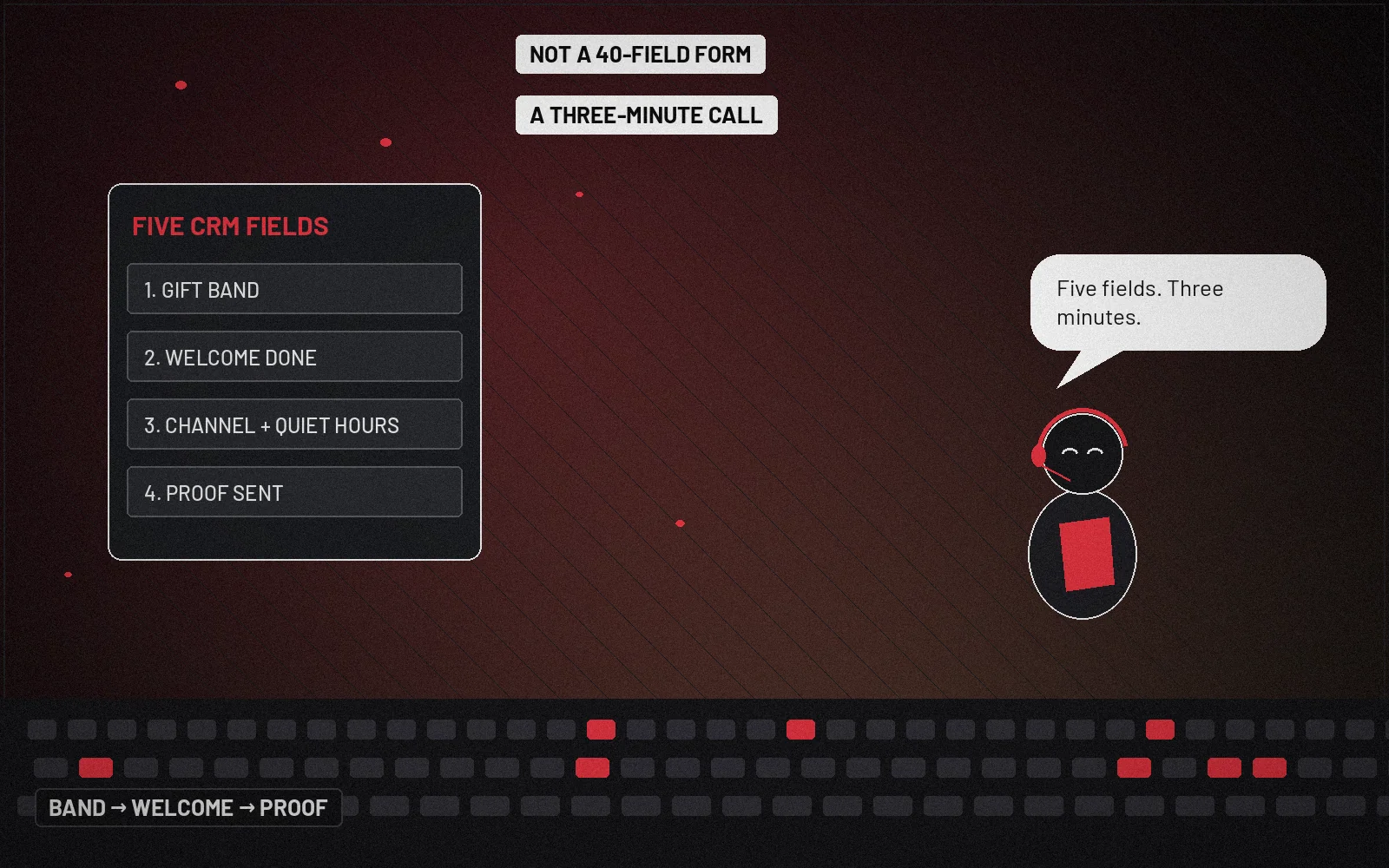
- 1. Gift band — mid-tier range in local currency
- 2. Welcome done — date and owner
- 3. Channel preference — and quiet-hours note
- 4. Proof sent — asset ID or link
- 5. Next ask window — date range, not “sometime”
Pair fields with a script that fits a three-minute call:
- Thank + name the program
- One impact line tied to their gift size
- Preference question
- Permission to send a short proof update
- Soft close: “I’ll check back in a few weeks—okay?”
If you need starter language, borrow discipline from donor welcome call scripts for mid-tier and rewrite in your voice. Do not import US major-gift theater into a barangay or KL volunteer culture. Respect is local.
Creative that builds trust (no panic urgency theater)
Mid-tier creative fails when it looks like the acquisition blast with a different subject line. These donors already gave. They need proof of competence.
Rules that hold in APAC advocacy:
- Screenshot-safe — assume every asset will be forwarded without context
- Specific — name the workstream; avoid abstract “fight for justice” fog
- Calm urgency — deadlines are fine; fake scarcity is not
- Consent-aware — field imagery and survivor stories need process, not vibes
Test creative with a forward test: would you send this to a skeptical uncle? If not, kill it. Panic urgency theater converts some first gifts and destroys second gifts. That trade is bad math.
Quiet-hours and channel hygiene across PH / SG / MY
SMS and WhatsApp can raise money and also torch trust. Map quiet hours by market. Keep suppression lists clean. Segment mid-tier away from cold blast lanes so a stewardship donor does not get three emergencies in one night.
Compliance is not only legal—it is brand. A PDPA-aware send cadence in Singapore and a respectful evening window in Metro Manila are both stewardship. Channel hygiene belongs in the fundraising ops retainer, not as an afterthought for legal.
Owned email still matters for proof packs. Use SMS for time-sensitive confirmations and reminders, not for essay-length guilt. If your team cannot staff replies, do not open a channel that implies human presence.
Scorecard: second-gift rate, not just open rate
Weekly operator metrics:
- Mid-tier welcome completion rate (target: high within 48 hours)
- Proof-pack send rate by day 14
- Second-gift rate inside 45 days
- Unsubscribe / complaint rate on stewardship lanes (should stay low)
- Average second-gift size vs first gift
Open rate is a diagnostic, not a goal. A beautiful open rate with a flat second-gift rate means you entertained people who already paid you once. That is not fundraising ops. That is content cosplay.
Publish the scorecard to leadership every Monday. When second-gift rate rises, protect the ops hours that produced it. When it falls, audit welcome ownership before you buy more acquisition media.
What “pays for itself” means in numbers operators respect
You do not need a data-science team. You need arithmetic.
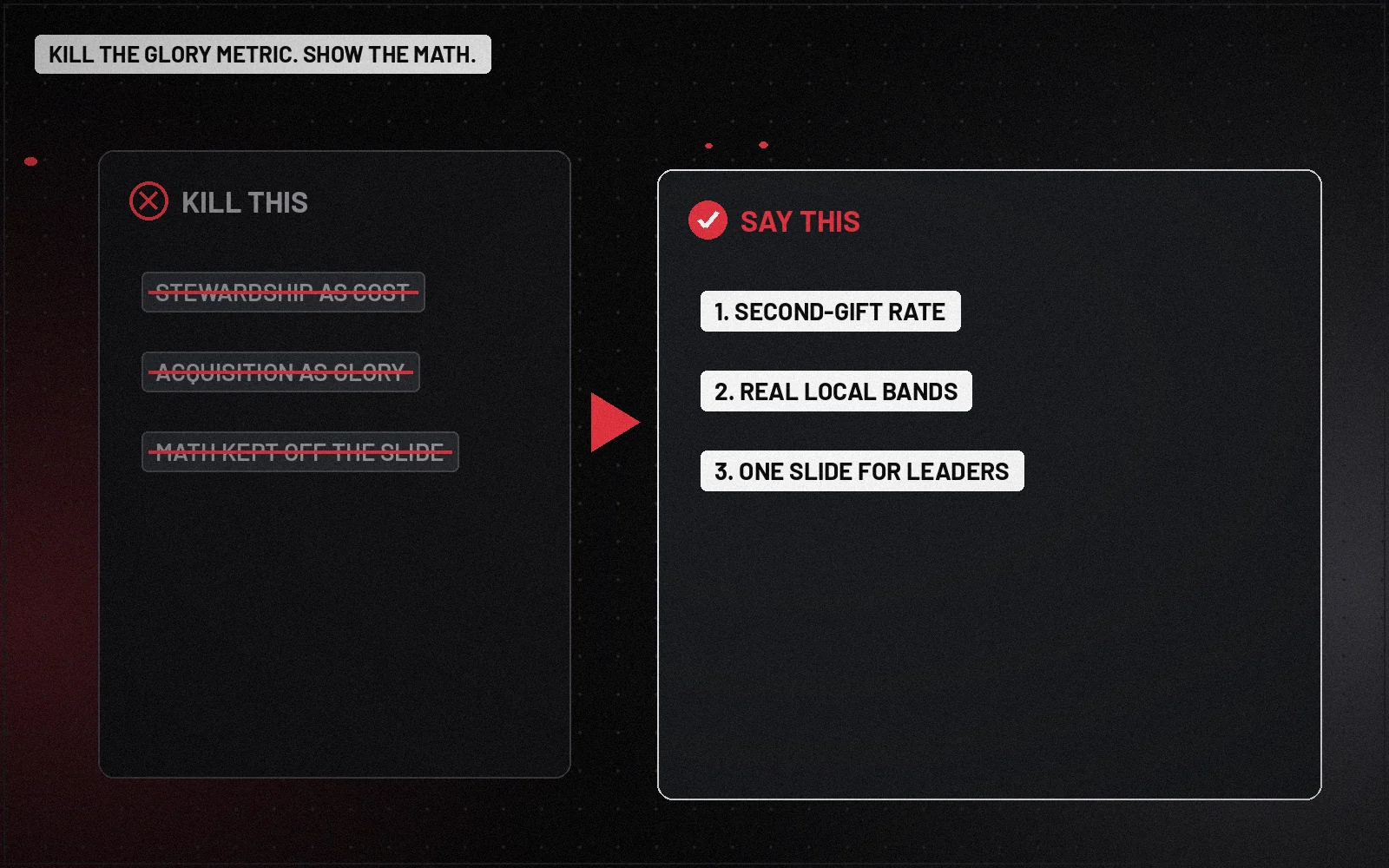
If 200 mid-tier donors give an average first gift of PHP 2,500 (or RM 200 / SGD 80—use your real band), and your second-gift rate inside 45 days is 15%, that is 30 renewals. Lift second-gift rate to 30% with welcome calls and proof packs, and you roughly double that renewal revenue without buying another cold audience. The cost of two part-time call hours a day is usually cheaper than the media required to replace those donors from zero.
Put the math on one slide for leadership. When stewardship looks like cost and acquisition looks like glory, orgs choose glory—and then wonder why September payroll is tight after a viral June.
Welcome-call quality control without corporate scripts
Train for tone, not telemarketing. The best welcome calls in PH and MY advocacy sound like a competent organizer who is grateful and busy—not a script reader. Record (with consent where required) a handful of good calls for internal training. Score only three things: thank clarity, impact specificity, preference capture.
If a caller cannot name what the gift supports in one breath, pause dialing and fix message discipline first. Stewardship without a message system becomes awkward small talk that donors remember for the wrong reasons.
Mid-tier creative examples that survive forwards
- A two-photo field update with consent notes and one sentence of outcome
- A budget line that shows how mid-tier gifts fund a concrete workstream
- A short FAQ: “Where did my gift go?” with links to public reporting
- A calm invite to a briefing call for RM500+ / PHP equivalent donors
Avoid: countdown GIFs, fake matching claims, guilt photography, and text walls that look like campaign spam. Mid-tier donors are often professionals who already donate to two other causes. Compete on competence.
Building the ops roster
Name owners:
- Welcome pod lead
- Proof asset editor
- CRM hygiene owner
- Second-ask copy owner
- Quiet-hours / compliance checker
If one person “does fundraising,” mid-tier will always lose to the next blast. Retainer support from a dual-desk partner can supply playbooks, call coaching, and creative systems while your organizers keep the relationships local—which is where trust lives.
Monthly giving vs second gift (do not confuse the jobs)
Monthly programs are powerful when you can steward them. They are also a different product. A second gift in 21–45 days can be a one-time renewal that proves trust; monthly is an ongoing relationship with billing, failure handling, and quiet-hours replies. Do not force every mid-tier donor into monthly on the second touch unless ops can answer “why was I charged again?” by morning.
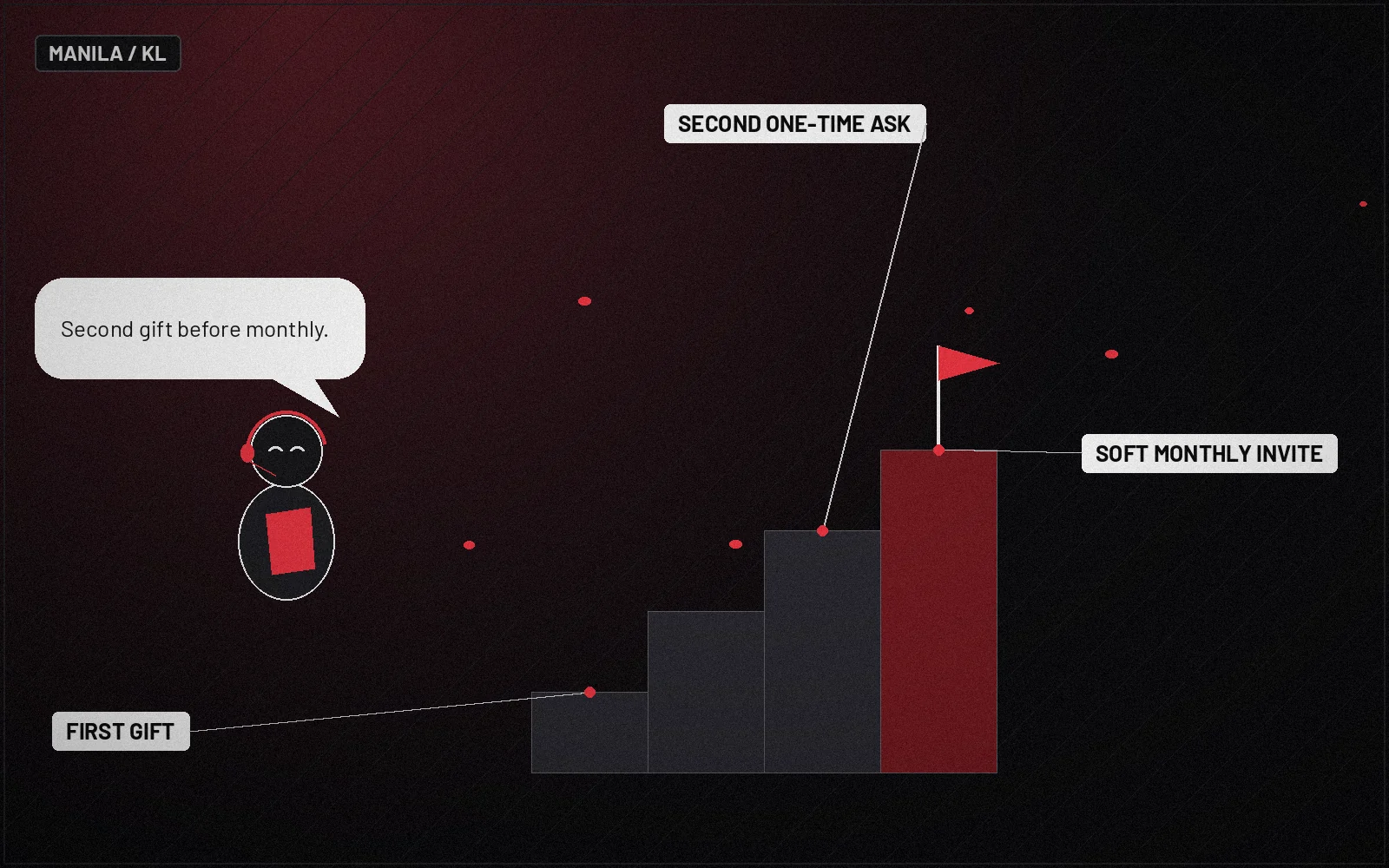
Sequence logic that works:
- 1. First gift
- 2. Welcome + proof
- 3. Second one-time ask sized to the first gift
- 4. Soft monthly invite only for donors who engage with proof and prefer recurring
That order protects trust in PH, MY, ID, and SG markets where aggressive recurring upsells feel extractive—especially during accountability news cycles when emotions are already high.
Training volunteers without burning them out
If volunteers make welcome calls, give them a two-page kit: purpose, script spine, FAQ, escalation list, and a “stop and hand off” rule for major-gift signals. Cap daily call targets. Celebrate second-gift rate, not dial count. Burned volunteers become your next retention problem.
Pair volunteer energy with staff CRM ownership. Volunteers should not be the only people who know who was thanked. That is how mid-tier memory dies when a volunteer leaves.
Soft CTA: mid-tier stewardship ops engagement
If first gifts are easy and second gifts fund the year, your money problem is probably ops—not awareness. Neuwark builds mid-tier stewardship sequences, welcome-call systems, and CRM hygiene for advocacy teams across PH, MY, ID, and SG.
Read more on Insights, explore packaging on Services, meet the dual desk on About, or contact us to scope a stewardship ops engagement. Bring last quarter’s second-gift rate. If you do not have it, that is the first deliverable.