
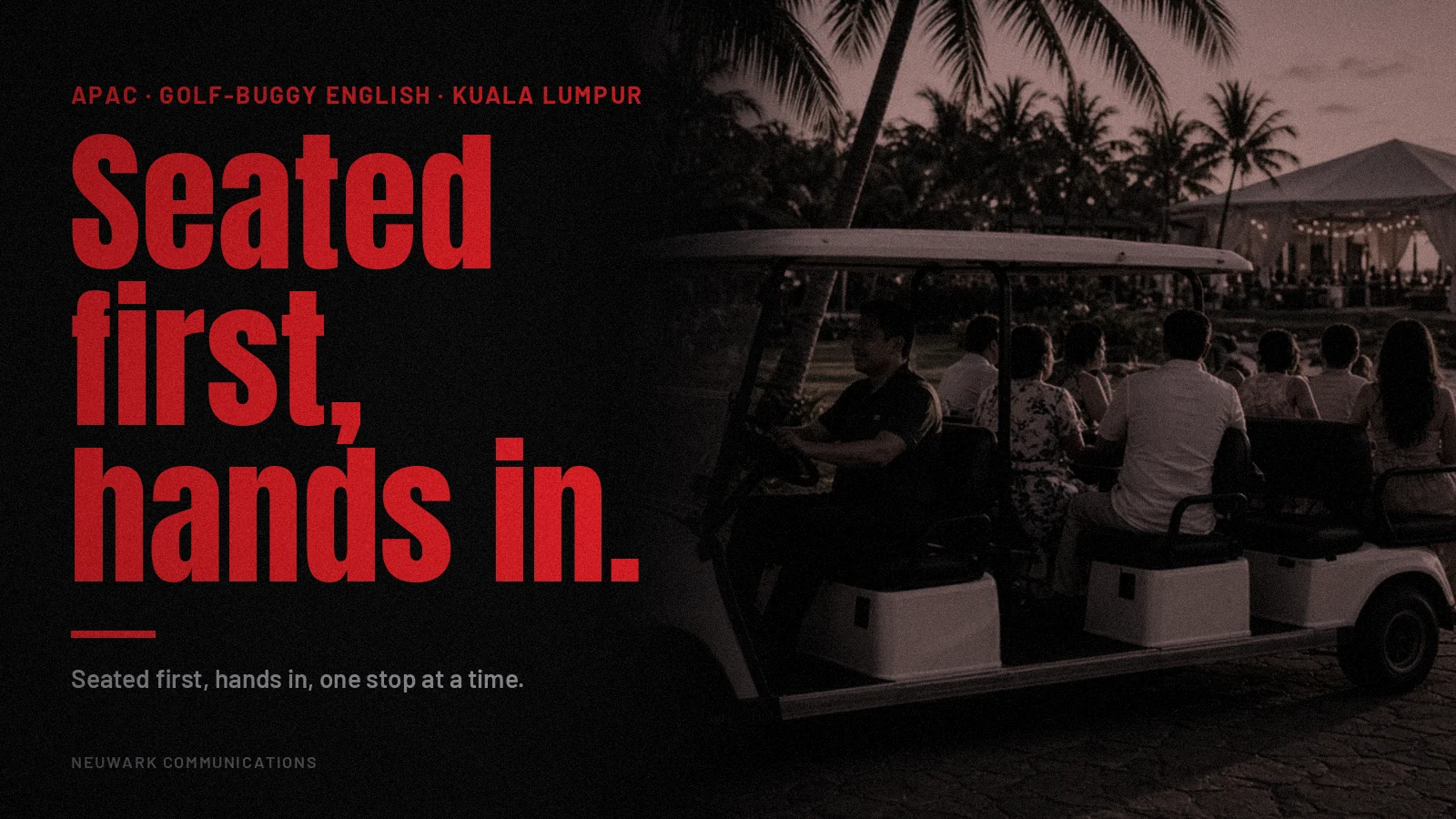
Seated first, hands in, and one stop at a time.
Golf-buggy line English APAC is the short resort transfer rule for drivers: seated first, hands in, one stop at a time.
Street-smart APAC English: short sentences a tired operator can say out loud.
A Cebu resort lobby at sunset, with a beachfront dinner starting soon.
Guests climb onto a buggy while it is already rolling.
One guest hangs an arm over the side to wave at friends on the path.
Quick answer: A golf-buggy line English APAC is the resort transfer rule for drivers: seated first, hands in, one stop at a time. The driver says it before every run, so guests sit before the buggy moves, keep arms inside and step off only at the named stop.
Pair it with the drop-off line English APAC at the hotel porch and the shuttle-pickup line English APAC for coach runs. Good event language on a resort transfer gets every guest to dinner on time.
What goes in a golf-buggy line English APAC?
Three parts. Seated first, hands in, one stop at a time.
Golf-buggy line (illustrative):
“Seated first: everyone sits, then we move.”
“Hands in: arms and bags inside the rail, please.”
“One stop at a time: we stop at the dinner venue first; step off when I stop.”
1. Seated first. The driver waits until every guest is seated before moving. No one climbs on a rolling buggy.
2. Hands in. Arms, bags and phones stay inside the rail. The driver says it once and checks with a glance.
3. One stop at a time. The driver names the stop and stops fully. Guests step off one at a time, on the path side.
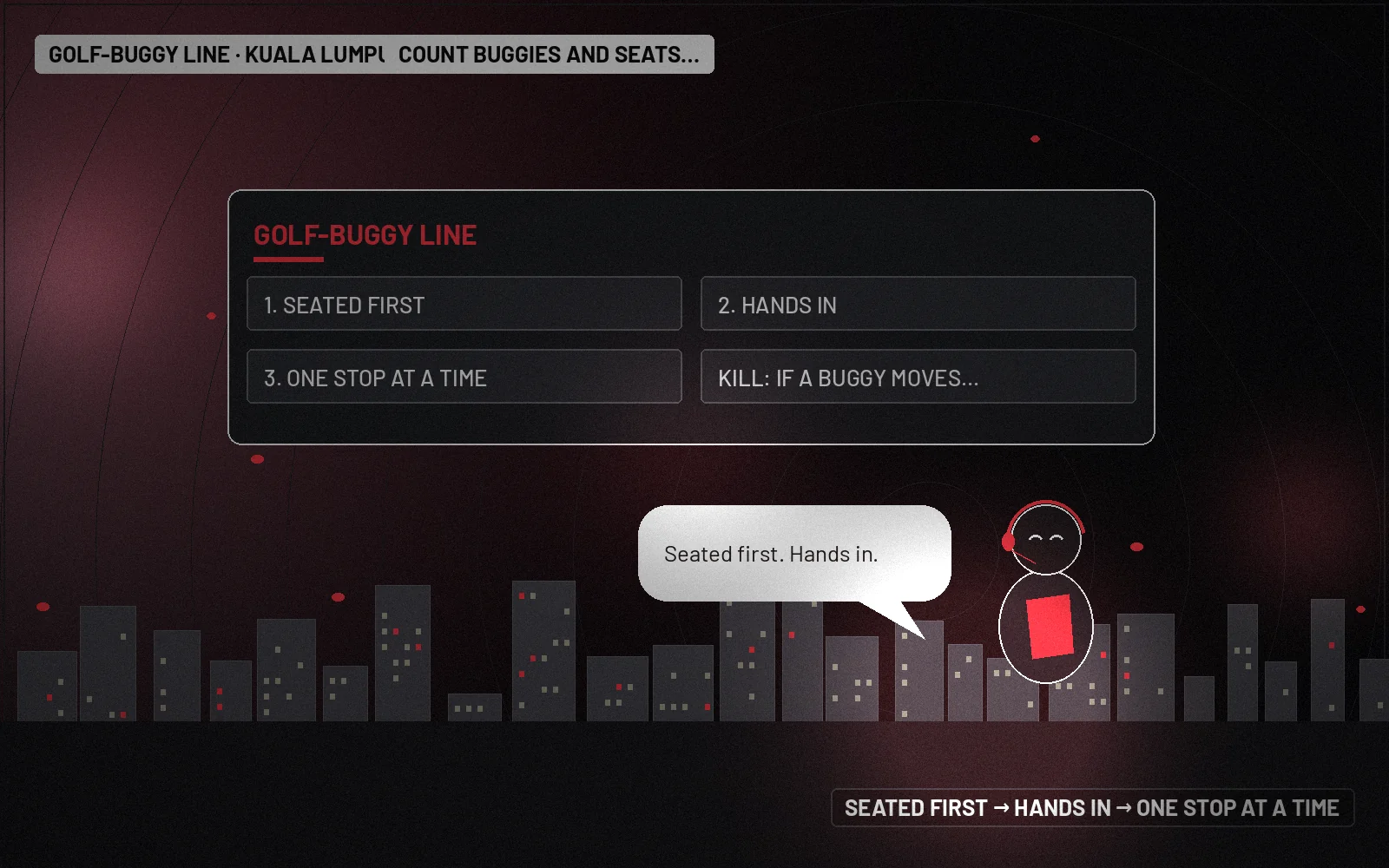
Speakable lock (illustrative): “Seated first, hands in, and one stop at a time.”
The rolling start is the habit to break. The driver moves off before the last guest sits, and someone stumbles.
What should buggy drivers stop saying to guests?
Stop saying hop on and start saying seated first. Hop on invites guests to climb aboard a moving buggy. Wait, check the seats, then name the stop.
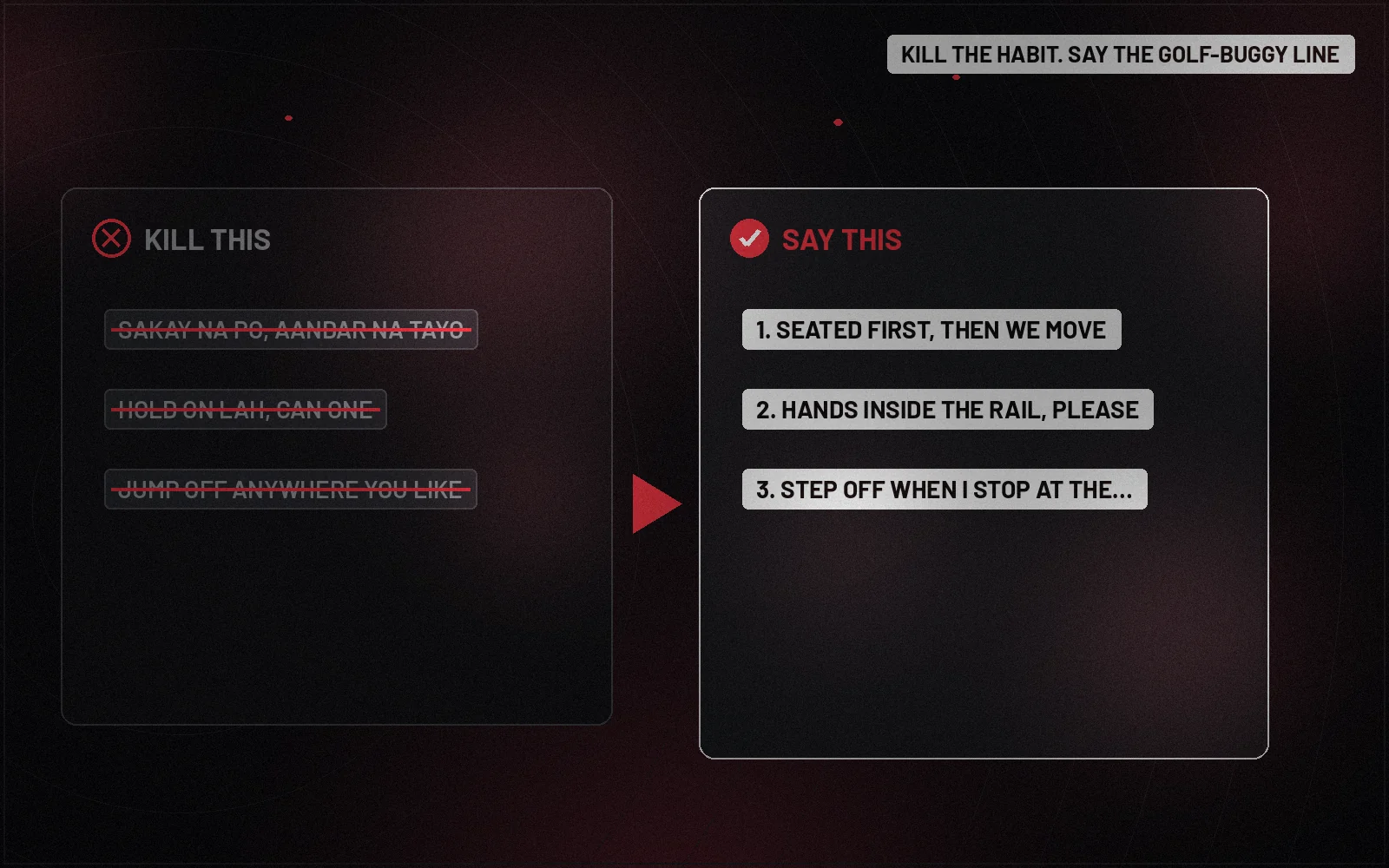
| Kill this | Say this (illustrative) | Why |
|---|---|---|
| Sakay na po, aandar na tayo. | Seated first, then we move. | Safe start |
| Hold on lah, can one. | Hands inside the rail, please. | Hands in |
| Jump off anywhere you like. | Step off when I stop at the venue. | One stop |
| Squeeze in, we fit six more. | Four seats, four guests. | Seat count |
| We’ll stop somewhere near. | First stop is the beach dinner venue. | Named stop |
Lines in this table are illustrative, not quotes from real people.
Who owns the golf-buggy line on a resort transfer?
The driver owns the buggy, and the transfer host owns the queue. The host loads guests in groups that match the seats. The driver says the line, waits for seats, and names each stop.
What if more guests are waiting than the buggy can seat?
Run another trip instead of squeezing. The host tells the next group the wait time and keeps them in the shade. Seat count never changes for speed.
How does this play out on PH, SG and Kuala Lumpur desks?
Same three parts. Different desks.
Philippines desk. In Cebu and Bohol resorts, guests are often families with seniors and kids. Say it with respect: seated first po, hands in, one stop at a time. Ma’am, sir, step off on the path side.
Singapore desk. In Singapore resort venues, guests expect a smooth, brisk transfer. Keep it brisk: seated, hands in, stop named. One trip at a time.
Kuala Lumpur desk. In Kuala Lumpur area resorts, drivers may switch between Malay and English. Keep the three beats in English on the dash card so every guest hears the same rule.
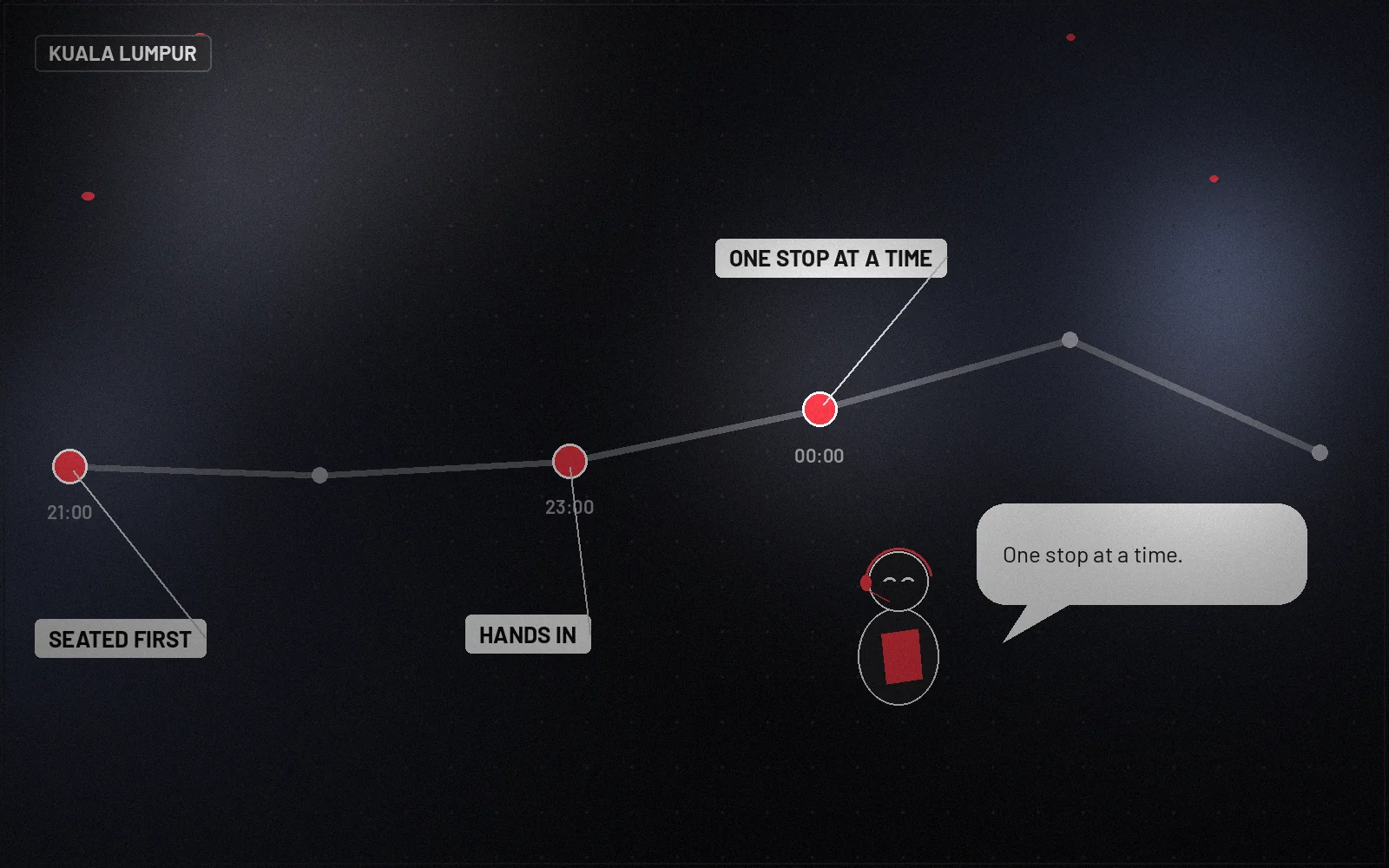
Monday field kit
- Count buggies and seats against the guest list for each transfer window.
- Put a dash card with the three beats in every buggy.
- Brief drivers: seated first, hands in, one stop at a time.
- Mark one loading point at the lobby and one drop point at the venue.
- Kill rule: if a buggy moves before every guest is seated, the transfer host stops that buggy and briefs the driver again.
FAQs
What is a golf-buggy line English APAC?
A golf-buggy line English APAC is the resort transfer rule for drivers: seated first, hands in, one stop at a time. It keeps every transfer calm and every guest on board.
When should a buggy driver start moving?
The driver starts only when every guest is seated and hands are inside the rail. A quick glance back confirms it.
How many guests should ride a resort buggy?
One guest per seat, never more. Extra guests wait for the next trip with the transfer host.
Neuwark Communications builds event and campaign communications as part of our strategy and messaging work. More street-smart lines live in Insights.
Related: drop-off line English APAC · shuttle-pickup line English APAC
Talk to us about your next event script.
Illustrative lines only. Communications craft, not legal advice.