
In a regulated Singapore business, a media briefing is never just a media briefing. A quote given to one journalist can count as selective disclosure under SGX rules, a soft-launch interview pitch can breach healthcare advertising regulations, and a confident line about a pending lawsuit can stray into sub judice territory. Any media relations agency Singapore clients hire for a regulated sector should run a fence check before the desk picks up the phone, not after the story lands.
This guide is for corporate communications, investor relations, and public affairs leads (and the agencies that support them) in listed companies, healthcare providers, and other businesses where a regulator reads the same newspaper as your customers. It is educational process guidance, not legal advice. Rules change, so read the live source text linked below and bring in counsel before any statement that touches disclosure, litigation, or advertising rules.
Neuwark Communications supports Singapore public-affairs and media work from Level 39, Marina Bay Financial Centre Tower 2, 10 Marina Boulevard, Singapore 018983 (+63 923 859 6587, hello@neuwarkcommunications.com). Related services: Singapore public affairs, Singapore crisis and issues communications, and Singapore government relations.
The short answer
Briefing journalists safely in a regulated sector comes down to three habits:
- 1. Disclose first, brief second. If something is material, it goes to the official channel (SGXNET for listed issuers) before or at the same moment it reaches any journalist.
- 2. Know which rulebook governs the person speaking. A listed issuer, a licensed healthcare provider, and a party to a court case each face a different fence. The spokesperson's talking points must match the strictest one in play.
- 3. Assume the regulator reads every quote. Treat each on-record line as if it were a filing, because in practice your supervisor, the exchange, or the court may read it before your customers do.
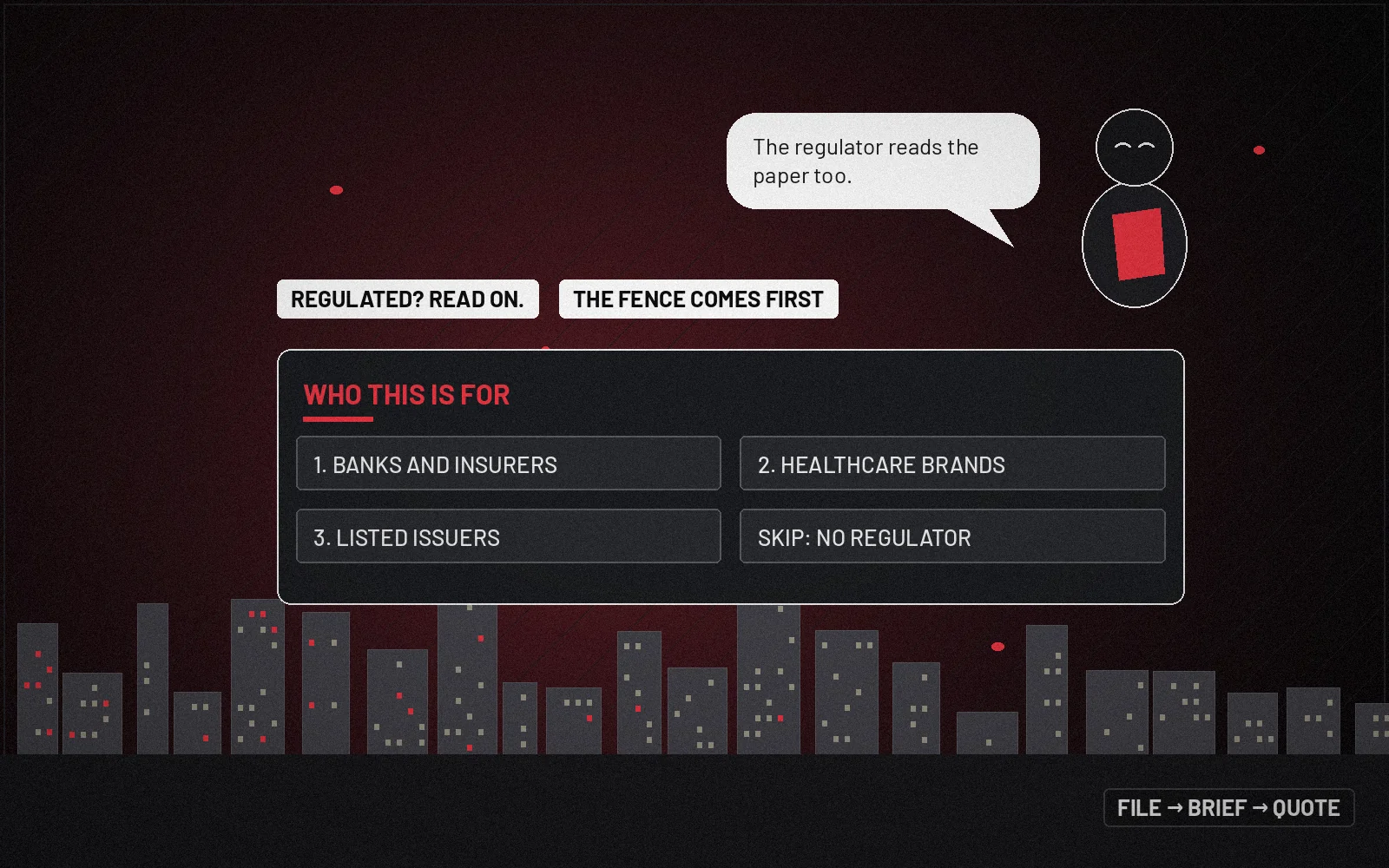
Who this is for, and who should skip it
| Use this playbook if you… | Skip it, or hand it off, if you need… |
|---|---|
| Run media for an SGX-listed company, a healthcare licensee, or a business in active litigation | A legal opinion on whether specific information is material. That is counsel's call, with the company secretary |
| Brief Singapore journalists from a regional HQ and need fences your spokespeople can remember | Advice on what to tell a regulator during an investigation. That is counsel and the compliance team, not the comms desk |
| Are choosing or briefing a media relations agency and want to test whether it understands regulated work | General brand PR with no disclosure, licensing, or litigation exposure |
Why "briefing regulators by accident" happens
Most regulated-sector media mistakes are not lies. They are good-faith answers given in the wrong order or to the wrong audience. Four Singapore rule sets explain why.
1. Listed issuers: a journalist is not a private audience
SGX's Practice Note 7.1 on continuing disclosure says the Exchange does not prohibit briefings with analysts, investors, and the media, but warns they can create a perception of selective access. It suggests pre-releasing prepared material such as slides or speeches via SGXNET, or posting it on the issuer's website with an accompanying SGXNET announcement. Where material, non-public information slips out in a briefing, the issuer must disseminate it via SGXNET as promptly as possible and may request a trading halt (paragraphs 7.4 and 7.5).
The Appendix 7.1 Corporate Disclosure Policy goes further: under no circumstances should material information be disclosed on an individual or selective basis to analysts, stockholders, or other persons unless it has already been fully disclosed to the public. The same Practice Note notes that SGX's continuous disclosure rules have statutory backing under section 203 of the Securities and Futures Act.
Two details matter most to a media desk:
- Leaks remove the confidentiality exemption. If a report carries the salient terms of a deal or is attributed to a reliable source, SGX is likely to treat the information as no longer confidential. The issuer must then announce it, or release a holding statement if it is not ready to confirm (Practice Note 7.1, paragraphs 4.2 and 4.3).
- Regulatory contact can itself be disclosable. Practice Note 7.1 (paragraph 5.16) lists being contacted by a relevant authority, or served an order to produce documents for an investigation, as events likely to require immediate disclosure, subject to the Board's materiality assessment. A spokesperson who tells a reporter "we're cooperating fully with the authorities" before any SGXNET announcement may be making that disclosure selectively.
Separately, section 199 of the Securities and Futures Act 2001 prohibits statements that are false or misleading in a material particular and likely to move the market or induce trading, where the maker knows, ought to know, or is reckless about it. That covers an over-optimistic quote as surely as a filing.
2. Healthcare licensees: you may not pitch the interview
Under regulation 9 of the Healthcare Services (Advertisement) Regulations 2021, a licensee or its employee may consent to be interviewed at the request of a print or broadcast media organisation. The licensee must not solicit, or authorise anyone to solicit, a media organisation to interview it. Anything said in the interview that promotes the licensee's services must meet the same content rules as an advertisement.
For a communications team used to pitching stories, this flips the normal playbook. The agency cannot "sell in" the clinic founder for a feature. It can make expertise findable, answer inbound requests well, and make sure promotional lines in an interview would pass as compliant advertising.
3. Parties to court proceedings: comment, but don't prejudge
The Administration of Justice (Protection) Act 2016 makes it contempt to intentionally publish matter that prejudges an issue in a pending court proceeding where that prejudgment poses a real risk of prejudice to or interference with it. Intending to publish is enough; intending the prejudice is not required. The Act defines "publish" broadly enough to include communicating to a member of the public, so a quote to a journalist counts.
The Ministry of Law's explanatory note on the Act stresses that it is a misunderstanding that no comment at all can be made on pending cases. Comment is possible as long as it does not prejudge an issue and create that real risk. The practical rule: describe process and facts already on the public record, and never predict outcomes or characterise the other side's evidence.
4. Everyone: a false statement can come back as a correction notice
Under section 11 of the Protection from Online Falsehoods and Manipulation Act 2019, a Correction Direction can require whoever communicated a false statement of fact in Singapore to carry a correction notice, and it can be issued even if that person did not know the statement was false. A company quote repeated online is exposed in the same way as any other statement. Our earlier guide on preparing for POFMA directions covers that night in detail.
Original element 1: the briefing fence matrix
Map every planned briefing against this matrix before confirming the journalist. If a row applies, its fence becomes a hard condition of the briefing.
| Situation | Fence before you brief | Who clears it | The line spokespeople must not cross |
|---|---|---|---|
| Listed issuer, results or deal news | Material content released on SGXNET first, or simultaneously; slides pre-released or posted with an SGXNET notice | Company secretary and IR, with counsel on materiality | Giving one journalist a number, date, or deal term the market has not seen |
| Listed issuer, contacted by a regulator | Board materiality assessment done; announcement made if required | Board, Nominating Committee where relevant, counsel | "We're cooperating with [agency]" before the market knows there is anything to cooperate on |
| Market rumour or leaked deal | Holding statement ready if the leak is specific; trading halt considered | Company secretary, counsel, Board | "No comment" while the story already carries salient terms |
| Healthcare licensee | Inbound request only; promotional content checked against advertisement rules | Clinical lead, compliance | Pitching a doctor for an interview, or adding claims an ad could not carry |
| Pending litigation | Talking points limited to public-record facts and process | Litigation counsel | Predicting the result, or describing the other party's case |
| Statement of fact about a public issue | Fact source documented and dated | Subject-matter owner | Repeating a figure nobody inside can source |
Original element 2: the 10-question pre-briefing gate
Run this gate at least a day before any regulated-sector interview, background briefing, or media roundtable. A single "no" or "don't know" pauses the briefing until it is resolved.
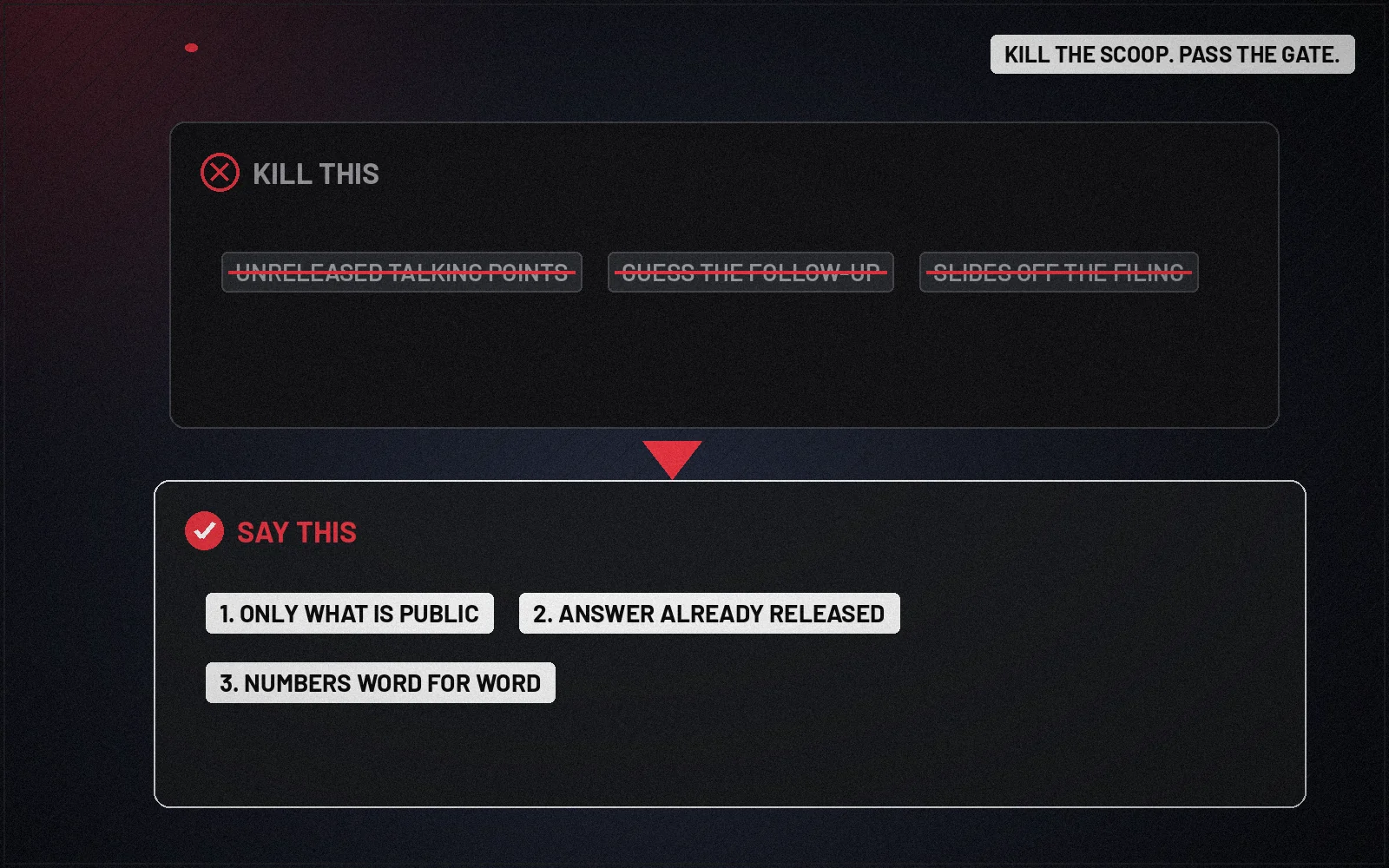
- 1. Is there anything in the planned talking points that has not been publicly released through the official channel?
- 2. If a journalist asks the obvious follow-up ("how much?", "when?", "who?"), is the answer already public?
- 3. Has the company been contacted by any regulator, exchange, or agency about a matter the journalist could raise? If yes, has the Board decided on disclosure?
- 4. Is any litigation, arbitration, or inquiry pending that touches the topic?
- 5. For healthcare: did the media organisation request this interview, and is that request on file?
- 6. Do the slides or handouts match what has been filed, word for word on numbers?
- 7. Is every factual claim in the key messages backed by a dated source someone inside can produce?
- 8. Does the spokesperson know the three questions they must decline, and the exact words to decline with?
- 9. Is someone from IR, legal, or compliance sitting in, or at least on call?
- 10. If something material slips out anyway, who files the announcement, and how fast?
Question 10 is the one most teams skip. Under Practice Note 7.1, inadvertent disclosure has to reach SGXNET as promptly as possible, so the filing owner's phone number belongs on the briefing sheet.
Original element 3: a worked illustration (fictional, labelled)
Scenario (illustrative only, no real company): A fictional SGX-listed logistics group schedules a trade-press interview about its new regional warehouse. Two days before, its CFO learns that an agency has asked the group for documents relating to a subsidiary's past contracts.
The draft talking points (reject): "Strong quarter ahead. We expect the warehouse to lift margins meaningfully. On the inquiry you may have heard about, we're cooperating fully and expect it to be resolved quickly."
What is wrong: "Strong quarter" and "lift margins meaningfully" hint at earnings direction the market has not seen. The inquiry line may disclose a regulatory contact the Board has not yet assessed or announced, and "resolved quickly" predicts an outcome nobody can promise.
The gated version (ship): The Board assesses the document request first and, if it is material, announces it on SGXNET before the interview. The talking points then cover only the warehouse's announced capacity and opening date, both already filed. On the inquiry, the spokesperson says: "We've made an announcement on SGXNET, and we'll update the market there if there are material developments." The IR lead sits in, and the filing owner's number is on the sheet.
Common traps
| Trap | Why it fails | Fix |
|---|---|---|
| Embargoed exclusive for one outlet on deal news | An embargo still gives one party material information before the market | File first, then offer the interview on filed facts |
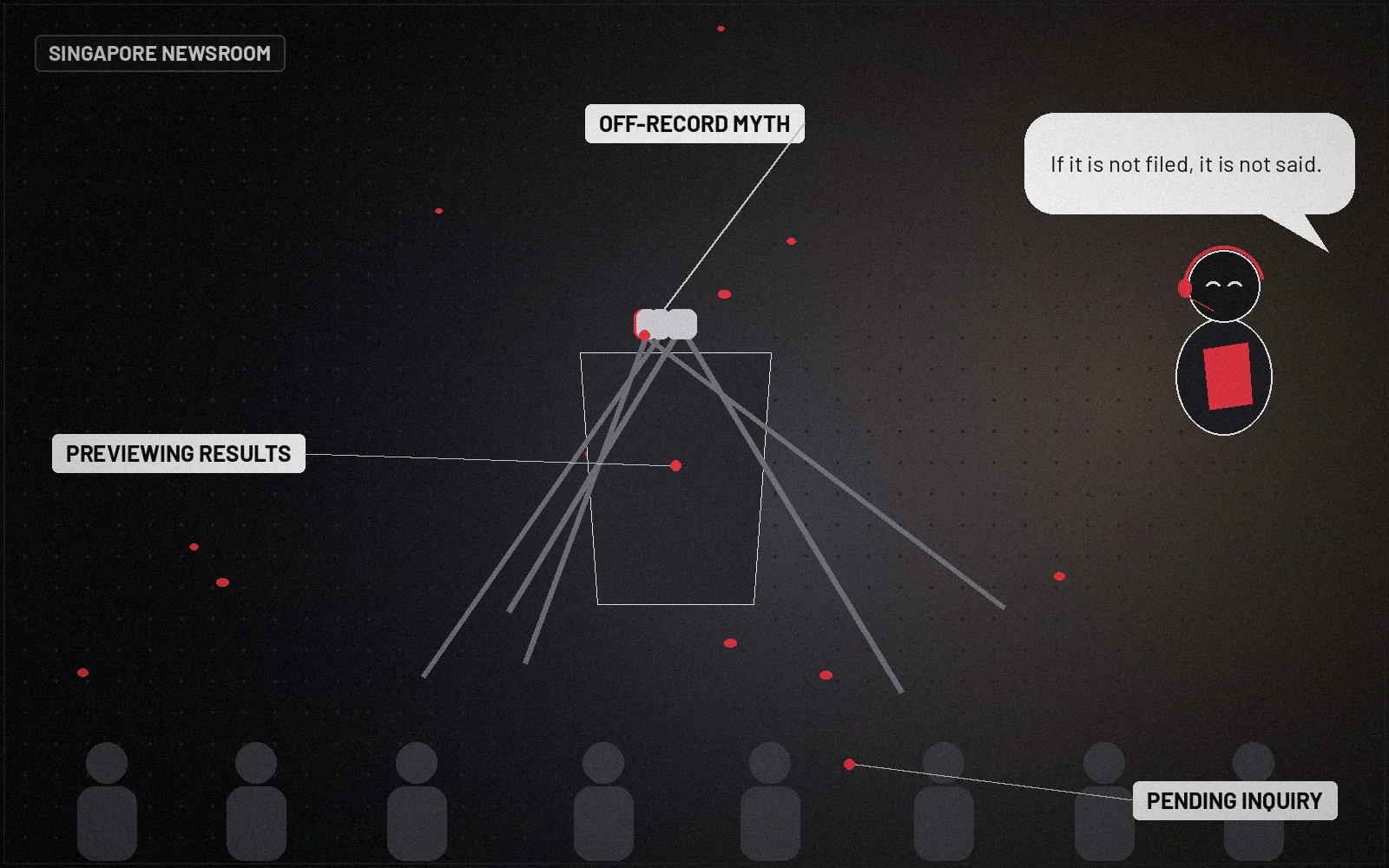
| "Off the record" as a safety net | Off the record is a newsroom convention, not a disclosure exemption | Treat everything said to a journalist as potentially public |
| Agency pitching a clinic's doctor as an "expert voice" | Healthcare licensees must not solicit interviews | Build findable expertise and respond to inbound requests |
| Commenting on a rival's lawsuit or your own | Prejudging a pending case risks contempt | Process and public-record facts only |
| Website newsroom posts news before SGXNET | Material information on the web should be released via SGXNET first or at the same time | One release order, owned by the company secretary |
How to choose a media relations agency in Singapore for regulated work
When you shortlist agencies, ask them to walk you through their pre-briefing gate. A capable regulated-sector partner will ask who your company secretary is before asking for your story angles. It will refuse to pitch a healthcare licensee, and it will know the difference between a holding statement and a "no comment". If the first proposal promises "exclusive placements" for undisclosed news, that agency is selling a risk, not a service. For the wider question of when you need public affairs or government relations support rather than media relations alone, see our buyer's split of government relations and public affairs and the Singapore regulator map.
FAQ
Can a listed company still do media interviews in Singapore?
Yes. SGX explicitly does not prohibit briefings with analysts, investors, or the media. The condition is that material, non-public information is not handed out selectively. Prepared material should be released via SGXNET first or posted with an SGXNET notice, and anything that slips out must be announced promptly.
Is "no comment" safe if a deal has leaked?
Not always. If the report is specific enough that the information is no longer confidential, SGX expects an announcement, or a holding statement if you cannot yet confirm. Silence on the market channel while the press carries the terms is the risky option.
Can our clinic send a press release about a new service?
Healthcare advertising in Singapore is regulated, and regulation 9 specifically bars licensees from soliciting media interviews. Have compliance check any release against the advertisement regulations, and do not follow it with interview pitches. Respond to journalists who ask.
Can we say anything while we're in court?
Yes, within limits. You can state public-record facts and describe the process. Avoid predicting the outcome or characterising the evidence, and have litigation counsel clear every line.
What to do next
Before your next regulated-sector briefing, put the fence matrix and the 10-question gate on one page, name the filing owner, and rehearse the three questions your spokesperson must decline. If you want a Singapore team to stress-test a briefing plan, or to build the desk rhythm around your disclosure calendar, start with Singapore public affairs or contact Neuwark. For when a briefing turns into an issue, see issues management before the crisis call.