
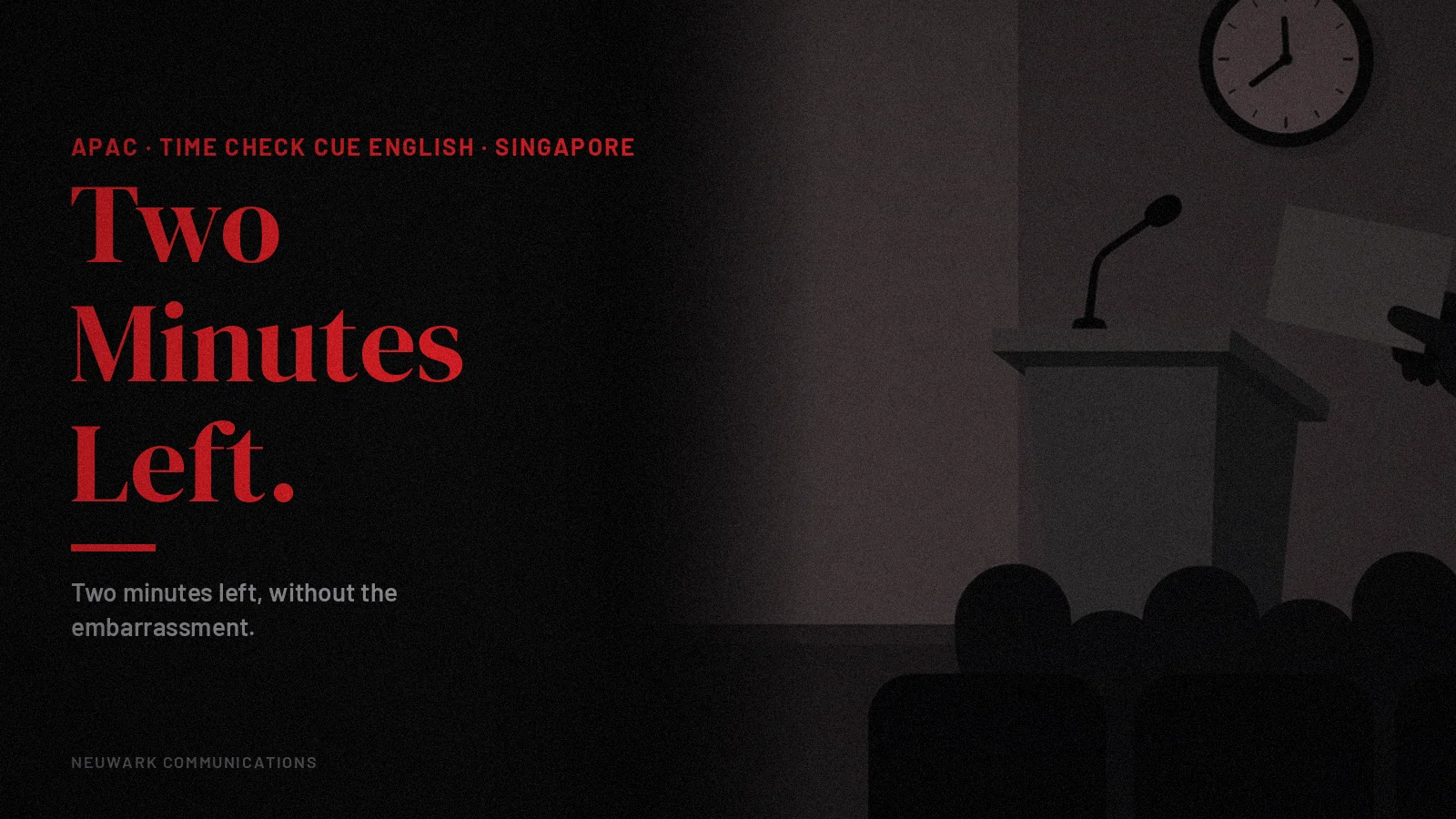
A panel in a Singapore hotel ballroom, running long. The moderator leans into the mic and says, “Sorry, sir, we’re out of time, we really need to move on.”
The speaker loses his last point, and the whole room watches him go red.
Time check cue English APAC is the short signal that tells a speaker time is nearly up: how long is left, what to do, shown or said quietly.
Street-smart APAC English: short sentences a tired operator can say out loud.
It sits inside our run-of-show cue English APAC, which moves the whole programme to the next segment. The time check cue is smaller: one speaker, one signal. For audience questions, our town hall ground rules English APAC set the limits up front.
Quick answer: A time check cue English APAC is a quiet, agreed signal that tells a speaker how much time is left and what to do with it, such as two minutes and please wrap up. Agree the cards and words before the session, show them from the front row, and keep the spoken version for the moderator.
What goes in a time check cue English APAC?
Two parts. How long is left, what to do.
Time check cue (illustrative):
Card at five minutes: “5 minutes”
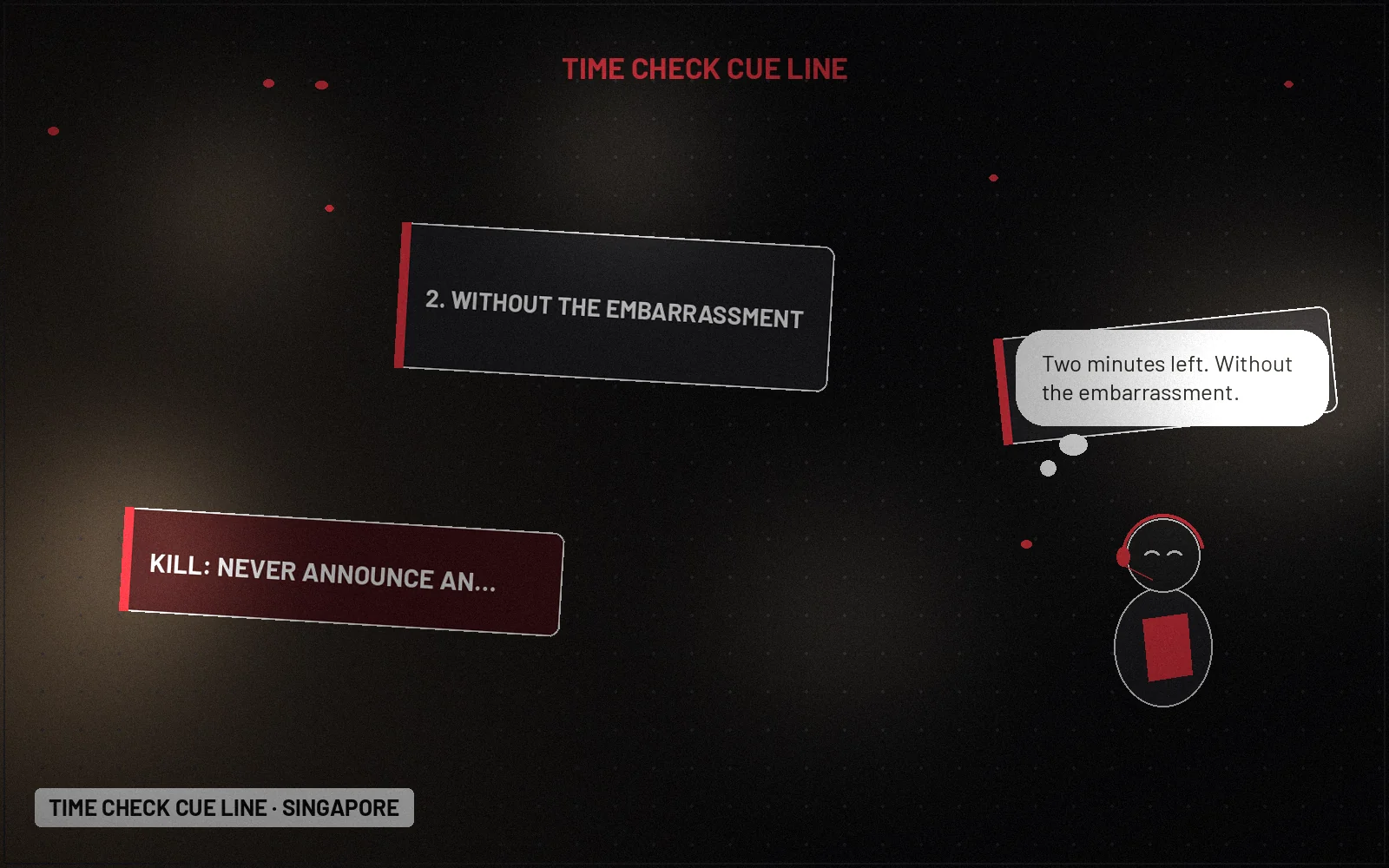
Card at two minutes: “2 minutes. Please wrap up.”
Card at time: “Time. Last sentence, please.”
Say what to do, not just how long. “Two minutes” leaves the speaker to work it out; “two minutes, please wrap up” tells them.
Why agree the cue card before the session?
Because a card the speaker has never seen is just a coloured square. Show each speaker the cards in the green room or at the briefing, say who will hold them and where, and ask how they want to be warned. Some want five and two; some want only two.
It also gives permission. A speaker who agreed to the cards does not feel ambushed when they appear.
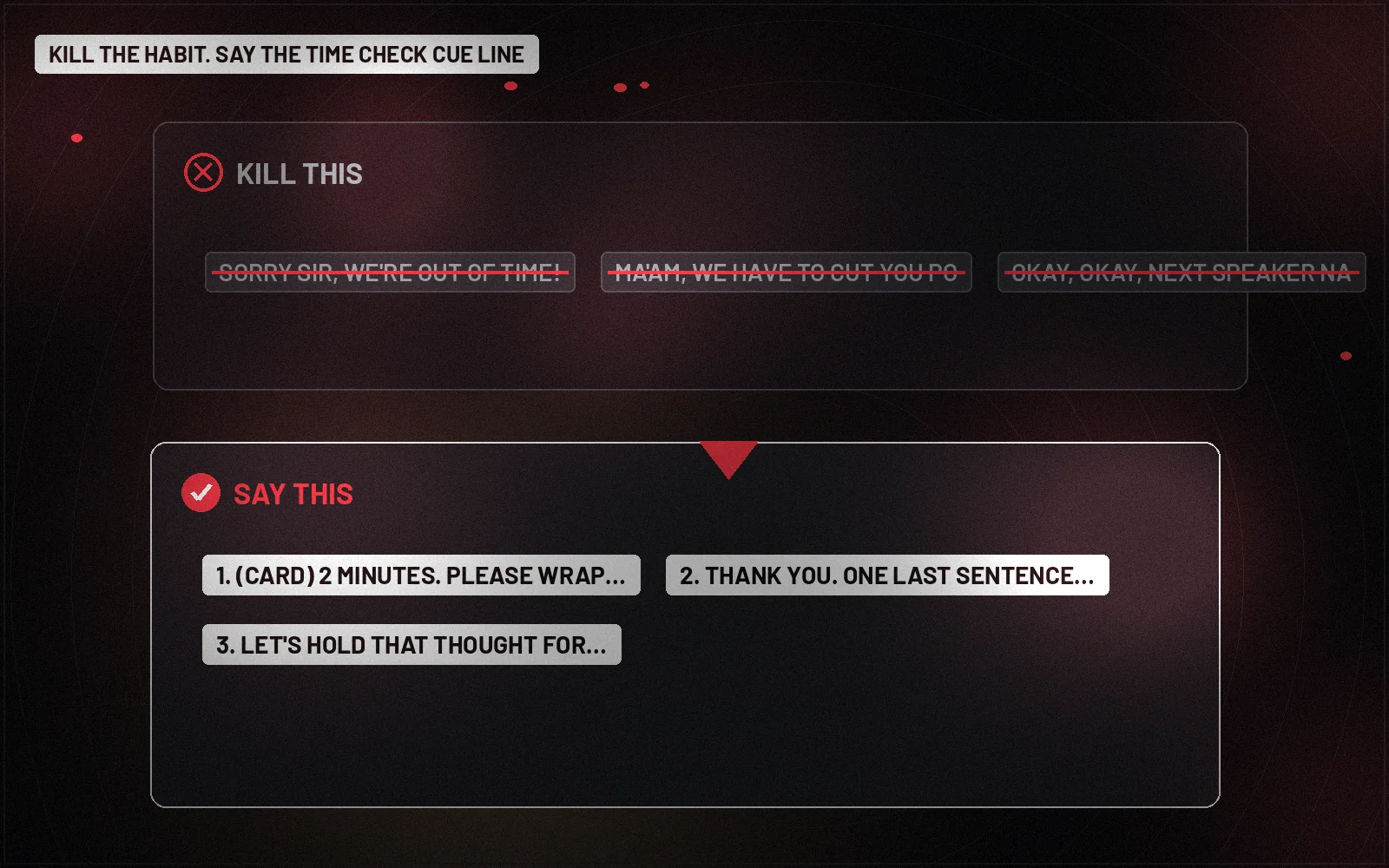
| Kill this | Say this (illustrative) | Why |
|---|---|---|
| Sorry sir, we’re out of time! | (card) 2 minutes. Please wrap up. | Quiet, agreed, off the mic |
| Ma’am, we have to cut you po. | Thank you. One last sentence, please. | Gives them an ending |
| Okay, okay, next speaker na. | Let’s hold that thought for the Q&A. | Parks the point, keeps face |
| Can you speed up? | Two minutes left. Your last point, please. | A time and an action |
| (waving from the back of the hall) | (card raised from the front row, at eye level) | Seen by the speaker, not the room |
Who holds the cards, and where?
One timekeeper, in the front row or beside the stage, in the speaker’s eye line. Not the back of the hall, where the audience sees the cards first. The timekeeper uses a stopwatch, not a phone screen, and passes a note to the moderator if a speaker misses the cards.
What should the moderator say out loud?
Only what helps the speaker land. At time: “Thank you. One last sentence, please.” Then a warm handover: “Let’s hold that thought for the Q&A.” The moderator never announces that the speaker has overrun. They close the segment and move on.
On a panel, the moderator gives time checks to the whole panel at once: “We have five minutes, so a quick last word from each of you.” Nobody is singled out.
What if the speaker ignores the cards?
Give one more chance at the agreed “time” card, then the moderator steps in with the closing line, warm and short. If the session is streamed or recorded, the run of show decides how much overrun is possible, and the moderator knows that limit before going on stage.
How does this play out in PH and SG?
Same two parts. Different rooms.
Philippines desk. At a barangay hall forum or a covered court town hall, speakers may be senior community figures, and a public cut feels like a loss of face. Agree the cards in private, use “po” and a thank-you in the spoken close, and brief the emcee to say the same line every time. Send speakers the cue plan by Viber or WhatsApp the day before.
Singapore and wider APAC desk. At a Suntec or Marina Bay conference, sessions are often tightly scheduled, with a desk timer facing the speaker. Use it, but still agree the words, and keep the cards in plain English for speakers working in a second language.
Paste-ready lock
Speakable lock (illustrative): “Thank you, we have two minutes left, so one last point, please.”
Monday field kit
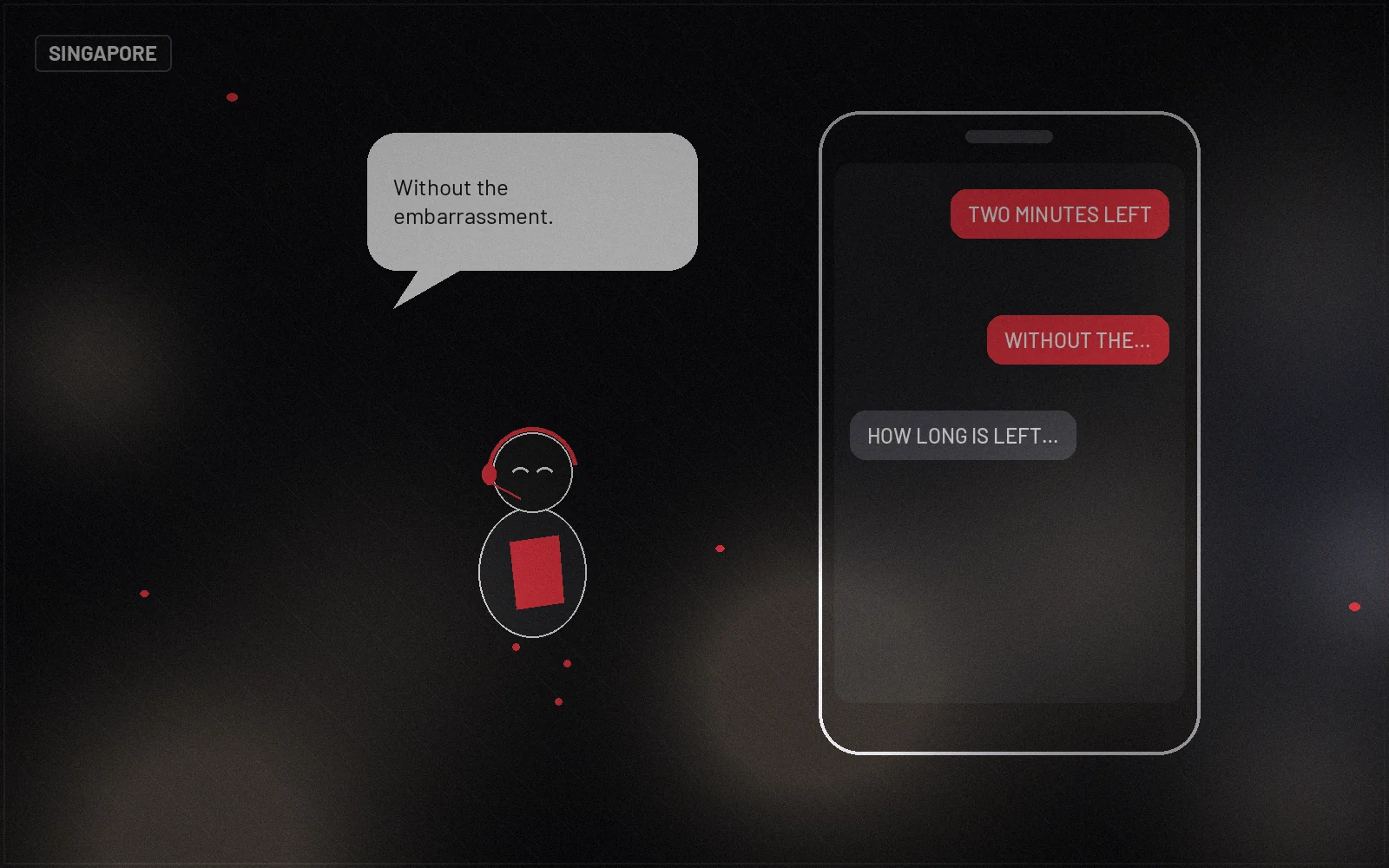
- How long is left, what to do. Two parts, every time.
- Show each speaker the cards before the session.
- One timekeeper, front row, in the speaker’s eye line.
- The moderator’s closing line ready and warm.
- Kill rule: never announce an overrun on the mic.
What to do this week
- Make three cards: five minutes, two minutes, time.
- Pick the timekeeper and the seat.
- Add the cue plan to the speaker briefing.
- Rehearse the moderator’s closing line.
FAQs
What is a time check cue English APAC?
It is the short signal that tells a speaker time is nearly up: how long is left, what to do, shown or said quietly. Most of the time it is a card, agreed with the speaker in advance.
How do you tell a speaker to wrap up politely?
Show the agreed two-minute card, then at time say a short thank-you and ask for one last sentence. Give them an ending, not an interruption.
What should a moderator do when a panel runs over?
Give the time to the whole panel at once and ask for a quick last word from each. Nobody is singled out, and the session still ends on time.
Neuwark Communications plans event and field messaging as part of our services, including Digital and Social for streamed sessions and speaker briefings. Panels that always overrun? Talk to us at Contact. More language companions live in Insights.
Illustrative lines only. Not legal advice; counsel checks election-period and platform rules.
Related: Run-of-show cue English APAC · Town hall ground rules English APAC