
The host asked who was speaking. The guest started the theory of change.
Spokesperson intro English APAC is four lines a host, a reporter and a volunteer can say without a decoder: the name, the organisation in one breath, the stake of this appearance, and who answers after the lights go off.
Street-smart APAC English: short sentences a tired operator can say out loud.
Most advocacy intros are CVs. “A multi-awarded advocate, fellow and mother of three who has spent two decades fighting for…” The clip starts late. The quote that ships is the biography, not the stake.
This is a companion to our press kit English APAC, which gives reporters the organisation’s identity line and desk. This piece gives a host the person: who is speaking tonight and why. The name spelling and the identity line should match the kit exactly.
What are the four spokesperson intro English APAC lines?
| Line | Job | Say this (illustrative) |
|---|---|---|
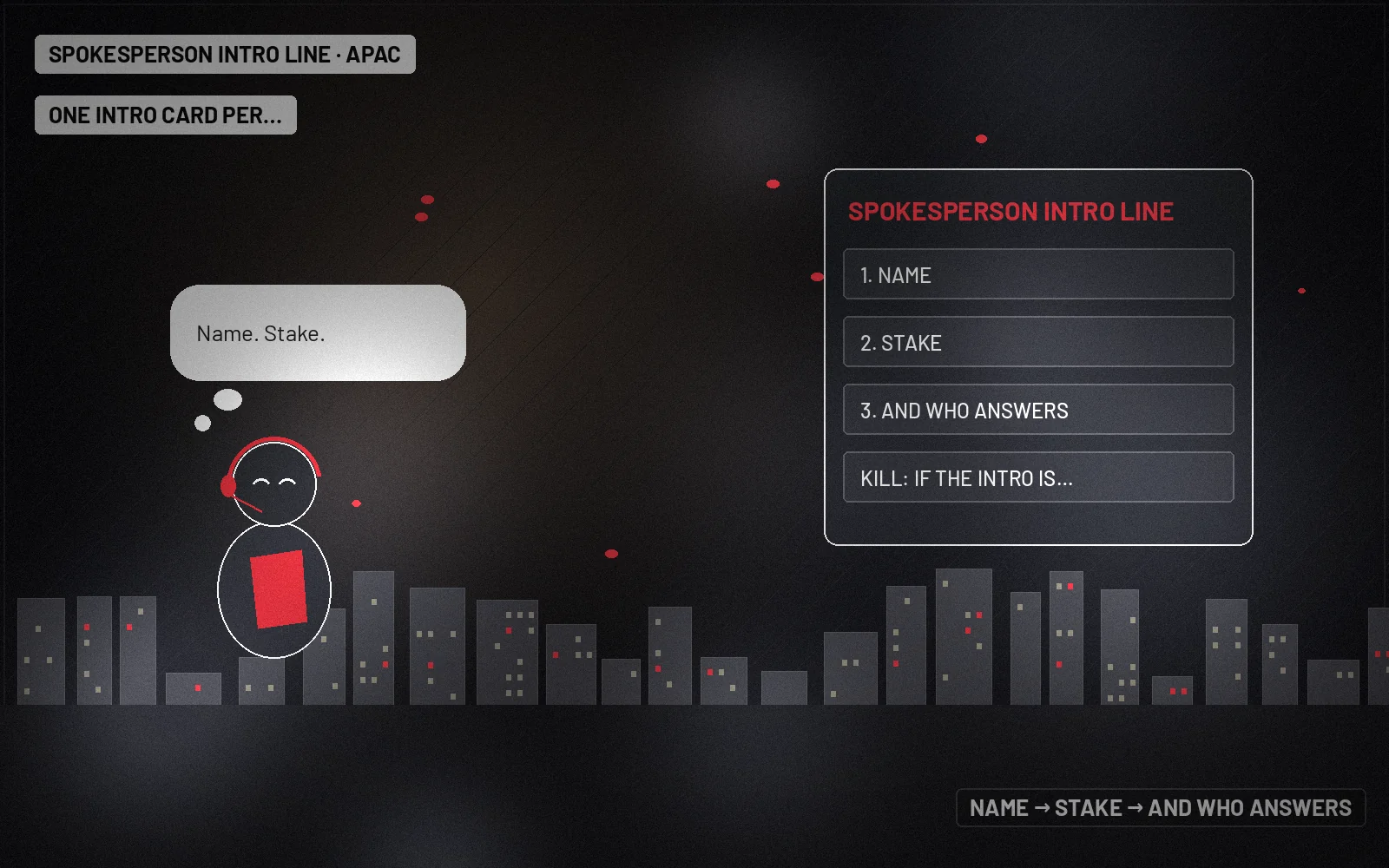
| 1. Name | What they are called on air | “Maya Santos.” |
| 2. Organisation | One breath, no slogan | “Spokesperson for the clean air coalition.” |
| 3. Stake | Why this desk, this hour | “She is here on the patient-cost line in the 2027 budget.” |
| 4. After | Who picks up | “Questions after the show go to the coalition’s press desk, not her personal phone.” |
The name and organisation here are fictional and illustrative. Use your spokesperson’s real name, spelled exactly as in the press kit.
The volunteer at the door uses the same name and stake. If the door card and the TV card disagree, you trained two organisations. See our volunteer door card English.
Why does the stake change every time?
Because the career stays the same and the reason for tonight does not. A host needs to know why this person is in this chair on this night.
Rewrite the stake line for every appearance. “She is here on the patient-cost line” tells the audience what to listen for. A list of fellowships tells them to change the channel.
What must the intro not do?
| Kill this | Why it fails | Say this instead |
|---|---|---|
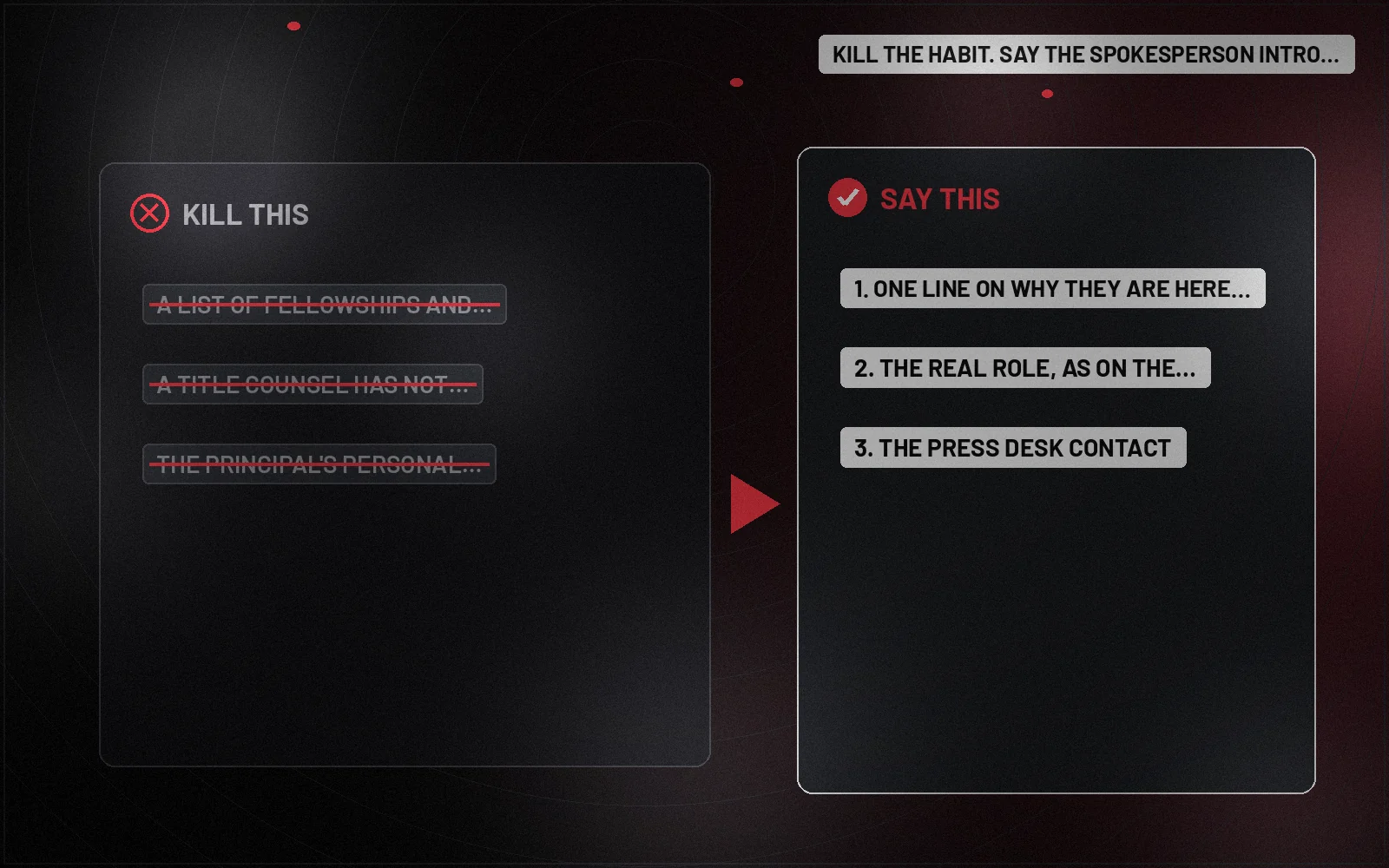
| A list of fellowships and awards | Pushes the stake out of the clip | One line on why they are here tonight |
| A title counsel has not cleared (“the voice of the people”) | A claim you will be asked to defend | The real role, as on the press kit |
| The principal’s personal number in a live intro | Privacy and safety risk | The press desk contact |
| A preview of a claim still under embargo | Breaks the embargo on air | Only what is public tonight |
| A long intro | The host talks over it and the clip starts late | Short enough to read in one breath or two |
What goes on the pre-tape card for the host?
The host card is three lines on paper, large type, no logo stack:
- Name and organisation.
- Stake in one sentence.
- What they will not take questions on tonight.
Hand it over before the show, and say the name out loud once so the host hears the pronunciation. If the host ad-libs a title anyway, the spokesperson corrects it once in the first answer, then moves to the stake.
How does the intro work with a holding line?
On a bad night, the intro is the only thing the spokesperson controls before the first question. Keep it identical to the calm-night version: name, organisation, stake, who answers.
If the stake tonight is an incident, the stake line names the incident plainly and the “after” line points to the desk that owns the next update. Our press holding line English APAC and doorstep holding English cover what the spokesperson says next.
How does the intro change between radio, TV and a livestream?
The four lines stay. The delivery changes.
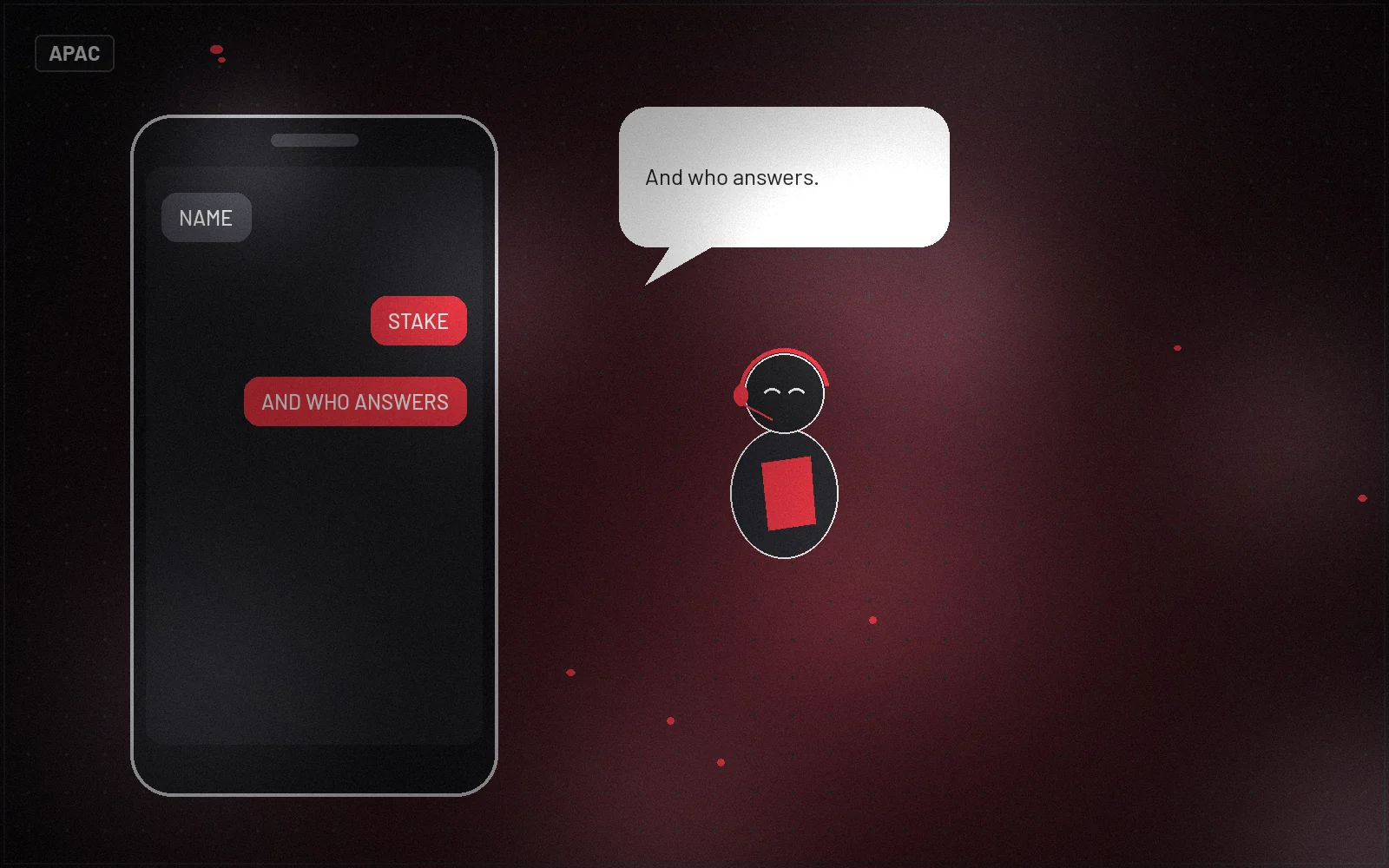
On radio there is no lower-third, so the host says the name and organisation again after a break. Give the host a one-line re-intro: name, organisation, stake, in that order. On TV the lower-third carries the name and role, so the spoken intro can go straight to the stake. On a livestream, pin the four lines as a comment so late joiners know who is speaking.
Paste-ready re-intro for radio (illustrative):
“Back with Maya Santos of the clean air coalition, on the patient-cost line in the 2027 budget.”
Whatever the format, the name spelling on screen and in the pinned comment must match the press kit. A misspelled name on a lower-third becomes the screenshot of the night.
Monday field kit
- One intro card per spokesperson, dated.
- Same name spelling as the press kit.
- Stake line rewritten per appearance, not per career.
- An “after” line that is a desk, not a face.
- Kill rule: if the intro is longer than the first answer, cut the intro.
FAQs
What is spokesperson intro English APAC?
Spokesperson intro English APAC is the four-line card a host can read: name, organisation, the stake of this appearance, and who answers after. It matches the press kit word for word on name and role.
Can we mention a book or a case?
Mention a book or case only if it is why they are in the chair tonight. Otherwise it waits for the pre-interview.
What if two coalition partners share the slot?
Two partners get two names and one stake. Do not give each partner a paragraph, because the audience will remember neither.
Who writes the intro card?
The press desk writes the card and the spokesperson checks it. The host gets it before the show, not in the studio doorway.
What to do this week
Time the intro out loud. If it runs longer than the first answer, it is a CV. Cut it to four lines.
Neuwark Communications writes principal cards under Strategy & Messaging and Crisis & Rapid Response. If your intros still sound like programmes, talk to us at Contact. More language companions live in Insights.
Communications craft, not legal advice. Check media, election and disclosure rules with counsel in each market before a spokesperson goes on air.
Related: Press kit English APAC · Press holding line English APAC · Doorstep holding English · Volunteer door card English