
The brief was twelve pages.
The chair gave you three minutes.
The clip will be twelve seconds.
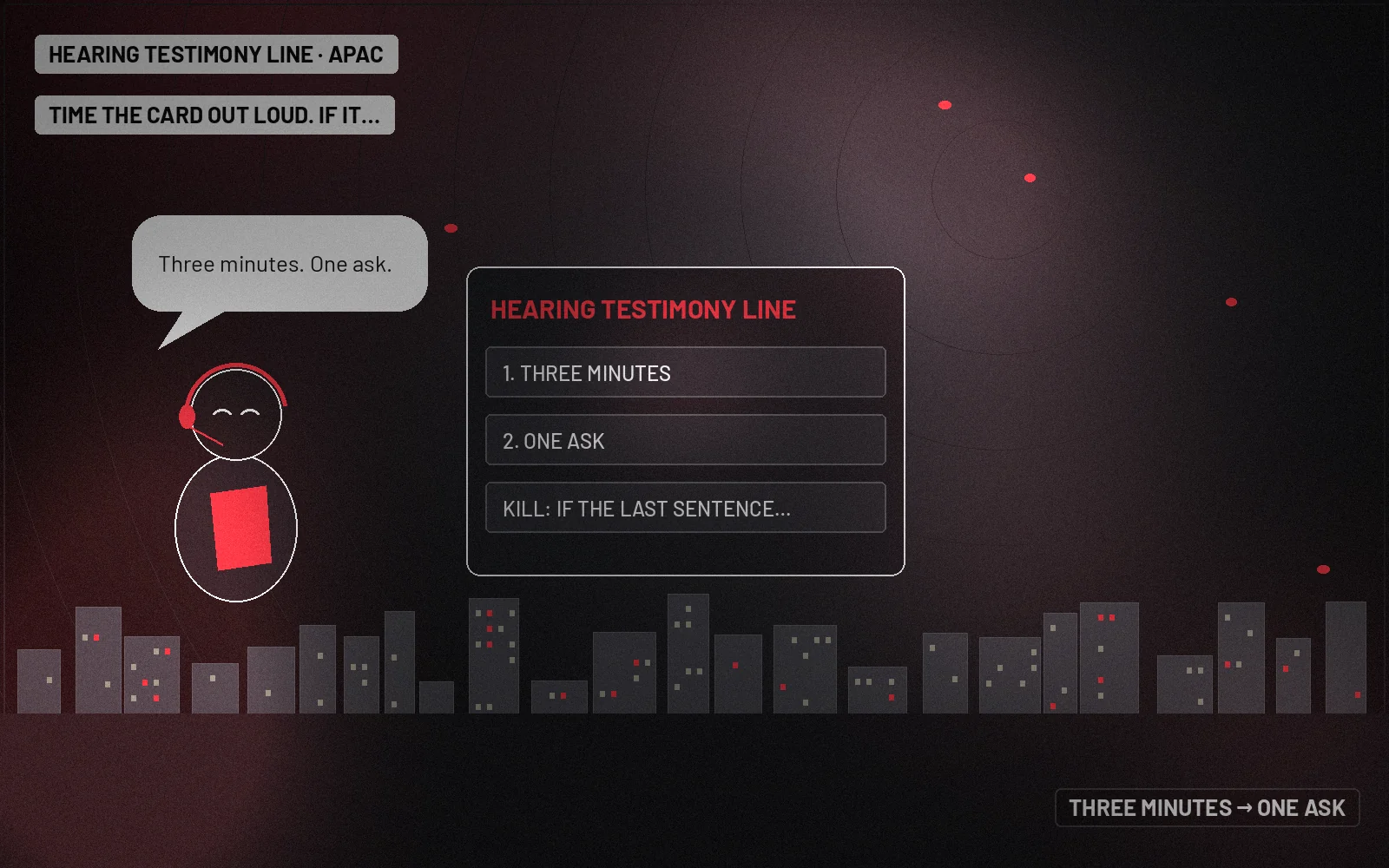
Hearing testimony English APAC is four spoken blocks a principal can finish before the gavel: who you are, what is broken, the one proof, the one ask. Not a speech. Not a reading of the position paper.
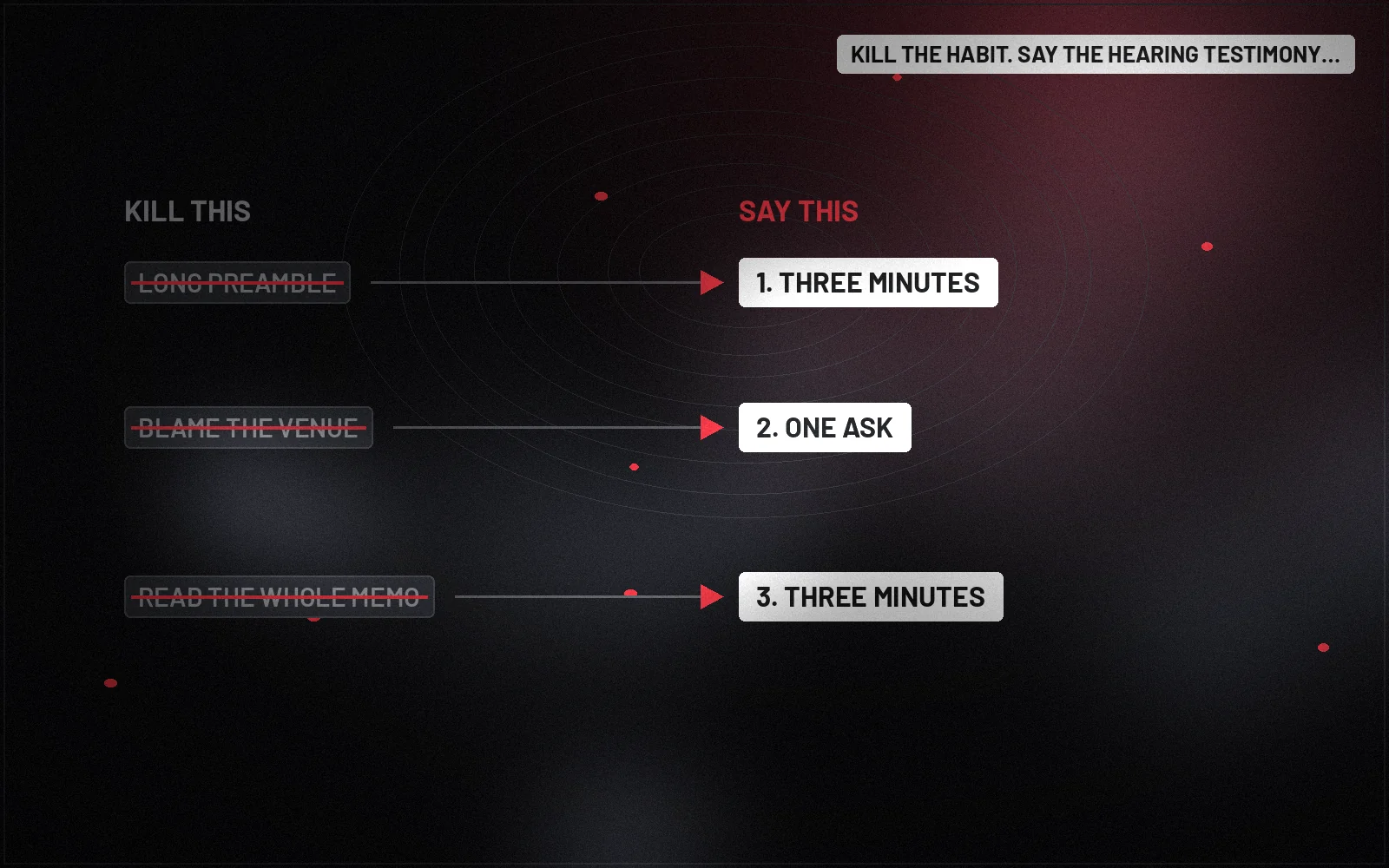
Most testimonies die in the greeting.
“Honorable chair, distinguished members, on behalf of our coalition of partners across the region…”
The clock is already gone.
The clip has nothing to cut.
Street-smart APAC English: short sentences a tired operator can say out loud.
This sits next to our CRM field note English piece, which covers what the organiser writes down after a short hearing slot. This one covers what the principal says at the stand. For the lines around the room, see doorstep holding English and press holding line English APAC.
What are the four blocks?
| Block | Time | Job | Say this (illustrative) |
|---|---|---|---|
| Name | 15 sec | Who speaks, for whom | “I am the research lead at our coalition. We track flood-control contracts.” |
| Break | 45 sec | The problem in the public’s words | “Families in our district still wait on a project that was already paid.” |
| Proof | 60 sec | One document, one date, one number | “The award is on the posted contract list, with its date. The amount is public.” |
| Ask | 30 sec | One action this committee can take | “Name the owner and the next inspection date in the record today.” |
Write the ask first.
Then cut every sentence that does not earn the ask.
What hearing English must not do
- Stack five asks. The record will keep none.
- Invent a figure that is not on the page in front of you.
- Read the coalition list. Credit lives in the written submission.
- Debate the opponent. The chair did not invite a second hearing inside your three minutes.
- Close with “we hope you will consider.” Hope is not an ask.
Paste-ready card (illustrative)
Name: Your name, your role, your organisation.
Break: The named place is still waiting on a project that was already paid.
Proof: The document, its date, the public amount.
Ask: Enter the owner and the next inspection date in the record today.
Boundary: We are not alleging a named crime. We are asking for the public fields.
How does hearing testimony English APAC handle questions?
The three minutes end. The questions start. Most principals relax here and lose the record.
Same four blocks, shorter. Answer the question in one sentence. Point back to the proof. Repeat the ask.
If you do not know, say so and promise the answer in writing by a date you can keep. Then keep it.
Do not guess a number to fill the silence. A guessed figure in the transcript outlives the hearing.
Who writes the card?
The policy lead owns the proof. The comms lead owns the words. The principal owns the delivery.
Write it together the night before. One page. The principal reads it out loud twice with a timer running. Anything they stumble on gets cut or swapped for a word they already use.
Bring two printed copies. One for the stand. One for the staffer in the row behind, who holds the written submission and the source pages if a member asks.
What happens after the gavel?
The clip goes out the same day. Same object as the testimony. Same ask.
Caption the clip with the ask, not with “our testimony today.” Link the written submission.
If the committee acts on the ask, say so plainly. If it does not, say what you will do next.
What if English is not the principal’s first language?
Many APAC hearings run in English. Many principals think in another language first.
Do not write the card in committee English they would never say. Write it in the short English they already use at the office. Short words. One idea per sentence. Numbers written the way they will say them.
If the rules allow testimony in another language, ask whether interpretation is available and send the card to the interpreter ahead of time.
Practise the ask in both languages. If it changes meaning when it moves, fix the English first. The ask has to survive the translation.
Monday field kit
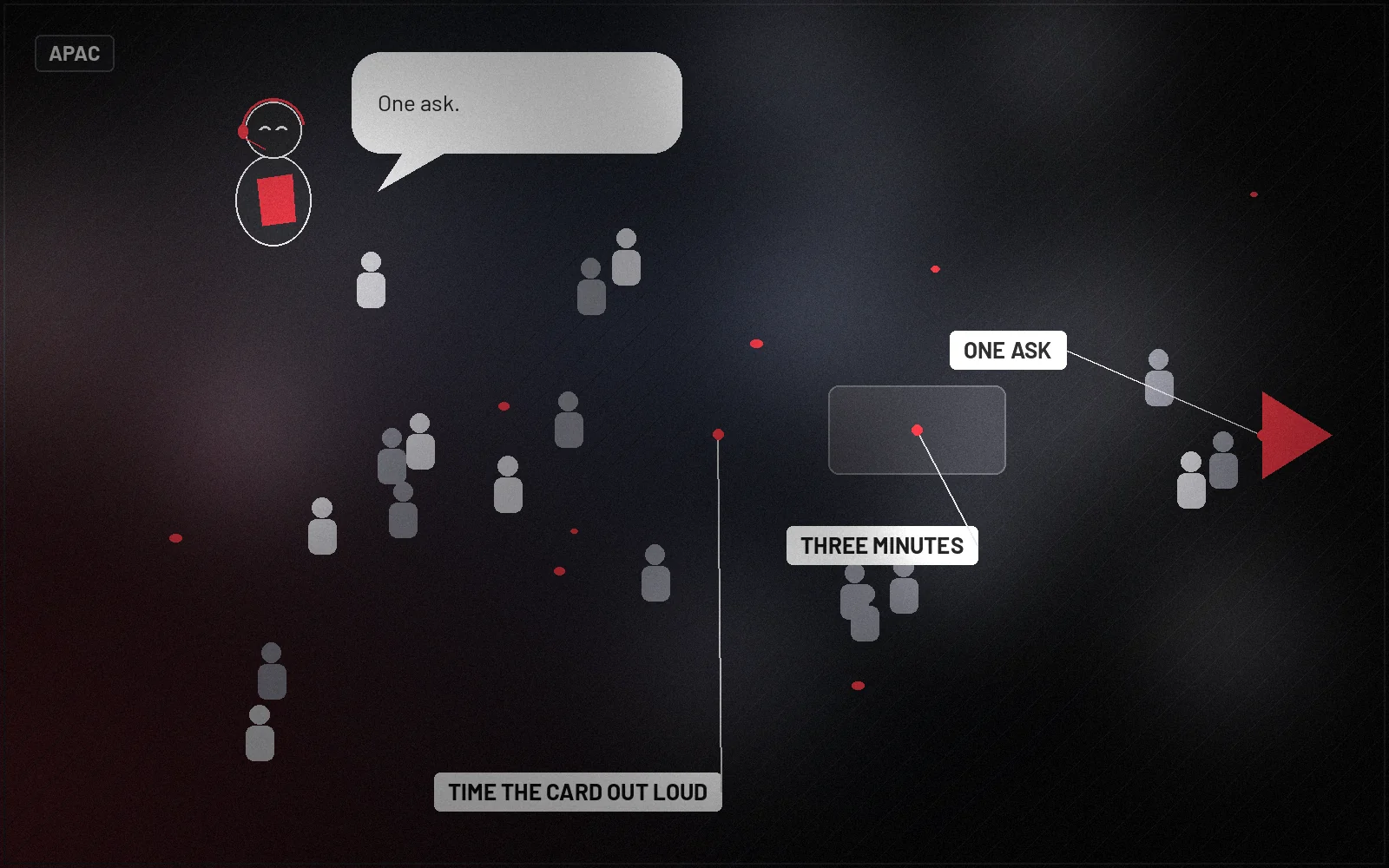
- Time the card out loud. If it runs past 2:45, cut adjectives first.
- Print one page. No second sheet on the stand.
- File the written submission with the sources. Testimony points. It does not replace the binder.
- Kill rule: if the last sentence is not an ask the committee can do today, rewrite it.
FAQs
What is hearing testimony English APAC?
It is four spoken blocks for a short hearing window: name, break, proof, ask. Written so a clip and the record hold the same object.
Should we submit the long paper too?
Yes. The paper carries sources. The spoken card carries the object. Do not read the paper into the mic.
What if the chair cuts us off early?
Lead with the ask if the clock looks short. A testimony that opens with the ask still lands if the chair stops you halfway.
Can two people split the three minutes?
They can, but it usually costs a block. One voice and one ask are easier for the record and the clip to hold.
What to do this week
Pull the last testimony your team gave. Read only the final sentence. If it is not an ask the committee could do that day, rewrite the card before the next hearing.
Neuwark Communications writes hearing and stakeholder language under Public Affairs and Strategy & Messaging. If your principal still opens with the greeting, talk to us at Contact. More language companions live in Insights.
Communications craft, not legal advice. Check hearing rules, submission formats and what can be said on the record with counsel before you testify.
Related: CRM field note English · Doorstep holding English · Press holding line English APAC · Clip-safe English for debate prep