
The volunteer is nervous. The script is two pages. The voter hangs up at the biography.
Call-time script English APAC is four spoken lines a volunteer can read without looking down: who you are, why this number, one ask, and how to stop.
Street-smart APAC English: short sentences a tired operator can say out loud.
Most call sheets open with gratitude and a theory of change. The first seconds of a call are for identity and consent. Charm starts after the person stays.
This is a companion to our volunteer door card English. The door card is in person: stake, proof, boundary. This piece is the phone, where nobody can see your lanyard and the person can hang up in one tap. It also sits next to our quiet-hours SMS ask English, which covers the text version of the same ask.
Communications craft, not legal advice. Do-not-call, election, data-protection and quiet-hours rules differ by market. Check with counsel before a list is dialed.
What are the four call-time script English APAC lines?
| Line | Job | Say this (illustrative) |
|---|---|---|
| 1. Who | Name the organisation and the volunteer | “Hi, this is Jo, a volunteer with the classroom repair coalition.” |
| 2. Why this number | Where the number came from | “You signed the classroom repair note last month.” |
| 3. One ask | One. Not three. | “Can I save you a seat at Thursday’s 7pm briefing?” |
| 4. How to stop | Dignity on the same call | “If you want no more calls, say so and I will mark it now.” |
If the person says no, mark it. Do not pitch a donation in the same breath.
Every line is illustrative. Use your real organisation name, the real source of the number, and your own event.
Why does “why this number” matter so much?
Because the first question in every listener’s head is “how did you get my number?” If you do not answer it, they stop listening while they wonder.
Line two has to be true and specific. “You signed the note” or “You asked for updates at the covered-court briefing.” If you cannot say where the number came from, that number should not be on today’s list. Take it to the list owner before anyone dials.
What may the volunteer not say?
| Kill this | Why it fails on a recording | Say this instead |
|---|---|---|
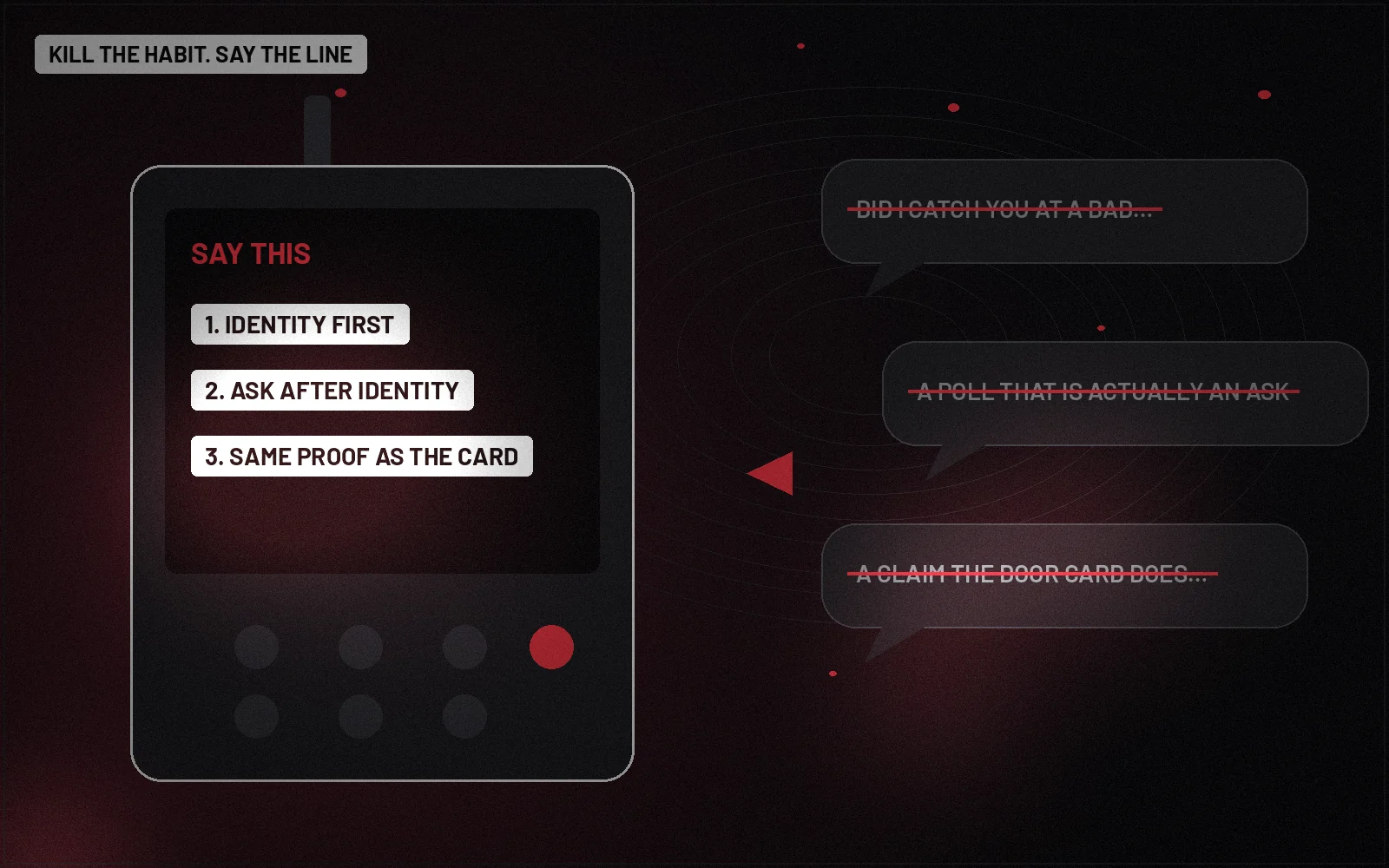
| “Did I catch you at a bad time?” as line one | Invites a hang-up before identity | Identity first |
| A poll that is actually an ask | Feels like a trick | Ask after identity |
| A claim the door card does not carry | The call becomes the exhibit | Same proof as the card |
| Calling outside the quiet-hours window on the sheet | Consent hole | Check the window before you dial |
Assume any call can be recorded. Say only what you would be comfortable hearing played back.
What does the volunteer say when the person stays?
Paste-ready pickup (illustrative):
“Thursday 7pm, one hour, the classroom line. I can text the same link. Yes or no is enough.”
Then stop talking. Silence is not a gap to fill with the manifesto. It is the person thinking.
If they say yes, confirm the one detail they need and end the call. If they have questions, answer from the card or log the question for the desk.
What goes on the call sheet besides the script?
The quiet-hours window for that list. The source of the numbers. The one ask for this shift. A box to tick for “no more calls,” and the name of the shift lead.
The sheet is a record, not just a prompt. When someone asks later why they were called, the sheet should be able to answer. Keep “no more calls” marks in the list itself, not only on paper, so the next shift does not dial the same person tomorrow.
What about voicemail?
Keep it to identity, one line of why, and a way to reply. No ask that needs a conversation.
Paste-ready voicemail (illustrative):
“Hi, this is Jo, a volunteer with the classroom repair coalition. You signed our note last month. The briefing details are in a text from this number. No need to call back.”
Monday field kit
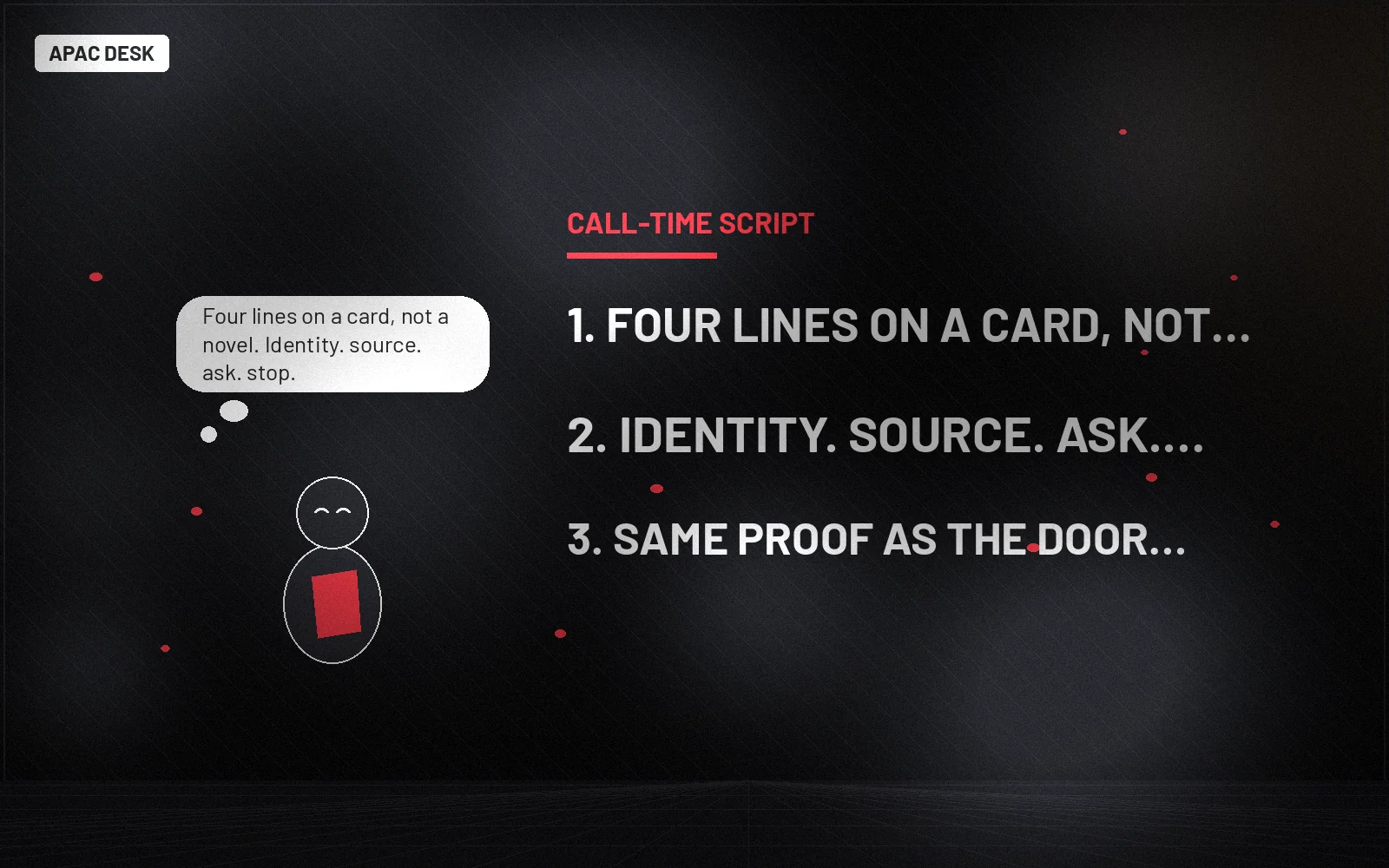
- Four lines on a card, not a novel.
- Identity. Source. Ask. Stop.
- Same proof as the door card.
- Quiet hours on the sheet.
- No second ask on a no.
- Role-play once before the first dial.
FAQs
What is call-time script English APAC?
Call-time script English APAC is the four-line spoken card a volunteer uses on an advocacy call list without improvising the first seconds. It covers who you are, why this number, one ask and how to stop.
Do we read a disclosure in every market?
Read the disclosure your counsel cleared for that list and that purpose. This card does not replace that line, it sits in front of it.
What if they ask for the principal?
The volunteer says, “I am a volunteer. I can take the question to the desk.” Then they log the question and do not invent an answer.
How many calls should one person get?
That depends on your list rules and local law, so the list owner and counsel set the limit. The volunteer’s job is to respect every “no more calls” on the spot and mark it before the next dial.
What to do this week
Print the four lines. Role-play once. Then dial.
Neuwark Communications writes field language under Public Affairs and Strategy & Messaging. If your call sheet is still two pages, talk to us at Contact. More language companions live in Insights.
Communications craft, not legal advice. Check current telemarketing, election and data-protection rules with counsel in each market before a volunteer dials.
Related: Volunteer door card English · Quiet-hours SMS ask English · Mid-tier donor welcome call scripts · Provincial radio host-read English