
Your field team did not lose the argument because the opponent had a better line. They lost it because somebody forwarded a half-checked claim into a barangay group at 9:40 p.m., and by morning that claim was “what HQ said.”
That is not a volunteer problem. That is a field kit problem. Progressive campaigns across the Philippines still treat WhatsApp and Viber like a kitchen table—everyone talks, nobody owns the pin, and rumor travels faster than the message card.
Neuwark Communications builds communications systems for campaigns and advocacy coalitions that run on prepaid data and group chats, not Silicon Valley Slack fantasies. A field kit is the thinnest stack that keeps truth pinned, roles clear, and rumor quarantined—so your canvassers and coordinators stay operators, not rumor amplifiers.
Why group chats become rumor factories mid-cycle
Early campaign weeks forgive chaos. People are nice. The candidate is still “new.” Mid-cycle is different. Turnout pressure rises. Opponents seed screenshots. Coalition partners freestyle. A single wrong number in a voice note becomes a policy position by breakfast.
Three patterns show up in Philippine progressive field ops:
- Pin rot — last week’s message card is still the top pin while HQ already shifted the ask.
- Role blur — a logistics volunteer answers a policy question because “the chat was quiet.”
- Screenshot politics — internal speculation gets exported to a family group and returns as “heard from the campaign.”
Donors notice when field messaging wobbles. So do validators. In Metro Manila, Cebu, Davao, and provincial hubs across APAC-facing progressive networks, the campaigns that win trust are the ones that treat chat as infrastructure, not vibe.
What a field kit is—and is not
A field kit is not “create more groups.” It is a small set of channels with named jobs, named owners, and hard rules about what never gets forwarded.
It is also not a CRM replacement. Your CRM holds contacts. Your field kit holds tonight’s truth for people who will knock doors tomorrow on weak signal.
If your kit cannot survive a brownout, a monsoon commute, and a coordinator who only has 200MB left, it is not a kit. It is a slideshow.
The four-channel discipline that keeps truth ahead of rumor
Run four channel types. Name them in plain language. Do not invent cute titles volunteers will forget.
Channel 1 — Command (HQ ↔ city / district leads)
Purpose: decisions, schedule changes, security notes, “stop saying X.”
Rules:
- Only leads post operational commands.
- Volunteers ask questions here; they do not debate policy.
- Every command gets a time stamp and an owner (“Maria owns redistribution of Precinct 12 packs”).
- No memes. No “thoughts?” threads that become accidental policy.
Command is where you kill a bad line in under fifteen minutes. If that kill requires three admin approvals across personal chats, your opponent already won the night.
Channel 2 — Turf (street-level assignment)
Purpose: who walks which block, when they check in, what is done or hostile.
Rules:
- Assignments live in a linked form or board—not only as a wall of text that scrolls away.
- Status language is fixed: open / partial / done / hostile / revisit.
- Coordinators update status; volunteers confirm completion with the same five fields every night.
- Do not mix turf with morale chat. Morale belongs elsewhere or you will never find the map.
Progressive campaigns often under-index hostile revisit. Those doors still vote. Digitize the objection phrase so message can answer it next week—inside the kit, not in a random sticky note.
Channel 3 — Message (the living card)
Purpose: the only approved lines for the shift.
Rules:
- One pinned message card per week (or per surge). Archive the old pin in a dated note.
- Card includes: one sentence why this week matters, two local proof points, one ask, one bridge for the top objection.
- Language variants (Tagalog, Cebuano, Ilocano, English mix) sit as replies under the pin—not as freestyle translations in five chats.
- If counsel or message lead updates the card, the pin changes the same hour. Pin rot is how you invent two campaigns.
Volunteers do not need your stump speech. They need a card they can open offline after downloading once.
Channel 4 — Rumor quarantine (intake only)
Purpose: catch opponent lines, screenshots, and half-true stories before they become your voice.
Rules:
- Anyone can drop a rumor here with source note (“jeepney terminal,” “FB group,” “relative chat”).
- Nobody replies with “counter-talking points” until message lead clears a line.
- A rumor that is false still teaches you what persuadables are hearing. Log the phrase, not your feelings.
- After clearance, the approved counter moves to Message—never the other way around.
This channel is the difference between a campaign that learns overnight and a campaign that argues with itself in public.
Operator build: stand up the kit in five working days
You do not need a six-month “digital transformation.” You need a controlled cutover that respects how Philippine field teams actually work.
Day 1 — Inventory and kill duplicates
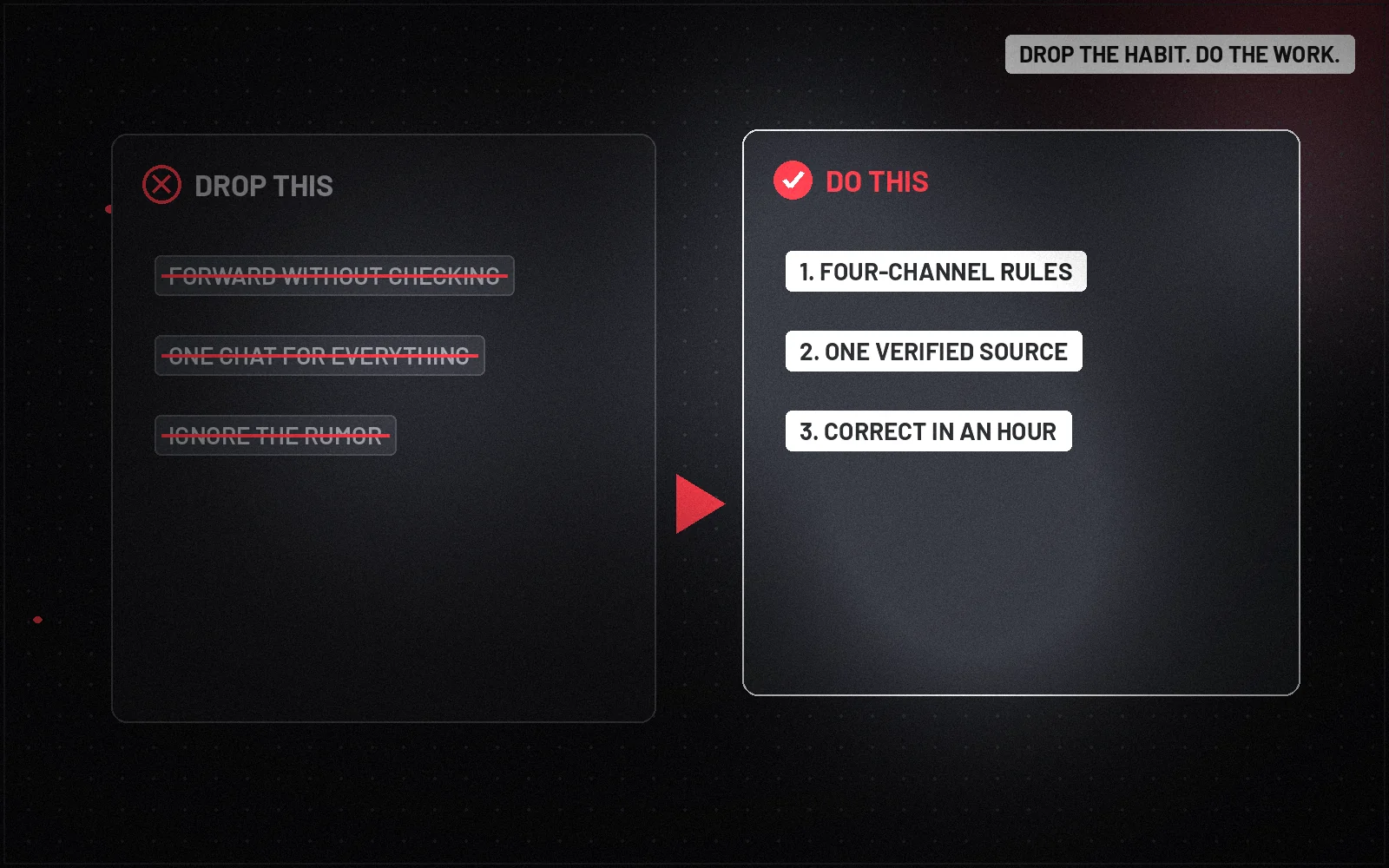
- List every WhatsApp/Viber group that still claims to be “official.”
- Merge or archive until each city has one Command, one Turf pattern, one Message, one Quarantine.
- Name admins in writing. Dual-admin for Command. Single message owner for the pin.
Day 2 — Templates and pins
- Lock the message card template with message lead / counsel.
- Write the rumor intake prompt (source, exact words, where heard, urgency).
- Create the nightly debrief form: doors, objections, rumors, materials, tomorrow constraint.
Day 3 — Pilot one city
- Run real shifts, not training theater.
- Watch where people abandon the form because data is expensive or fields are too many.
- Cut friction. Five required fields beat twenty optional ones.
Day 4 — Train in twenty minutes
- Teach channel jobs, not software romance.
- Practice one rumor drill: drop a fake screenshot in Quarantine, clear a counter, update Message pin.
- Confirm offline PDF fallback for dead-signal sitios—then sync at end of shift.
Day 5 — Scale with a kill switch
- Publish who can pause a bad forward in five minutes.
- Brief coalition partners: your kit rules apply to shared field days too.
- Set weekly hygiene: archive dead groups, rotate pins, audit admin lists.
Metrics that prove the kit is working
Track four numbers weekly:
- Pin freshness — hours since Message pin matched HQ’s current card
- Rumor latency — time from Quarantine drop to cleared counter or “ignore”
- Forward discipline — mystery-check: does a random volunteer still circulate last week’s line?
- Debrief completion — % of turf owners filing the five fields before midnight
Vanity (“we have 40 groups”) without pin freshness is theater.
PH and APAC realities your kit must absorb
Prepaid data, family-shared phones, and multilingual streets are not edge cases. They are the product environment.
Design for:
- Low bandwidth — cards as text-first images under 200KB when needed; avoid video-only instructions.
- Shared devices — no sensitive donor lists in field chats; separate ops from fundraising threads.
- Language pride without freestyle — approved variants only; freestyle translation is how policy softens into mush.
- Coalition days — when partner orgs join a canvass, they get a guest pin and a guest admin window—not permanent write access forever.
- Quiet hours overlap — field kits respect sleep and shift work the same way compliant SMS does; urgency at 11 p.m. is usually ego, not strategy.
Across APAC progressive networks—from Manila to Jakarta to regional diaspora nodes—the kits that travel are the ones that treat chat culture as local and message discipline as non-negotiable.
Failure modes progressive teams keep repeating
Turning Quarantine into a debate club. The point is intake and clearance, not crowd-sourced spin.
Letting every barangay invent its own “official” chat. Local flavor belongs in proof points and language, not in schema and pins.
Putting fundraising asks inside turf chats. You will train volunteers to mute the map.
Ignoring screenshot risk. Assume anything typed can leave the group. Write accordingly.
Hiring a tool before naming owners. Software does not invent nightly sync culture.
Nightly sync: close the rumor window before breakfast
The product of a good field kit is not “more messages.” It is a morning brief that changes tomorrow’s plan.
Every night, city leads should be able to answer:
- What objections showed up in exact phrases?
- Which rumors need a cleared counter by 8 a.m.?
- Which materials failed in the rain or under fluorescent barangay hall lights?
- Which segments need revisit with a different validator?
HQ publishes a one-screen brief. Volunteers who see their notes change tomorrow keep filing. Volunteers who shout into a void stop typing—and start freelancing.
Soft close: talk to Neuwark when the chat is the campaign
If your progressive campaign in the Philippines is still running field truth through vibes and scrollback, you are funding cognitive dissonance. Paid media will say one thing. Doors will apologize for another. Screenshots will invent a third.
Neuwark Communications designs WhatsApp and Viber field kits as communications infrastructure—roles, pins, quarantine, and nightly sync that survive monsoon season and opponent rumor packs.
Start with one city, four channels, five days, one kill switch.
Pin the truth. Quarantine the rumor. Sync before breakfast.
That is how progressive field kits stop leaking—and start winning the night that decides the morning.