

Nobody taps a sticker that says Learn More. They tap one that says where they are going.
A story lives for a few seconds. The sticker label gets less than that. If the label is vague, the thumb swipes to the next story.
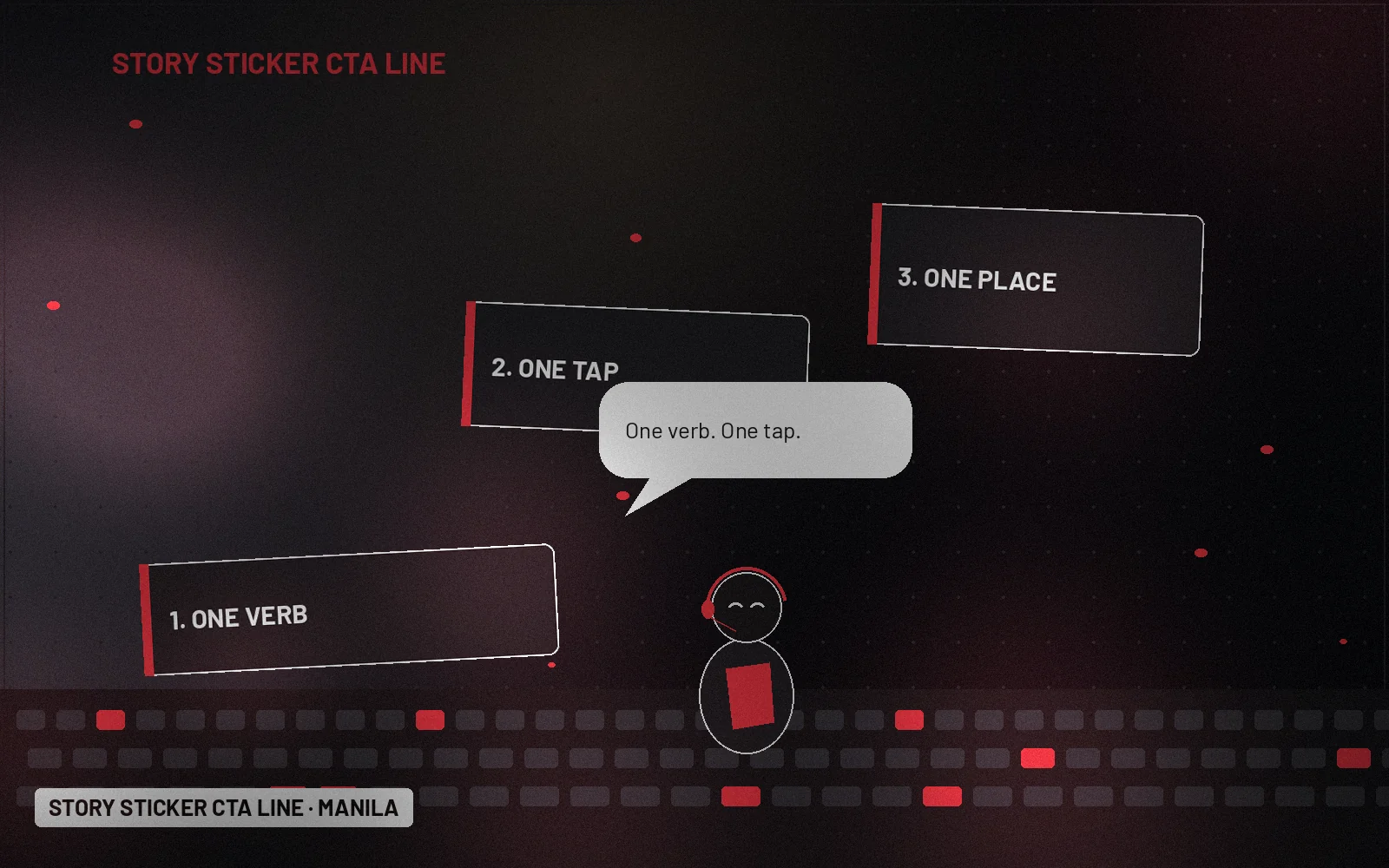
Story sticker CTA English APAC is the two-to-four word label on a link sticker: one verb, one destination, nothing else.
Street-smart APAC English: short sentences a tired operator can say out loud.
This piece cousins our end card English APAC note. The end card closes a video. The sticker opens a door. Same discipline: few words, one job.
What is the sticker label actually for?
It tells the viewer what happens after the tap. Not why they should care. The story already did that.
The story carries the stake. The sticker carries the next step. When a team puts the stake in the sticker, the label gets long, the font gets small, and nobody reads it.
One object per story. One sticker per story. If you need two links, you need two stories.
What does a good link sticker say?
A verb and a place. “Sign the petition.” “See the flood map.” “Get the schedule.”
| Kill this | Say this (illustrative) | Why |
|---|---|---|
| Learn more | See the flood map | Names what opens |
| Click here | Get Saturday’s schedule | Verb plus object |
| Support the cause | Sign the petition | One action, not a feeling |
| Join the movement | Pick a volunteer shift | Something a person can finish |
| Link in sticker! | Read the full statement | No exclamation, no echo |
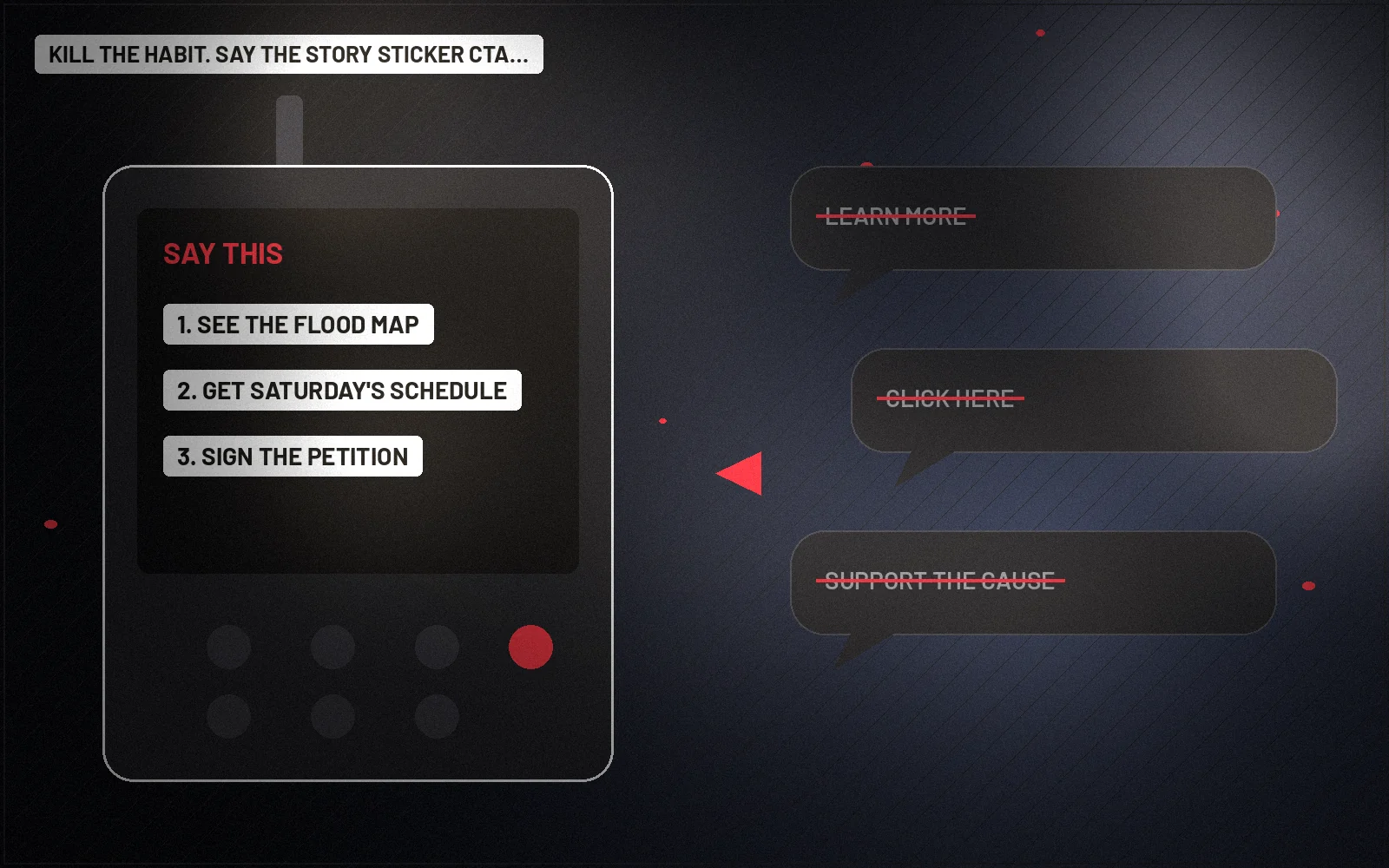
Rule of thumb: if the label still makes sense with the story muted and the screen dimmed, it ships.
How short is short enough?
Short enough to read at arm’s length on a cheap phone. Two to four words is the working range on our desk, not a platform rule.
Platforms change how stickers display, how much text they show and who can add links. Check the current help page before a campaign, and date the screenshot in your brief. Do not promise the team a character limit you have not checked this month.
Test it the street way. Hold the phone at arm’s length. Ask a colleague who did not write it what happens after the tap. If they hesitate, cut a word.
Where does the stake go, then?
On the story frame, above the sticker. One line, big type, plain words.
Story frame (illustrative):
“Our barangay’s drainage list is public now.”
Sticker: “See the list”
The frame says why. The sticker says what next. Neither repeats the other.
Why does this matter more in PH and SG?
Because stories get watched in transit, in queues and on shared phones. Attention is short and data is not free for everyone.
In Metro Manila, a supporter might watch your story on prepaid data between jeepney stops. A vague label wastes a tap that cost them something. In Singapore, a commuter on the train sees a dozen stories before the next station. Your label competes with a food delivery promo.
Taglish audiences read English stickers fine. What they skip is corporate English. “Tingnan ang mapa” and “See the map” can both work. “Discover our resources” fails in both languages.
What happens when the link breaks?
The sticker becomes a promise you broke in public. Check the link on mobile data before you post, not just on office Wi-Fi.
Point the sticker at a page that loads fast and opens on the thing the label named. If the sticker says “See the flood map”, the map is the first thing on screen. Not a hero video. Not a donate pop-up.
If a link dies mid-campaign, delete the story or post a new one with a fixed sticker. Do not leave a dead sticker live because the story is getting views.
Who signs off on the story sticker CTA English APAC label?
The same person who signs off the destination page. One owner, both ends.
When the social desk writes the sticker and the web desk owns the page, they drift. The sticker says “petition” and the page opens on a newsletter form. Put one name on both, and the label and the page stay the same object.
What to do this week
- Pull your last ten stories with a link sticker.
- Read each label out loud. Mark every one that does not name a place.
- Rewrite those as verb plus object. Four words or fewer.
- Open each destination on mobile data. Check the page opens on what the label promised.
- Put one owner’s name on sticker and page for every live campaign.
FAQs
What is story sticker CTA English APAC?
Story sticker CTA English APAC is the short label on a link sticker that tells the viewer what opens after the tap. It is one verb and one destination, written for a phone at arm’s length.
Can the sticker label carry the campaign slogan?
No. The slogan belongs on the story frame or nowhere. The sticker label only names the next step.
Should the label be in English or Filipino?
Use the language the story frame uses. Mixing a Filipino frame with a stiff English sticker reads like two different teams wrote it.
How do we know the label works?
Watch taps against views on the platform’s own insights, and compare labels on similar stories. Treat any figure as yours to verify and date, not a benchmark.
Neuwark Communications writes short-form copy under Digital & Social and Creative & Brand. If your stickers still say Learn More, talk to us at Contact. More language companions live in Insights.
Communications craft, not legal advice. Counsel checks election-period rules and each platform’s current advertising and political content policies before any campaign story runs.
Related: End card English APAC · Reel caption English · Townhall livestream CTA English APAC · Push notification English APAC