
Quick answer: A speaker-ready line English APAC is the tech desk’s short script when a speaker drops off slides: file in, run every slide, name it by session. Say it the same way to every speaker, so no deck reaches the stage untested or under the wrong name.
A Kuala Lumpur conference centre, 8:40 in the morning.
The opening speaker hands a USB stick to the tech desk and walks off to find coffee.
At nine, the wrong deck opens on the big screen.
Speaker-ready line English APAC is the short line at the speaker-ready desk: take the file, run every slide with the speaker, and name it by session.
Street-smart APAC English: short sentences a tired operator can say out loud.
It comes before our laptop line English APAC at the stage tech table and the clicker-handoff line English APAC at the lectern. Good event language at the desk stops the wrong deck before it opens.
What goes in a speaker-ready line English APAC?
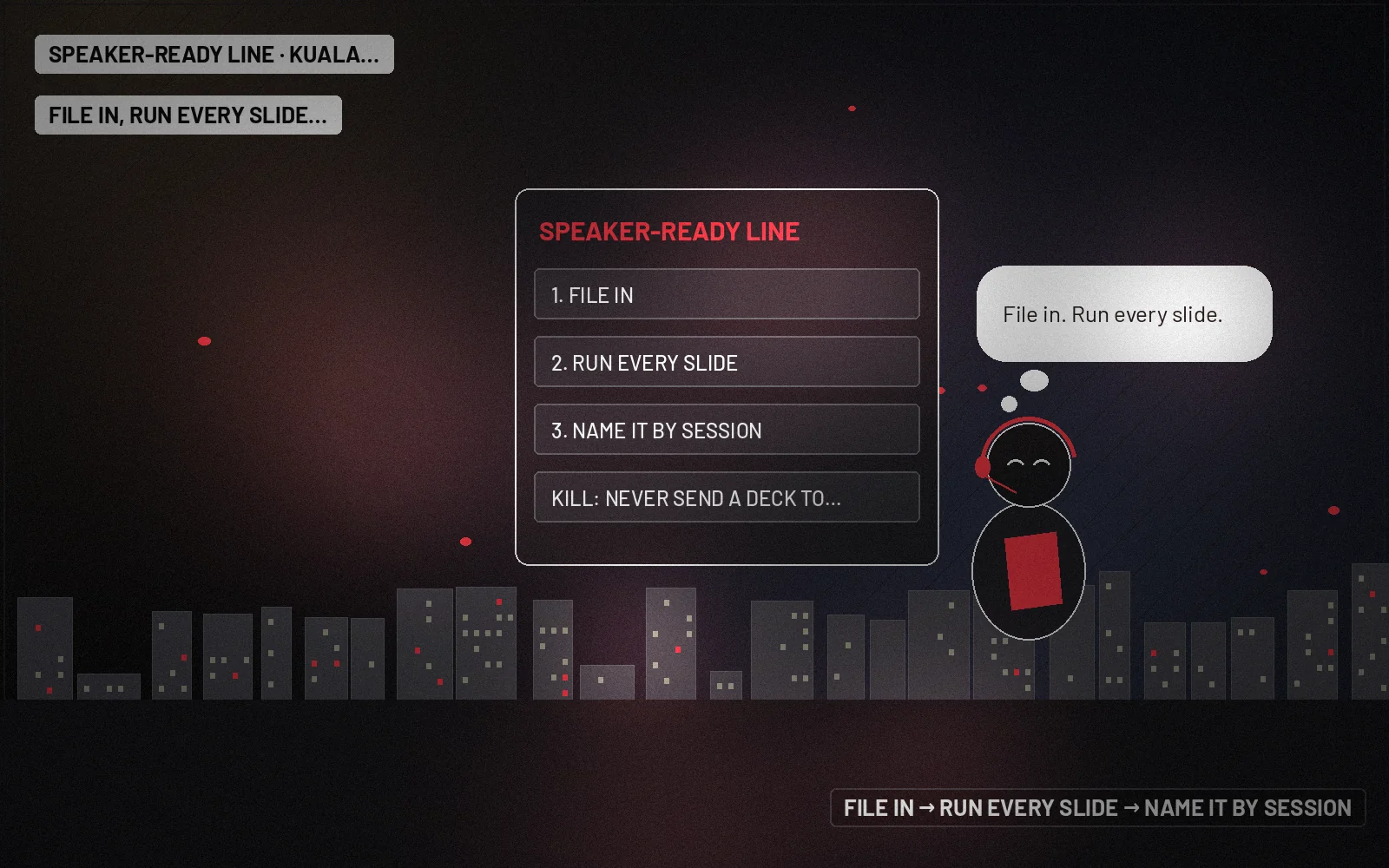
Three parts. File in, run every slide, name it by session.
Speaker-ready line (illustrative):
“Good morning. Your file in here, please.”
“Let’s run every slide together, videos too.”
“Saved under your session, Hall B, 10 AM.”
Running every slide matters most. Fonts, videos and builds break on a new machine, and the speaker is the only one who knows what each slide should look like.
What does the tech desk say when a speaker drops off slides?
Ask for the file, then ask the speaker to stay for the run. Click through every slide on the show machine, not on the speaker’s laptop. Play any video with sound. Then say the session name and time out loud so the speaker hears where the file lives.
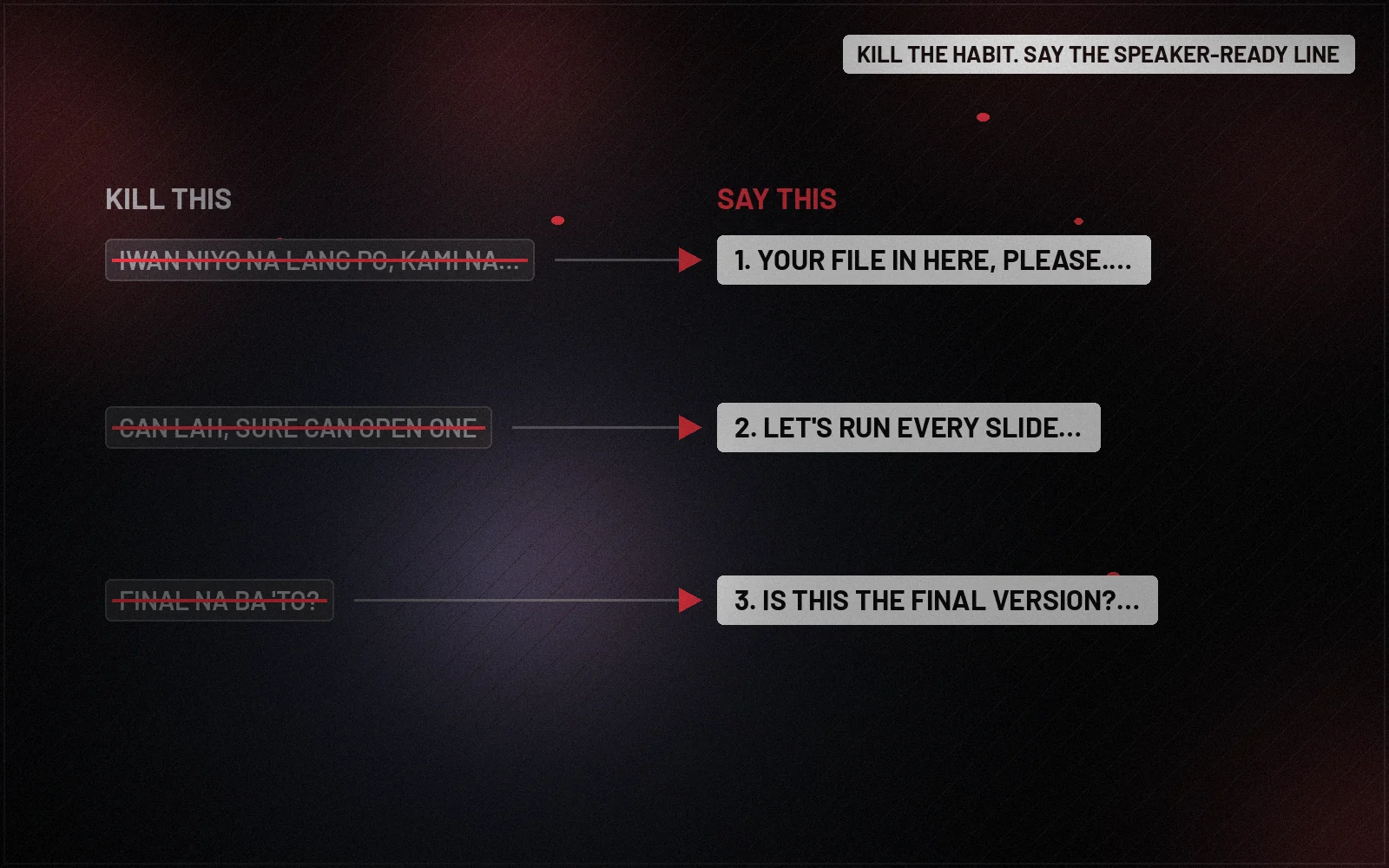
| Kill this | Say this (illustrative) | Why |
|---|---|---|
| Iwan niyo na lang po, kami na bahala. | Your file in here, please. Can you stay five minutes? | The speaker stays |
| Can lah, sure can open one. | Let’s run every slide together, videos too. | Test, don’t assume |
| Final na ba ‘to? | Is this the final version? We’ll lock it now. | One version |
| Later we check. | Saved under your session, Hall B, 10 AM. | Where it lives |
| Just email the new one. | Changes come to this desk, by the morning break. | One door for changes |
Lines in this table are illustrative, not quotes from real people.
What if the speaker sends a new version later?
Changes come to the desk, not by email to whoever is around. Set one cut-off, such as the break before the session, and say it when the file comes in. Replace the old file, remove it from the show machine and run the new one with the speaker if you can.
How should the desk name presentation files?
Name every file by session first: hall, start time, speaker surname. The operator scrolling at 9:58 needs the session, not the deck title. Keep one folder per hall and one file per slot.
How does this play out in PH and SG?
Same three parts. Different desks.
Philippines desk. In the Philippines, speakers often arrive with last-minute edits and a deck still open on the laptop. Ask with po and keep it warm: sir, ma’am, can we run it together po, five minutes only? Post the cut-off time in the speakers’ Viber group the night before.
Singapore and wider APAC desk. In Kuala Lumpur and Singapore, conference desks often run tight changeovers. Keep the line in plain English, say the session name and time out loud, and give the change cut-off at drop-off, not at the door of the hall.
Paste-ready lock
Speakable lock (illustrative): “Your file in here, please, let’s run every slide together, and it’s saved under your session.”
Monday field kit
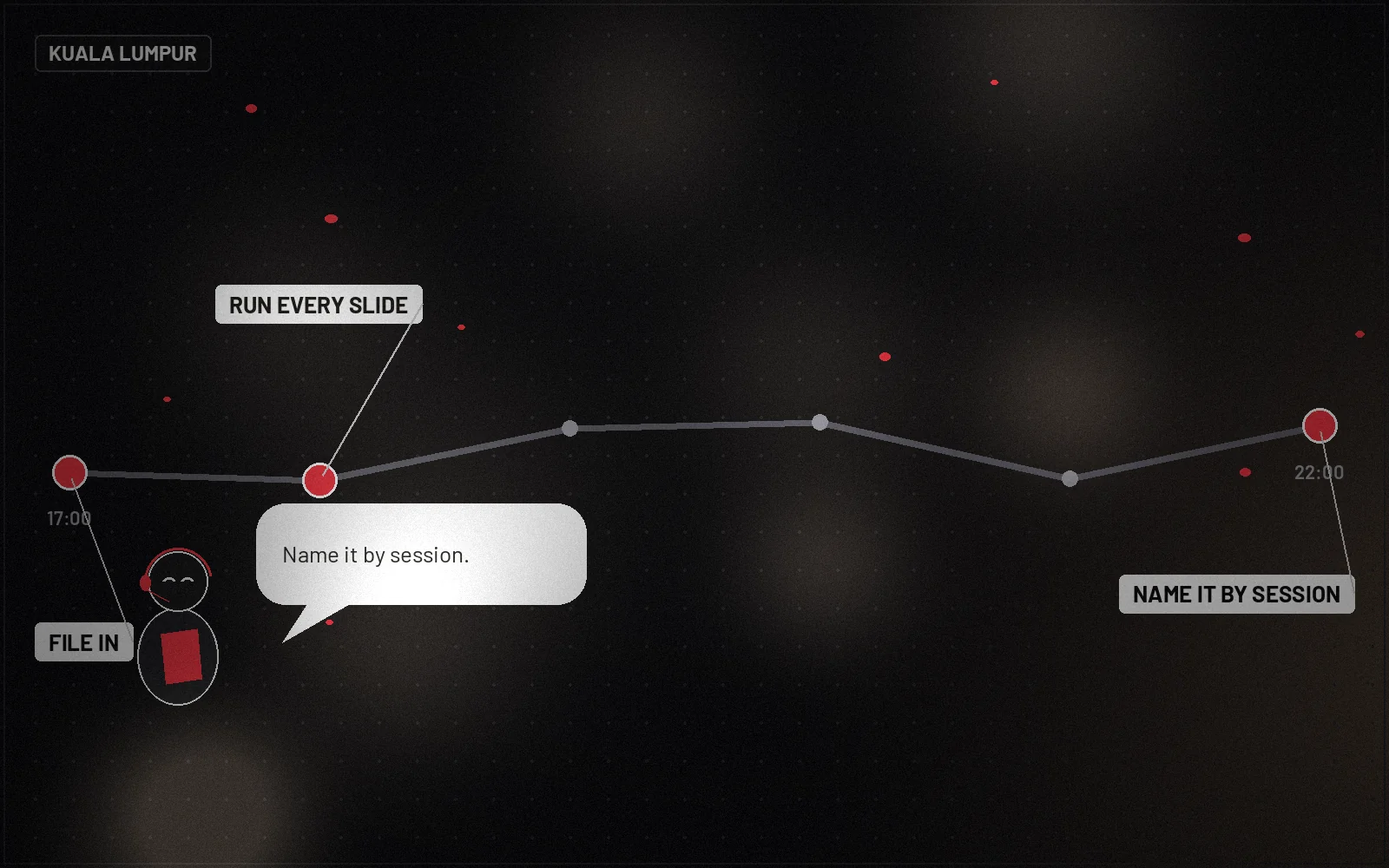
- File in, run every slide, name it by session.
- One show machine per hall, tested at load-in.
- Files named hall, start time, speaker surname.
- One change cut-off, said at drop-off.
- Kill rule: never send a deck to the stage that nobody has run end to end.
What to do this week
- Write the three lines on the speaker-ready desk card.
- Agree the change cut-off with the programme lead.
- Set the folder and file naming for every hall.
- Send speakers the drop-off time and place.
- Book one run-through slot per keynote.
FAQs
What is a speaker-ready line English APAC?
A speaker-ready line English APAC is the tech desk’s short line at slide drop-off: file in, run every slide, name it by session. Every speaker hears the same words.
What should a speaker-ready room check?
A speaker-ready room should open every slide on the show machine, play every video with sound and confirm the session name. The speaker watches the run, not just the operator.
How late can a speaker change slides?
Set one cut-off, usually the break before the session, and say it when the file comes in. Changes after that go through the desk lead only.
How do you name conference presentation files?
Name each file by hall, start time and speaker surname. The operator needs to find the session fast, not the deck title.
Neuwark Communications writes event scripts like this through strategy and messaging. More street-smart lines live in Insights.
Related: laptop line English APAC · clicker-handoff line English APAC
Talk to us about your next event script.
Illustrative lines only. Communications craft, not legal advice.