
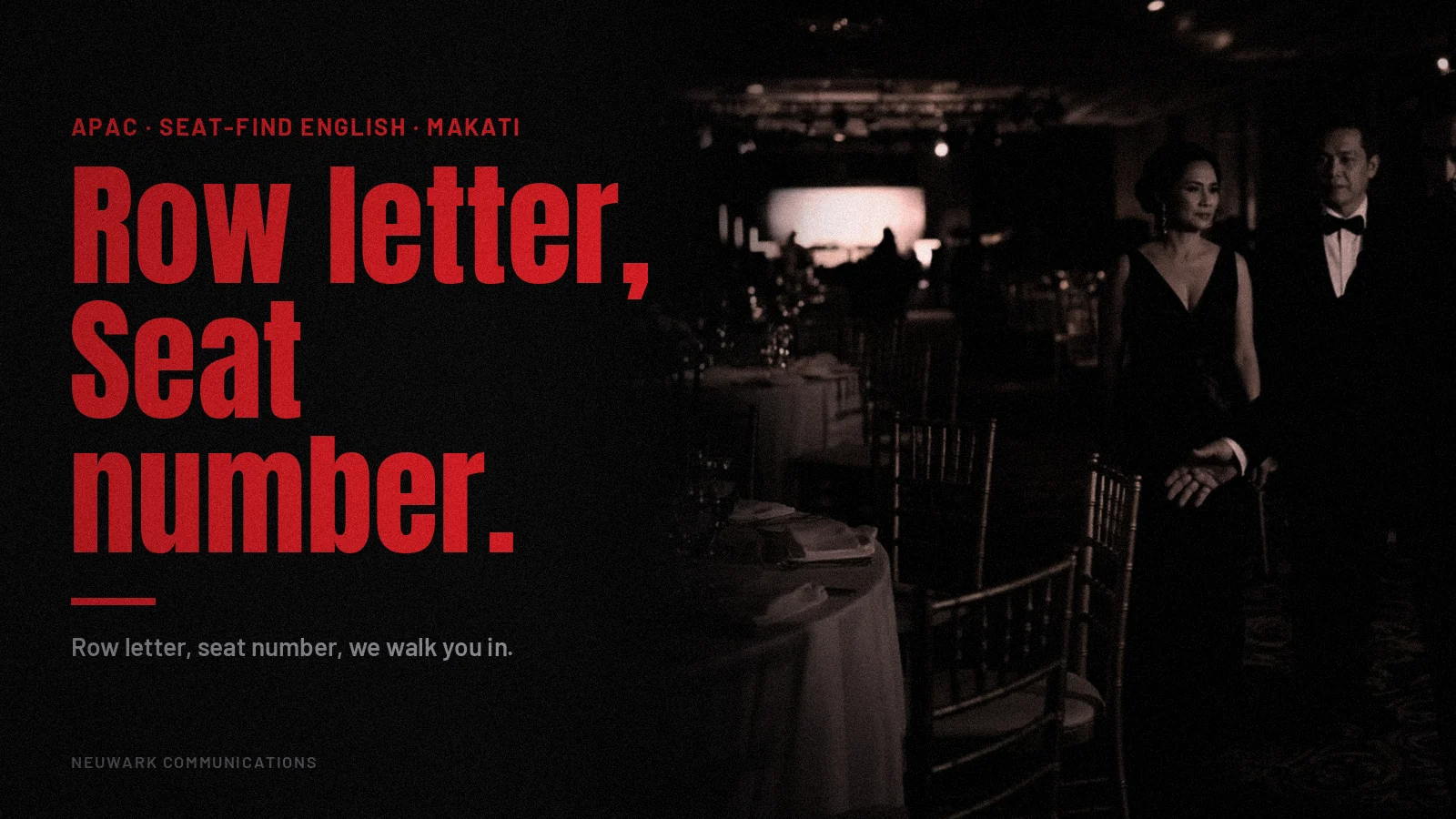
Row letter, seat number, we walk you in.
Street-smart APAC English: short sentences a tired operator can say out loud.
Quick answer: A seat-find line English APAC is the ballroom usher’s rule for guests who arrive after the lights go down: row letter, seat number, we walk you in. The usher reads the ticket out loud, confirms the seat with the guest, then leads them there with a low torch so nobody hunts in the dark.
A business forum in a Makati hotel ballroom, twenty minutes in.
House lights are down, the keynote has started, and two guests slip through the side door holding printed tickets.
They squint at rows they cannot see, phone lights on, while forty people nearby lose the speaker’s next point.
Pair it with the usher torch line English APAC for the walk itself and the table number line English APAC for banquet rounds. Same craft: one short rule, said early and said the same way.
What is a seat-find line English APAC?
It is the usher’s three-part rule for anyone arriving in the dark. Row letter, seat number, we walk you in. Said at the door, before the guest takes a single step into the room.
1. Row letter. Take the ticket, tilt it into your torch light, and say the letter out loud. The guest hears it and nods.
2. Seat number. Say the number and the side: seat twelve, left of the aisle. Now both of you are holding the same fact.
3. We walk you in. The usher leads, torch aimed at the carpet, and stops at the row. The guest never hunts alone.
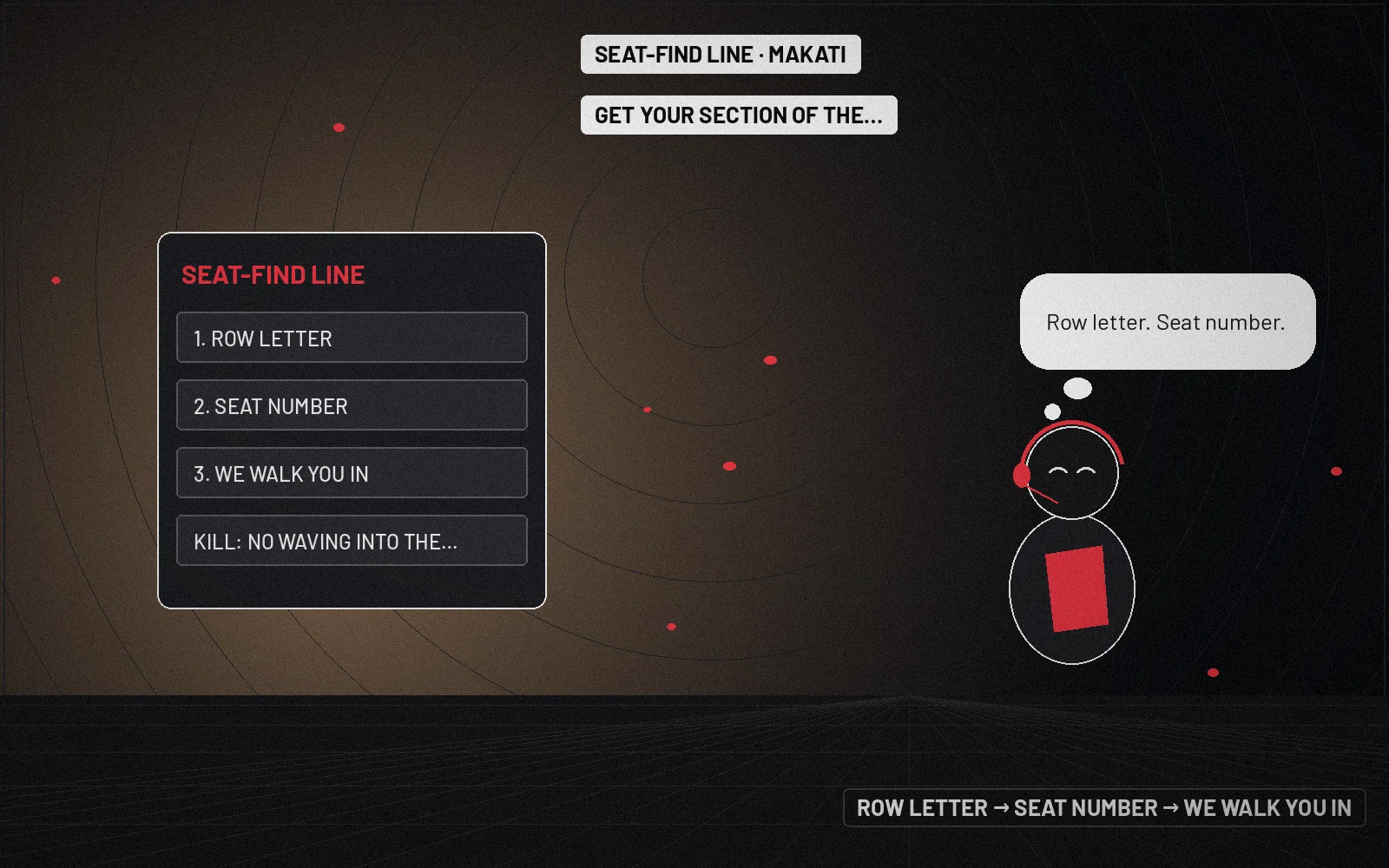
The whole thing fits in one breath at the door: row letter, seat number, we walk you in.
The habit to break is the wave. A tired usher points vaguely into the dark and goes back to the door. The guest guesses, sits in the wrong seat, and the real ticket holder turns up at the break to an argument nobody needed.
What should a ballroom usher stop saying?
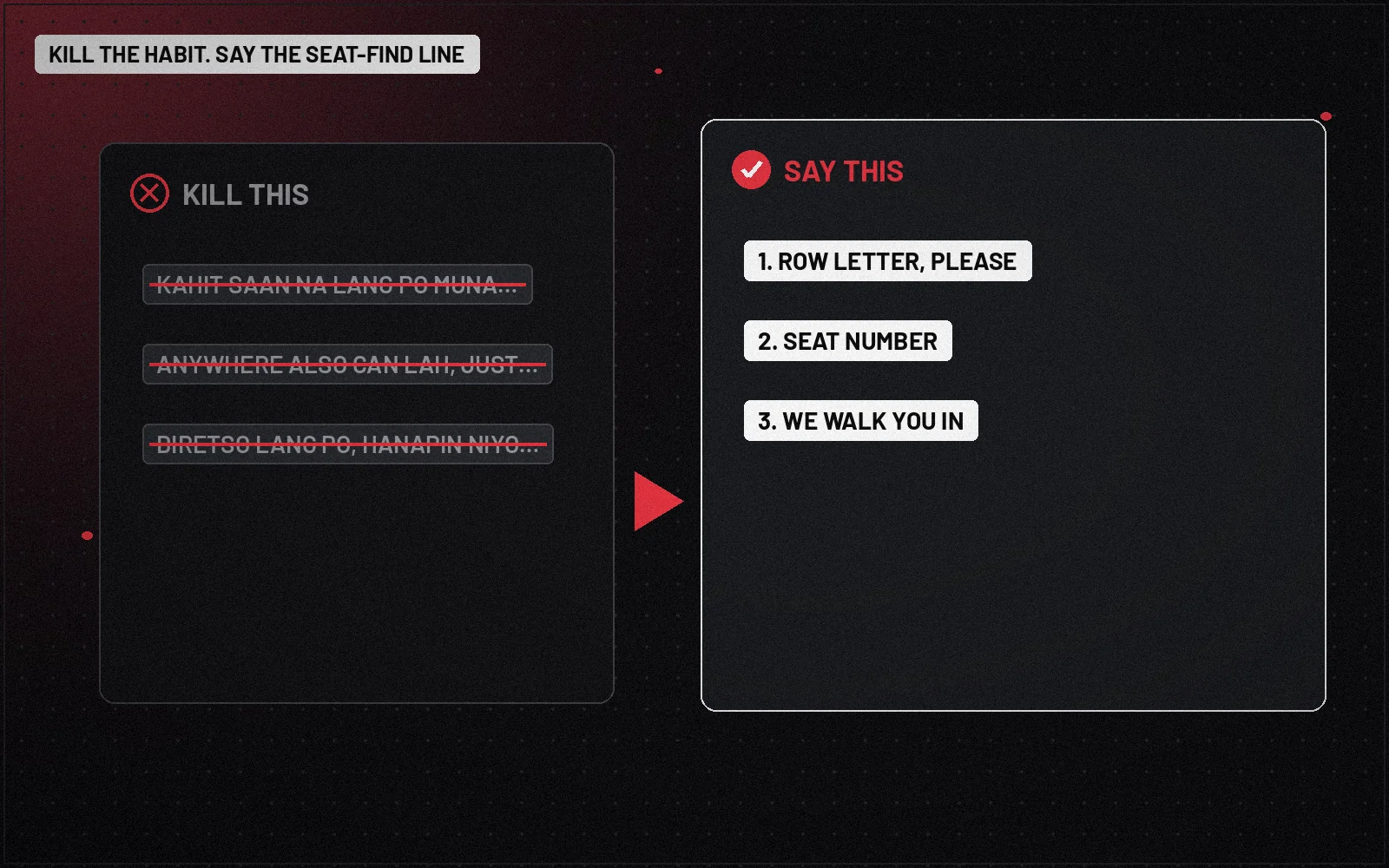
Stop telling guests to sit anywhere or find it themselves. Read the ticket, say the seat, and walk them there.
| Kill this | Say this (illustrative) | Why |
|---|---|---|
| Kahit saan na lang po muna, may bakante pa naman po. | Row letter, please. | Wrong seats turn into arguments at the break |
| Anywhere also can lah, just sit first. | Seat number. | Saying it out loud means both of you heard it |
| Diretso lang po, hanapin niyo na lang. | We walk you in. | Guests in the dark trip on bags and feet |
Lines in this table are illustrative, not quotes from real people.
Keep the torch on the floor the whole way and your voice under the PA. The room should not notice you passing.
What if the guest’s seat is already taken?
Walk the guest to the nearest open seat, then sort the ticket at the break. Do not ask a seated guest to move in the middle of a keynote.
This is the uncomfortable rung. The ticket is right, the seat is wrong, and the person sitting in it may be a sponsor. The usher says the line, offers the open seat, and tells the floor lead the row and number. At the break, the lead fixes it quietly, away from the aisle and away from an audience.
Who decides where late guests sit?
The floor lead decides, working from the seating plan the organiser signed off. Ushers carry the plan for their section and nothing else.
If a ticket and the plan disagree, the usher seats the guest in the nearest open seat and radios the floor lead. Nobody rewrites the plan in the dark.
PH / SG / Jakarta desk notes
Same three parts. Different desks.
Philippines desk. Polite and soft. Row C po, ma’am. Seat twelve po, left side. We walk you in po, this way. Save the long apology for after the talk.
Singapore desk. Quick and clear. Row C. Seat twelve, left. Follow me. No extra chat while the speaker is on.
Jakarta desk. A quiet “Pak” or “Bu” first, then the letter and number in plain English. Hold the ticket in your torch light so the seat reads without translation.
Paste-ready lock
Speakable lock (illustrative): “Row letter, seat number, we walk you in.”
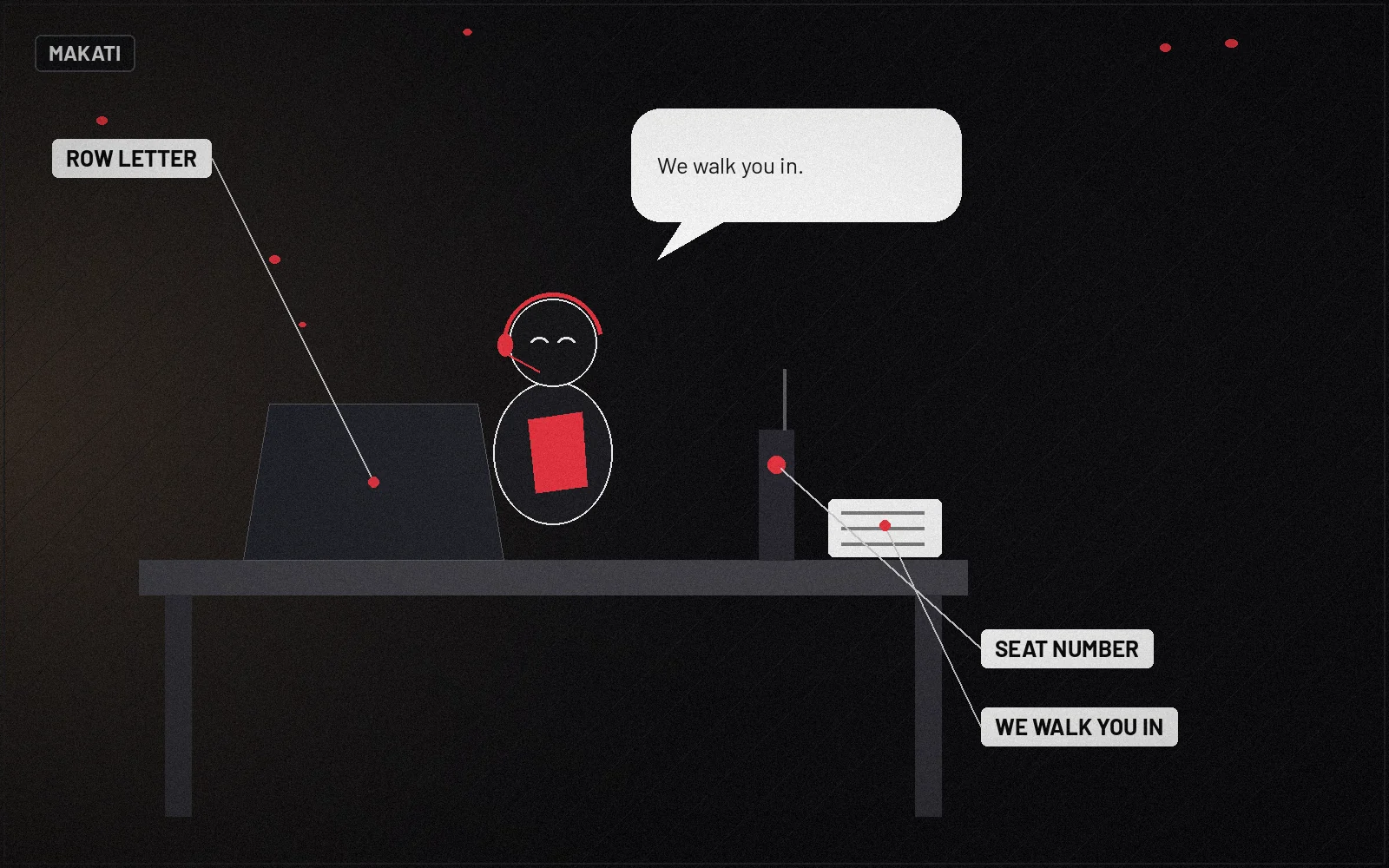
Monday field kit
- Get your section of the seating plan and a working torch before doors.
- Agree the floor lead’s radio call for wrong-seat fixes.
- Brief ushers on the lock: row letter, seat number, we walk you in.
- Practise reading a ticket in torch light at the door.
- Kill rule: no waving into the dark, no sit-anywhere, no moving guests mid-keynote.
Illustrative only. Agree the floor lead’s plan for wrong-seat fixes before doors.
FAQs
What is a seat-find line English APAC?
A seat-find line English APAC is the ballroom usher’s rule for guests who arrive after the lights go down: row letter, seat number, we walk you in. The usher reads the ticket out loud, confirms the seat with the guest, then leads them there with a low torch so nobody hunts in the dark.
What should a ballroom usher stop saying?
Stop telling guests to sit anywhere or find it themselves. Read the ticket, say the seat and walk them there.
What if the guest’s seat is already taken?
Walk the guest to the nearest open seat and sort the ticket at the break. Never move a seated guest mid-keynote.
Who decides where late guests sit?
The floor lead decides from the signed-off seating plan. Ushers seat mismatches in the nearest open seat and radio the lead.
Our Manila HQ in Makati builds usher scripts for forums and galas in ballrooms a short walk away, and our account office at MBFC Tower 2 tunes them for Singapore.
Neuwark Communications builds event and campaign communications as part of our strategy and messaging work. More street-smart lines live in Insights.
Related: usher torch line English APAC · table number line English APAC
Talk to us about your next event script.
Illustrative lines only. Communications craft, not legal advice.