
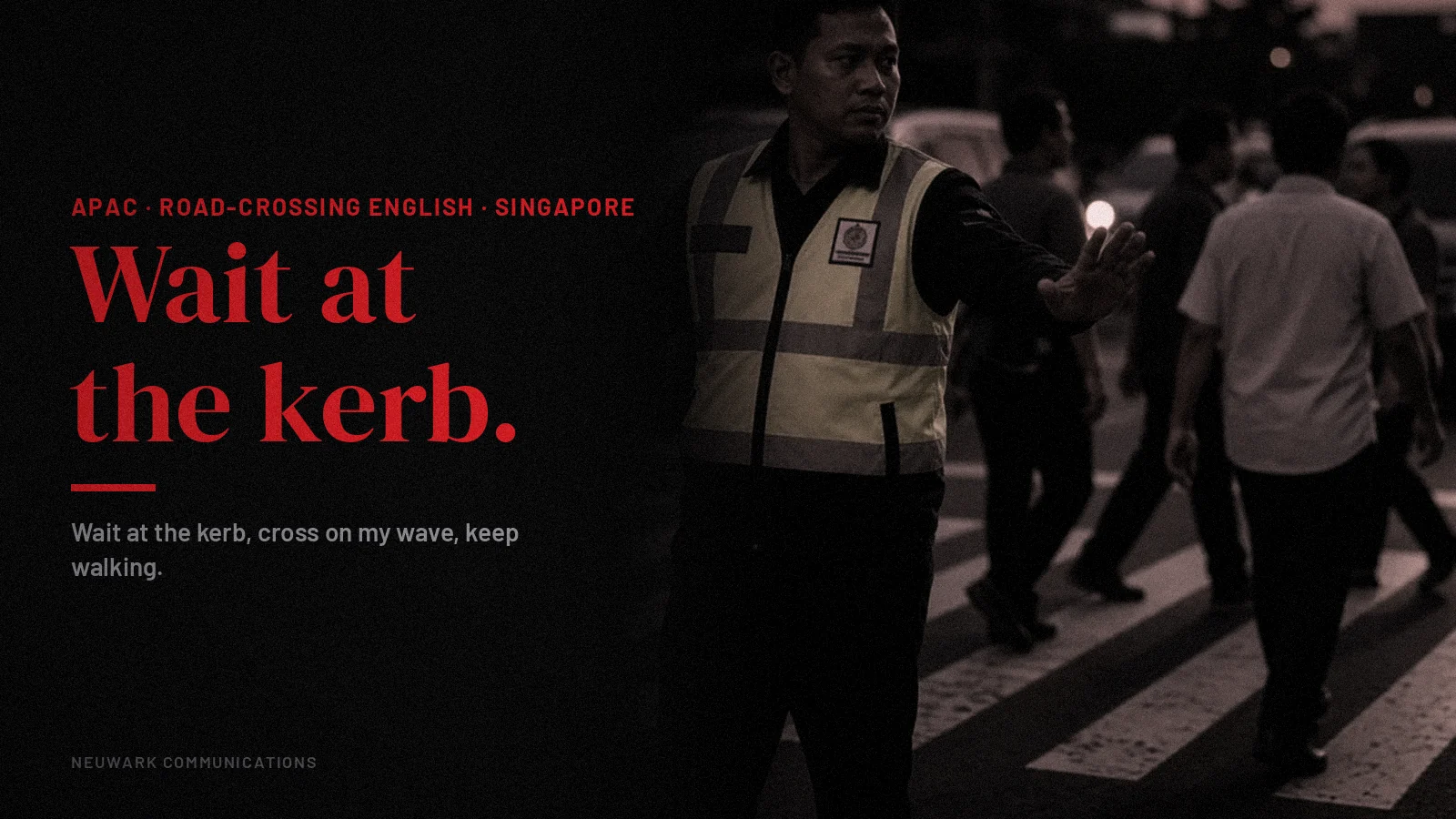
Wait at the kerb, cross on my wave, keep walking.
Street-smart APAC English: short sentences a tired operator can say out loud.
Quick answer: A road-crossing line English APAC is the traffic marshal’s rule for walking event guests across a busy road between a car park and the venue: wait at the kerb, cross on my wave, keep walking. The group holds behind the kerb, moves only on the marshal’s signal and never stops mid-road.
A trade forum in Jakarta, with the car park on the far side of a wide, busy road from the venue’s front steps.
As the morning session nears, delegates come out of the car park in clusters, lanyards swinging, looking for a gap in the traffic.
Two of them step off the kerb between a bus and a row of motorbikes, and the marshal’s call comes a second too late.
Pair it with the drop-off line English APAC for guests arriving by car and the taxi-queue line English APAC for the ride home. Same craft: one short rule, said early and said the same way.
What is a road-crossing line English APAC?
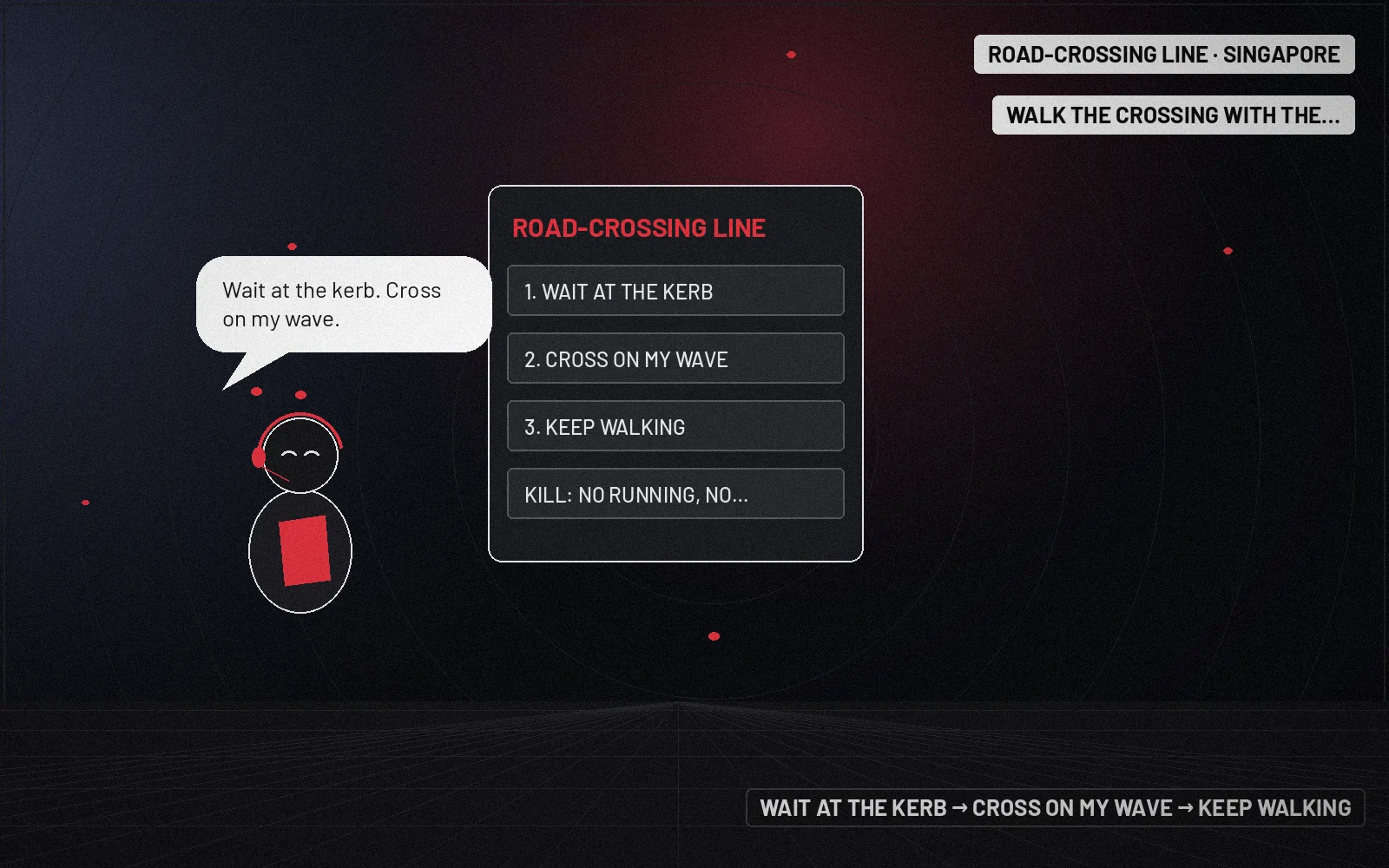
It is the traffic marshal’s three-part rule for walking guests across a road. Wait at the kerb, cross on my wave, keep walking. Said at the kerb as each cluster arrives, before anyone starts looking for a gap.
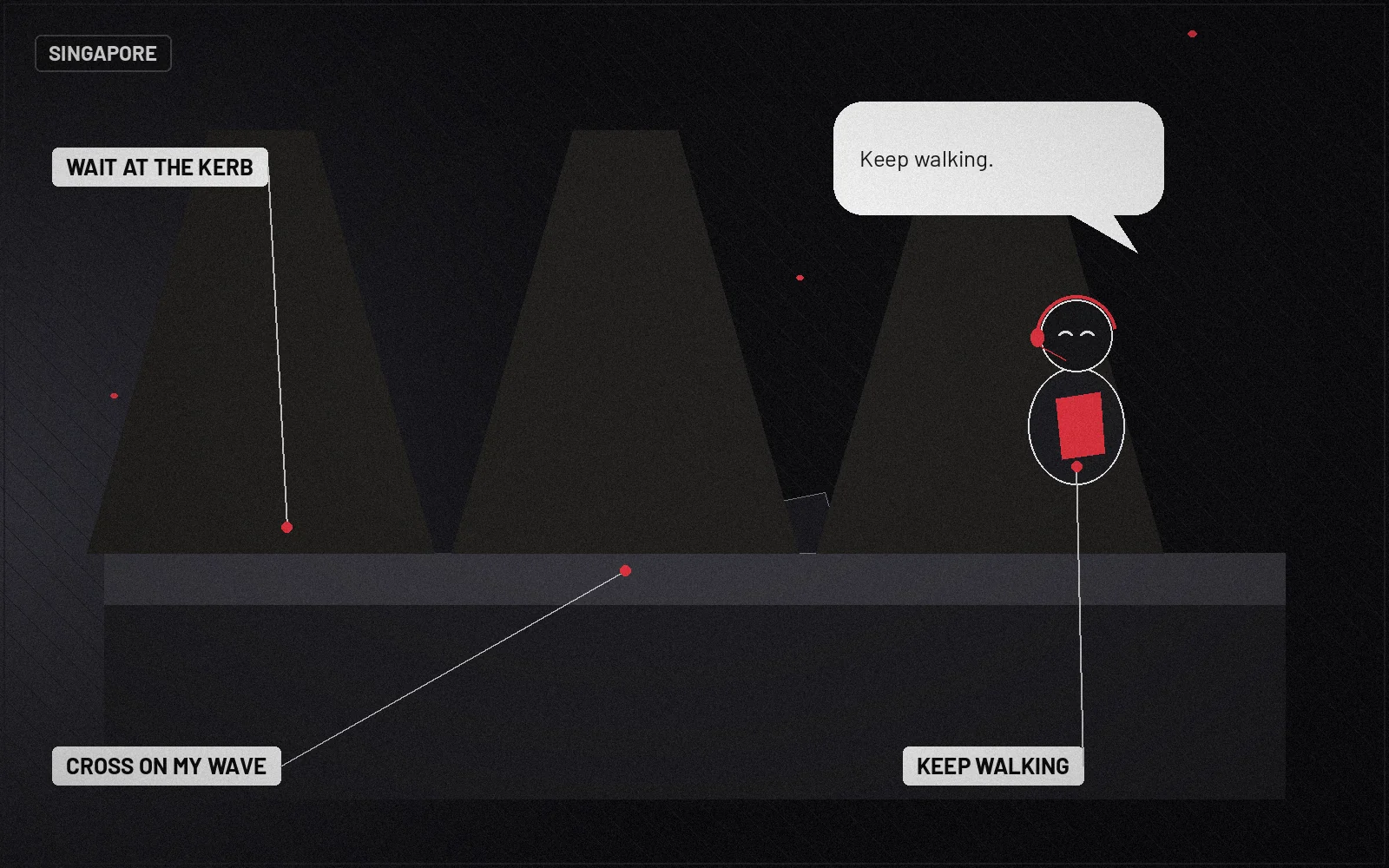
1. Wait at the kerb. The group stands behind the kerb edge, not on the road and not between parked cars.
2. Cross on my wave. The marshal decides when, after the traffic has stopped for the light or for the second marshal’s signal. Guests move on the wave, not on a gap they think they see.
3. Keep walking. Once on the road, everyone crosses in one steady move. No stopping for photos, no turning back for a dropped pen.
The habit to break is the hopeful point. A tired marshal waves vaguely at the road and says go when it looks clear.
What should a traffic marshal stop saying?
Stop telling guests to run or to judge the traffic themselves. The marshal reads the road; the guests follow one clear wave.
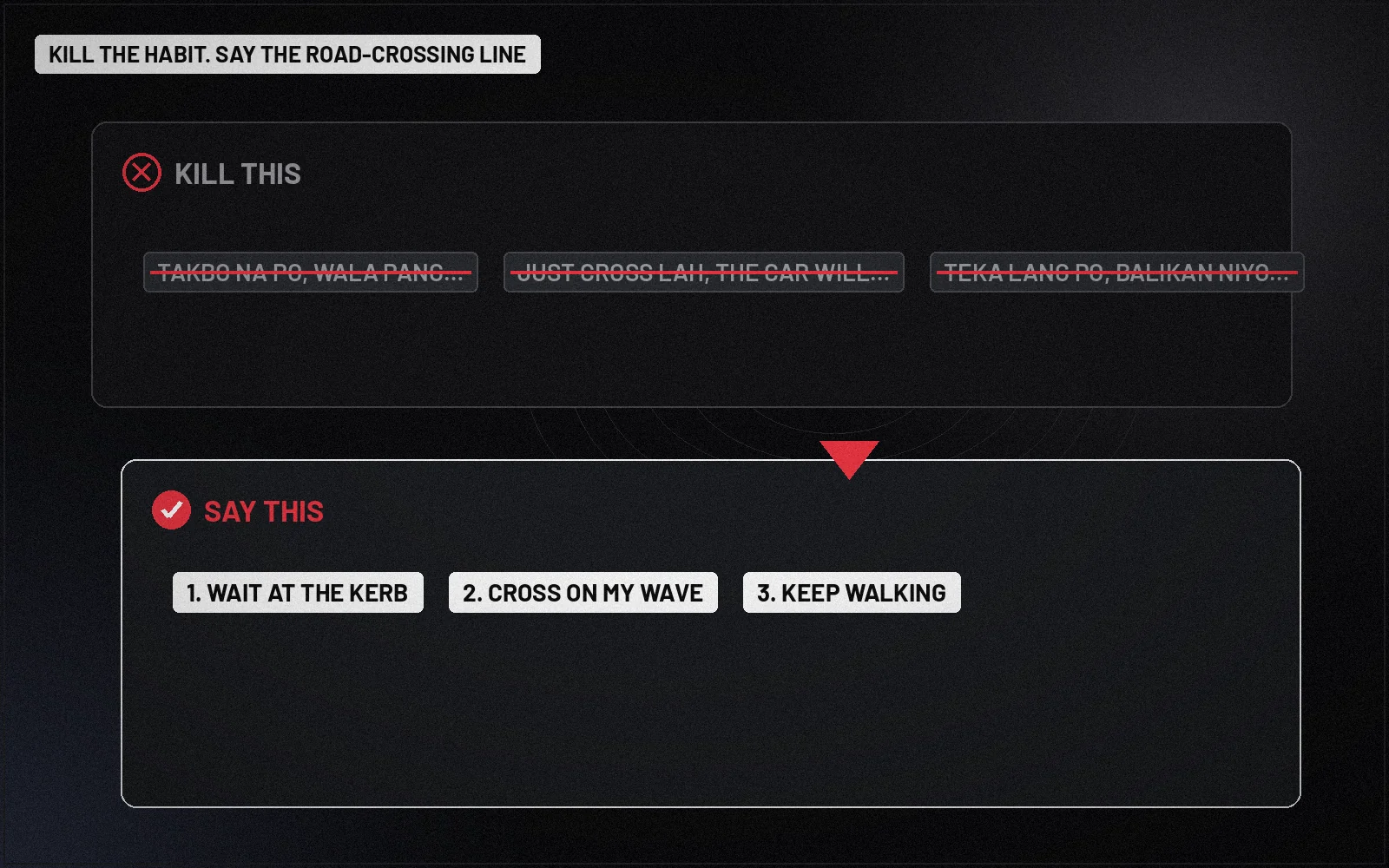
| Kill this | Say this (illustrative) | Why |
|---|---|---|
| Takbo na po, wala pang sasakyan! | Wait at the kerb. | Running splits the group and trips people up |
| Just cross lah, the car will stop one. | Cross on my wave. | Drivers do not always stop; the wave is the plan |
| Teka lang po, balikan niyo yung nahulog. | Keep walking. | A guest who turns back is the one drivers do not expect |
Lines in this table are illustrative, not quotes from real people.
Stand where drivers and guests can both see you, with a light wand after dusk.
What if a guest stops in the middle of the road?
Keep walking with them, take their arm if needed, and let the second marshal hold the lane. Never call a guest back across traffic.
This is the rung nobody likes to rehearse. A delegate drops a phone and freezes, the group bunches behind, and drivers are already edging forward. The marshal walks beside the guest to the far kerb, the second marshal holds the lane, and the phone gets picked up once the road is clear, by a marshal, not a guest.
Who plans where guests cross?
The site lead plans it with the venue and the local traffic contact during the site visit. The plan picks one crossing point, the times it is staffed and how many marshals stand there.
PH / SG / Jakarta desk notes
Same three parts. Different desks.
Philippines desk. Firm but polite. Wait lang po sa gilid, ma’am. On my wave po, sir. Tuloy-tuloy lang po, keep walking. A clear arm signal beats a long sentence.
Singapore desk. Brisk and clipped. Wait at the kerb. Cross on my wave. Keep walking. Same words for every cluster.
Jakarta desk. Marshals here often work beside venue security and the local traffic team. Use Bapak or Ibu only if the house style asks, then the three parts with a whole-arm wave drivers can read.
Paste-ready lock
Speakable lock (illustrative): “Wait at the kerb, cross on my wave, keep walking.”
Monday field kit
- Walk the crossing with the site lead at the time of day guests will cross.
- Agree the hand signals and radio calls between the two marshals.
- Brief marshals on the lock: wait at the kerb, cross on my wave, keep walking.
- Practise the frozen-guest move once, walking to the far kerb together.
- Kill rule: no running, no crossing on a guess, no calling anyone back mid-road.
Illustrative only. Agree with the site lead how many marshals the crossing needs before the first car parks.
FAQs
What is a road-crossing line English APAC?
A road-crossing line English APAC is the traffic marshal’s rule for walking event guests across a busy road between a car park and the venue: wait at the kerb, cross on my wave, keep walking. The group holds behind the kerb, moves only on the marshal’s signal and never stops mid-road.
What should a traffic marshal stop saying?
Stop telling guests to run or to cross on their own judgement. The marshal reads the road and gives one clear wave.
What if a guest stops in the middle of the road?
Walk beside them to the far kerb while the second marshal holds the lane. Pick up anything dropped only once the road is clear.
Who plans where guests cross?
The site lead plans one crossing point with the venue and the local traffic contact during the site visit. Marshals stay at that point, and the lead adds staff if the crowd grows.
Our Manila HQ in Makati and our account office at MBFC Tower 2 in Singapore both work on arrival lines like this for organisers who want guests across the road calmly.
Neuwark Communications builds event and campaign communications as part of our strategy and messaging work. More street-smart lines live in Insights.
Related: drop-off line English APAC · taxi-queue line English APAC
Talk to us about your next event script.
Illustrative lines only. Communications craft, not legal advice.