
Mid-cycle is when campaigns reveal their real media philosophy. Not in the launch deck. Not in the optimistic CPM forecast. In the week Meta delivery collapses, TikTok inventory tightens, YouTube CPVs spike, or a policy change freezes political ads with a cheerful error message. Someone will say the sentence that burns budgets: just put more money behind what worked last month. That is not strategy. That is superstition with a credit card.
Neuwark Communications builds persuasion systems for political and public-interest work in the Philippines and across APAC. We treat paid media like a portfolio: correlated risks, job-level allocations, rebalancing rules, and a surge reserve you do not casually loot. We don’t decorate agendas. We engineer belief. Belief that depends on one auction’s mood is rented attention with an eviction notice.
Portfolio theory is not finance cosplay. It is operator discipline.
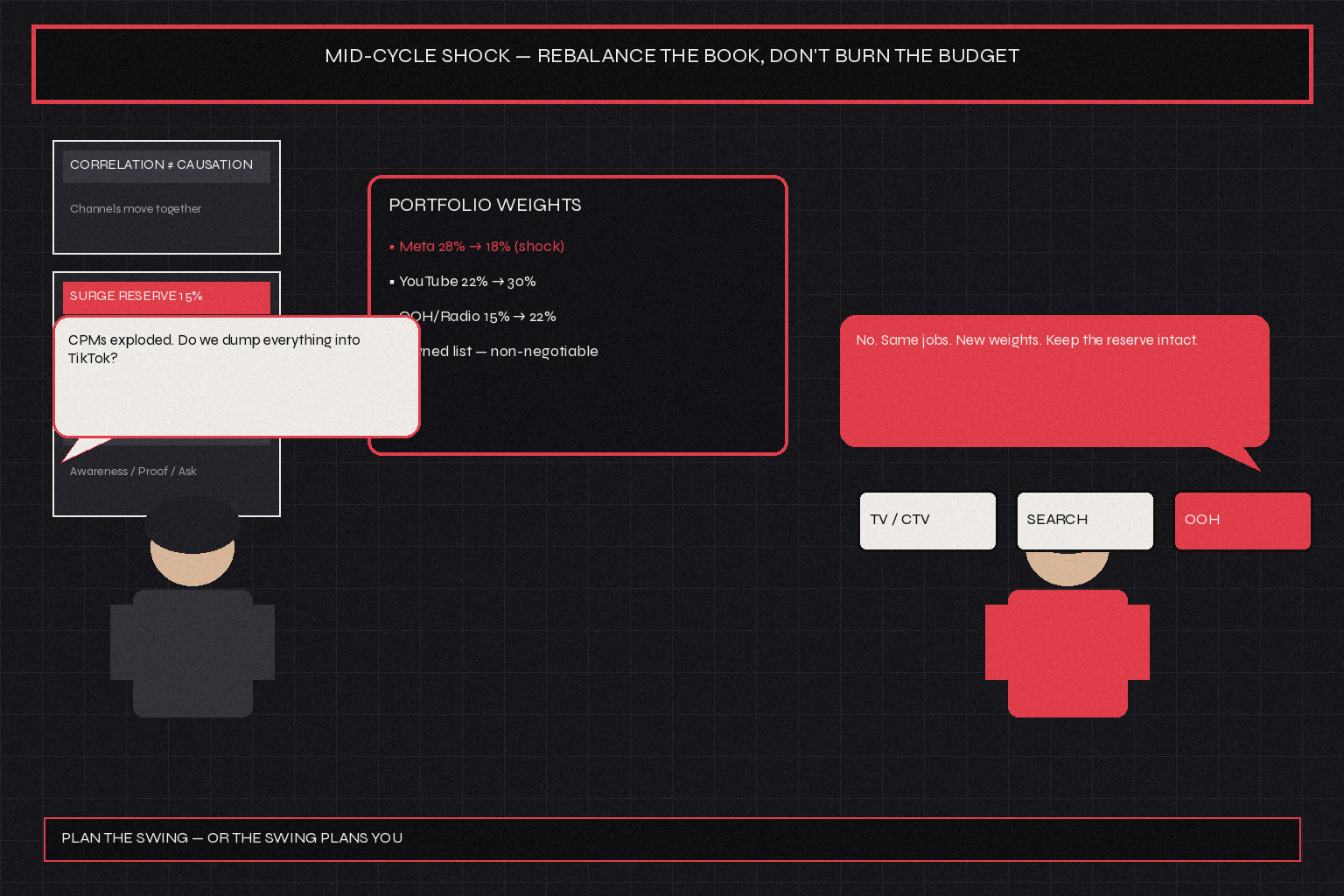
Finance people already know what campaign teams keep learning the hard way: assets that look diversified can move together when the weather changes. Facebook and Instagram are not two independent bets if they share ranking logic and policy. Programmatic display and some social placements can shock in the same news week. “We are on four platforms” is not diversification if three of them are the same risk wearing different icons.
What you are actually holding
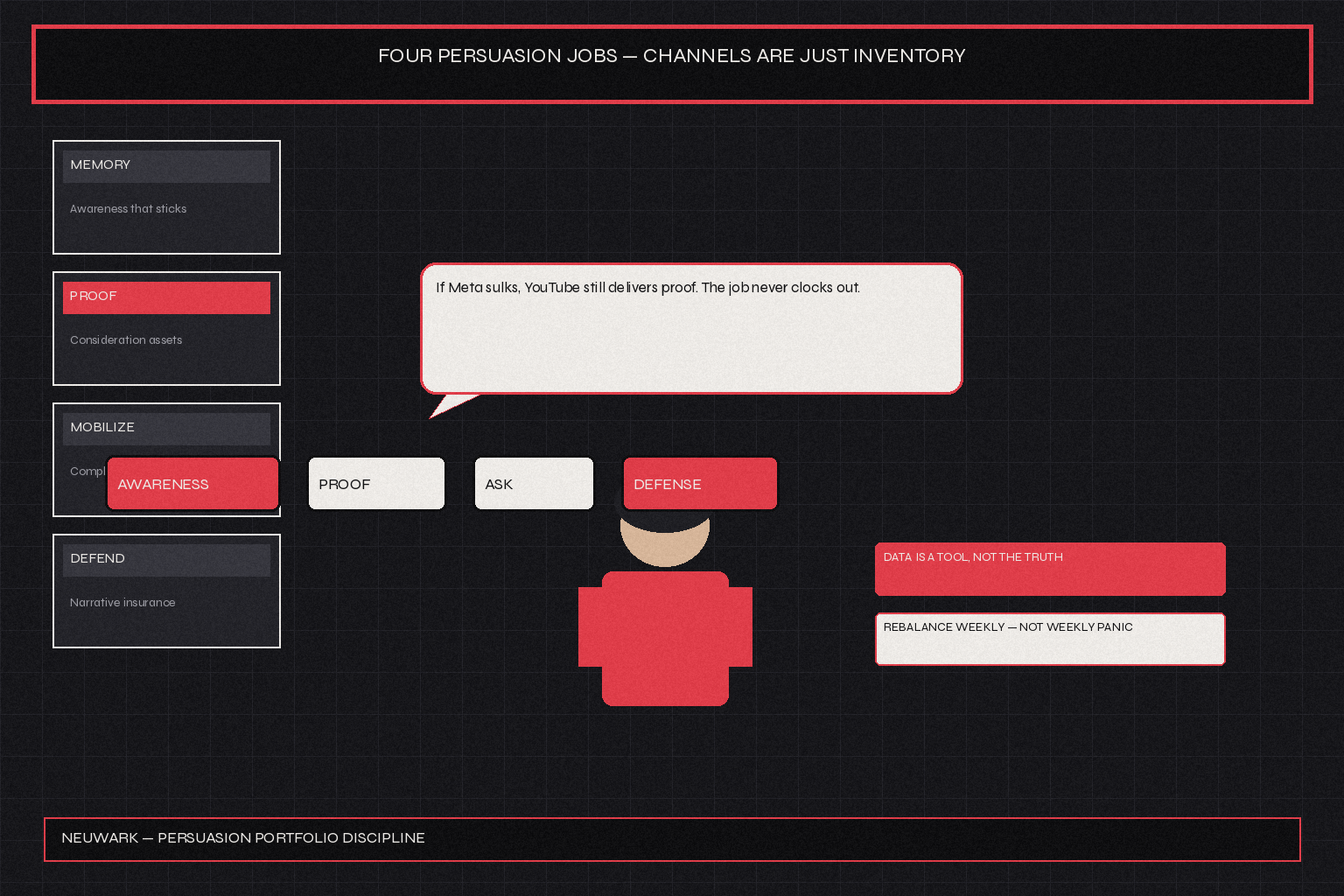
A paid media portfolio is a set of persuasion jobs funded through inventory, not a list of logos on a slide.
- Awareness with memory — distinctive creative that can be recalled after competing noise.
- Proof / consideration — validators, explainers, myth-busts, longer cuts.
- Mobilization — completed actions with friction removed.
- Defense — rapid rebuttal without abandoning your frame.
Channels are the instruments. Jobs are the holdings. When an algorithm shocks, you do not abandon the holdings. You reweight instruments so the jobs keep getting done.
Correlation is the silent killer
In Philippine and APAC races, correlation shows up as:
- Same creative fatigue across Meta placements because you fed one cut everywhere.
- Same disapproval wave when creative claims trip multiple platforms’ issue-ad rules.
- Same audience exhaustion when you chase “efficient” lookalikes into overlapping pools.
- Same news-cycle dependency when all digital flights ignore TV/radio/OOH as ballast.
Portfolio theory says: map what fails together. Then buy ballast that fails differently—YouTube for proof depth, search for intent, community radio for vernacular trust, transit OOH for unavoidable city presence, owned email/SMS as the non-rented core.
Rebalancing rules you write before the shock
Amateur teams improvise under fire. Operators pre-commit.
1. Define tripwires, not vibes
Examples of tripwires that trigger rebalance—not panic:
- CPM or CPV up >35% week-over-week with no creative refresh.
- Delivery volume down >40% at stable bid/budget.
- Disapproval rate above a set threshold.
- Frequency climbing while actions flatline (fatigue, not “need more spend”).
- Policy / account health incident.
Tripwires produce a 48-hour triage, not an overnight budget dump.
2. Rebalance to the job, not to the loudest vendor
If Meta awareness dies, ask: which other inventory still buys memory? Maybe YouTube + limited OOH + radio flight. If consideration proof softens, do not “boost” a weak slogan cut—pull validator clips from the proof library onto still-working inventory. If mobilization is the deadline (hearing, GOTV, filing), protect action-capable channels first even at higher unit cost.
3. Keep creative dual-pathed so rebalancing is possible
Portfolio theory fails if every peso of creative is locked to one format. Every major message needs:
- 6–9s hook cut
- 15–25s proof cut
- static / carousel proof unit
- vernacular variant where the electorate actually lives
Without dual-path creative, “rebalancing” is a spreadsheet fantasy.
4. Treat owned media as a risk-free sleeve
Email, SMS, community group seeding, partner newsletters—these are not “nice to have.” They are the portfolio’s cash position. When rented attention shocks, owned channels keep the conversation alive. Fund list growth every week, not only when Meta sulks.
The surge reserve: the most adult line item in the book
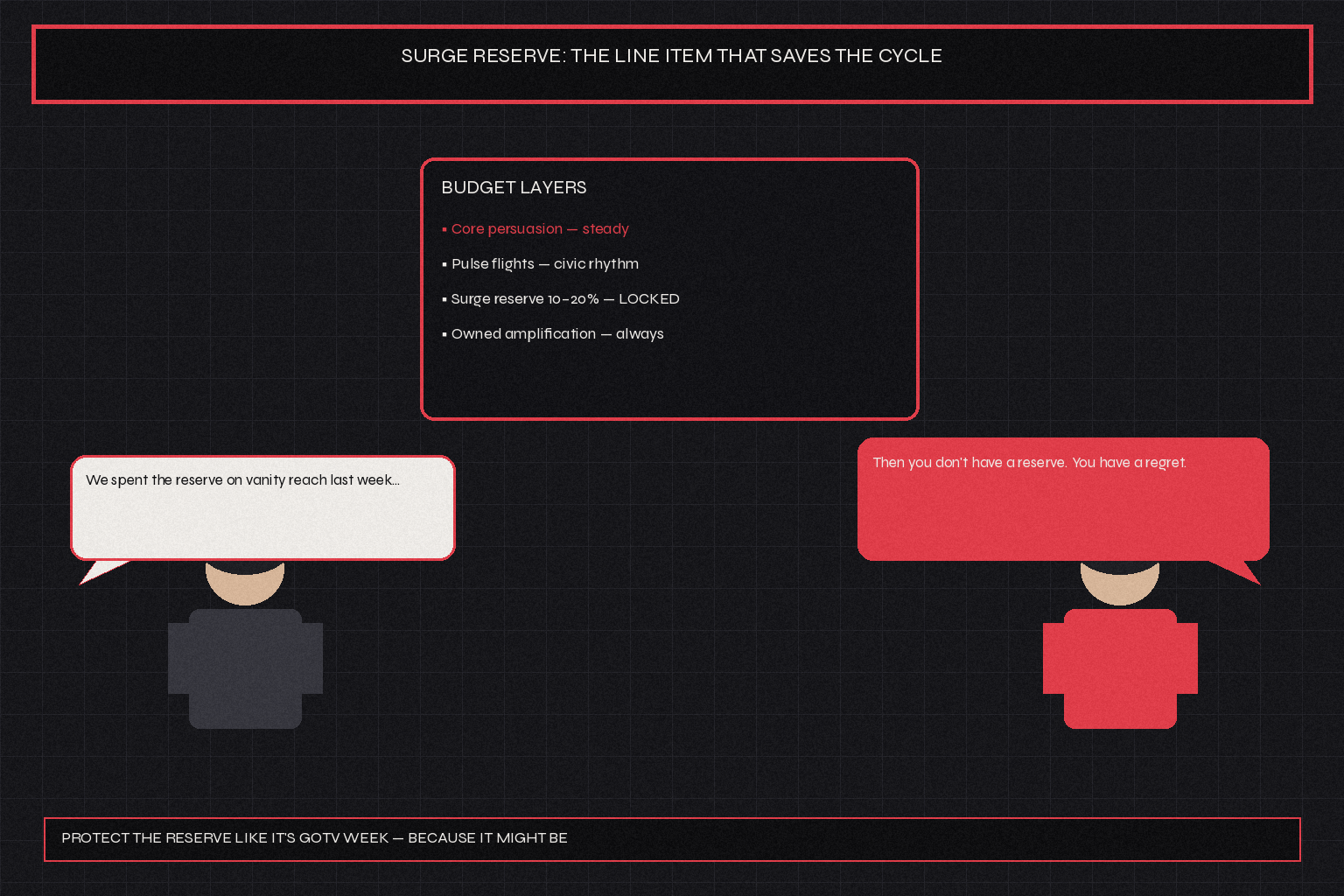
Hold 10–20% as surge reserve for mid-cycle shocks: algorithm, opponent dump, unexpected earned opportunity, disaster week that rewrites the public mood. Rules:
- Reserve is unlocked by tripwire + named owner, not by anxiety in a group chat.
- Spending reserve on vanity reach is theft from future you.
- After use, write a one-page after-action: what broke, what held, which creative transferred.
If your plan has no reserve, you will invent one by cutting the wrong job at the wrong time.
Budget layers that survive weather
- Core persuasion — steady proof against priority persuadables.
- Pulse — civic rhythms: debates, payday cycles, legislative moments, holidays, disaster response windows.
- Surge reserve — protected.
- Owned amplification — non-negotiable.
This is portfolio construction. The algorithm is weather. Weather is not a strategy; it is a constraint you price in.
Philippine and APAC constraints change the math
Global playbooks assume always-on political inventory and English-majority feeds. Many APAC campaigns face intermittent ad-policy friction, vernacular creative needs, family-group distribution, and media diets where TV and radio still set national weather while digital spends the persuasion budget.
Translate portfolio theory into that reality:
- Vernacular units are diversification, not translation afterthoughts.
- Community validators reduce platform dependence by turning paid clicks into social proof.
- Earned calendar is a correlation breaker—pulse media around real civic events, not only auction signals.
- Vendor accountability in plain language weekly: what changed, what you recommend, what you will stop.
Rebalance the book. Do not burn the budget proving a mood.
Mid-cycle algorithm shocks are not rare black swans anymore. They are seasonal. Campaigns that win treat paid media as a persuasion portfolio with tripwires, dual-path creative, ballast channels, and a reserve that stays sacred until it is needed.
A mid-cycle shock tabletop you can run in 90 minutes
Before launch, gather media, creative, digital, and the principal’s chief of staff. Simulate three shocks:
1. Auction shock — CPMs up 50%, delivery down 30%. 2. Policy shock — 40% of issue ads disapproved in 24 hours. 3. Narrative shock — opponent dump forces defense job to the front.
For each, force the room to answer on a whiteboard:
- Which persuasion jobs are time-critical this week?
- Which inventory still delivers those jobs within 48 hours?
- Which creative units transfer without a reshoot?
- What does the surge reserve unlock—and what does it *not* unlock?
- Who has authority to move money without a six-person group chat?
If your team cannot answer those calmly in a tabletop, they will not answer them calmly when real money is on fire. Tabletop scars are cheaper than auction scars.
Vendor scorecards that survive mood swings
Score partners monthly on: plain-language diagnosis, creative transfer help, policy literacy, willingness to recommend stopping spend, and honesty about correlation across their own placements. A vendor who only ever recommends “more budget on us” is not a strategist. They are a vending machine.
In coalition settings, publish a shared portfolio sheet so partners do not independently panic-buy the same Meta auction against each other. Friendly fire is still fire.
Neuwark Communications plans and runs that kind of media for candidates, causes, and institutions who refuse to gamble belief on a single feed’s favor. If your current “plan” is panic-buying whatever still delivers impressions, start a conversation with us—before the next shock writes your burn rate for you.
[Start a conversation →](https://neuwarkcommunications.com/contact)