Every modern campaign eventually meets the same quiet terror: the platform that carried your persuasion last month starts behaving like a different product. Reach collapses. CPMs spike. Creative that was “efficient” becomes invisible. A policy tweak throttles political or issue ads overnight. Someone in the war room says the fatal sentence—just put more money behind it—and the budget burns to prove a mood, not a strategy.
Algorithms have moods. Campaigns need plans. Neuwark Communications builds persuasion media for political and public-interest work in the Philippines and across APAC environments where Meta, TikTok, YouTube, Google, programmatic, and local inventory all matter—and none of them owes you stability. We don’t decorate agendas. We engineer belief. Belief that depends on a single feed’s favor is not belief. It is rented attention with an eviction notice.
Stop treating paid media like a faucet. Build a portfolio.
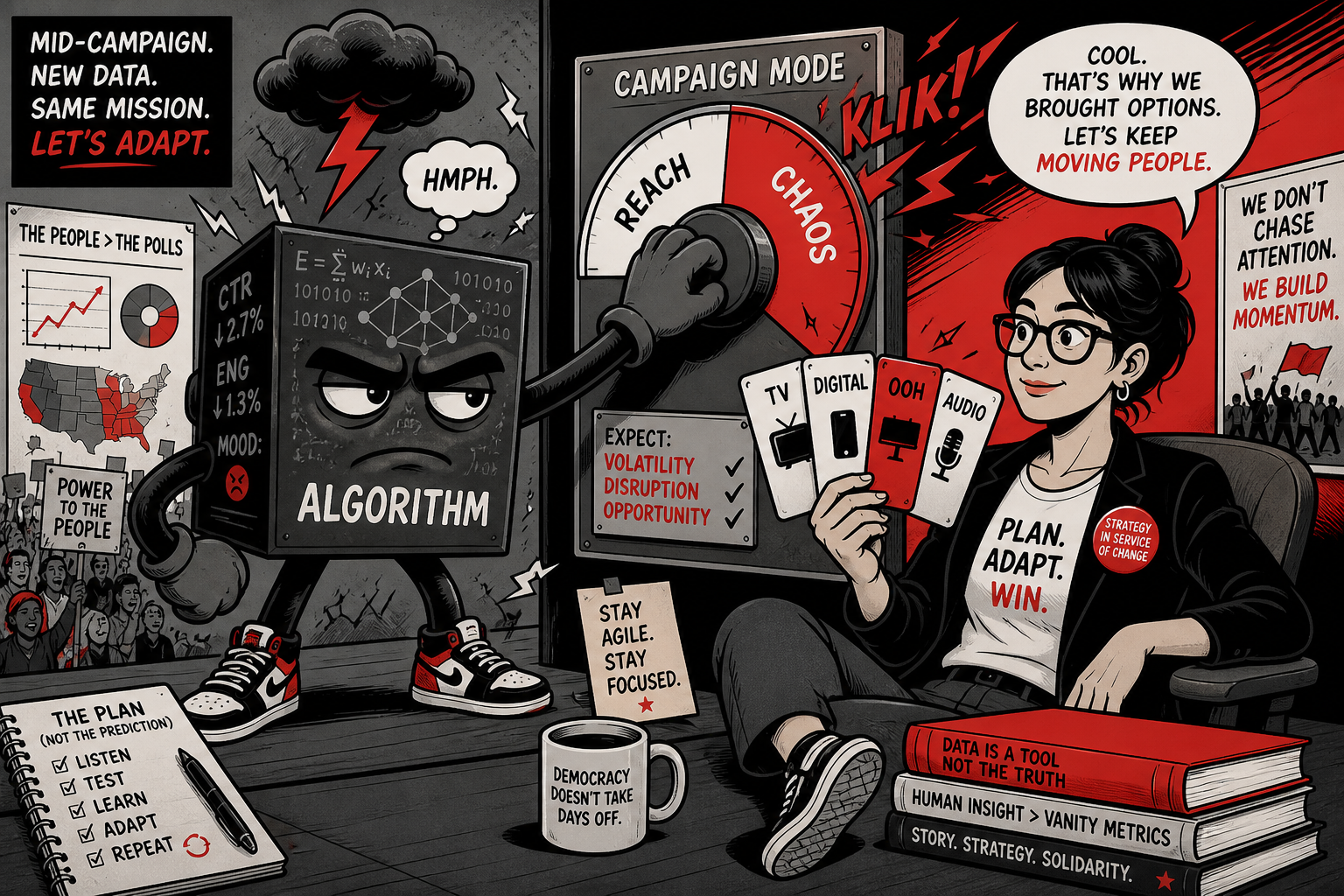
Panic buying is what happens when media planning was never a system. Teams confuse delivery mechanics (auction, ranking, placement) with persuasion strategy (who must move, what proof they need, what action closes the loop). When the mechanic changes, they raise spend to recover yesterday’s vanity metrics. That is how you finance the platform’s recovery, not your campaign’s.
A healthier model: treat paid media as a portfolio of persuasion jobs, each with its own success definition, creative requirements, and fallback inventory.
The four jobs paid media must do (and keep doing when one channel wobbles)
1. Awareness with memory. Not “impressions.” Memory. Can a persuadable adult recall your frame after three days of competing noise? This job often needs frequency discipline, distinctive creative assets, and complementary channels (YouTube + FB/IG + out-of-home or radio in PH markets), not one viral bet.
2. Consideration / proof delivery. Longer cuts, validator clips, myth-busting sequences, explainer carousels. This is where message systems earn their keep. If you only have slogan creative, you have nothing to serve when people finally lean in.
3. Mobilization. Concrete asks with friction removed: event RSVP, volunteer signup, donation, early voting info, petition, hearing attendance. Optimize for completed actions, not clicks that die on a slow landing page.
4. Defense / suppression of opponent narrative. Rapid creative that answers attacks without abandoning your frame. Many progressive and advocacy teams under-fund this job until it is too late. In competitive Philippine races and contested issue fights, defense is not optional—it is a scheduled line item.
When an algorithm mood-swings, you do not abandon the jobs. You reallocate inventory across the portfolio while the jobs stay constant. That is the difference between strategy and superstition.
Mid-cycle platform change: an operator playbook

Assume change. Write it into the plan the way finance writes contingency into budgets.
Before launch: design for breakage
– Dual-path creative. Every major message needs a 6–9s cut, a 15–20s cut, and a static or carousel proof variant. When video ranking softens, you still have usable units. – Landing resilience. Own email/SMS capture and a fast, mobile-first action page. If paid social reach falls, you still have a permission channel. – Inventory map beyond “the app everyone loves.” In the Philippines, that can mean YouTube, Facebook/Instagram, TikTok (where policy allows), Google Search/Display, community radio, transit, barangay-adjacent OOH, and partner newsletters. In other APAC markets, add LINE, local publishers, and CTV where relevant. The point is optionality, not novelty for its own sake. – Measurement that survives UI changes. Prefer incrementality tests, geo splits, and action-based KPIs over last-click fairy tales. Document baselines weekly so a sudden CPM jump is diagnosed, not mythologized. – Policy literacy. Political and issue advertising rules shift. Keep a named owner for ad account health, creative disapprovals, and backup pages. Disapproval chaos is an operational failure, not bad luck.
During the swing: diagnose before you spend
When delivery tanks, run a 48-hour triage—not a 48-hour spending spree.
1. Is it auction cost, ranking, creative fatigue, audience saturation, or policy? Different diseases, different medicine. 2. Protect the jobs with the shortest deadlines (GOTV, hearing dates, filing windows) first. 3. Shift budget to channels that still deliver the same job, even at a higher unit cost, if the persuasion value remains positive. 4. Refresh creative from the proof library, not from panic brainstorms. New packaging of proven proofs beats random novelty. 5. Tighten geography and audience before you widen. Broad desperation burns cash; precision preserves learning.
After the swing: institutionalize the scar
Write a one-page after-action: what broke, what held, which creative transferred, which vendors actually helped. Campaigns that learn become institutions that win next cycle. Campaigns that only complain become case studies.
Creative and media must share one nervous system
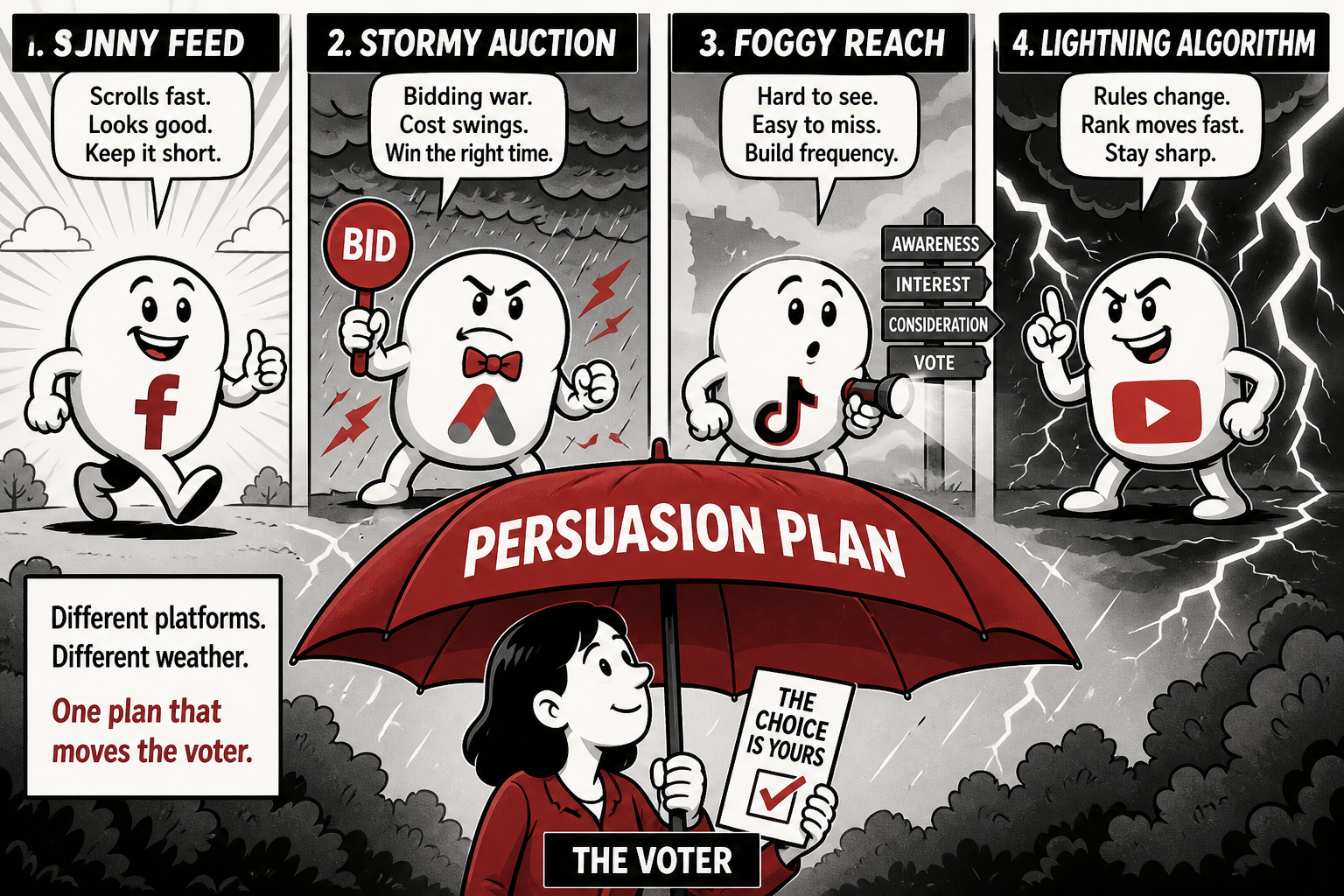
Algorithm volatility exposes a cultural split inside many progressive shops: media buys efficiency; creative buys beauty; strategy buys consensus language. That split is expensive. When ranking changes, creative quality and message clarity become media strategy. Distinctive, frame-true assets travel better under scarcity. Generic “inspirational” bank-ad aesthetics die quietly in the auction.
Practical alignment rules we enforce:
– Media briefs include the message hierarchy (frame, proof, ask), not just targeting specs. – Creative reviews include a delivery reality check: will this unit work muted, cropped, and half-watched? – Weekly standups review job-level KPIs, not only platform dashboards. – Surplus budget goes to underfunded jobs, not to the channel that felt good last week.
In advocacy coalitions, add one more rule: partners do not freestyle paid creative off-brand under “urgency.” A shared sentence and shared visual system prevent the public from experiencing your coalition as five unrelated NGOs shouting at once.
Budget architecture that survives mood swings
Think in layers:
– Core persuasion (steady): always-on proof and consideration against priority persuadables. – Pulse (flexible): flights timed to debates, scandals, legislative moments, holidays, payday cycles. – Surge reserve (protected): 10–20% held for mid-cycle shocks—algorithm, opponent dump, or unexpected earned opportunity. – Owned amplification (non-negotiable): list growth and community distribution so you are never 100% rented.
If your plan has no surge reserve, you will invent one by cutting the wrong thing at the wrong time.
Philippine and APAC realities that change the buy
Global playbooks assume always-on political inventory, stable page access, and English-majority feeds. Many APAC campaigns operate under tighter constraints: intermittent ad-policy friction, vernacular creative needs, family-group chat as a distribution layer, and media diets where television and radio still set the national weather even when digital spends the persuasion budget.
Translate that into planning:
– Vernacular creative is a media variable, not a translation afterthought. A Tagalog or Cebuano proof unit can outperform an English “national” cut with the same targeting because comprehension and trust rise together. Budget for parallel production, not subtitle rescue. – Community amplification multiplies paid. Seed validators and local pages before the flight, so paid clicks land in social proof instead of cold silence. – Earned and paid must share calendars. A debate night, a Senate hearing, a disaster week, or a holiday exodus changes attention more than a minor auction shift. Pulse media around real civic rhythms. – Vendor accountability. Demand weekly explanations in plain language: what changed in delivery, what you recommend, what you will stop doing. If a partner only reports screenshots, replace them before the next swing.
These are not exotic tips. They are how persuasion media stays adult when the algorithm sulks.
Plan for the swing, or the swing plans you.
Platforms will keep changing the rules mid-cycle. That is not a glitch in your campaign; it is the weather. The operators who win treat paid media as a persuasion portfolio with fallbacks, dual-path creative, policy discipline, and measurement that tells the truth under stress.
Neuwark Communications plans and runs that kind of media for candidates, causes, and institutions who refuse to gamble belief on a single algorithm’s mood. If your current plan is “boost what worked last month,” start a conversation with us—before the next swing writes your burn rate for you.
[Start a conversation →](https://neuwarkcommunications.com/contact)