Most out-of-home creative is designed for a pitch-deck sky: clean dusk, dry pavement, a hero billboard glowing like a perfume ad. Monsoon Asia laughs at that render. Manila, Cebu, Jakarta, Bangkok, Ho Chi Minh City, Kuala Lumpur—these are cities of sudden water, fogged glass, sodium light, LED glare, jeepney spray, and MRT glances measured in heartbeats. If your OOH dies in the rain, it was never outdoor creative. It was indoor optimism printed large.
Neuwark Communications builds political and public-interest persuasion for Philippine and APAC environments where the street is still a mass medium. Dark cinematic craft and crimson clarity are not decoration here—they are legibility under weather. We don’t decorate agendas. We engineer belief that can survive wet glass.
Design for the glance that happens under an umbrella
Outdoor in monsoon cities is not “brand awareness.” It is interruption under constraint. Constraints you must design for:
- Water on surfaces — droplets, sheeting rain, smeared bus-stop acrylic.
- Glare and competing light — LEDs fighting streetlights, headlights, storefronts.
- Humidity and fade — printed color that shifts; vinyl that peels; mold as a media partner you did not hire.
- Motion chaos — traffic density that collapses viewing time.
- Power and maintenance reality — digital boards that go dark after storms.
Legibility rules that beat beauty rules
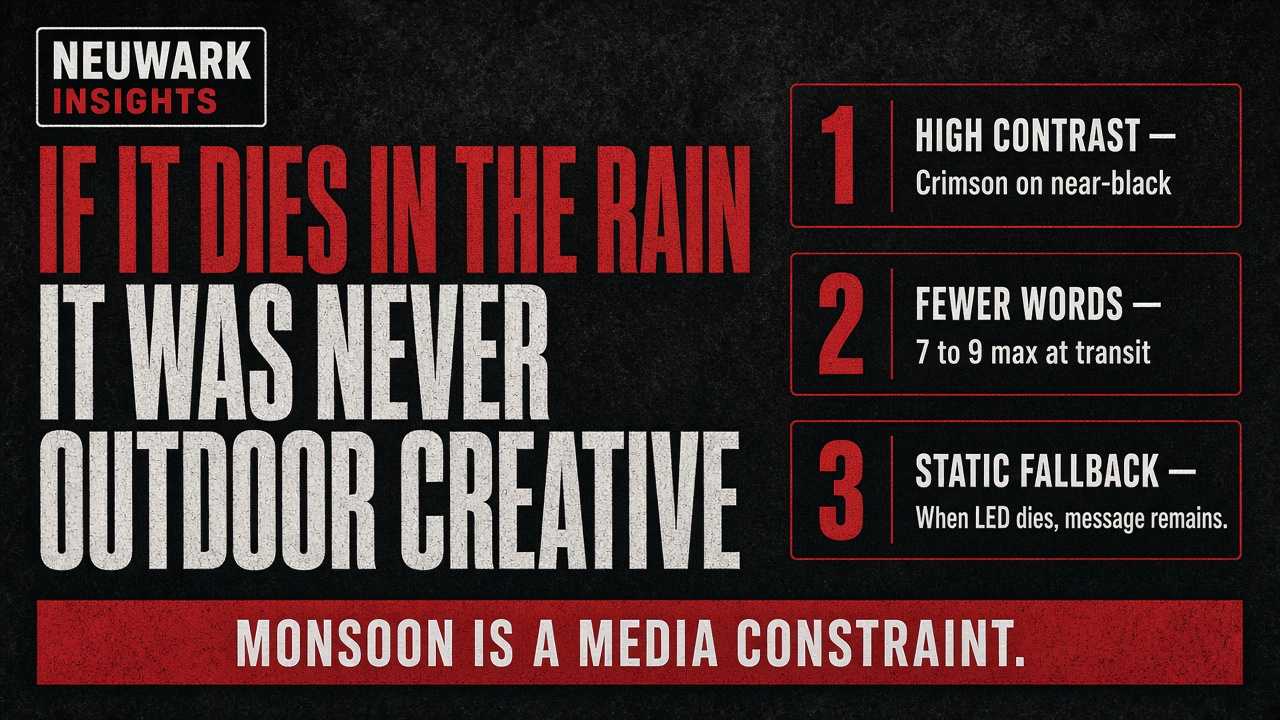
1. High contrast first. Crimson on near-black, white on charcoal, never pastel hero photography that turns to mud at 4 p.m. 2. Fewer words. Transit: 7–9 words max. Highway: a phrase you can finish before the next brake light. 3. One dominant image idea. Not a collage. Not a manifesto. One frame, one proof, one ask. 4. Type that survives distance and distortion. Avoid thin hairlines and low-contrast gray type. If it needs a perfect render to work, it will fail on site. 5. Matte over vanity gloss where reflections kill the read. 6. Static fallback for every digital unit. When the board dies, the message should still exist as a poster logic, not a motion dependency.
Beautiful is optional. Readable in weather is mandatory.
Transit shelters beat highway heroes (more often than agencies admit)
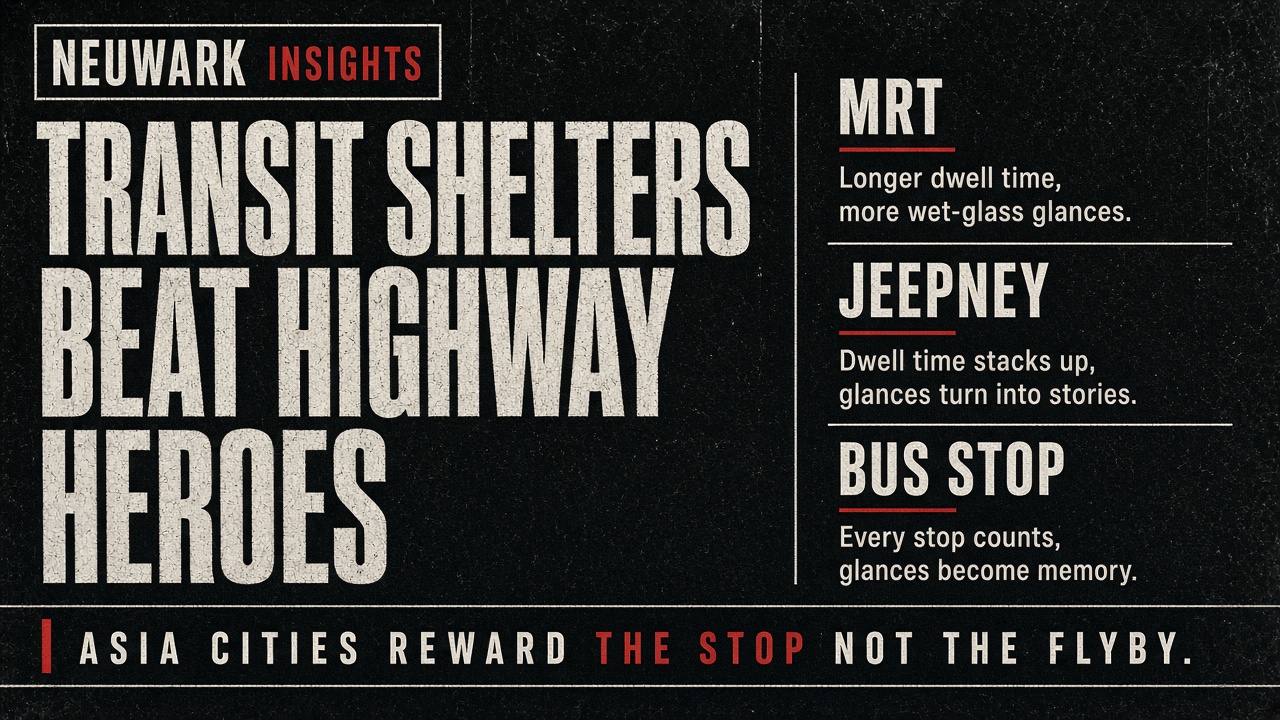
Asia-city mobility is waiting: under shelters, on platforms, in UV-blocked jeepney windows, in Grab back seats stuck in flood traffic. Eye-level inventory often outperforms skyline vanity for persuasion jobs—especially for progressive and public-interest campaigns that need comprehension, not just “presence.”
Shelter creative that works
- Put the frame at eye height, not the logo.
- Use vernacular language the waiting public actually speaks—Tagalog, Cebuano, Bahasa, Thai—before English “national” polish.
- QR codes only if the landing page is mobile-fast and the ask is immediate. A slow page in wet hands is sabotage.
- Design for shared viewing: multiple people under one roof should be able to read without awkward closeness to fine print.
- Plan post-typhoon maintenance as a media line item. A destroyed face is not “earned grit.” It is negligence.
Highway giants still matter for memory at scale—especially along EDSA-like corridors—but they are not automatically the smartest peso. Portfolio the street: shelters + corridors + terminal dominance near real voter/commuter flows.
LED vs print in humid cities: pick for the job
Digital outdoor is not inherently more “modern” for campaigns. It is a different risk profile.
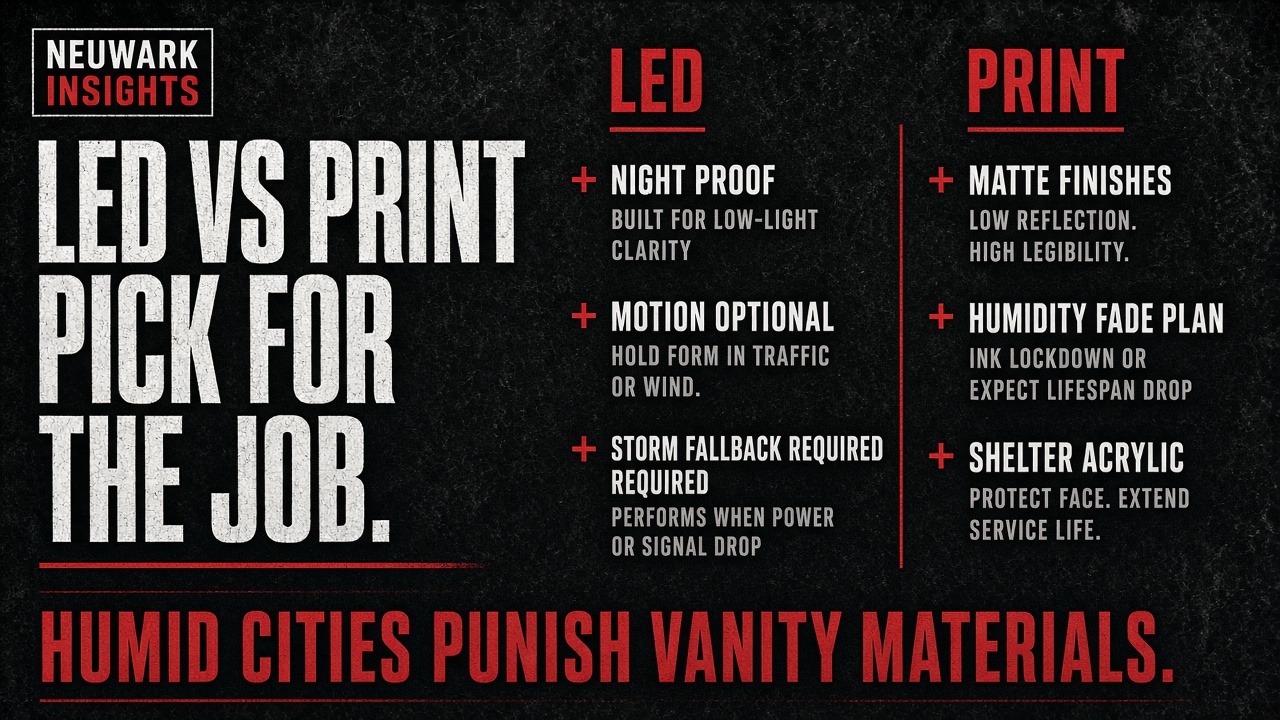
LED strengths: night presence, motion for hooks, rapid creative swap in a crisis week, dayparting around commute pulses.
LED risks: glare washout, content that only works in motion, downtime after weather, higher operating costs, creative that becomes noise in a strip of competing screens.
Print strengths: texture, daylight reliability, lower operational drama, physical permanence that signals seriousness in civic space.
Print risks: slow swap, weather degradation, production lead times that punish late message changes.
Operator move: hybrid corridor systems. LED for night pulse and rapid rebuttal; print for daytime permanence and vernacular proof. Always produce a static master that can travel between both.
Production notes progressive teams skip (and then regret)
- Spec inks and materials for humidity; ask vendors what survived last monsoon, not what looks good in the catalog.
- Photograph sites at rain peak and night—not only at golden hour scouting.
- Build a damage/replace SLA into buys near flood-prone roads.
- Avoid mapping gimmicks that become illegible wet. A clean geographic claim in type often beats a pretty but fragile map.
- Endorsement faces: use high-contrast crops. Soft beauty lighting dies outdoors.
OOH as persuasion infrastructure, not leftover budget
In many PH and APAC campaigns, OOH is treated as the thing you buy when digital feels “done.” Flip that. Street presence is ballast when algorithms shock. It is also civic theater: the public sees who is willing to stand in physical space with a clear sentence.
Integrate OOH into the message system:
- Same frame hierarchy as social and video (frame → proof → ask).
- Same crimson/dark cinematic system so the city feels one campaign, not five vendors freelancing.
- Pulse around real rhythms: payday weekends, debate nights, filing deadlines, disaster response weeks when attention reorganizes.
If the city is underwater, your creative should still speak.
Monsoon is not an excuse. It is a brief. Design for wet glass, short glances, vernacular clarity, and maintenance reality—and OOH becomes one of the most honest persuasion channels in Asia cities.
Night, flood, and the commute: three creative briefs in one buy
Monsoon Asia OOH is not one environment. Brief creative for three conditions explicitly:
- Day rain — low contrast risk, wet acrylic, umbrella crowds at eye level.
- Night LED — high glare, motion competition, crimson must hold against adjacent screens.
- Flood-week improvisation — some sites dark or unreachable; surviving sites must carry heavier narrative weight.
Ask vendors for photos of your exact faces after the first real storm—not after installation day champagne. Campaigns that refuse site truth get surprised by illegibility the public already noticed.
Integration with digital without becoming a QR graveyard
OOH should echo the message system, not try to become a mobile website. Use short URLs or QR only for high-intent asks near waiting inventory (shelters, terminals). On highway units, prioritize memory and frame. If someone needs to screenshot your billboard in the rain to understand your politics, the creative failed upstream.
Pair street presence with geo-aware mobile only when privacy and ethics rules allow—and never as an excuse for weak outdoor craft. The board must work alone.
A monsoon OOH checklist before you sign the buy
- Site photos at rain peak and night, not only dry scouting day.
- Contrast test: grayscale the creative—does the hierarchy survive?
- Type size proof at real viewing distance (tape mock on acrylic if needed).
- Maintenance SLA and replacement timeline after typhoon signals.
- Vernacular lock signed by message owners, not only by the printer.
- Static master exported even for LED-only buys.
- Crisis swap path: how fast can a defense frame replace a celebration frame?
Miss two of these and you are buying hope, not outdoor media.
Neuwark Communications plans and crafts outdoor systems for candidates and causes who need belief to travel through weather, not around it. If your current boards only work in the render, start a conversation with us before the next downpour grades your creative for free.