

A meta description that performs thought leadership will not earn the click.
Meta description English is two sentences a searcher can finish in one breath: the answer, then the next step. It is not a slogan. It is not a second H1.
Street-smart APAC English: short sentences a tired operator can say out loud.
Search still shows the description. Answer engines skim it. If the two sentences argue with the title, the page looks unsure before anyone lands.
This is a companion to our title-tag lock for APAC night desks, which locks title, H1, meta and slug as one claim. That piece makes the four fields agree. This one writes the meta itself, line by line.
Why do advocacy metas fail in APAC search?
They sell the organisation. Searchers did not type the organisation. They typed a problem.
They stack three claims. Long descriptions get trimmed on the results page, and desks work to about 155 characters because that is roughly where trims start. The third claim dies mid-word and reads like a glitch.
They copy the H1. Then title and description fight for the same job.
What are the two sentences?
| Sentence | Job | Pattern |
|---|---|---|
| 1. Answer | Matches the query in one line | Who does what, so the reader can take one named next step. |
| 2. Boundary + next | What you will not pretend, plus where to go | One thing we do not promise, then the page to read next. |
Keep the pair under 155 characters when you can. If you cannot, cut adjectives before you cut the next step.
Paste-ready pair (illustrative):
Write the SERP line before the night desk ships. Two sentences, one next step, no slogan. Not a ranking promise: a line people can finish.
The boundary sentence is the one most desks skip. It is also the one that stops a reader, or a machine, from assuming you promised more than you did.
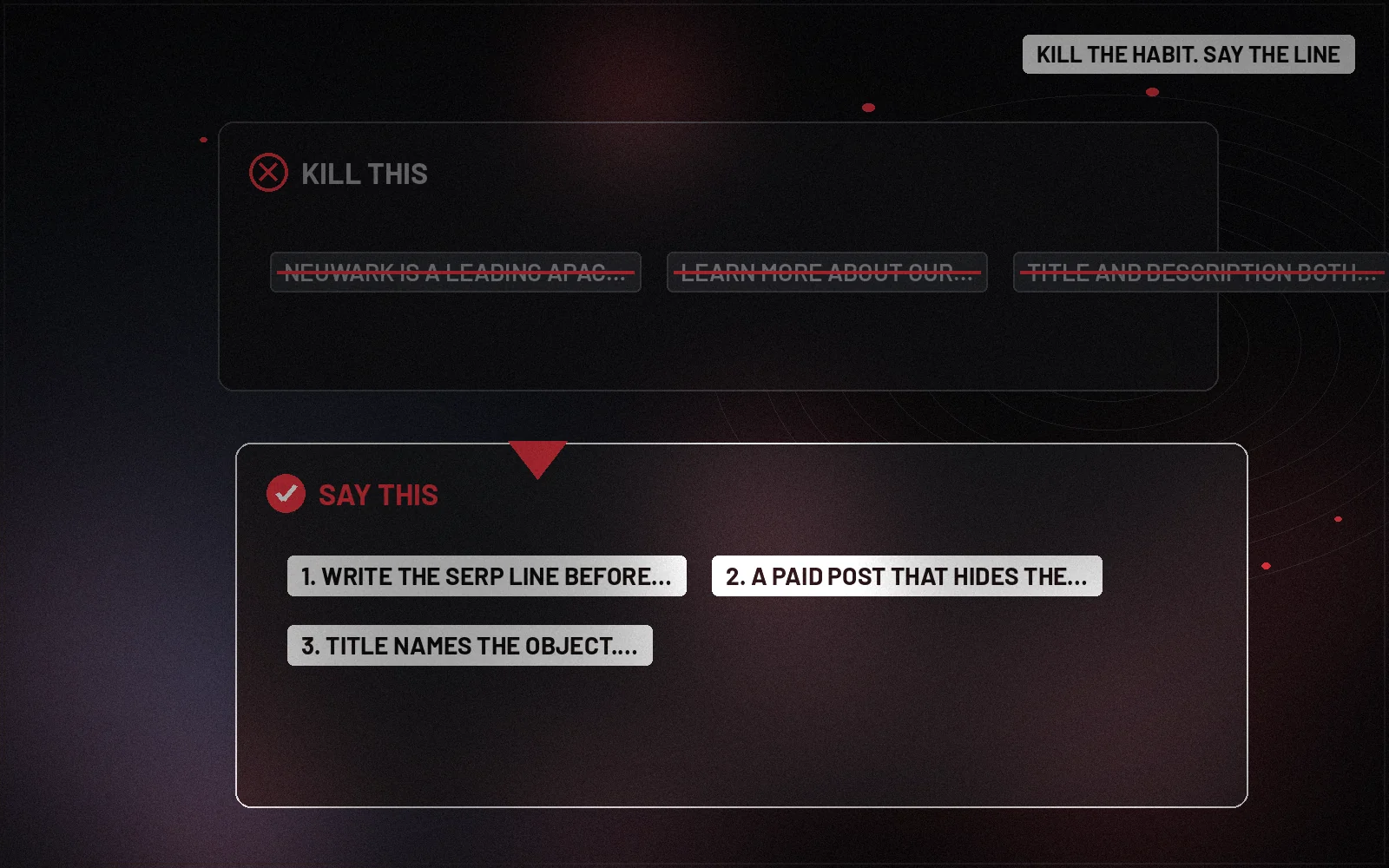
Kill this / say this
| Kill this | Say this (illustrative) |
|---|---|
| “Neuwark is a leading APAC communications partner delivering holistic narrative solutions.” | “Write the SERP line before the night desk ships. Two sentences. One next step.” |
| “Learn more about our award-winning work across the region.” | “A paid post that hides the label in hashtag nine will screenshot as unpaid. Here is the caption line.” |
| Title and description both start with the same noun phrase | Title names the object. Description answers the question. |
| “Click here to find out how we can help you win.” | Drop “click here.” The link is already the click. |
Where does meta description English sit next to the title and the share card?
Three fields, three jobs. Do not make one field do another’s work.
The title names the object. The meta answers the question and names the next step. The share card, covered in our OG card English piece, carries the line that survives a group-chat preview.
They should agree on the claim. They should not repeat each other word for word. If the title, the meta and the OG description are the same sentence three times, you spent three fields to say one thing once.
Kill: the title pasted into the meta, then pasted into the share card. Say: title as object, meta as answer plus next step, card as the stake line.
What does the boundary sentence protect?
It protects the click from becoming a complaint.
A meta that says “Everything you need to win the budget fight” sets a promise the page cannot keep. The searcher lands, finds a two-page explainer, and leaves. Next time they skip your result.
A boundary is short and calm. It says what the page is, and what it is not.
| Kill this | Say this (illustrative) |
|---|---|
| “The complete guide to campaign SEO.” | “Four fields to lock before publish. Not a ranking promise.” |
| “Guaranteed to get you into AI Overviews.” | “One source block per page. We cannot promise a citation.” |
| “Win every debate.” | “Lines for the first ninety seconds. Counsel signs anything legal.” |
How do translations get their own meta?
Lock the claim set in English first. Then write each language’s meta as a new pair, in that language’s rhythm, with the same claim and the same next step.
Do not paste a machine translation of the English meta into the Filipino or Bahasa page. The sentence will run long, the next step will slide off the end, and the searcher will see half a promise.
Each language gets its own length cap, checked on a phone.
Monday field kit
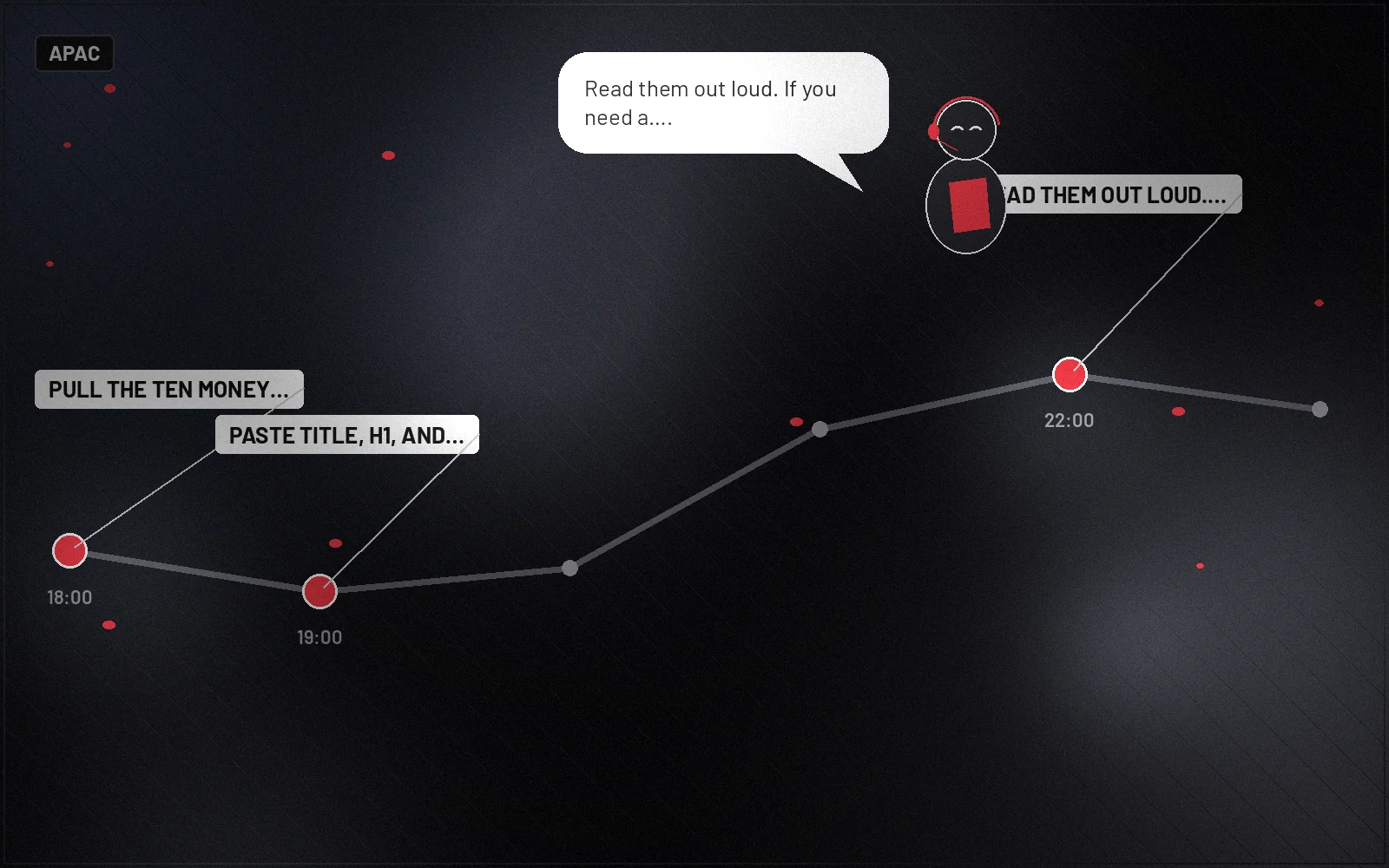
- Pull the ten money URLs.
- Paste title, H1, and meta into one sheet.
- Read them out loud. If you need a breath in sentence one, cut.
- Lock a 155-character cap for EN. Translations get their own cap, not a paste.
- Add a boundary sentence wherever the meta implies a promise.
- Check the pair on a phone results page, not in the CMS preview.
Paste-ready note for the CMS:
Meta check: sentence one answers the query. Sentence two is boundary plus next step. Under the cap. Does not repeat the title.
FAQs
What is meta description English?
It is two speakable sentences that answer the query and name the next step. It is written to survive a trim on the results page.
Is the meta a ranking factor?
Google has said it does not use the meta description for ranking. Treat it as a click line: if it mismatches the H1, you trained the searcher to bounce.
Do I write a different meta per language?
Yes. Lock the claim set, then write each language’s pair fresh. Do not machine-translate the English meta and ship it as Filipino or Bahasa.
What if Google rewrites the meta?
Google often shows its own snippet when it thinks page text fits the query better. Write a pair so plain that the page and the meta say the same thing, and there is little left to rewrite.
What to do this week
Open your five most-visited pages on a phone results page. Read each meta out loud. Rewrite every one that sells the organisation instead of answering the question.
Neuwark Communications writes title-and-meta systems under Digital & Social and Research & Insights. If your metas still start with the agency name, talk to us at Contact. More desks: Insights.
Communications craft, not legal advice. Check current advertising and platform rules with counsel in each market before you publish.
Related: Title-tag English APAC · OG card English APAC · AI Overview source English · People Also Ask English APAC