
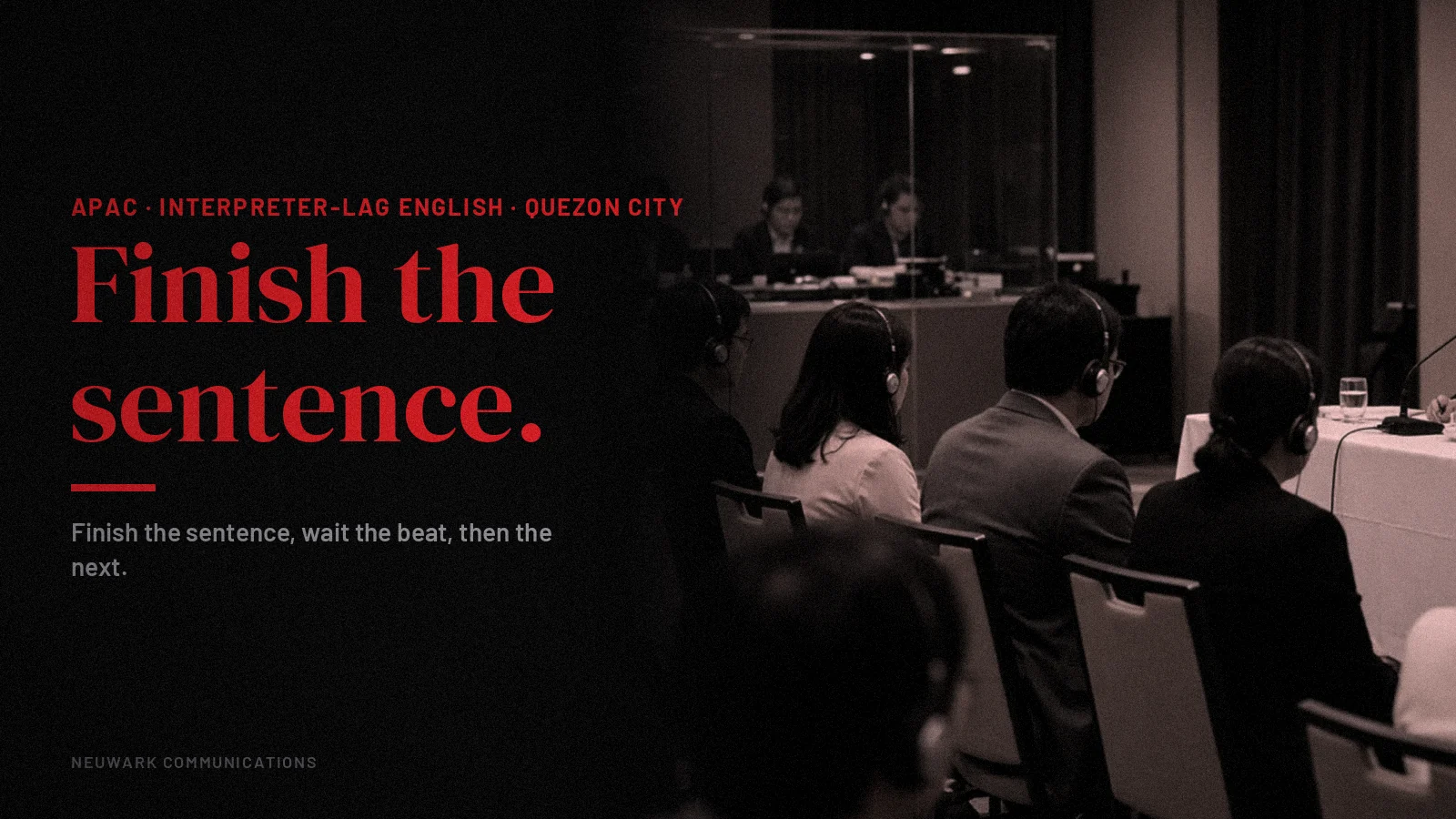
Interpreter-lag line English APAC is the short speaker rule for headset channels: finish the sentence, wait the beat, then the next.
Street-smart APAC English: short sentences a tired operator can say out loud.
A Bangkok hotel forum with a Thai and English headset channel.
The speaker runs three sentences together and jokes over the top.
Half the room laughs late, and the booth drops a line.
Quick answer: An interpreter-lag line English APAC is the speaker rule for headset channels: finish the sentence, wait the beat, then the next. Brief it in the ready room so the interpreter keeps pace and the headset room hears every point.
Pair it with the interpreter-booth line English APAC for the booth itself and the translation-check line English APAC before the session opens. Good event language on a bilingual stage gives both rooms the same talk.
What goes in an interpreter-lag line English APAC?
Three parts. Finish the sentence, wait the beat, then the next.
Interpreter-lag line (illustrative):
“Finish the sentence: one full thought, then stop.”
“Wait the beat: count one in your head while the channel catches up.”
“Then the next: start the next sentence, not a side joke.”
1. Finish the sentence. One full thought, said to the end. Half sentences are the hardest thing to interpret.
2. Wait the beat. A silent count of one. The interpreter is a few words behind, and the beat lets them land.
3. Then the next. The next sentence starts clean. Side jokes and asides wait, or go.
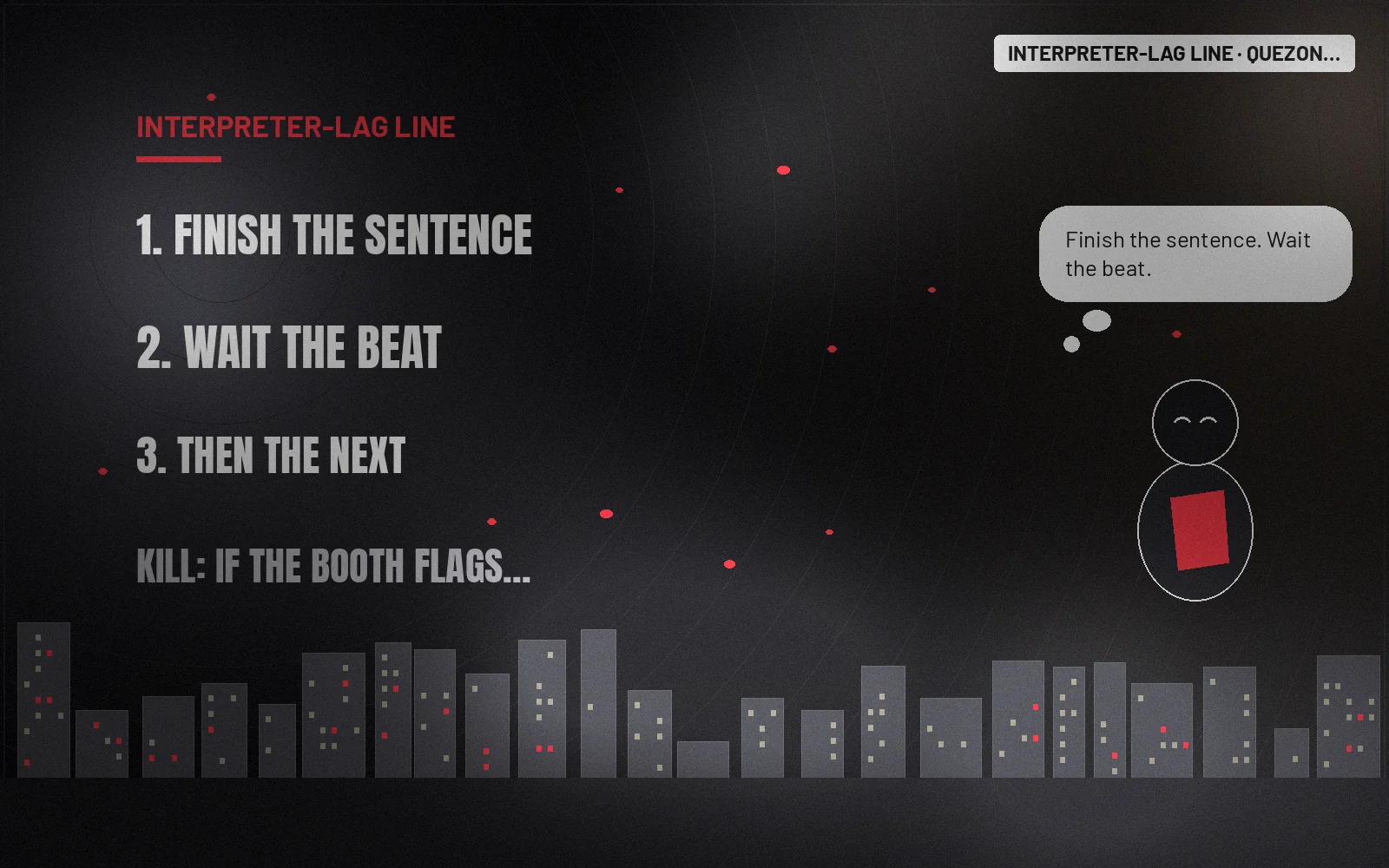
Speakable lock (illustrative): “Finish the sentence, wait the beat, then say the next one.”
The run-on is the habit to break. Nervous speakers speed up, and the headset room falls behind.
What should the stage manager stop telling bilingual speakers?
Stop saying just talk normally and start naming the beat. Normal keynote pace is too fast for a live channel. Give speakers one rule they can hold on stage.
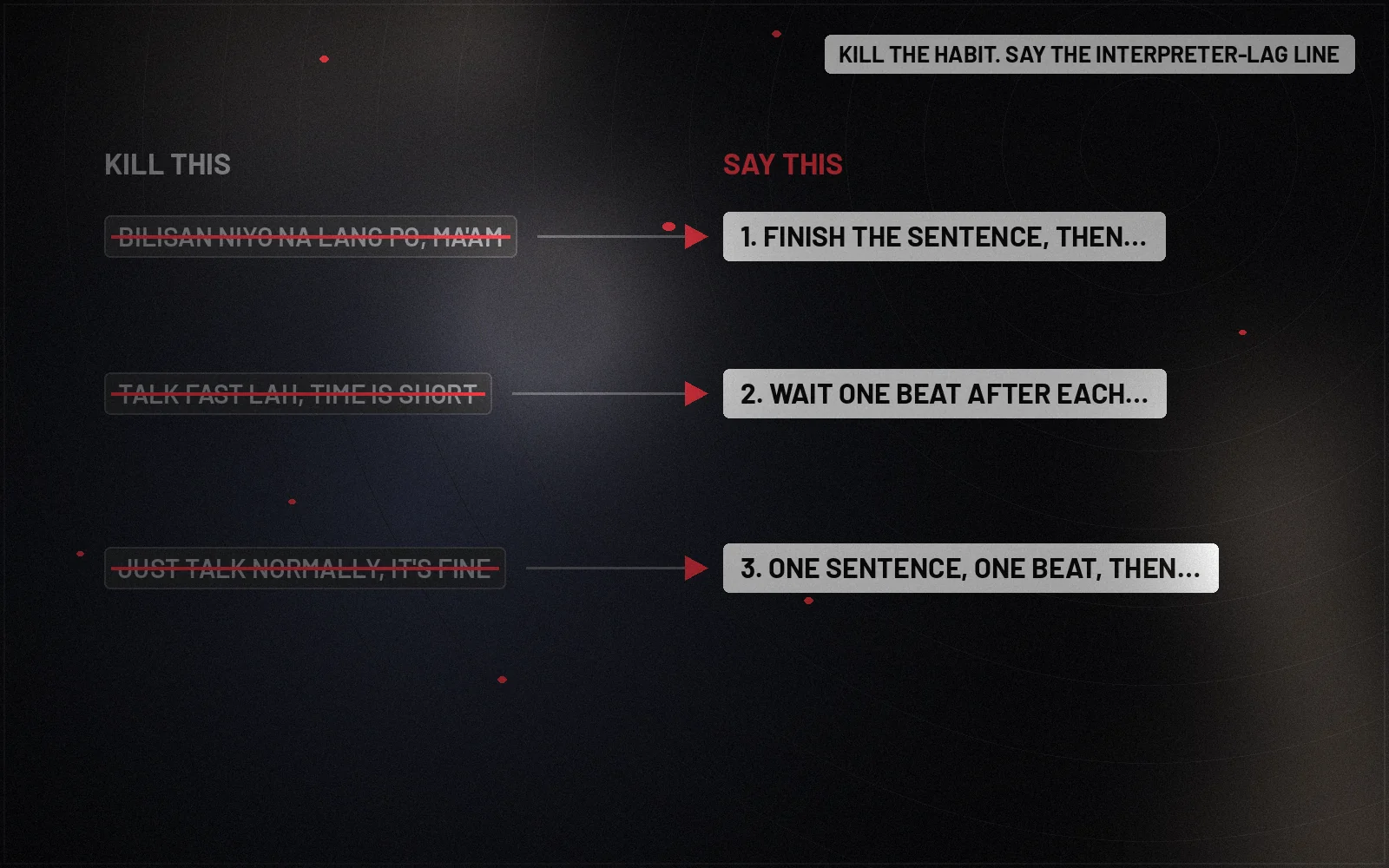
| Kill this | Say this (illustrative) | Why |
|---|---|---|
| Bilisan niyo na lang po, ma’am. | Finish the sentence, then pause. | Full thought |
| Talk fast lah, time is short. | Wait one beat after each sentence. | Channel keeps up |
| Just talk normally, it’s fine. | One sentence, one beat, then the next. | Clear pace |
| Add a joke, they’ll get it. | Save the joke for the Q and A. | No side lines |
| The booth will figure it out. | Check the headset nods before you go on. | Room is with you |
Lines in this table are illustrative, not quotes from real people.
Who owns the interpreter-lag line on a bilingual stage?
The stage manager owns the brief, and the speaker owns the beat. The stage manager says the line in the ready room. The speaker keeps the pace on stage, and the booth flags the stage manager if it falls behind.
What if the speaker forgets the beat mid-talk?
Use one quiet floor signal, agreed in advance. A raised hand near the confidence monitor works. The speaker finishes the sentence, waits, and resets.
How does this play out on PH, SG and Bangkok desks?
Same three parts. Different desks.
Philippines desk. In Manila and Quezon City forums, speakers often switch to Taglish mid-talk. Brief it with respect: finish the sentence po, wait the beat, then the next. Ask them to keep one language per sentence.
Singapore desk. In Singapore and Kuala Lumpur, bilingual panels run on tight slots. Keep it brisk: sentence, beat, next. Tell speakers the beat is already in the timing.
Bangkok desk. In Bangkok forums, the Thai channel often runs longer than the English. Ask speakers to hold the beat a little longer after numbers and names.
Monday field kit
- Send speakers the line with their briefing pack.
- Agree one quiet floor signal for slowing down.
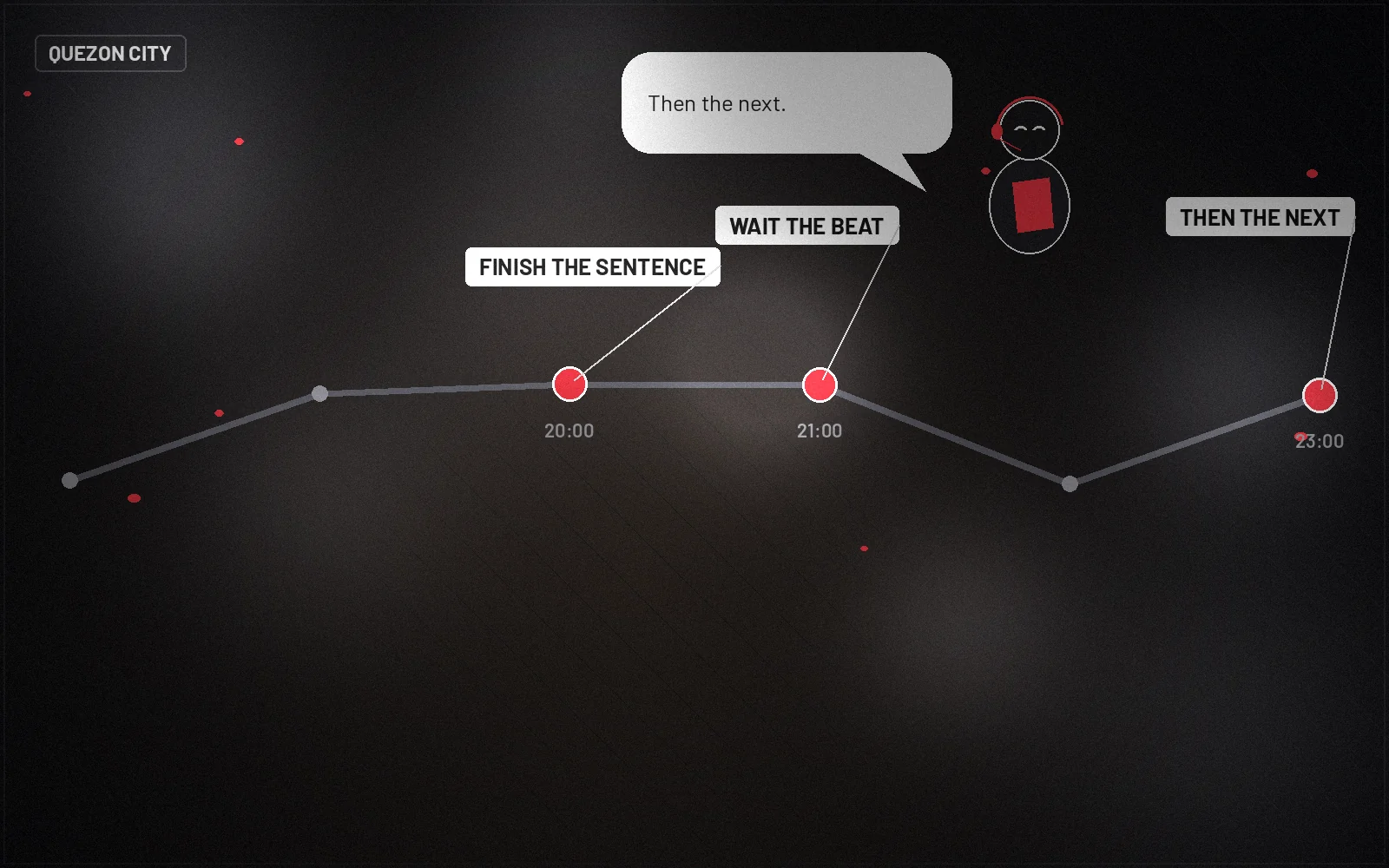
- Brief every speaker in the ready room: finish the sentence, wait the beat, then the next.
- Give the booth the slides and names before the session.
- Kill rule: if the booth flags twice, the stage manager gives the floor signal and the speaker resets the pace.
FAQs
What is an interpreter-lag line English APAC?
An interpreter-lag line English APAC is the speaker rule for headset channels: finish the sentence, wait the beat, then the next. It keeps the headset room in step with the live room.
How long should a speaker pause for interpretation?
A silent count of one after each sentence suits most channels. Pause a little longer after numbers and names.
Why do jokes fail on a headset channel?
Jokes depend on timing, and the channel runs a few words behind. Half the room laughs late or not at all.
Who signals a speaker to slow down for the interpreter?
The stage manager gives one quiet floor signal agreed in advance. The booth flags the stage manager first.
Neuwark Communications builds event and campaign communications as part of our strategy and messaging work. More street-smart lines live in Insights.
Related: interpreter-booth line English APAC · translation-check line English APAC
Talk to us about your next event script.
Illustrative lines only. Communications craft, not legal advice.