
Philippine campaigns love a famous face. The rally photo pops. The timeline spikes. The war room confuses heat with persuasion. Then canvass week arrives, and the voter who liked a celebrity dance clip still asks the only question that matters: sino ba talaga ang nagsasabi ng totoo dito? Fame can open a door. It rarely holds the room.
Neuwark Communications works in political and public-interest persuasion where trust is local, vernacular, and allergic to elite distance. We distinguish celebrity endorsements (reach + risk) from influencer validators (credibility + conversion). We don’t decorate agendas. We engineer belief—and belief in PH races travels through people who already owe their community an answer.
The trust ladder: who actually moves whom
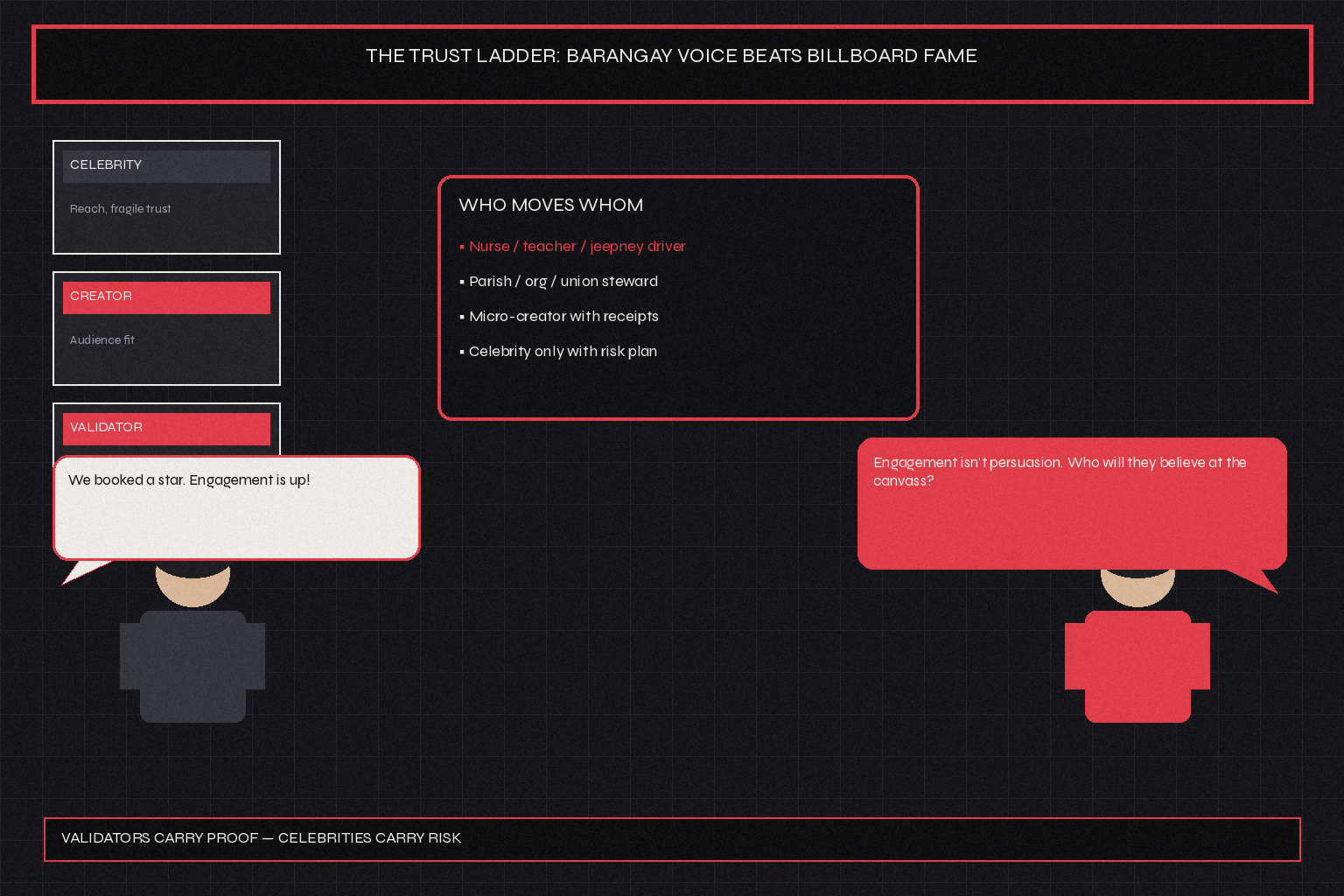
Think of influence as a ladder, not a follower-count leaderboard.
1. Lived validators — nurse, teacher, jeepney driver, market vendor leader, union steward, parish organizer, farmer leader. Low glamour, high consequence. Their endorsement is a reputation transaction. 2. Micro-creators with receipts — community pages, local explainers, niche educators who already teach this audience something useful. 3. Mid-tier influencers — larger reach, still somewhat accountable to a specific public. 4. Celebrities — maximum reach, fragile trust, opponent-ready risk surface.
Progressive and reform-leaning campaigns often overbuy tier 4 because it feels like “winning the culture.” Culture is not a trending audio. Culture is who gets believed when the group chat turns into an argument.
Validators carry proof. Celebrities carry narrative weather.
A validator can say: I work the ward night shift; this health claim matches what we see. A celebrity can say: I support this candidate. Both are speech acts. Only one regularly transfers epistemic authority—the right to be treated as knowing.
In PH races, family networks, barangay dynamics, church and org life, and workplace chats still adjudicate truth. Design your influencer program for those rooms.
When celebrity still makes sense (and how not to get wrecked)
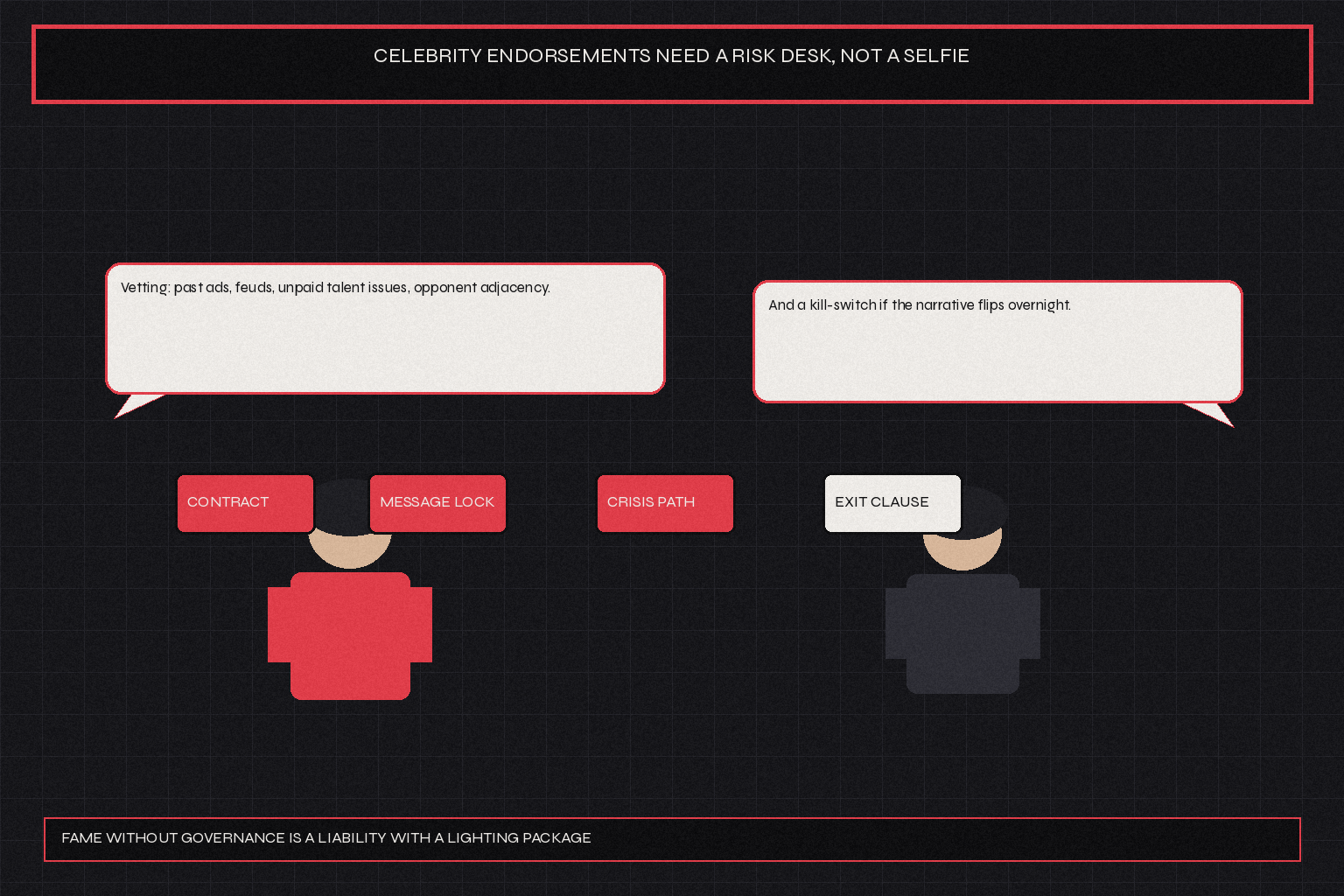
Celebrity is not forbidden. It is hazardous materials. Use it when:
- You need rapid national awareness for a late entrant or a frame reset.
- The celebrity’s public identity already rhymes with your message (not a rented contradiction).
- You have a risk desk: vetting, contract, message lock, crisis path, exit clause.
- You will pair the celebrity with validators so fame does not float alone.
Risk desk checklist (non-optional)
- Past brand deals, political adjacency, unpaid talent conflicts, unresolved public feuds.
- Opponent diggability: old posts, interviews, tax/labor issues, alliance history.
- Message governance: approved lines only; no freestyle policy claims on live.
- Kill-switch: how you pause, contextualize, or exit within 12 hours if narrative flips.
- Disclosure: paid partnership clarity that does not insult the audience’s intelligence.
Fame without governance is a liability with a lighting package.
Micro-validators: small followings, high conversion
The highest ROI units in many local and provincial races are not megastars. They are people with 3,000–80,000 followers who already function as information utilities for a niche: traffic updates, nursing tips, farming advice, parish announcements, campus explainers, barangay sports pages. Their audience showed up for usefulness. Your campaign borrows that usefulness—or it gets rejected as contamination.
Brief validators like adults
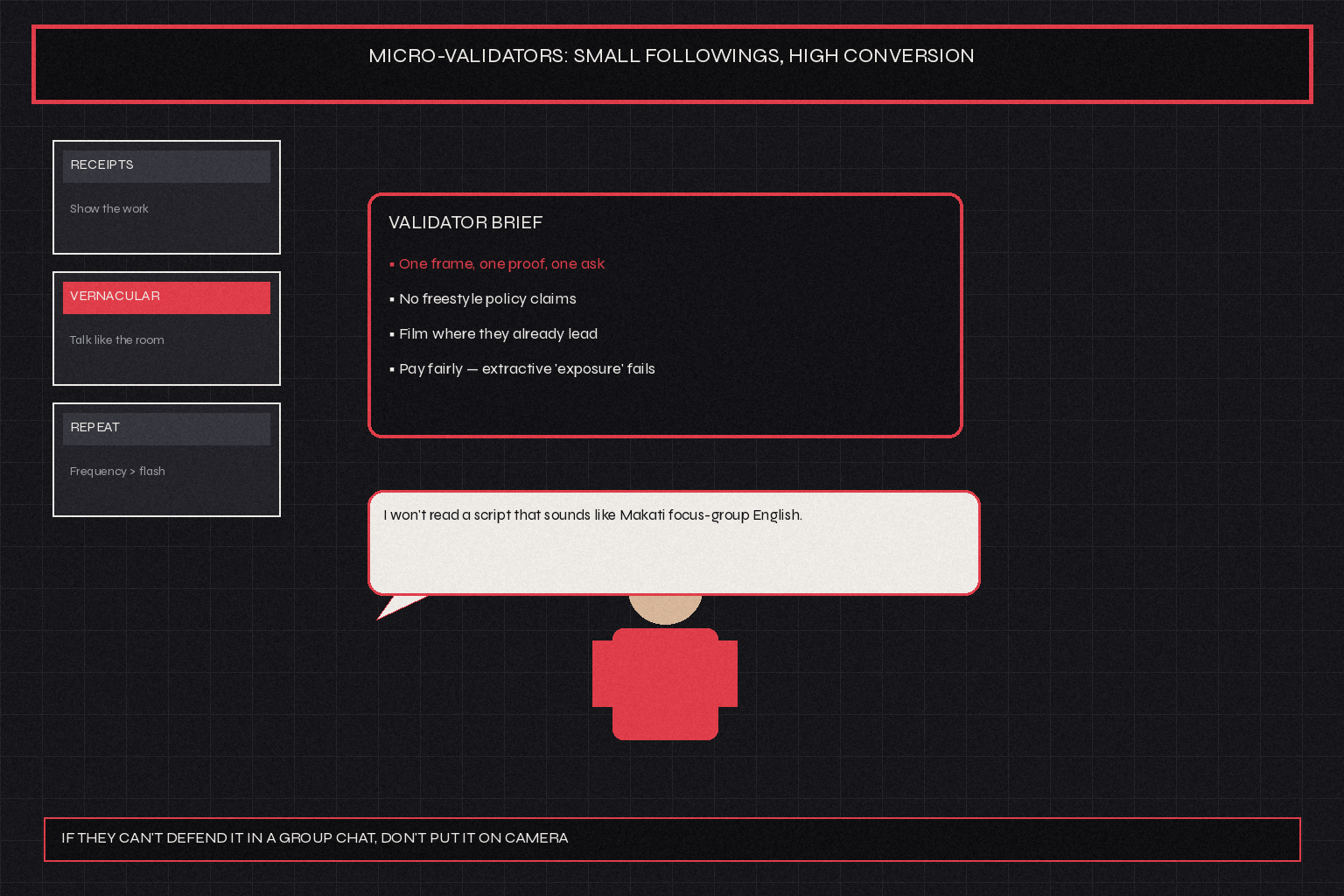
- One frame, one proof, one ask. Not a speech.
- Film where they already lead—clinic, classroom, terminal, farm, studio corner—not a sterile set that screams “national HQ.”
- Vernacular first. If they refuse Makati focus-group English, they are doing quality control for you.
- Pay fairly. Extractive “exposure” deals produce weak work and quiet resentment that leaks.
- Give them a proof pack: facts they can defend in comments without inventing.
If they cannot defend it in a group chat, do not put it on camera.
Measurement that respects the job
Do not judge validators only by views. Track:
- Comment quality and question types (confusion vs hostility vs intent).
- Downstream actions: site visits, volunteer joins, donation starts, event RSVPs in their geography.
- Canvass feedback: do names/phrases from validator content show up in door conversations?
- Negative spill: did we create a ratio storm that opponents clipped?
Celebrity metrics often look prettier. Validator metrics often matter more.
Building a mixed system without looking incoherent
A coherent PH race influencer system looks like this:
- Validators as the spine — weekly proof content in vernacular.
- Mid-tier amplifiers — package and distribute the best validator proofs.
- Celebrity as a pulse — timed to debate, filing, or frame reset; always paired with validator follow-through.
- Shared cinematic language — dark, intentional craft; not each creator’s random filter pack destroying brand recognition.
- Message system lock — frame hierarchy travels; creative packaging flexes.
Coalitions: prevent five NGOs from booking five contradictory influencers under “urgency.” One sentence. One visual system. Many voices.
Reach is easy to rent. Trust is expensive to fake.
In Philippine races, the campaigns that win persuasion—not just virality—invest in validators who already carry moral weight in real communities, use celebrities as governed pulses, and measure conversion in human rooms, not only dashboards.
Provincial races and the Manila-centric trap
National celebrity packages often over-index on Metro Manila attention economies. Provincial and local races punish that vanity. A Cebuano teacher with a modest page can outperform a Manila celebrity clip that never enters the local proof ecosystem. Budget for regional validator discovery the way you budget for regional media—early, with fieldwork, not as a last-week scramble.
Content ops that keep validators safe
Validators take social risk. Protect them:
- Prebunk likely attacks with a shared FAQ.
- Provide comment moderation support during peak hours after posting.
- Never force them into opponent-insult content that damages their long-term standing for your short-term dopamine.
- Offer exit dignity if the race turns toxic beyond what they signed up for.
Movements that burn validators for one news cycle will find the well empty next cycle. Reputation is a renewable resource only if you stop salting the soil.
Contracting without killing authenticity
Validators should sound like themselves inside a locked frame. That means:
- Co-write hooks in their cadence; do not drop a HQ script on their phone at midnight.
- Allow personal proof details that HQ could not invent—then fact-check, don’t flatten.
- Separate must-say lines (frame, legal, claim safety) from can-say color.
- Record multiple takes; pick the human one, not the “most national-sounding” one.
Audiences in the Philippines are fluent in detecting forced sincerity. Over-directed validators become low-budget celebrity ads—and inherit the distrust without the reach.
Opponent clipping is part of the medium
Assume every validator second will be re-cut by opponents. Brief for clip safety: no half-jokes about policy, no ambiguous sarcasm, no pile-ons that look like bullying when stripped of context. Strong and clear beats snark that travels badly.
Neuwark Communications designs validator-led influence systems for candidates and causes who need belief to survive the group chat. If your plan is “get a famous endorsement and boost it,” start a conversation with us before fame becomes your opponent’s best clip.
[Start a conversation →](https://neuwarkcommunications.com/contact)