
Your canvass numbers look fine until you ask who actually knocked which street yesterday.
That gap is not a “volunteer culture” problem. It is an ops digitization problem. Philippine progressive campaigns still lose turnout, message discipline, and donor confidence inside Excel tabs, group chats, and photocopied turf maps that never sync.
Neuwark Communications builds political and advocacy field systems that treat volunteers as operators—not vibe. Digitization here means signal you can act on tonight, not a CRM graveyard for after Election Day.
Why paper-and-chat systems break mid-cycle
Early campaign weeks forgive chaos. Mid-cycle does not.
When you run barangay canvass across multiple cities, three failures show up fast:
- Turf collisions — two teams hit the same block; nobody hits the stubborn precinct.
- Message drift — volunteers invent soft versions of your hard policy line.
- Debrief amnesia — evening notes die in Viber while HQ plans tomorrow on old data.
Donors notice. So do coalition partners. A progressive campaign that cannot answer “how many doors, which messages, what objections” sounds amateur even when the candidate is strong.
Digitization is not “buy software.” It is forcing every field action to leave a usable trail.
What “digitized” actually means for PH field
Skip the Silicon Valley fantasy of one app that volunteers love. Build a thin stack they will tolerate.
- One intake form for new volunteers (role, barangay, language, availability, device).
- One turf assignment they can open offline or on prepaid data.
- One message card per shift—not a 40-page binder.
- One debrief path that lands in HQ before midnight.
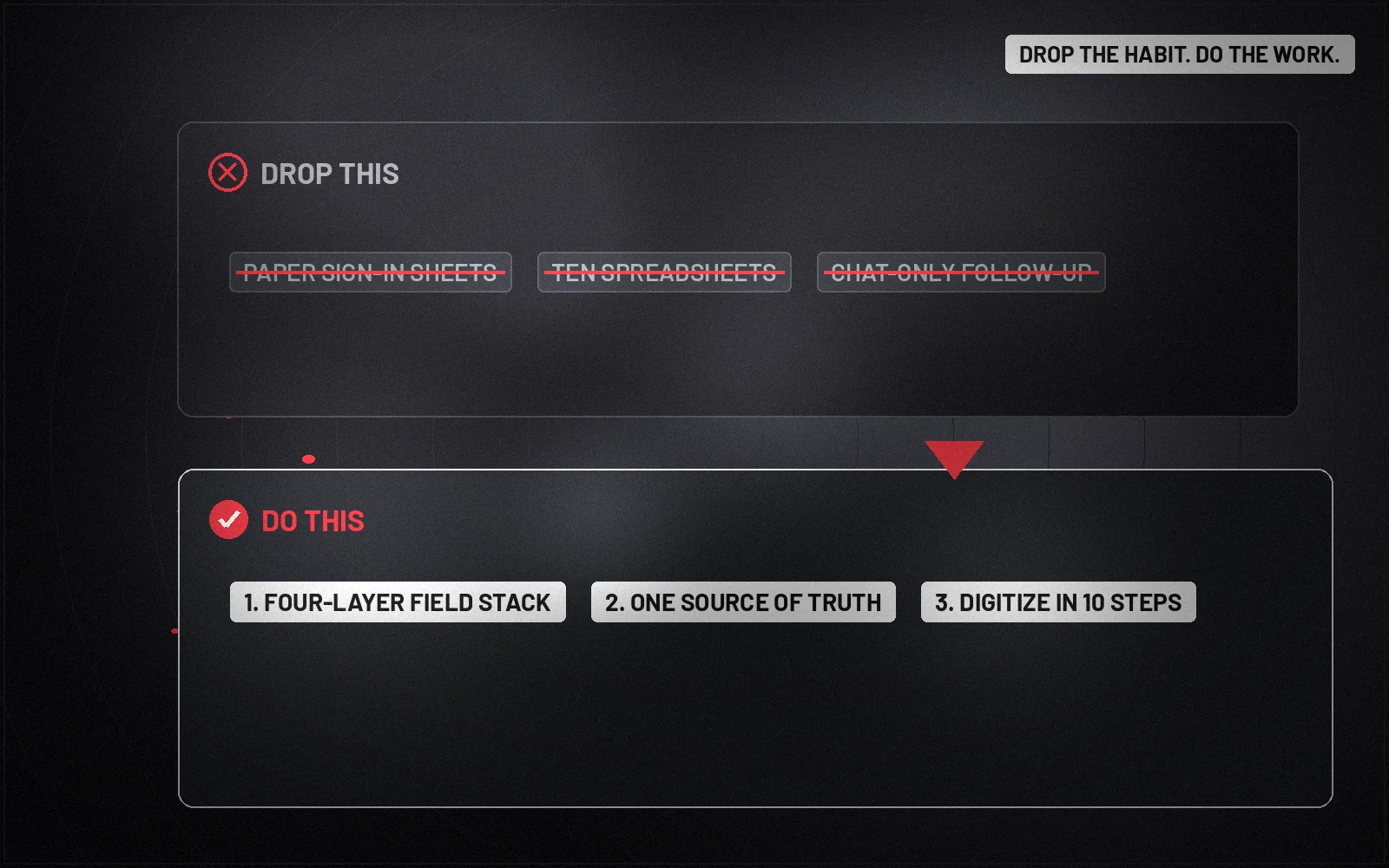
If any of those four live in a different chat thread every week, you do not have a system. You have nostalgia.
The four-layer field stack that survives monsoon season
Run this stack whether you use Google Workspace, a lightweight CRM, or a custom sheet. Tools matter less than ownership and cadence.
Layer 1 — Intake that sorts, not flatters
Capture what HQ needs to deploy, not what looks nice on a volunteer dashboard.
- Role: canvass, phone, logistics, content, legal watch.
- Geography: city / district / barangay preference.
- Language: Tagalog, Cebuano, Ilocano, English mix.
- Constraints: nights only, Sundays only, no motorcycle.
- Risk notes: public face vs quiet support.
Tag validators separately from door knockers. Mixing them creates both brand risk and wasted talent.
Layer 2 — Turf that updates when reality updates
Static PDF maps fail the first time rain cancels half a shift.
Use a living turf board:
- Precinct / sitio / street segments with status: open, partial, done, hostile, revisit.
- Owner per segment for the week—not “the youth wing.”
- Hard stop times so teams do not freestyle after dark without a check-in.
Progressive campaigns often under-index hostile revisit segments. Those doors still vote. Digitize the objection type so messaging can answer it next week.
Layer 3 — Message cards, not speech karaoke
Volunteers do not need your full stump. They need a shift card:
- One sentence on why this week matters.
- Two proof points locals already believe.
- One ask (register, attend, refer, donate micro).
- One bridge line for the most common objection.
Update cards weekly. Archive old ones. If yesterday’s card still circulates in a random group, your digitization failed at version control.
Layer 4 — Debrief that closes before rumor opens
The evening debrief is the product.
Require the same five fields every night:
- Doors / contacts attempted vs completed
- Top three objections heard (verbatim phrases)
- Any rumor or opponent line that showed up
- Materials that worked / failed
- Tomorrow’s constraint (weather, transport, security)
HQ should publish a one-screen morning brief from that data. Volunteers who see their notes change tomorrow’s plan keep reporting. Volunteers who shout into a void stop typing.
Operator checklist: digitize in 10 working days
You do not need a six-month transformation. You need a controlled cutover.
Days 1–2 — Inventory the mess
- List every sheet, chat, and paper form still “official.”
- Kill duplicates. Name one source of truth per layer.
Days 3–5 — Build the thin stack
- Intake form live.
- Turf board live for one pilot city.
- Message card template locked with counsel / message lead.
- Debrief form with required fields.
Days 6–8 — Pilot with one coordinator
- Run real shifts, not a training theater.
- Fix friction that causes people to abandon the form mid-door.
Days 9–10 — Scale with training that respects prepaid data
- Teach the stack in 20 minutes, not a webinar epic.
- Provide offline PDF fallback for dead signal areas—then sync at the end of shift.
Metrics that prove the system works
Track four numbers weekly:
- Coverage integrity — % of assigned segments with a logged outcome
- Message fidelity — mystery shopper checks vs card (sample, not surveillance theater)
- Objection latency — hours from field phrase to HQ message update
- Volunteer retention after week 2 — the real digitization ROI
Vanity totals (“10,000 doors”) without coverage integrity are press release math.
Common failure modes progressive teams repeat
Buying a CRM before naming owners. Software does not invent a night debrief culture.
Over-collecting PII. Field digitization is not a surveillance product. Collect what you need for ops and compliance—then protect it.
Letting every barangay invent its own sheet. Local flavor belongs in language and proof points, not in data schema.
Ignoring transport and safety constraints in the data model. If your board cannot mark “unsafe after 7 p.m.,” volunteers will invent unofficial workarounds—and you will not see them until something breaks.
What Neuwark expects from a serious field build
We design field ops as communications infrastructure. Message discipline, paid media, and volunteer canvass should share the same objection language and the same weekly truth.
If your digital ads promise one reality and your door teams apologize for another, you are funding cognitive dissonance. Digitize so the argument travels intact from HQ to street—and the street’s objections travel back before the algorithm or the opponent does.
Closing move
Start with one city, one coordinator, four layers, ten days.
Publish the morning brief. Protect the data. Retire the spreadsheet cult.
That is field volunteer ops digitization that makes money for progressive campaigns the only way that matters: turnout and trust you can prove.