
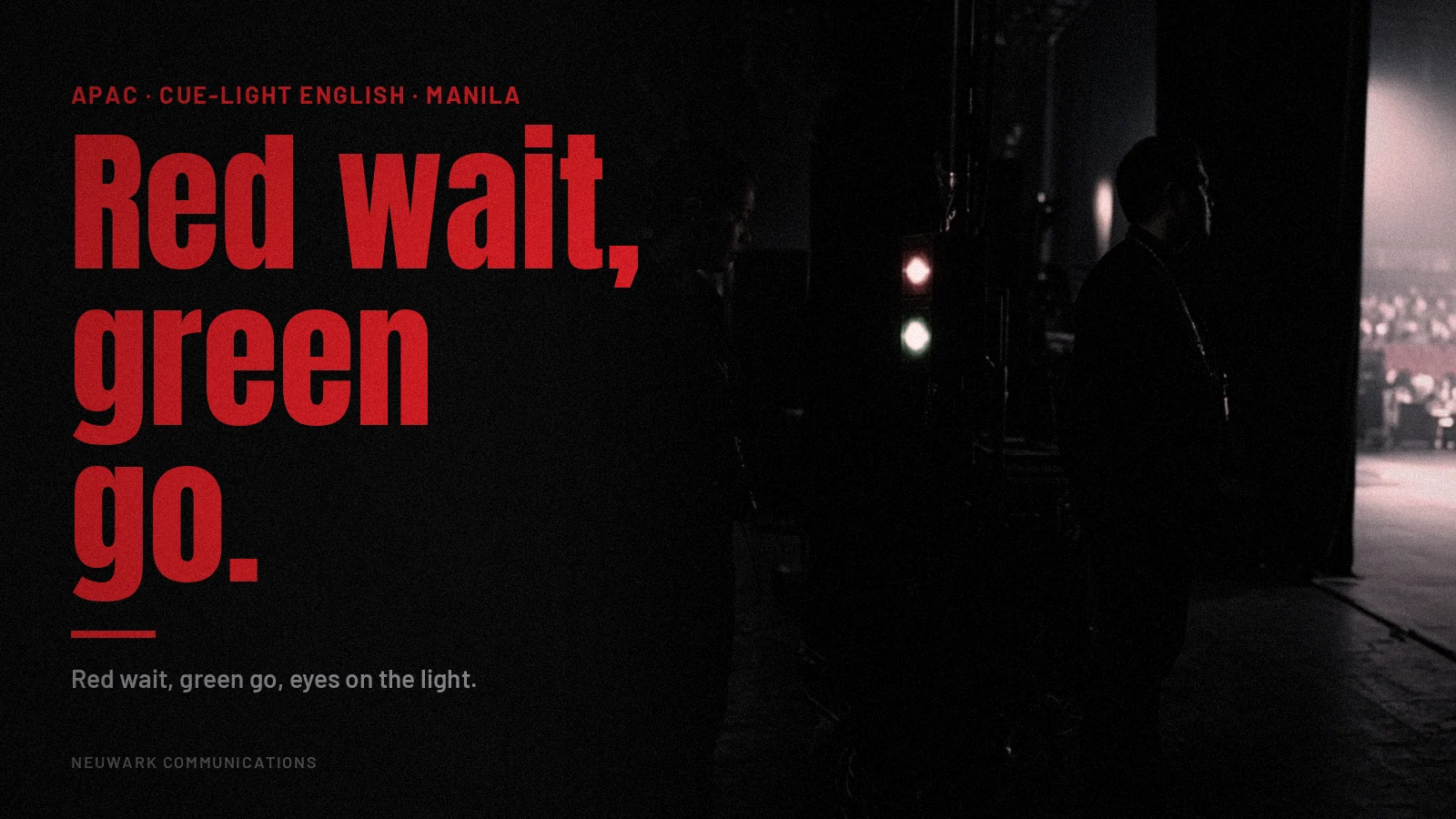
Cue-light line English APAC is the stage manager’s short light rule at the lectern or wings: red wait, green go, eyes on the light.
Street-smart APAC English: short sentences a tired operator can say out loud.
A Bangkok convention stage, one minute to a panel open.
The chair watches the emcee instead of the cue light.
Green flashes unseen, and the open lands four seconds late.
Quick answer: A cue-light line English APAC is the stage manager’s light rule: red wait, green go, eyes on the light. Brief it before every walk-up, so talent moves on the light, not on a guess.
Pair it with the standby-cue line English APAC on headset and the runner-radio line English APAC for floor runners off the light. Good event language at the cue light keeps every walk-up on time without a shout from the wings.
What goes in a cue-light line English APAC?
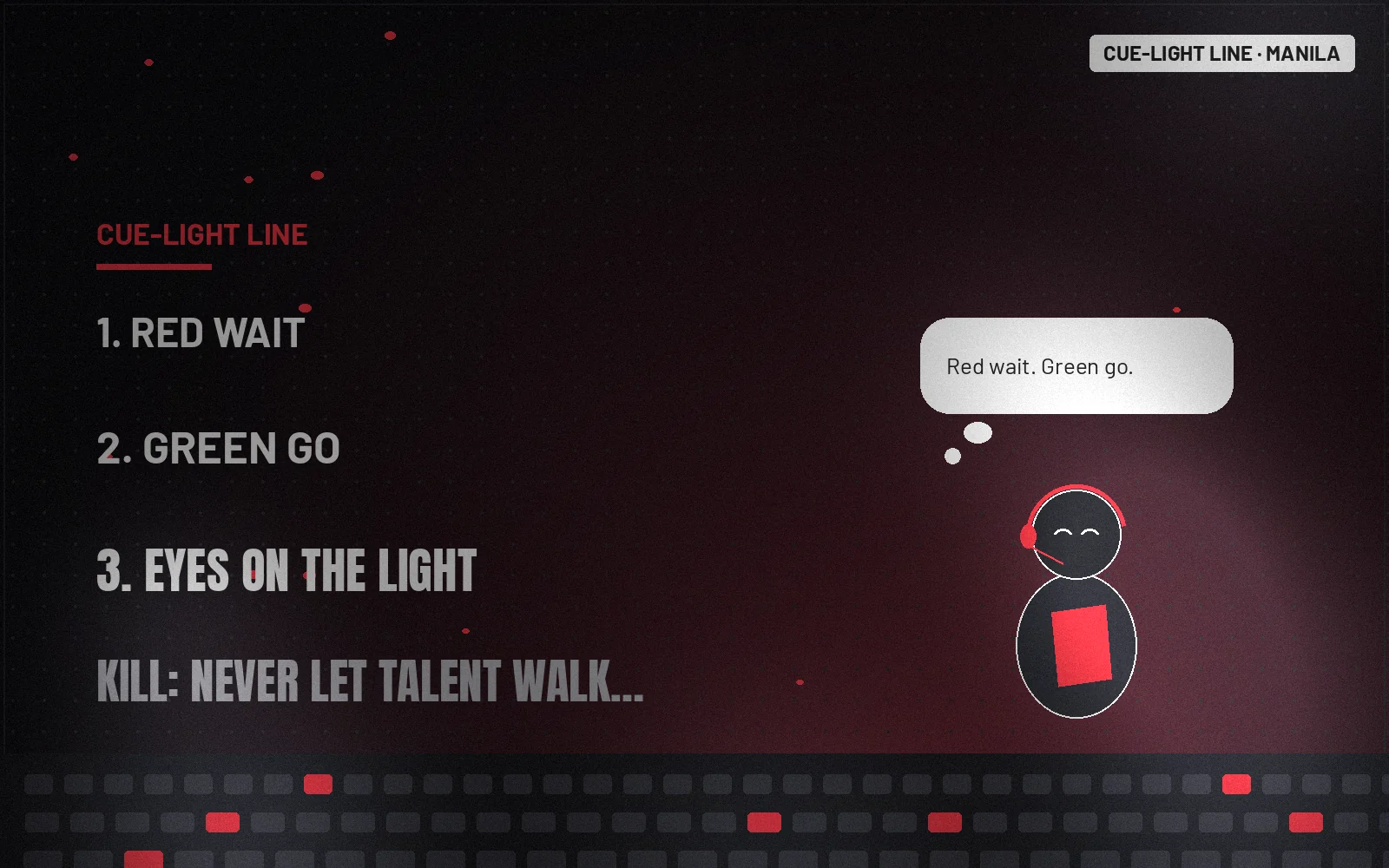
Three parts. Red wait, green go, eyes on the light.
Cue-light line (illustrative):
“Red means wait; do not step yet.”
“Green means go; take your walk now.”
“Keep your eyes on the light, not on the room.”
Speakable lock (illustrative): “Red wait, green go, keep your eyes on the light.”
Eyes on the light matters most. Talent who watches the crowd or the emcee misses the green flash, and a late walk throws the whole open off the clock.
What should stage managers stop saying about the cue light?
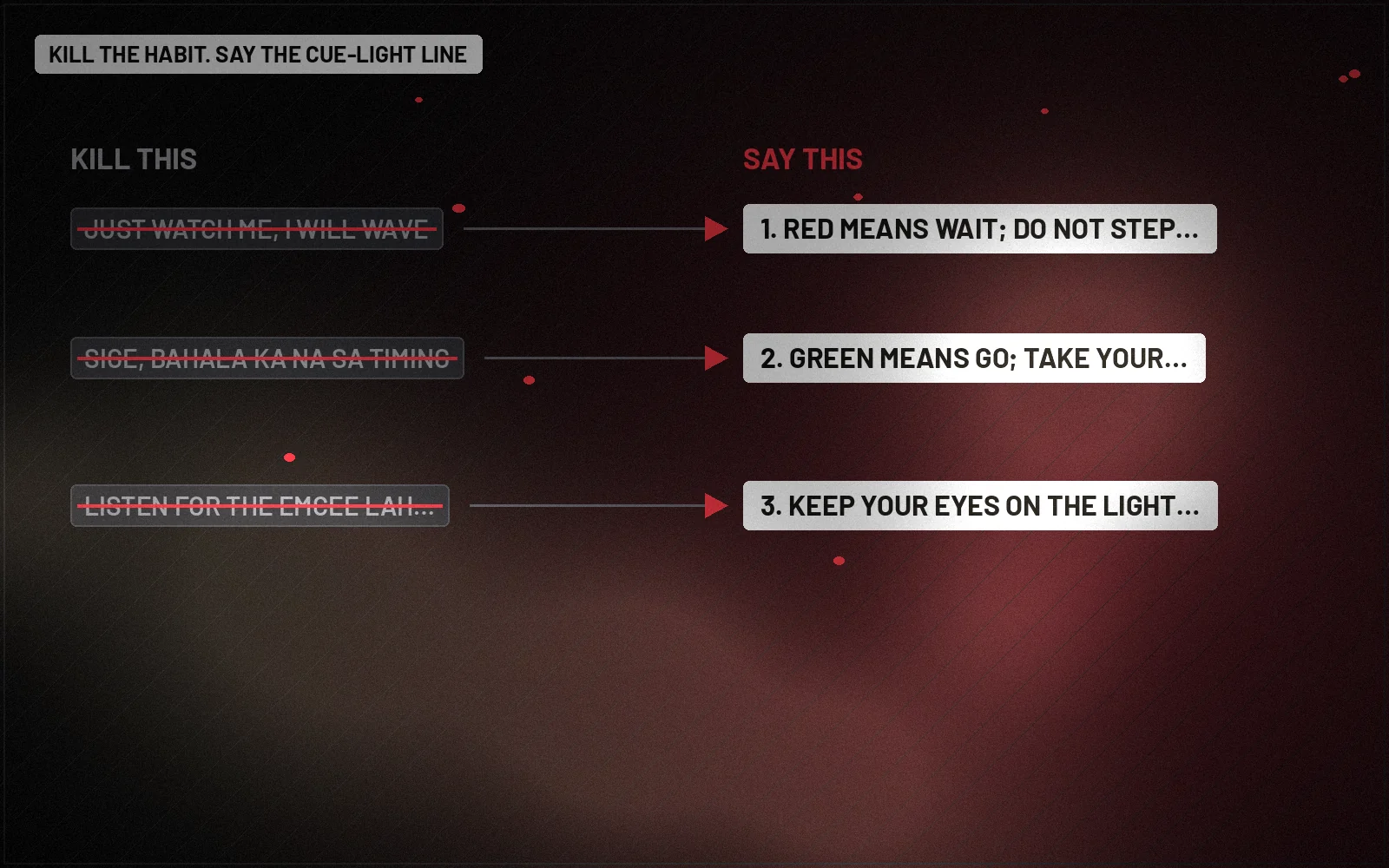
Stop saying just watch me and start naming red and green. Watch me fails when the stage manager is on headset facing away. Point to the light, say red wait and green go once, and confirm the talent’s eyes are on it before standby.
| Kill this | Say this (illustrative) | Why |
|---|---|---|
| Just watch me, I will wave. | Red means wait; do not step yet. | Red is wait |
| Sige, bahala ka na sa timing. | Green means go; take your walk now. | Green is go |
| Listen for the emcee lah, then walk. | Keep your eyes on the light, not on the room. | Eyes on light |
| Ay, kung feeling mo ready, go na. | Wait on red until green; no early steps. | No early steps |
| Light also can ignore if you hear go. | The light is the cue; ignore hallway noise. | Light wins |
Lines in this table are illustrative, not quotes from real people.
Where should the cue light sit for speakers?
In the talent’s natural sightline at the lectern or wing mark, never behind them. Test it at rehearsal from the exact stand mark with the stage wash on. If the light is too high, washed out or hidden by a monitor, move it before doors, not mid-show. Brief the same red-wait and green-go words every time a new speaker arrives at the mark.
What if talent still misses the green?
Hold the next cue, flash green again, and brief once more at the next break. Do not shout go from the wings over a live mic. If misses repeat, add a standby on headset for that person only, and keep the light as the public cue.
How does this play out on PH, SG and Jakarta desks?
Same three parts. Different desks.
Philippines desk. In Manila and across the Philippines, guest speakers may be new to cue lights. Brief with po: red wait po, green go po, eyes on the light po. Show the light at rehearsal and let them watch one full red-to-green cycle before the show. Keep a spare cue light taped at the desk in case the primary fails.
Singapore desk. In Singapore, cue lights are standard on corporate stages. Keep the line in plain English, confirm sightlines at rehearsal, and never replace the light with a shouted go once the room is live.
Jakarta desk. In Jakarta, open the brief with Bapak dan Ibu, then the same three beats in English and Bahasa Indonesia. Place a small duplicate light at the wing mark for guests who enter from stage left.
Monday field kit
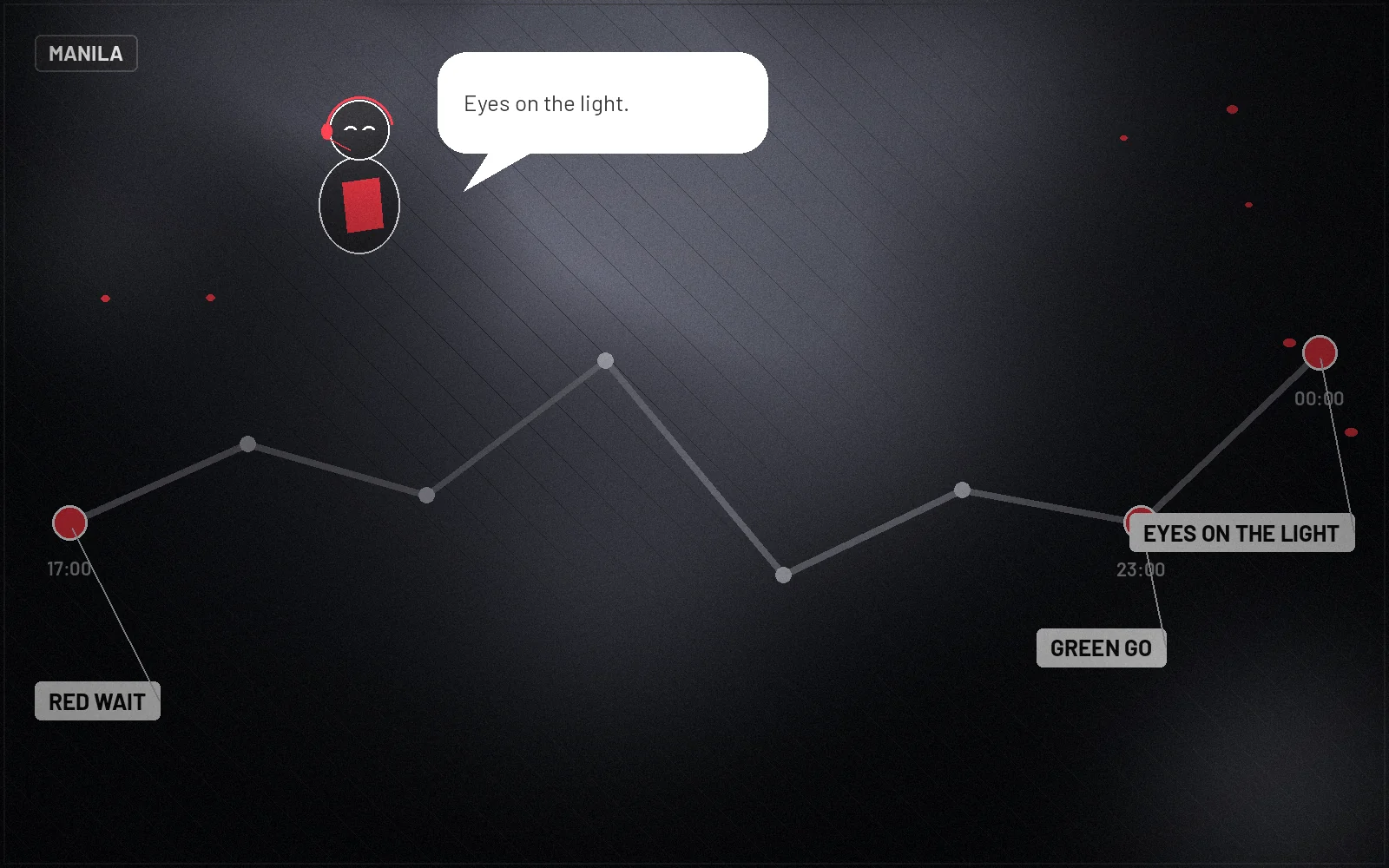
- Red wait, green go, eyes on the light.
- Cue light tested from the exact stand mark.
- Brief said once at arrival and once at standby.
- No shouted go over a live mic.
- Kill rule: never let talent walk on a guess while the light is red.
FAQs
What is a cue-light line English APAC?
A cue-light line English APAC is the stage manager’s light rule: red wait, green go, eyes on the light. Every speaker hears the same words.
How do you brief talent on a stage cue light?
Point to the light, say red means wait and green means go, and confirm their eyes stay on it. Test the sightline at rehearsal.
Why use a cue light instead of a hand wave?
A hand wave fails when the stage manager faces away on headset. A light in the sightline is the cue talent can always see.
Neuwark Communications builds event and campaign communications as part of our strategy and messaging work. More street-smart lines live in Insights.
Related: standby-cue line English APAC · runner-radio line English APAC
Talk to us about your next event script.
Illustrative lines only. Communications craft, not legal advice.