
As of September 7–8, 2026, Philippine headlines are doing what monsoon season always does to bad news: amplifying it until the waterline and the trust line look like the same graph. Reporting from outlets including Reuters, Philstar, and other major desks has framed a fast sequence—Office of the Ombudsman filing a roughly P7.44-billion plunder case tied to alleged kickbacks from flood-control and related projects; Sandiganbayan finding probable cause and issuing arrest warrants; former House Speaker Martin Romualdez (cousin of President Ferdinand Marcos Jr.) served while hospitalized. Marcos has publicly positioned himself as unwilling to spare relatives in the anti-corruption push. Romualdez, per reporting, has denied wrongdoing. Monsoon flooding has sharpened public anger over alleged flood-control irregularities.
This piece is not a verdict. Courts decide guilt. Communications decides whether institutions still have a voice when the public has already decided the weather is a metaphor.
If you were the crisis communications lead—for Malacañang, for the accused’s camp, or for a contractor/institution caught in the blast radius—what do you actually do in the first 72 hours?
Hour zero is not a press release. It is a control room.
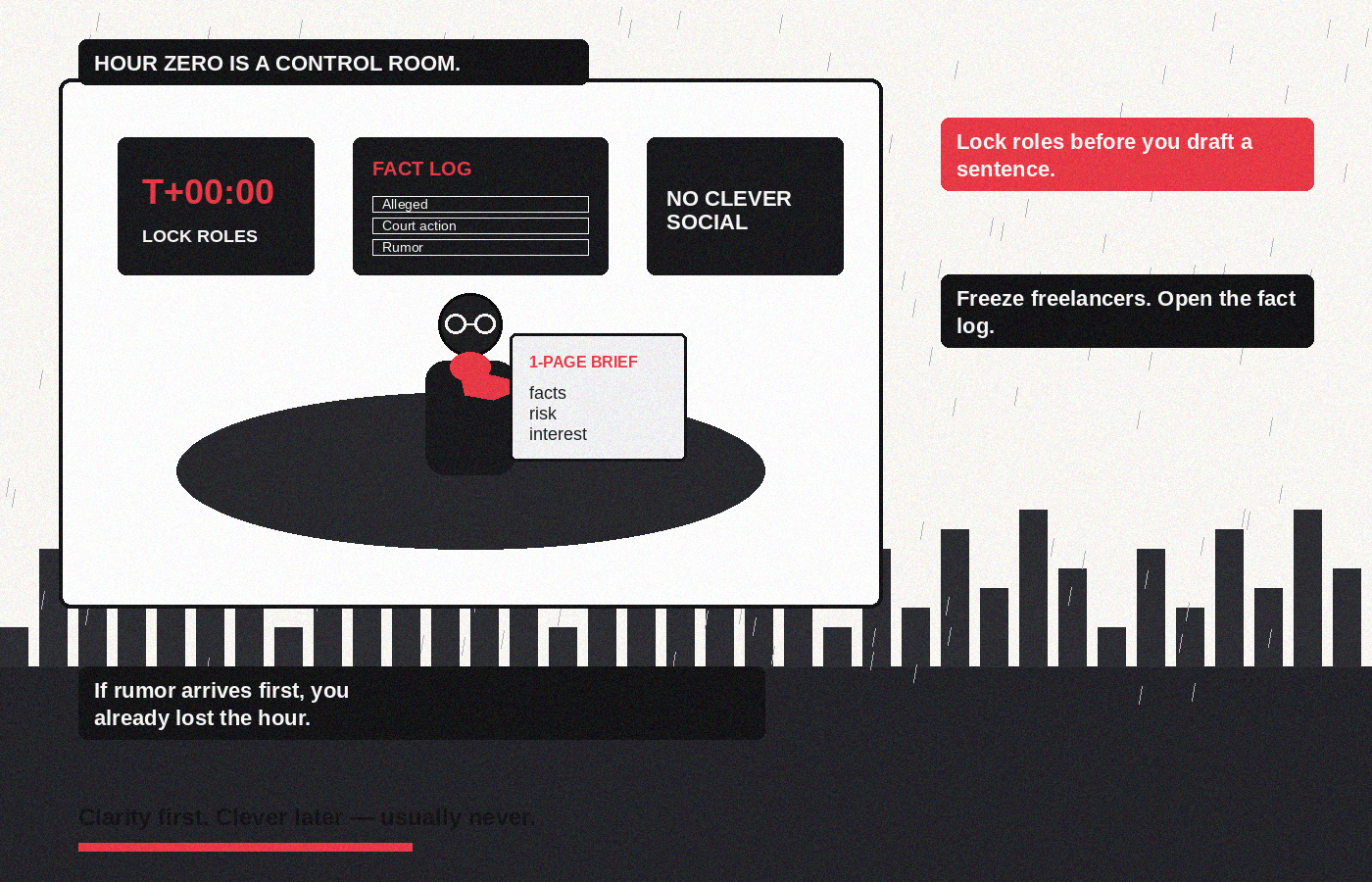
Most teams lose the first day by drafting language before they lock roles. Operator rule: no sentence leaves the building until three things exist on one page—incident facts as reported (with sources), open legal risk (what you must not say), and the single institutional interest you are protecting (due process, continuity of government, employee safety, market confidence, community trust). Confuse those and you invent a fourth crisis: your own.
In Philippine political crisis communications, the information environment is brutal. Facebook comment storms, vernacular radio, diaspora WhatsApp, and rival camps’ rapid-response desks all move faster than a clearance chain. Flood imagery does not wait for your lawyer. Neither does a hospital-bed arrest visual.
The 72-hour spine (use it or get used)
Hours 0–6 — Stabilize the machine.
- Name a crisis chair with authority to kill freelancing surrogates.
- Open a fact log: what is alleged, what is court action, what is medical/procedural, what is rumor. Attribute everything.
- Freeze all “clever” social. Clever dies under floodwater.
- Brief internal audiences first—staff, boards, regional offices—so they do not learn their employer’s position from TikTok.
Hours 6–24 — Choose a frame you can defend under oath and under rain.
- Palace/institution frame (illustrative, not prescribed): accountability through process, not theater; no relative above evidence.
- Accused-camp frame (illustrative): due process, presumption of innocence, medical dignity, challenge the case in court—not on primetime.
- Blast-radius contractor/agency frame (illustrative): separate the firm from the allegation; cooperate with lawful inquiry; protect workers and ongoing flood-mitigation work that communities still need.
Notice what those frames refuse: victory laps, victim cosplay, and “moving on” language while neighborhoods are still underwater.
Hours 24–72 — Publish proof of behavior, not volume of adjectives. Trust recovers when people see actions that match the sentence: document holds, independent review, personnel holds, community briefings, clear channels for whistleblowers, timelines for updates. Words without behavior become fuel.
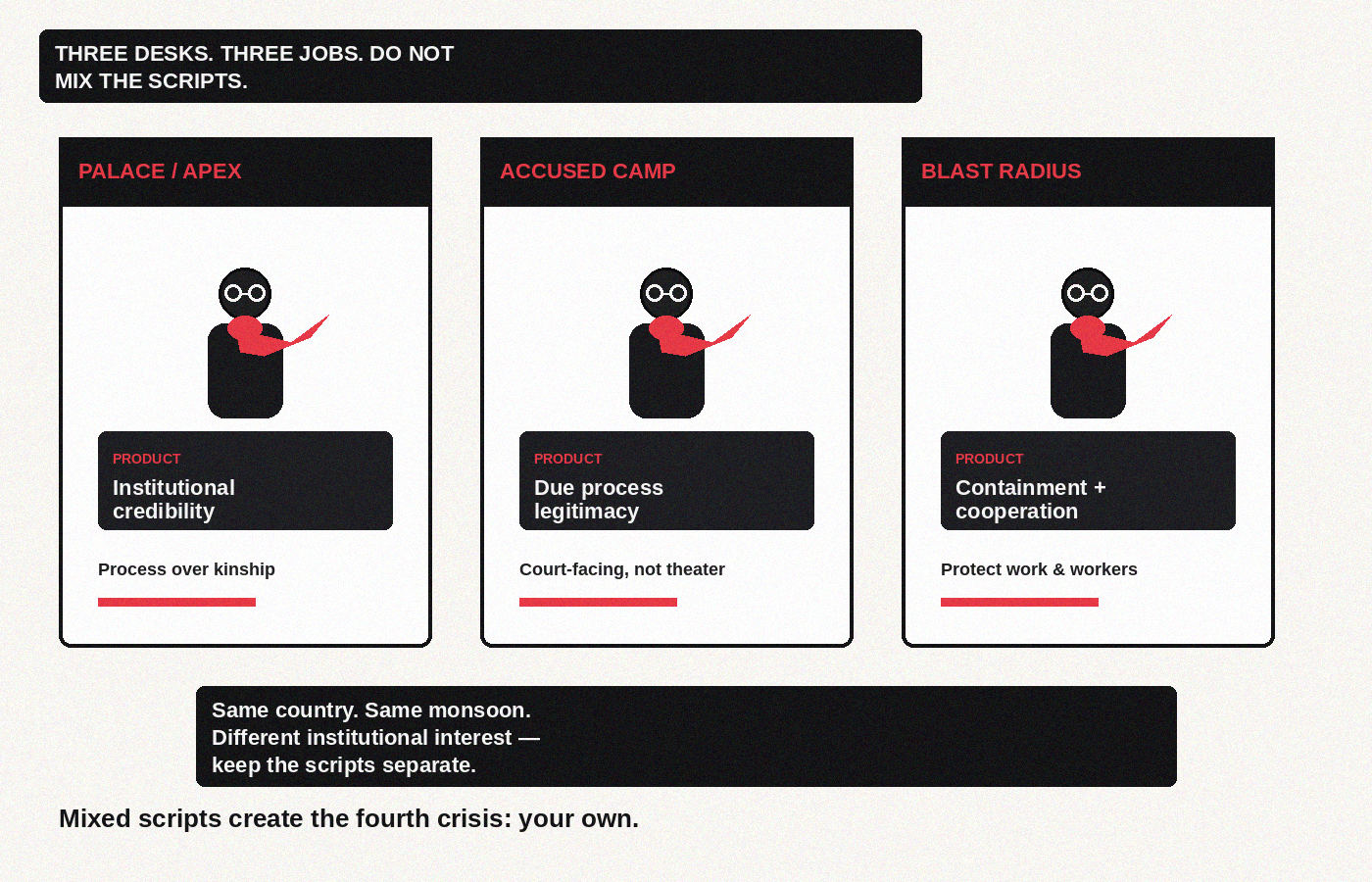
Three desks, three jobs—do not mix the scripts
If you sit near Malacañang (or any apex executive brand)
Your product is institutional credibility, not kinship management. The public already knows the cousin relationship; Reuters and local coverage have made that unavoidable framing. Your job is to make process feel real: evidence-led, even-handed, and consistent with prior anti-corruption vows attributed to the President. Inconsistency is the story. Consistency is the only available armor.
Operationally: one spokesperson cadence, no competing Cabinet freelancers, no “background” quotes that contradict the podium. If resignation or leave protocols apply to adjacent officials, communicate them as governance hygiene—not as sacrifice theater.
If you sit with the accused’s camp
Your product is due process legitimacy without sounding like you are asking the country to forget flooded streets. Deny carefully, if that is the legal posture; do not invent alternative facts. Per reporting, counsel has emphasized facing allegations in court and seeking fair process—not special treatment. That is the right register: sober, specific, court-facing. Hospital optics require human dignity language without turning illness into a shield narrative the public will punish.
Operationally: lock social accounts, script family spokespeople, prepare for non-bailable realities as reported under plunder rules, and build a Q&A that survives hostile edits. Never fight the monsoon. Fight for a fair hearing.
If you are a contractor, bank, LGU partner, or agency in the blast radius
Your product is containment with cooperation. Markets and communities punish silence almost as hard as they punish guilt-by-association. Say what you know, what you do not know, and what you are doing next. Suspend triumphal project PR. Publish a clean timeline of contracts under review as applicable. Protect employees from rumor-driven harassment. Offer a single tip line to counsel/compliance—not a marketing email.
SEO truth that operators already feel: search demand spikes for “flood control scandal,” “institutional trust,” and “crisis communications Philippines” precisely when you wish it would not. Own the explanatory page before rumor sites own it for you.
Channel discipline when the country is underwater
The first 72 hours are a channel problem as much as a message problem. Television wants a face. Radio wants a sentence that fits between traffic and weather. Facebook wants a clip that survives mute. Barangay networks want someone who will show up without a camera crew. If your crisis desk only writes for English broadsheets, you are speaking to a minority of the anger.
Build a density ladder from the same spine: 15-second vertical for feeds, 90-second explainers for community pages, one-page FAQ for staff and partners, and a longer statement for formal desks. Same frame. Different compression. That is how Philippines political crisis communications stays coherent without sounding cloned.
Also schedule silence. Not every hour needs a post. A timed update cadence—“next briefing at 4 p.m.”—beats a panic drip of half-answers. When flood-control scandal messaging meets monsoon coverage, the audience is already saturated. Your advantage is clarity, not volume.
Messaging traps that look smart and fail in 48 hours
1. “This is politics.” Sometimes it is. Saying so never drains water from a living room. 2. Over-legalizing the first statement. The public hears “we are hiding.” Pair legal caution with human clarity. 3. Sympathy contests. Flood victims set the emotional ceiling. Do not compete with them. 4. Surrogate chaos. One uncle on radio can erase three days of disciplined copy. 5. Premature redemption arcs. You have not earned a “we learned” chapter in week one. 6. Visual denial. If the country is watching flood footage, your sterile boardroom b-roll looks like another country.
A practical message hierarchy for institutional trust
- Frame: Public works integrity is non-negotiable when climate risk is lived experience.
- Proof: Document holds, independent review steps, personnel actions, community updates—dated and checkable.
- Ask: Give the process time and give the public receipts on a schedule you announce.
That hierarchy travels from English briefings to Tagalog explainers without becoming two different campaigns. In Philippines political crisis communications, vernacular coherence is not a nice-to-have; it is the difference between “statement” and “heard.”
What “good” looks like by hour 72
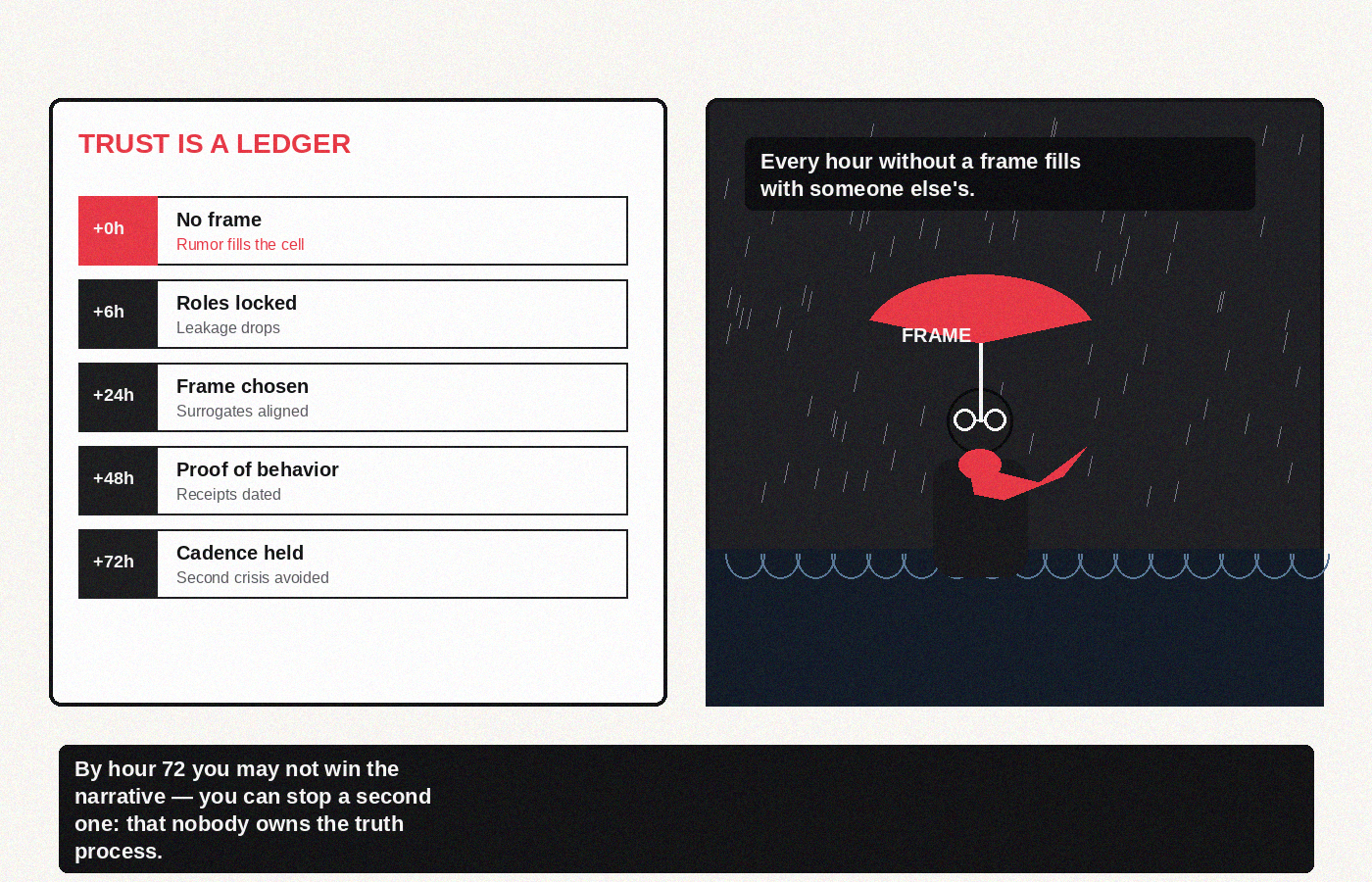
You will not have won the narrative. You may have prevented a second narrative: that nobody is in charge of the truth process. Success metrics for the first three days are ugly and useful:
- Internal leakage down; one external voice up.
- Corrections issued faster than rumors mutate.
- No contradiction between legal filings posture and public lines.
- Stakeholders (investors, LGUs, staff, partners) can repeat your frame in one breath.
- Flood-affected communities see relevant action language—drainage, relief coordination, project audits—not only courtroom theater.
Crisis communications here is flood-control scandal messaging with adult constraints: alleged amounts (reported around P7.44 billion), court instruments, medical settings, and a president’s prior vow not to spare relatives. Attribute carefully. Invent nothing. The country is fluent in both rainfall and rhetoric.
Build the room before the water finds the room.
Neuwark Communications works operator-level crisis, political, and institutional trust programs across the Philippines and APAC—message systems, rapid-response discipline, and public narratives that hold when the cycle turns hostile. If your organization is one rumor away from becoming the next case study, start the conversation before the warrant or the weather writes it for you.
[Start a conversation →](https://neuwarkcommunications.com/contact)