Advocacy film dies twice: once when the argument is weak, and again when the faces feel rented. You know the second death. Softbox smiles. “Diverse” extras who share no weather with the story. A fisherman who has clearly never handled that net. A nurse speaking English cadence that belongs to a brand announcer. Progressive campaigns in the Philippines and across APAC do not lose trust only because opponents attack. They lose it when communities watch themselves get cosplayed.
Neuwark Communications makes cinematic work for political and public-interest stages where belief must feel earned. Casting is not a nice-to-have. Casting is message strategy with a pulse. Authenticity on camera is a production system: who you invite, how you consent, how you direct, how you cut, and how you refuse the bank-ad reflex to make everyone aspirationally smooth.
Aspirational casting is how public-interest work becomes a bank ad
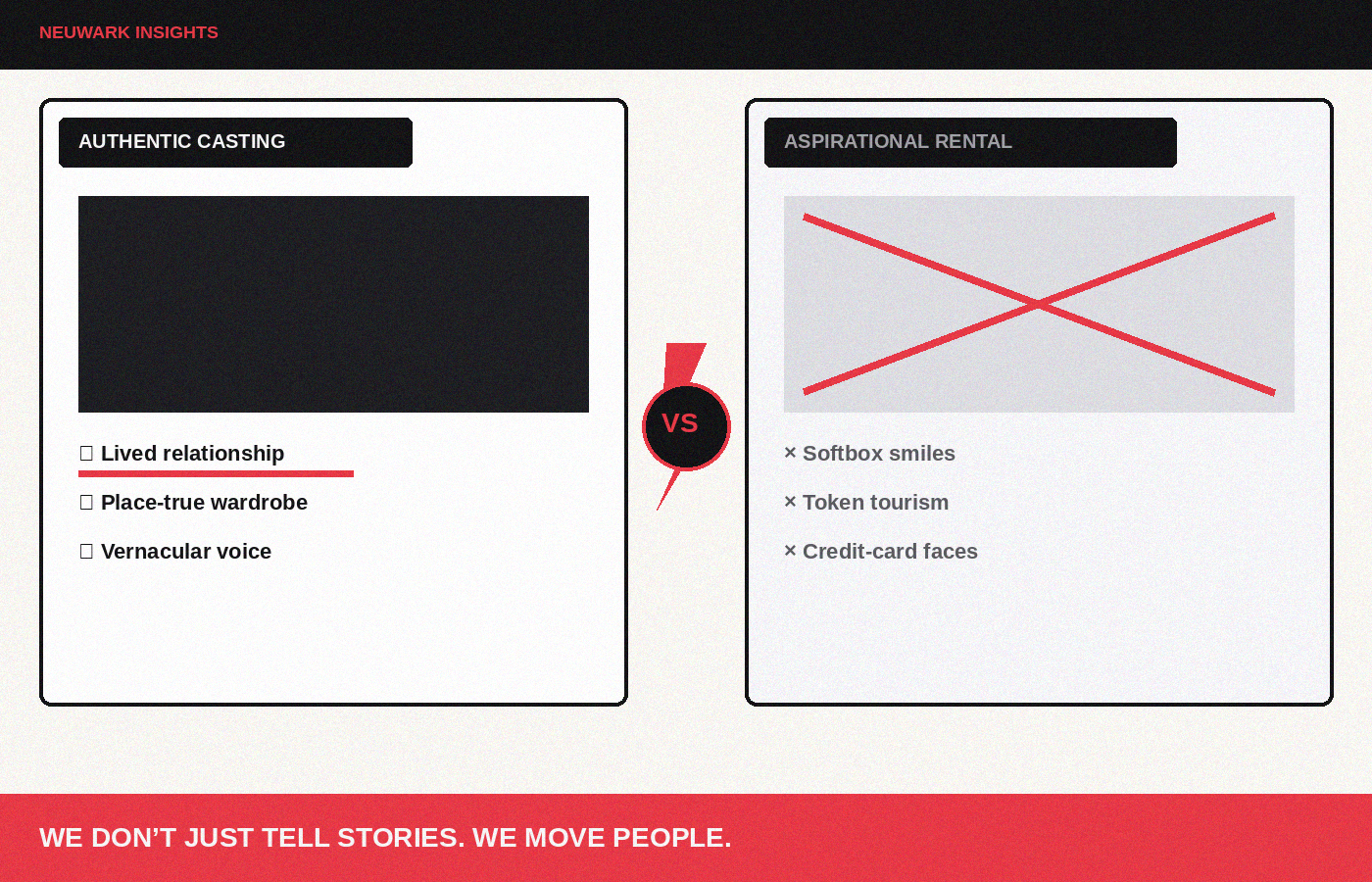
Bank ads cast upward mobility and frictionless belonging. They need faces that reassure shareholders and daydreamers. Advocacy often needs faces that carry consequence: workers after a shift, parents in a waiting room, organizers with tired eyes, elders who have watched the same promise recycle. When you cast “aspirational” by default, you accidentally adopt the bank’s moral universe—even if your script says justice.
In PH contexts, the mismatch is especially audible. Metro polish dropped onto provincial stories reads as Manila-centric tourism. Token Visayan or Mindanao representation without local direction and vernacular respect reads as extraction. Diaspora-only casting for a domestic accountability fight can feel like commentary from nowhere. Across APAC, the same pattern repeats whenever global template aesthetics overwrite local class and place.
Operator rule: if the person on screen could sell a credit card with the logo swapped, you are not casting advocacy—you are renting reassurance.
Authenticity is not “non-actor = automatic truth”
Non-actors can be extraordinary. Non-actors can also be unsafe, under-directed, or pushed into trauma performance for a crew’s tears. Authenticity is not amateurism. Authenticity is credibility under craft:
- People with real relationship to the claim being made.
- Direction that protects dignity and specificity.
- Hair, wardrobe, and locations that belong to the world—not a stylist’s Pinterest board of “poverty texture.”
- Language that matches how people actually speak—including code-switching—without mocking accent or forcing “global” English.
- Consent that remains real after the camera is gone.
Hiring trained actors is not betrayal. Hiring actors to fake a community’s weather without community partnership often is.
The casting system: roles, ethics, and logistics
Treat casting like field organizing.
1. Define the moral subject. Who does this story owe accuracy to? Name the community before you name the aesthetic.
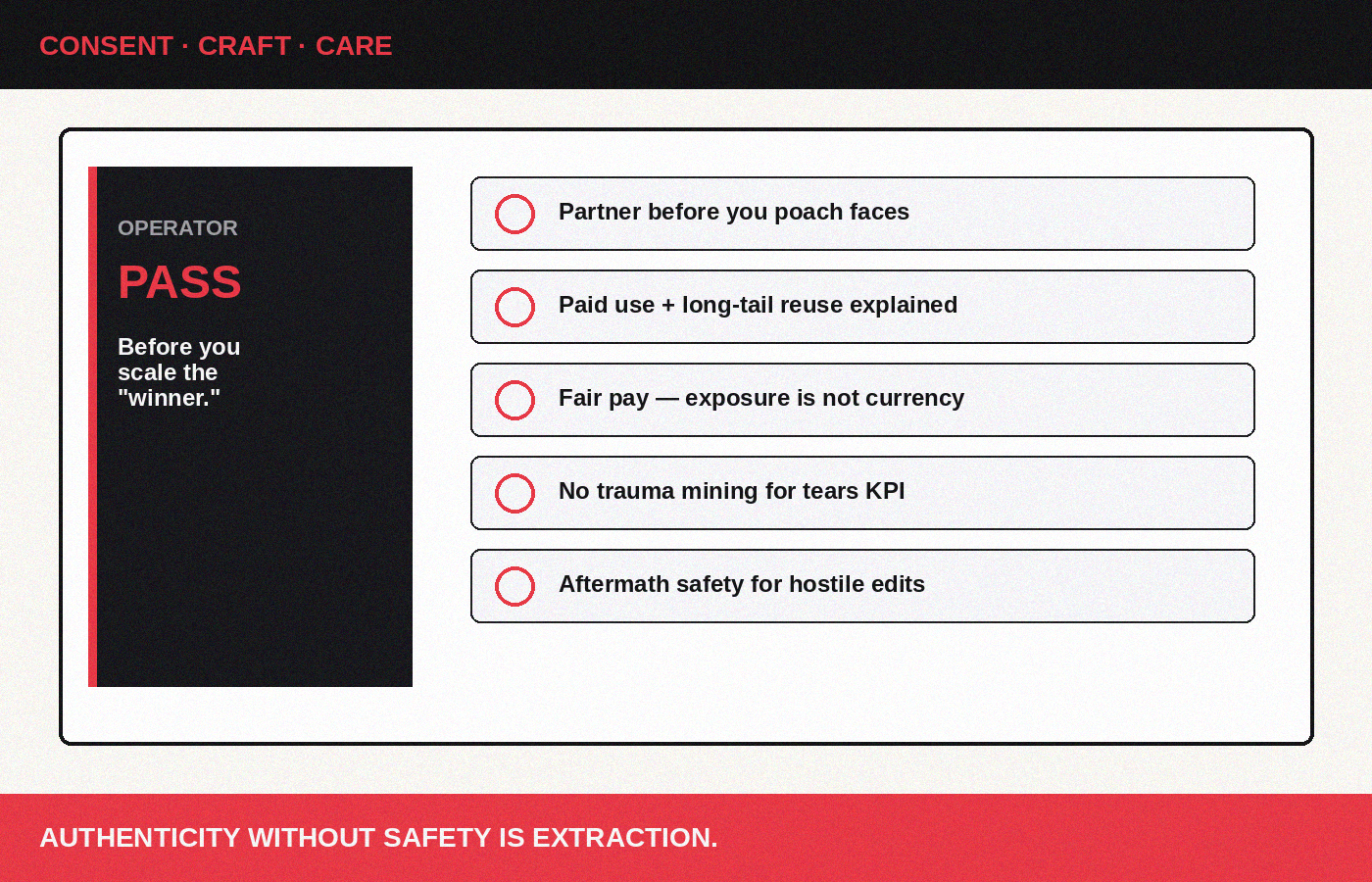
2. Partner before you poach. Work with local organizers, unions, clinics, campus groups, barangay leaders, or professional associations to invite participants—not to “find faces.”
3. Consent as process. Explain use cases (paid, organic, long-tail web). Allow withdrawal paths where feasible. Pay fairly. Do not confuse exposure with compensation. In disaster or graft narratives, be doubly careful about retraumatization and legal risk.
4. Cast for micro-truth. Hands, gait, silence, laughter timing, how someone holds a document—these read on mobile more than theatrical weeping.
5. Avoid trauma mining. Do not require people to re-perform their worst day for “authenticity.” Often the stronger frame is aftermath, labor, waiting, resolve.
6. Surrogate and validator casting. Experts and community leaders should sound like themselves, not like a binder. Mic technique helps; personality erasure does not.
Directing for stillness (and why tears are not the KPI)
Over-direction creates bank-ad faces: chin up, eyes misty, smile through hardship. Try a different discipline.
- Prefer questions over line-reads when working with non-actors; let answers find natural rhythm.
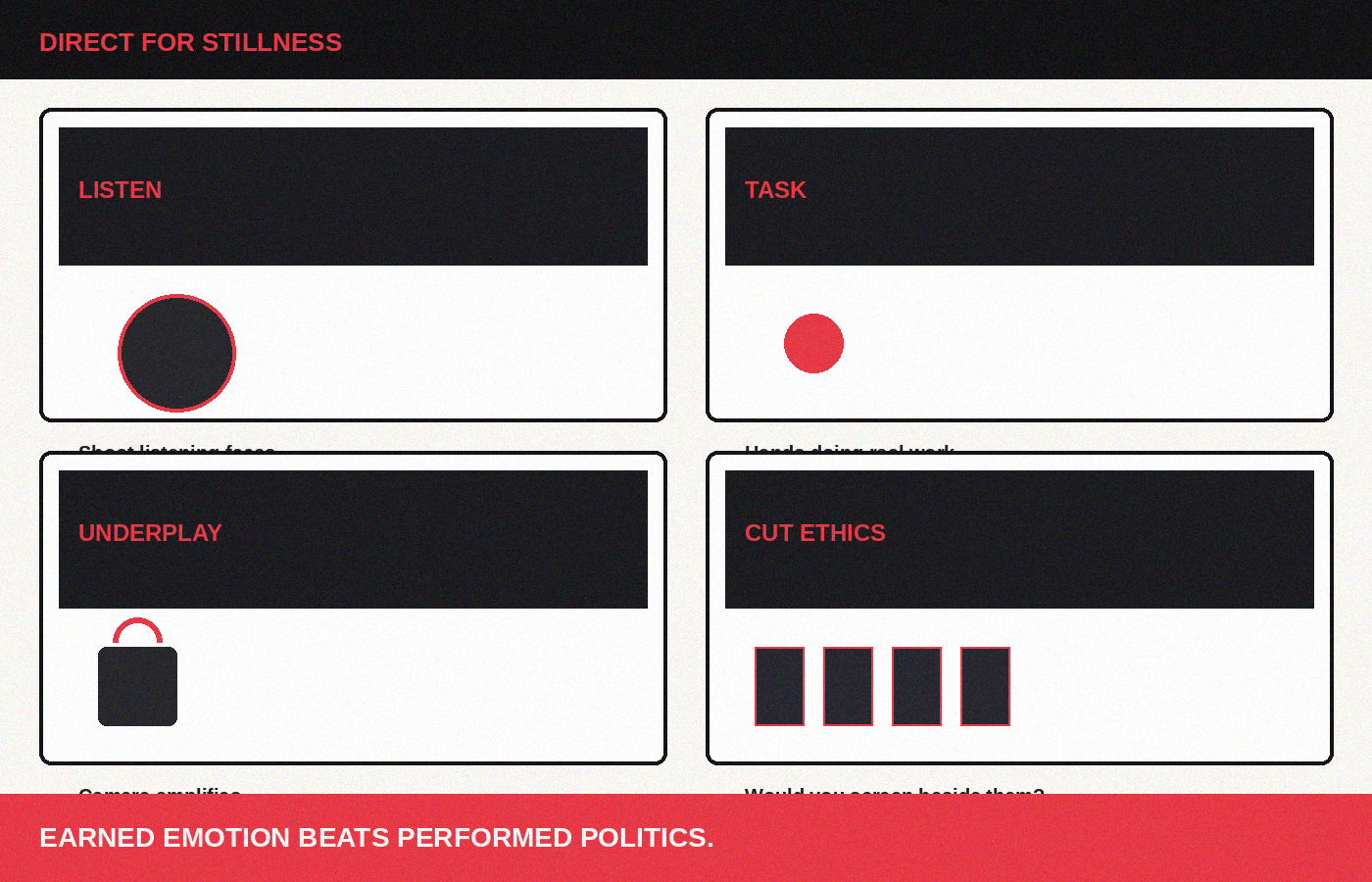
- Shoot listening, not only speaking. Listening faces carry democratic attention.
- Protect silence. Ambient truth often outperforms score-led emotion.
- Direct eyes and hands more than speeches. Specific tasks (counting, repairing, signing, waiting) generate honest behavior.
- For trained actors, ask for underplaying. Camera intimacy amplifies; theatrical grief reads as politics-as-telenovela to saturated audiences.
In the edit, refuse the cut that embarrasses the subject for the audience’s catharsis. If you would not screen it sitting beside them, it does not belong in a progressive film.
Craft choices that support authentic casting
Casting fails in post as often as it fails on set.
- Light motivated by place. Sodium, fluorescent, window, overcast monsoon—not beauty softboxes that turn every clinic into a clinic-branded spa.
- Wardrobe continuity with class truth. Clean does not mean rich; dirty does not mean authentic. Avoid costume poverty.
- Sound that keeps vernacular texture. Do not “fix” speech into broadcast anonymity if the point is lived voice.
- Stills and motion aligned. The face you boost in paid should be the same moral subject the long cut earned—not a prettier cousin from a stock library.
- Coalition kits. Shared do/don’t casting references so partners do not invent conflicting human brands.
What authenticity looks like in Philippine and regional practice
A nurse interviewed in the break room she actually uses, not a rented ward dressed as “healthcare.” A fisher speaking in the register of their coast, with subtitles serving access rather than replacing voice. An organizer filmed after a real meeting, sweat and all, without a makeup pass that erases labor. A validator who disagrees with your favorite line and still supports the frame—because real coalitions contain texture. These choices cost more in coordination than in equipment. They repay you in trust when opponents try to dismiss the film as Manila theater or NGO tourism.
Also plan for aftermath care: how clips are used in attack-response, whether faces appear in hostile edits, whether minors are excluded, whether locations that could invite harassment are anonymized. Authenticity without safety is just another extraction pipeline with better lighting.
A pre-flight authenticity checklist
Before lock:
1. Would the community depicted recognize this as their world? 2. Did participants understand paid amplification and long-tail reuse? 3. Is anyone on screen being asked to represent a whole identity they did not claim? 4. Does the performance ask for tears more than understanding? 5. If we muted music and removed lower-thirds, do we still believe them?
Fail (1) or (2) and you are not ready to spend—no matter how cinematic the grade. Authenticity is not a filter called “real.” It is a chain of choices that keeps dignity attached to persuasion.
Progressive film should move culture forward without treating people as props in someone else’s moral brochure. Cast like you mean the argument. Direct like you owe them. Cut like trust is the deliverable.
If you are producing advocacy or political film in the Philippines or across APAC and you are tired of work that looks inclusive while feeling extractive, start a conversation with Neuwark Communications. We build casting and craft systems that earn emotional authority—human enough to recognize, disciplined enough to persuade.
[Start a conversation →](https://neuwarkcommunications.com/contact)