
Answer engines do not quote your manifesto. They quote the sentence that already looks like an answer, with a source a stranger can check.
Source citation English APAC is the attribution line under a claim: who published the proof, what the document is called, when it came out, and where a stranger can check it. One claim. One line. No fog.
Street-smart APAC English: short sentences a tired operator can say out loud.
This is a companion to our AI Overview source English. That piece builds the whole source block: question, answer, proof, limit. This one zooms into the proof slot and writes the attribution line itself, without turning the paragraph into a bibliography.
Why do GEO pages get ignored?
The claim is sharp. The proof is a vibe. The citation is “according to experts” with no name, no date, no document.
A machine cannot attribute fog. A reporter will not either.
When the source is vague, two things happen. A careful reader stops trusting the claim. A careless one repeats it without you, and now your number is floating around with nobody’s name on it.
What are the four slots in a source citation English APAC line?
| Slot | Kill this | Say this (illustrative) |
|---|---|---|
| Publisher | “Experts” | The named body, office or outlet that published it |
| Document | “A recent study” | The document’s own short title, as the publisher uses it |
| Date | “Recently” | The publication date, in the same sentence as the figure |
| Where to check | “Available online” | The page on your site, or the place a stranger can search |
All four slots, one sentence where you can manage it. If you cannot fill a slot, say so, or drop the claim.
Where does the line sit?
Right under the claim it supports. Not in a footer. Not in a numbered list at the end that nobody scrolls to.
Order on the page:
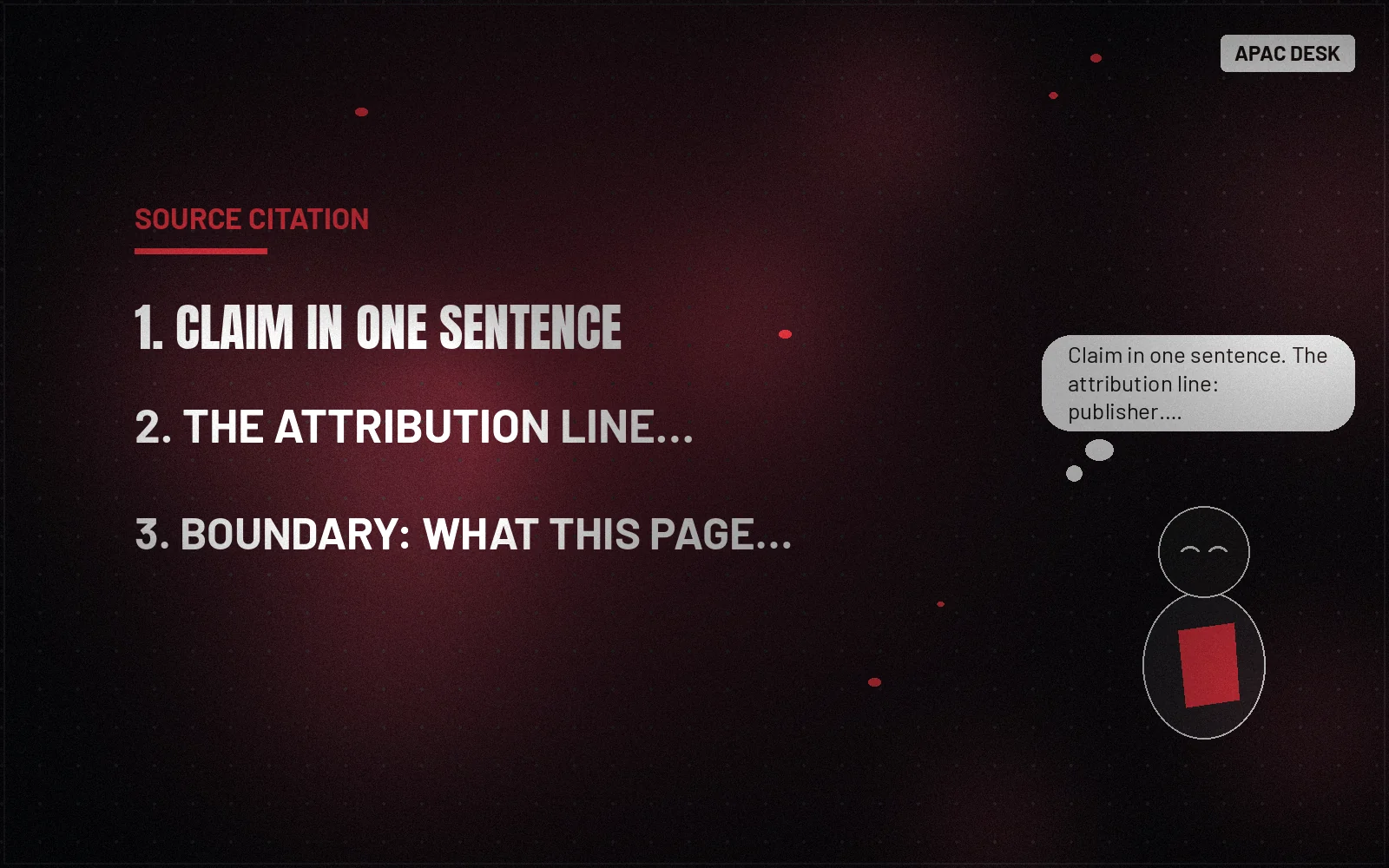
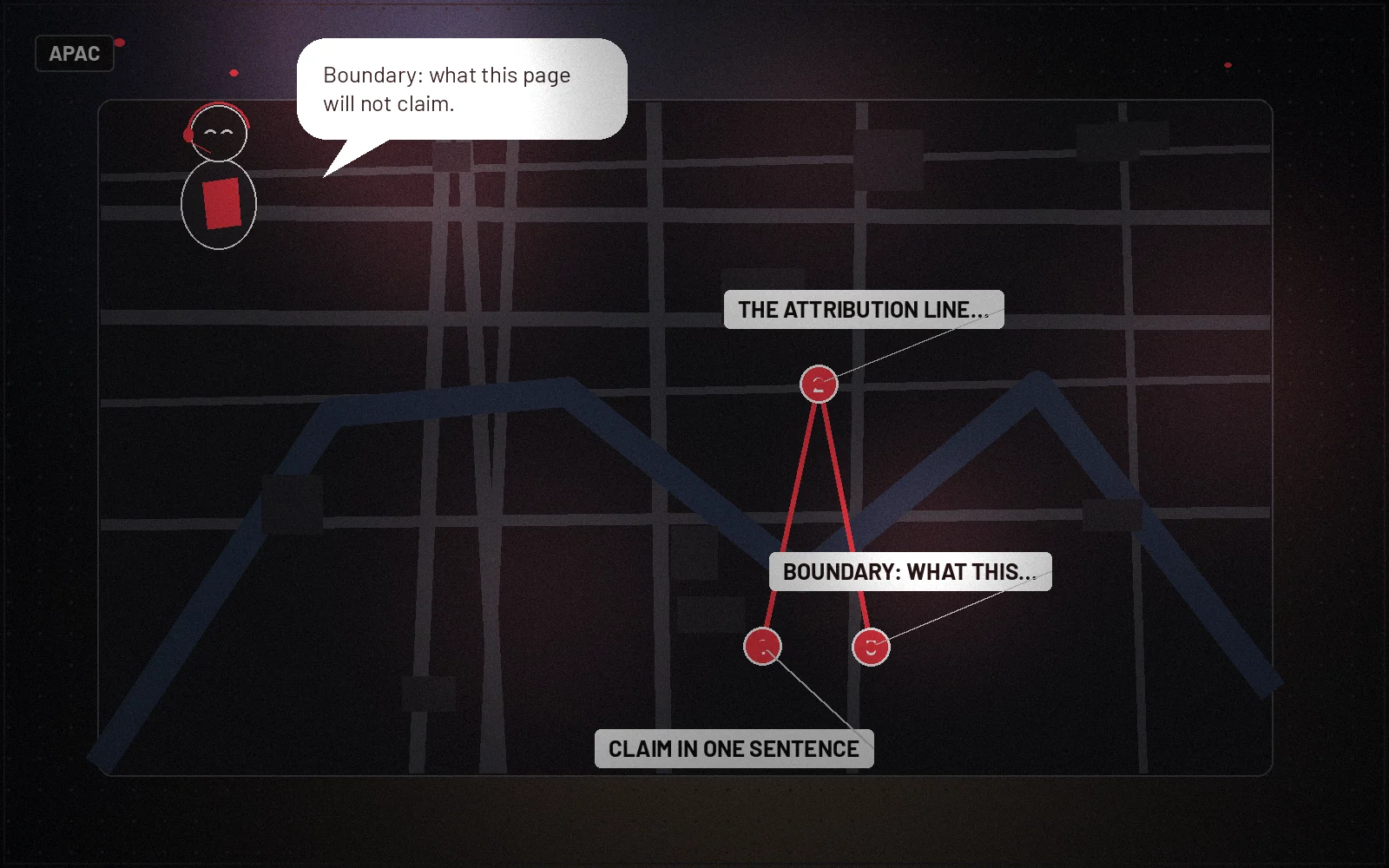
- Claim in one sentence.
- The attribution line: publisher, document, date, where to check.
- Boundary: what this page will not claim.
The attribution line is what lets a lifted sentence keep its source. If the claim and the source sit in the same paragraph, a quote is more likely to carry both.
Kill this / say this
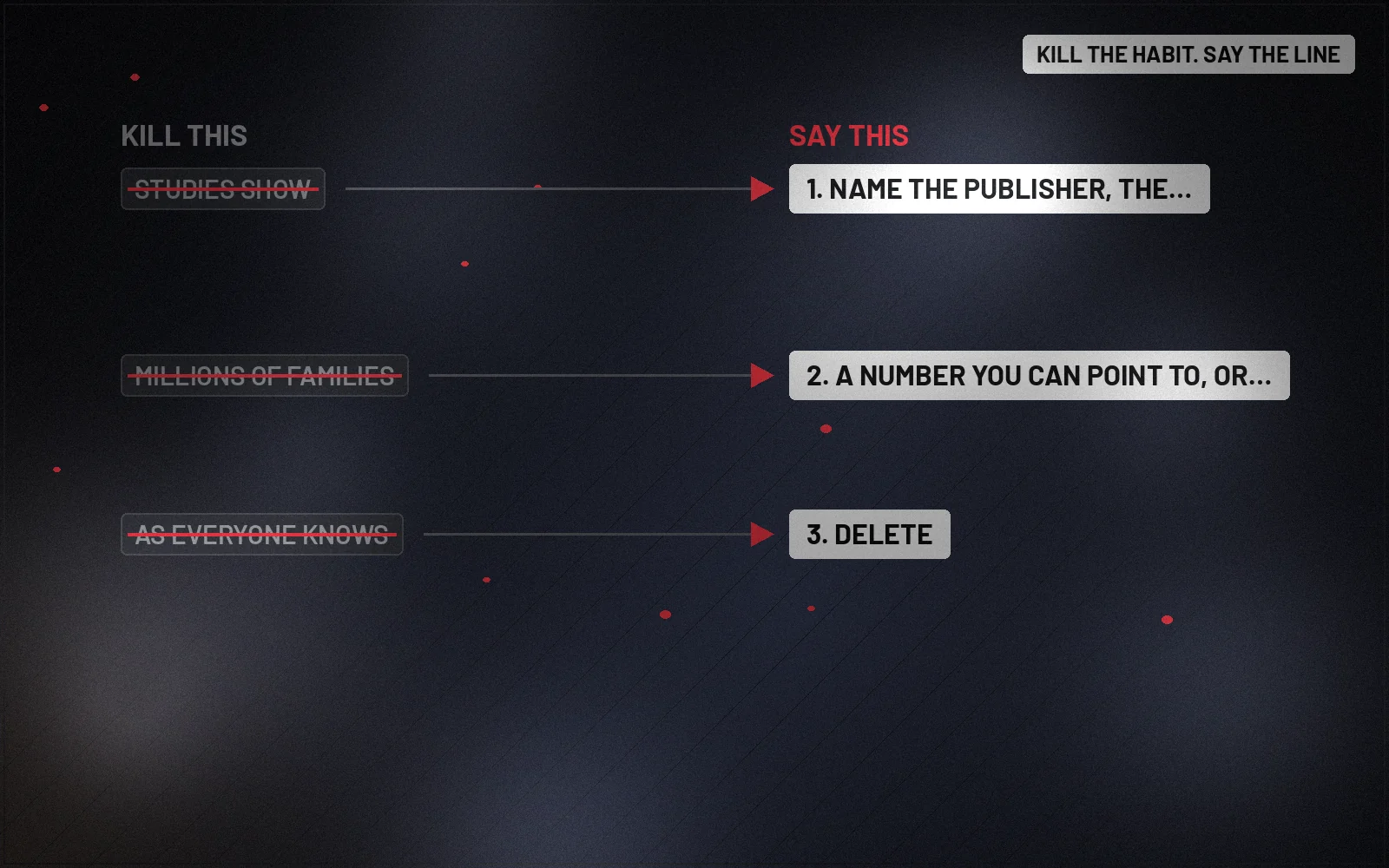
| Kill this | Why it fails | Say this |
|---|---|---|
| “Studies show” | Which study | Name the publisher, the document and the date in one sentence |
| “Millions of families” | Invented scale | A number you can point to, or no number |
| “As everyone knows” | Not a source | Delete |
| A footnote farm under a mushy claim | The claim never became a sentence | One claim. One checkable line. |
Do not invent a document name. If you do not have a public source, drop the number.
Paste-ready block (illustrative)
Claim: FAQPage markup only helps when the visible questions and the schema questions are the same sentences.
Source: Our FAQPage schema English APAC companion on this site, published 30 September 2026.
Boundary: This is communications craft, not a ranking guarantee.
How do you cite your own site?
By name, with a link. “Our FAQPage schema companion” plus the link beats “as we have always said” every time.
Self-citation is fine when the object lives on your site: a published position, a dated statement, a correction note. It is not fine as a way to launder a claim you never sourced in the first place. If the page you cite has no source either, you have built a loop, not a citation.
What if the source is a news report?
Name the outlet and the date. Then ask whether the original document is public.
If it is, cite the document and mention the report as how you found it. If it is not, cite the report as a report: “According to a report published by the outlet on this date.” Do not upgrade a news summary into an official finding. Do not cite a piece you have not read.
What is the kill rule?
If the sentence cannot survive an “according to whom?” reply in the group chat, it does not ship.
Incident line, for the desk log:
A proof line went out without a checkable source. We have removed the number and left the claim that we can stand behind.
Monday field kit
- Highlight every number on one live Insight.
- Attach an attribution line or delete the number.
- Put the claim and its source line under the first H2.
- Do not add three more studies for authority.
FAQs
What is source citation English APAC?
Source citation English APAC is the short line that pairs one claim with one checkable source. It names the publisher, the document, the date and where to check, so a person or an answer engine can attribute it.
Do we cite ourselves?
Yes, cite your own page when the object lives on your site. Name the page and link it, and never use “as we have always said” as a source.
What if counsel has not cleared the source?
If counsel has not cleared the source, do not publish the number. Publish the process instead, with a line that says the page will be updated when the official note is public.
Should the source line include a link?
The source line should link when the source is a page on your own site. For outside sources, name them clearly enough that a stranger can find them with one search, and follow your site’s own linking policy.
What to do this week
Take one Insights URL that ranks or that you want cited. Add one attribution line under the lede. Remove every unattached statistic.
Neuwark Communications builds evidence-first content under Research & Insights and Digital & Social. If your pages still say “studies show,” talk to us at Contact. More desks: Insights.
Communications craft, not legal advice. Check defamation, copyright and disclosure questions with counsel in each market before you publish a sourced claim.
Related: AI Overview source English · GEO FAQ answer block English · NewsArticle schema English · FAQPage schema English APAC