
A volunteer with a manifesto will improvise. Improvisation screenshots.
Volunteer door card English is three lines a person can say on a stairwell without looking down: the stake, the proof, the boundary. Then one ask. Not five.
Street-smart APAC English: short sentences a tired operator can say out loud.
Communications craft, not legal advice. Do not put named officials or unreleased numbers on a card.
This is the language companion to our volunteer message discipline playbook for barangay canvass. That piece covers the canvass kit, the one-page spine, training and field leadership. This one writes the card a volunteer actually holds.
What goes on the card?
Four lines. The first three are said. The fourth is asked.
| Line | Job | Say this (illustrative) |
|---|---|---|
| Stake | Why this household should care | “This week’s fight is the classroom line in the budget, not a slogan.” |
| Proof | One checkable object | “The one-page note lists the line and the public source. I can leave it.” |
| Boundary | What you will not invent | “I will not guess a peso figure you cannot check.” |
| Ask | One next step | “Read the one-pager or give me a number for Thursday’s briefing.” |
Every line is illustrative. Swap in your own verified issue, your own public source, and your own briefing date.
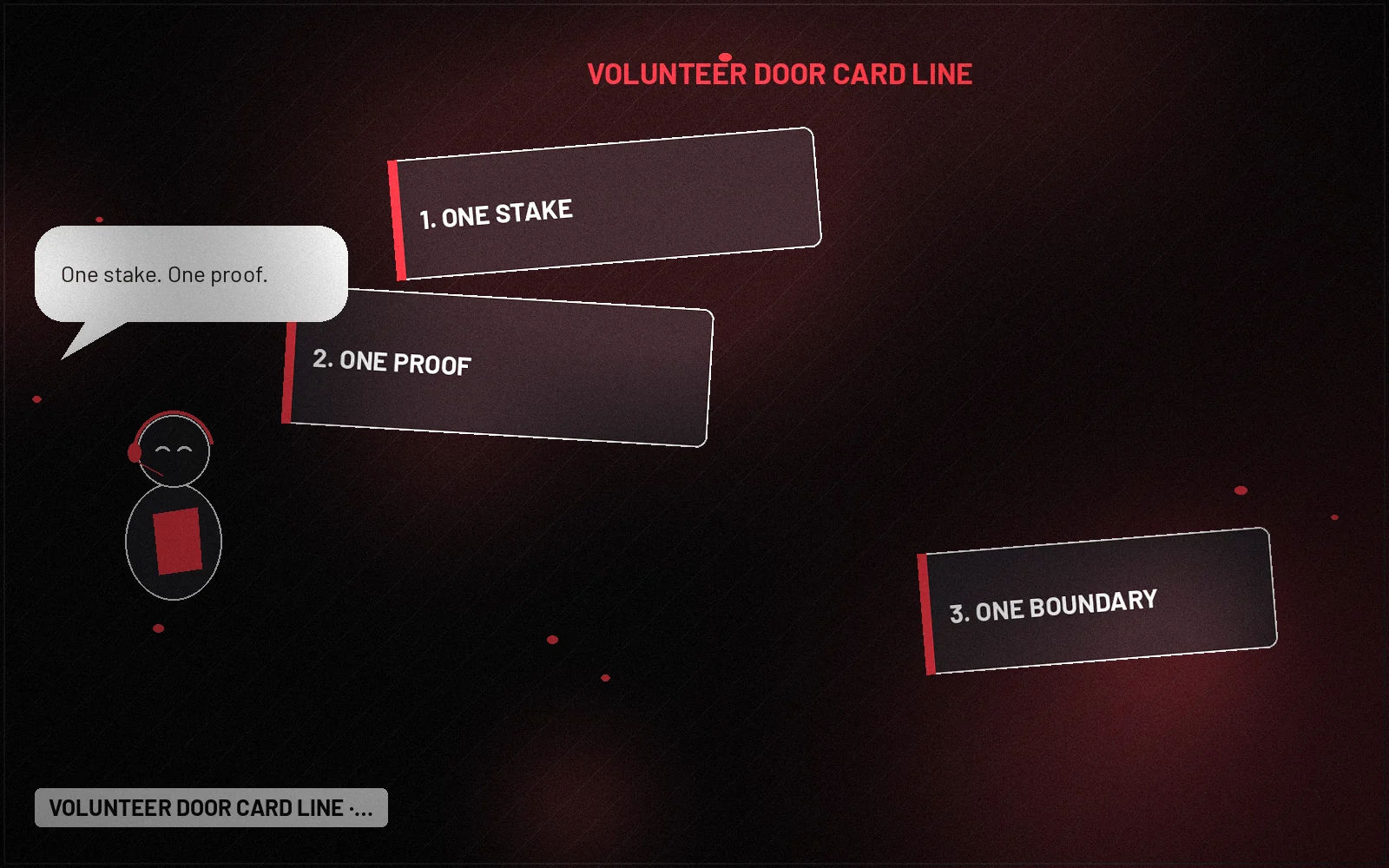
The boundary line is the one most cards skip. It is also the one that keeps a volunteer from becoming the story. A volunteer who says “I do not know, here is the note” loses nothing. A volunteer who guesses a number loses the door and maybe the week.
What does the volunteer door card English kill list look like?
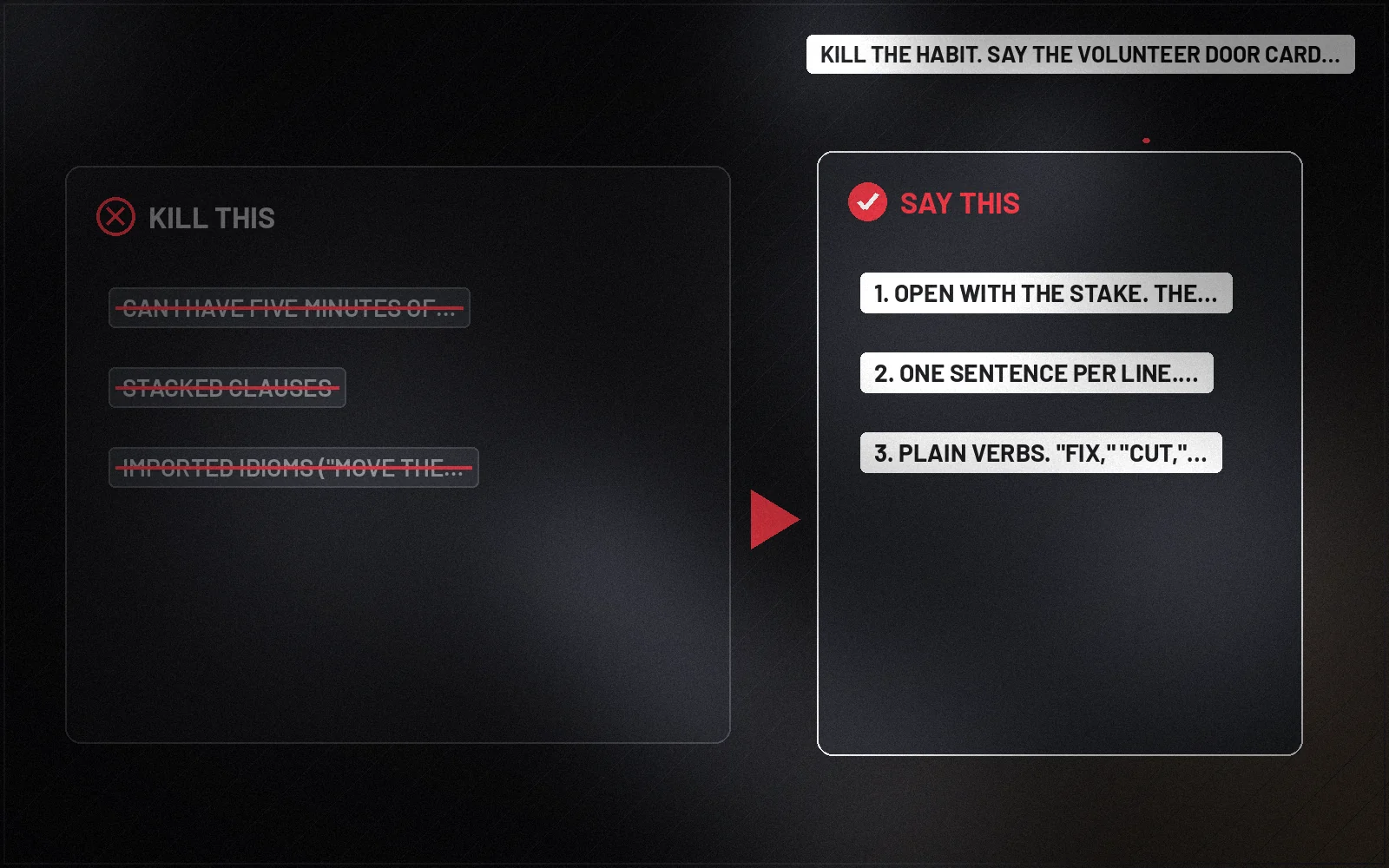
| Kill this | Say this (illustrative) |
|---|---|
| “Can I have five minutes of your time?” as line one | Open with the stake. The household decides the time. |
| Stacked clauses | One sentence per line. Breathe between them. |
| Imported idioms (“move the needle,” “double down”) | Plain verbs. “Fix,” “cut,” “fund,” “show up.” |
| A second ask in the same breath | One ask. The second one goes on the leave-behind. |
| Opponent nicknames | Name the issue, not the person. |
Nicknames feel like energy at HQ. At a door, they sound like a fight the household did not ask to join. They also screenshot.
How does the card travel?
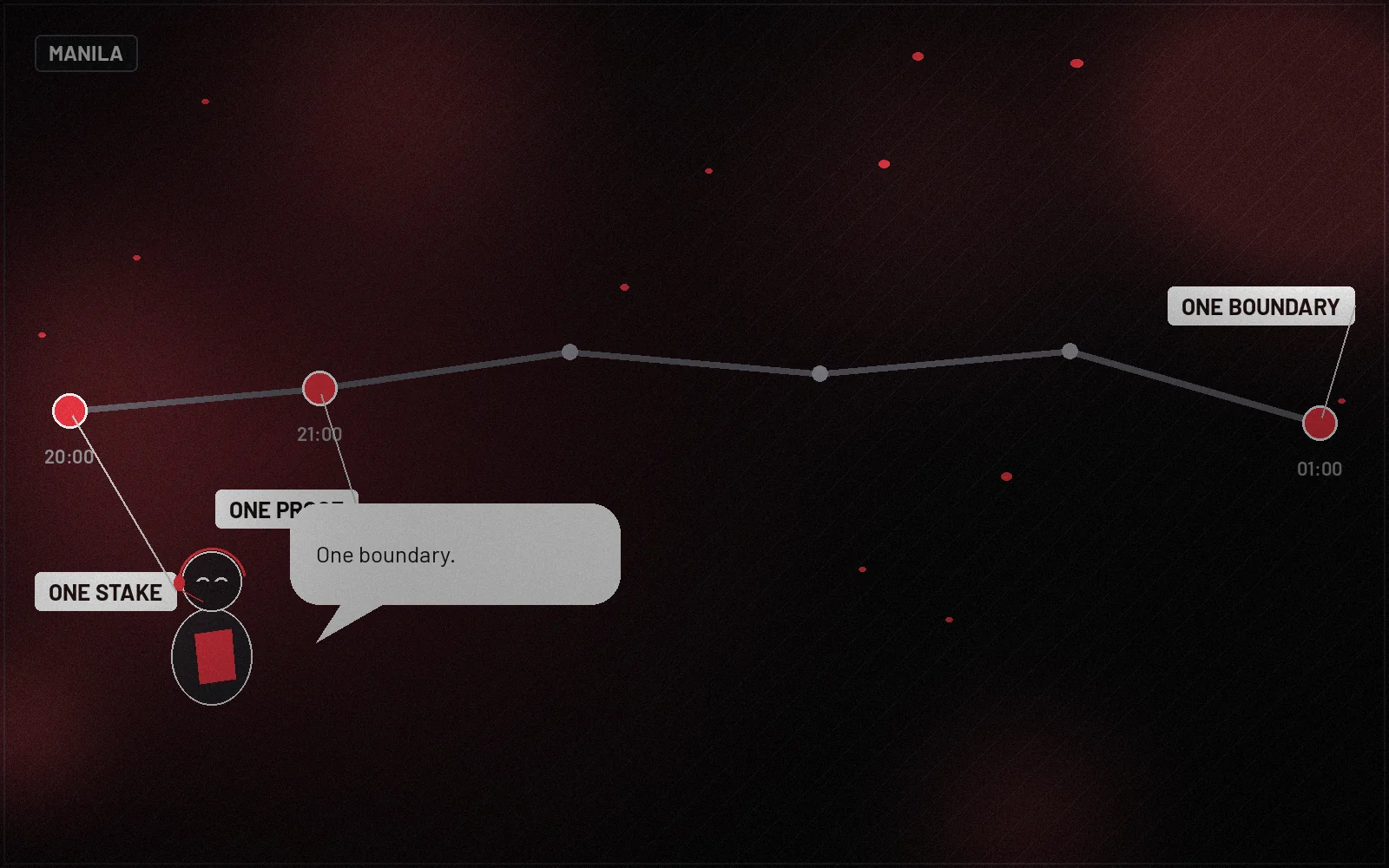
The same three lines become:
- The SMS the field lead sends at 6am
- The first slide of the huddle
- The caption under the mute clip
- The sentence a partner can paste without rewriting the fight
If those four surfaces disagree, you do not have a card. You have a group chat.
Write the card first. Then write the SMS, the slide and the caption from the card. Never the other way around.
What about vernacular at the door?
Keep the English spine. Let the volunteer say it in the language of the door.
The card fixes the order and the object: stake, proof, boundary, ask. It does not force a Manila volunteer to sound like a press release in a Cebu stairwell. Translate the lines as lines, not as a paragraph, and test each one out loud with a volunteer who speaks that language at home.
If the translated stake line gets longer than the English, cut it back. A long line at a door is a line nobody finishes.
What goes on the leave-behind?
The proof, in print. The ask, with one date and one link. A contact who answers.
Nothing that is not on the card. If the leave-behind adds a new number or a new promise, the volunteer just handed over a claim they never said and cannot defend.
Paste lock for the back of the card:
Stake. Proof. Boundary. One ask. If you need to look down, cut a clause.
Who checks the card before it is printed?
Two people. The message owner checks that the stake and the proof are true and sourced. A field lead checks that a tired volunteer can say it.
Those are different tests. A line can be accurate and unsayable. A line can be easy to say and wrong. The card ships only when both people sign the same version.
Keep the signed version in one shared folder with a date in the filename. When a volunteer asks “which card is current?”, the answer should be one file, not three screenshots from three group chats.
Monday field kit
- Write the four lines on one index card.
- Read them while walking.
- If you need to look down, cut a clause.
- Give the card to someone who was not in the meeting.
- If they add a slogan, the card failed.
- Collect cards at the end of the shift. Mark the lines people actually said.
FAQs
What is volunteer door card English?
Volunteer door card English is three spoken lines plus one ask that a volunteer can use at a door, a covered court, or in a chat without notes. It carries one stake, one proof and one boundary.
Can the proof be a feeling?
No, the proof is a public document, a date, a named program, or a leave-behind. The feeling belongs in the stake line.
What if the household asks a legal question?
The volunteer uses the boundary line: “I am not counsel. I can leave the public note and the briefing link.” Then the volunteer logs the question for the field lead, so someone qualified can follow up.
How often should the card change?
The card changes when the fight changes, not when HQ gets bored. If the stake line is still true, keep it, and only swap the proof or the ask date.
What to do this week
Print twenty cards. Collect the ones volunteers actually used. Kill the rest.
Neuwark Communications builds field message systems under Strategy & Messaging and Philippines Local Presence. If your volunteers are still improvising at the door, talk to us at Contact. More desks: Insights.
Communications craft, not legal advice. Check election, data privacy and canvassing rules with counsel in each market before volunteers go out.
Related: Volunteer message discipline for barangay canvass · Youth caption English · Coalition caption pack English · Clip-safe debate English