
Alt text that sells the campaign is not alt text. It is a second caption hiding in the code.
Alt text English is one sentence that names what is in the picture, so a screen reader, a search index, and a moderator see the same object. Not the slogan. Not the theory of change. The picture.
Street-smart APAC English: short sentences a tired operator can say out loud.
This is operator language, not legal advice. Do not invent names of people in stock or generated photos.
This is the language companion to our photo and video field kit standards. That piece covers how the field team shoots, clears and files pictures. This one writes the sentence that travels with each picture into the code.
What should alt text English say?
Name the object. Name the setting if it matters. Stop before the argument.
A reader using a screen reader hears the alt in the middle of your article. If it is a slogan, you interrupted them with an ad. If it is an object sentence, they get the same picture a sighted reader got, and they keep reading.
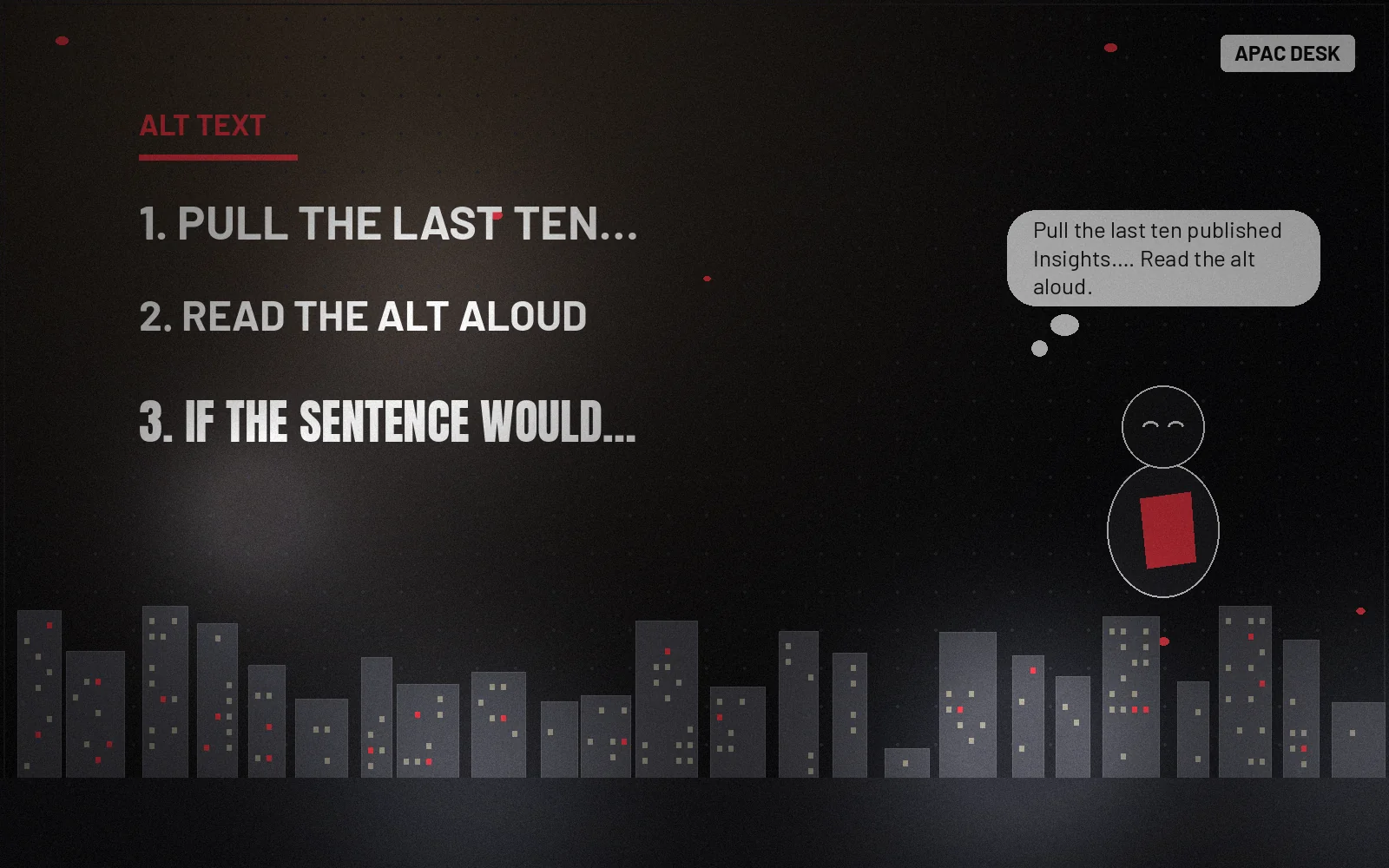
| Kill this | Why it fails | Say this (illustrative) |
|---|---|---|
| “Our movement for a better tomorrow” | Slogan. The picture is a desk. | “Closed briefing folder and laptop on a night desk, city lights through blinds.” |
| “Our senator fighting for classrooms” | Invents a person and a claim | “Empty covered-court chairs and a handheld mic on a stand. No faces.” |
| “Infographic proving the ₱7.2T budget is stolen” | Legal and factual risk in alt | “Budget flowchart graphic with unlabeled boxes. No figures claimed in alt.” |
| “Happy volunteers changing the nation” | Mood plus manifesto | “Three lanyards and clipboards on a plastic table. No faces.” |
Every line in the right-hand column is illustrative. Swap in what your own picture shows. Nothing more.
What must stay out of alt text?
- Claims the image does not show.
- Named officials, unless the photo is a cleared, identified portrait and counsel said the name can travel.
- Slogans that argue with the on-page H1.
- “Image of” as a prefix. The field already knows it is an image.
- Joke alt. Screen readers do not need your desk humor.
- Numbers you would not put in the headline. Alt is not a side door for an unchecked figure.
The last one is where desks get burned. Alt feels hidden. It is not. Anyone can view source, and a screenshot of a view-source window travels as fast as a screenshot of a caption.
Paste lock:
Alt: Night desk with a closed brief, a dark laptop, and city blinds. No faces.
If the picture has no people, say so. If the picture has people only from behind, say so. If you cannot describe it without a claim, do not ship the picture.
How long should an alt text English line be?
One sentence. Usually under twenty words. Long enough to name the object and the setting. Short enough that a screen reader user does not lose the paragraph they were in.
If you need two sentences, the picture is doing two jobs. Split it, or move the second job into the caption. The caption can argue. The alt cannot.
A quick test: read the alt aloud, then read the next paragraph. If the alt sounds like a pitch interrupting the article, rewrite it.
How does alt text English help GEO?
Search and answer engines read alt text as a description of the picture. They are not looking for your manifesto in an alt field.
A clean object sentence is something a machine can match to the image and cite. A slogan tells it nothing about what is in the frame. Worse, it teaches the index that your picture and your page are about two different things.
Keep three fields in line: the alt names the object, the caption carries the ask, and the H1 names the fight. When they agree, the page has one subject.
Who writes the alt on a night desk?
The person who uploads the picture. Not the SEO person the next morning. Not a plug-in that guesses.
Auto-generated alt tends to guess at mood and people. It may call a crowd “happy” or name a stranger’s age. That is a claim you did not check. Treat machine alt as a first draft and rewrite it before publish.
Put the alt line on the same checklist as the caption and the credit. If the upload has no object sentence, the post does not ship.
Monday field kit
- Pull the last ten published Insights images.
- Read the alt aloud.
- If the sentence would still work with the image deleted, rewrite it.
- One object per image.
- Same kill rule as captions: no new claims in the metadata.
- Log every rewrite in the desk sheet, so the next uploader sees the pattern.
FAQs
What is alt text English?
Alt text English is the one-sentence description of what the picture actually shows. It is written so a screen reader and a search index see the same object a sighted reader sees.
Can alt text carry the campaign ask?
No, alt text names the picture and nothing else. The ask lives in the caption, the H1, or the call to action.
Do decorative images need alt?
A decorative image should be marked decorative if the theme or CMS lets you. If it does not, write one short object line and stop.
What language should the alt be in?
The alt should be in the language of the page. Do not mix a Tagalog H1 with an English manifesto in alt, because the screen reader will switch voice mid-thought.
What to do this week
Open the media library. Fix the last ten alts. Ship no new image without an object sentence.
Neuwark Communications builds accessible, screenshot-safe content systems under Digital & Social and Creative & Brand. If your media library is full of slogans, talk to us at Contact. More desks: Insights.
Communications craft, not legal advice. Check accessibility, privacy and image-rights questions with counsel in each market before you publish.
Related: Photo and video field kit standards · Title-tag English APAC · OG card English APAC · NewsArticle schema English