
The ad made a promise. The landing page forgot it. That gap is where advocacy budgets go to die.
Paid search landing English is the four lines that keep the promise on the first screen: the H1, the proof line, the primary CTA, and the bounce-kill line under it. Short. Checkable. Sayable.
This is the language companion to our paid search landing pages for advocacy playbook. That one covers query clusters, page modules, message match, and measurement. This one gives you the sentences that sit on the money page.
Street-smart APAC English: short sentences a tired operator can say out loud.
What should the H1 on an advocacy landing page say?
It should say the query back in human words. Then stop.
The searcher typed a question. The H1 is the first breath of your answer. Not your mission statement. Not “About Us.” Not a campaign slogan they have never heard.
Quick test. Read the ad headline out loud. Then read the H1. If the second sentence sounds like a different organisation, rewrite it.
| Query intent | Kill this H1 | Say this H1 |
|---|---|---|
| What Unprogrammed Appropriations are | “Building a Transparent Tomorrow” | “Unprogrammed Appropriations, explained in one minute” |
| Education budget gap | “Invest in Our Future” | “Where the classroom money goes in the 2027 budget” |
| Flood-control follow-the-money | “Justice Now” | “Follow the flood-control money: what is public so far” |
| Briefing sign-up | “Join the Movement” | “Get the Monday budget briefing in your inbox” |
These are illustrative lines. Swap in your own cluster wording. Keep the searcher’s noun in the H1. If they typed “Unprogrammed Appropriations,” do not make them decode “fiscal blind spots.”
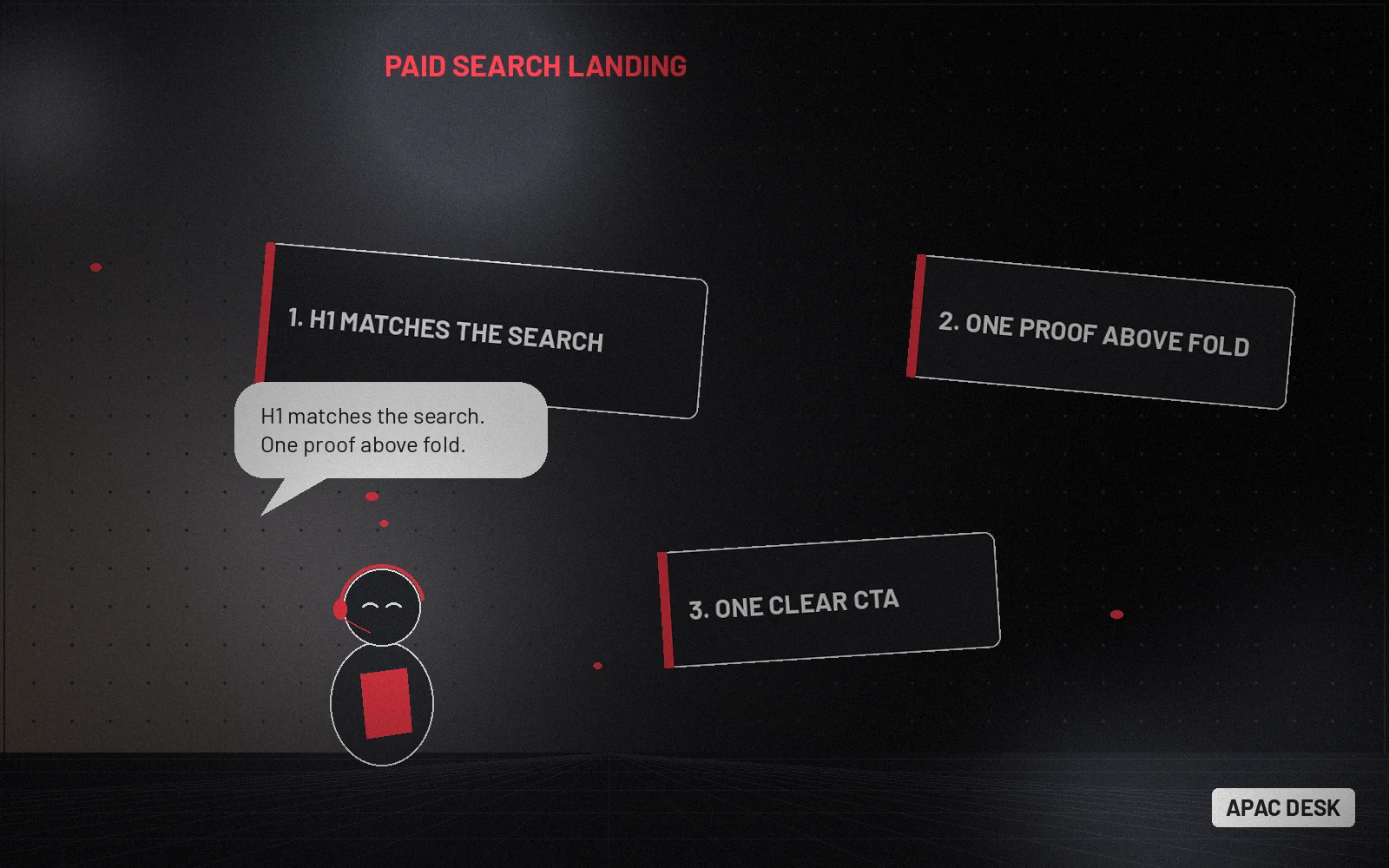
That is the whole craft of donate page H1 copy too. Name what they came for before you name what you want.
How do you write a proof line people will trust?
One claim. One source. One date. One sentence.
The parent piece puts proof above the fold. The English has to earn that spot. A proof line is not a vibe adjective. It is something a skeptical reader can check on their phone before the coffee cools.
Pattern: “[What we found], according to [named public document], [date or session].”
- Say: “The line item appears in the committee brief for this session week. Link below.”
- Kill: “Experts agree this is alarming.”
- Say: “We track every change to this line and post the date we saw it.”
- Kill: “Millions are affected.” Unless you can name the source and the number.
No invented statistics. If your proof line needs a number you have not verified, it is not a proof line yet. Use the document itself.
Which primary CTA words convert without sounding like a sales funnel?
A verb, an object, and a clock. One button.
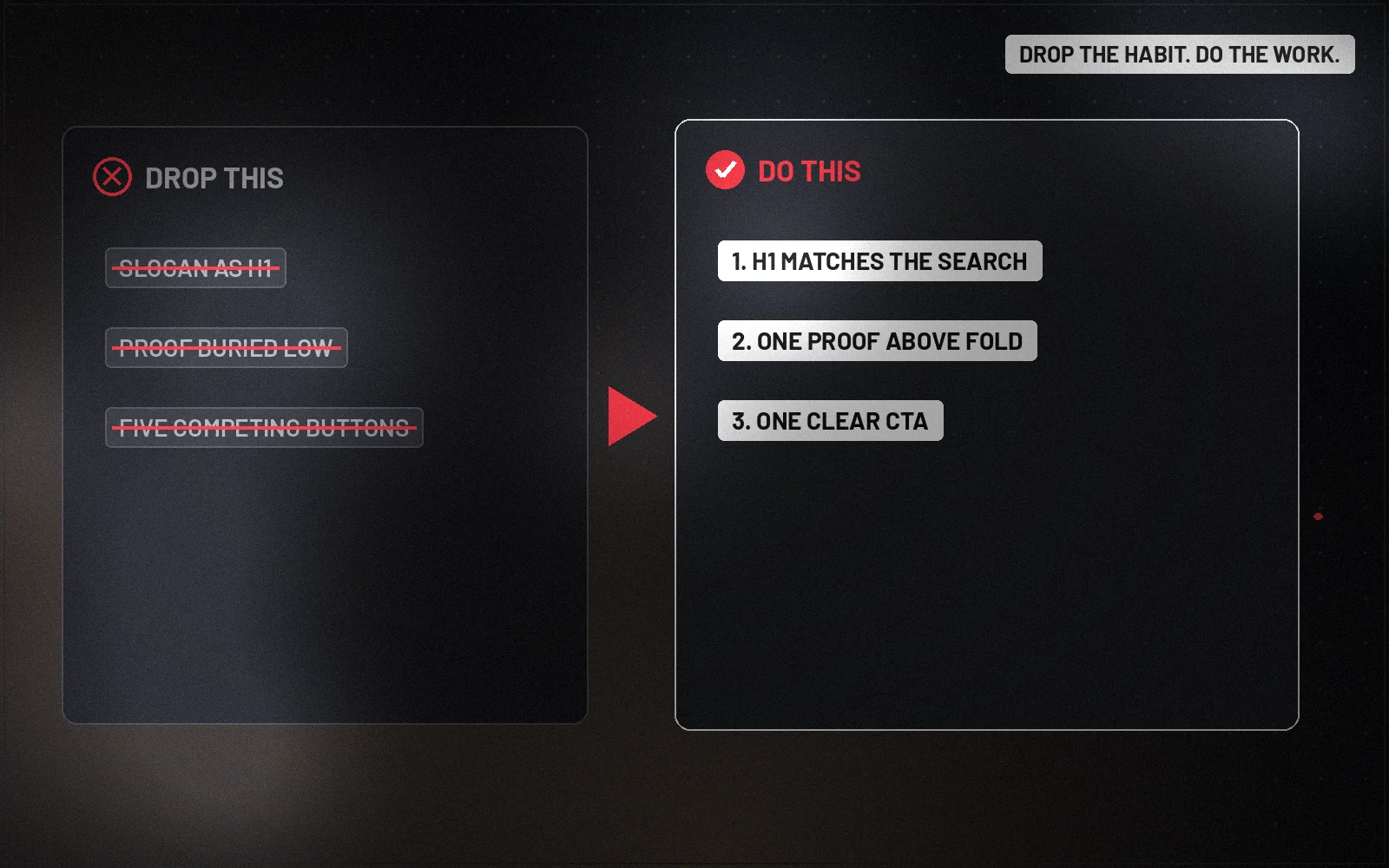
The parent piece is blunt: two equal buttons fight and both lose. Your English has to pick. Start with the behaviour the ad promised, not the one finance wants this week.
| Ad promised | Kill this CTA | Say this CTA |
|---|---|---|
| “Get the tracker” | “Learn More” | “Send me the tracker” |
| “Sign the petition” | “Donate Now” | “Add my name” |
| “Join the briefing” | “Submit” | “Save my seat for Monday” |
| “Support the watchdog work” | “Give Today!!!” | “Fund this week’s line-item check” |
“Submit” is a form talking to itself. “Learn More” is a shrug. The button should finish the sentence “I want to…” in the visitor’s own mouth.
Under the button, add one plain line on what happens next: “One email with the file. No daily blasts.” That line does more for trust than a badge.
What are bounce-kill lines, and where do they go?
Bounce-kill lines answer the doubt that makes a thumb hit back. They sit right under the CTA or right under the proof. One line each.
The doubts on an advocacy money page are predictable. Is this legit? Will you spam me? Where does my money go? Is this just outrage? Answer them before they are asked.
- Doubt: “Is this legit?” Line: “Run by [org]. Registered name and address in the footer.”
- Doubt: “Will I get spammed?” Line: “One email a week. Unsubscribe in one tap.”
- Doubt: “Where does the money go?” Line: “Your gift funds this week’s document checks.” Only if it is true.
- Doubt: “Is this just outrage?” Line: “Every claim on this page links to its source.”
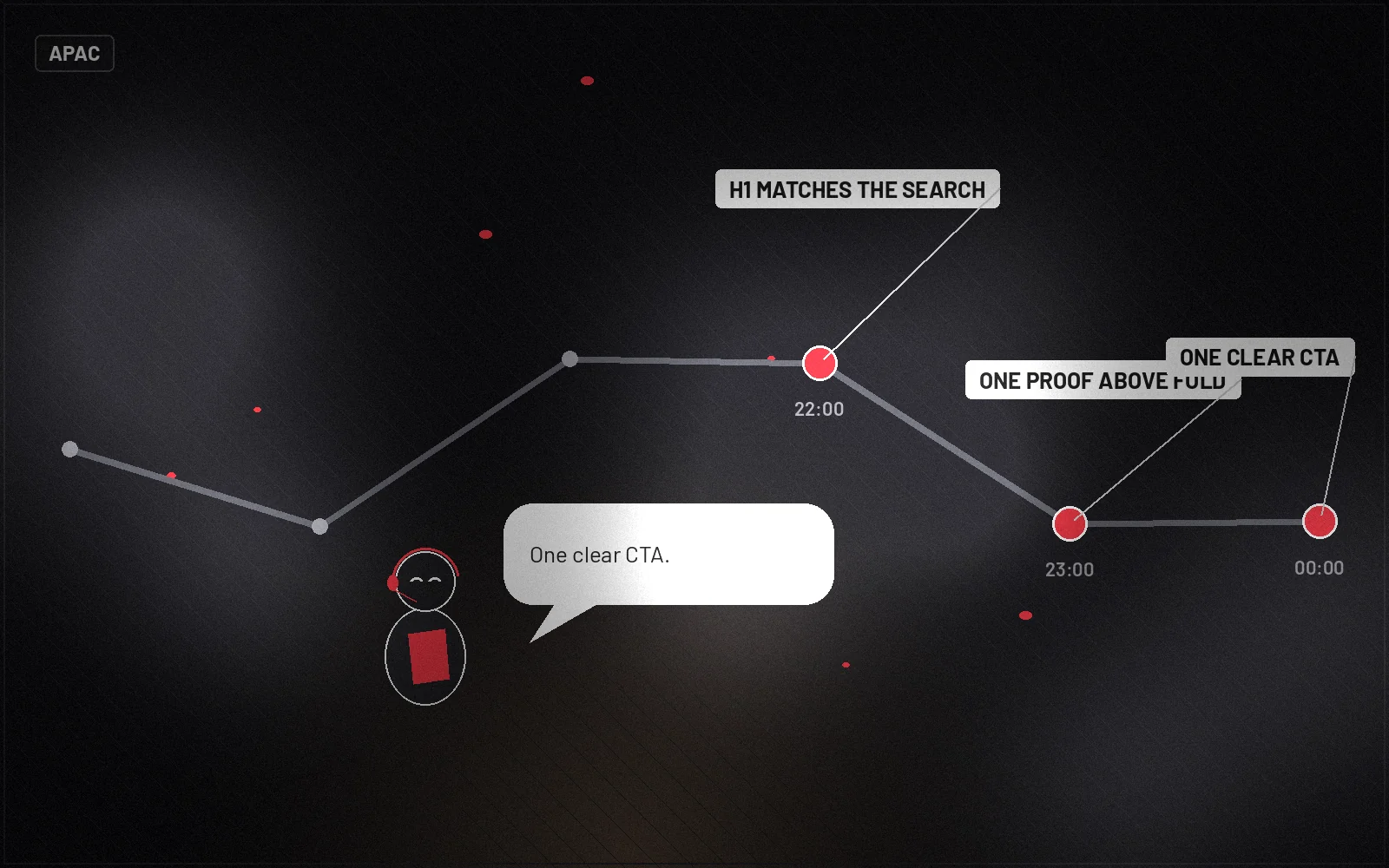
Kill the fake-urgency family. Countdown timers that reset. “Only a few spots left” on a free briefing. “Last chance” every Tuesday. Budget-week searchers arrive skeptical. Fake urgency confirms the skepticism.
How do you keep paid search landing English consistent with the ad?
Write the ad and the H1 in the same sitting. Same person. Same noun.
The screenshot test from the parent piece works for language too. Crop the ad and the first screen into one image. Show it to someone who wrote neither. Ask one question: “Same promise?” If they hesitate, the English broke, not the design.
Keep one glossary line per cluster. If the ad says “follow the money,” the H1 says “follow the money,” and the follow-up email says “follow the money.” Not “fiscal transparency” on one and “accountability journey” on the next. Every new synonym brings the fog back.
Monday field kit
- Pull your top three paid clusters. Write one H1 per cluster that repeats the searcher’s noun.
- Write one proof line per page: claim, named document, date.
- Pick one primary CTA per page. Verb, object, clock. Delete the second button.
- Write three bounce-kill lines: legit, spam, money. Put them under the CTA.
- Read aloud: ad headline, then H1, then CTA. One breath each.
- Kill every “Learn More,” “Submit,” and resetting timer on a paid destination.
Communications craft, not legal advice. Fundraising claims, data consent, and political-ad labels need counsel in each market before you scale spend.
FAQs
What is paid search landing English?
It is the short copy on the first screen of a paid advocacy page: the H1, the proof line, the primary CTA, and the bounce-kill lines. Each line keeps the ad’s promise in plain words a searcher can check in seconds.
How long should an advocacy landing page H1 be?
Short enough to say in one breath, and it should repeat the noun the searcher typed. If the H1 needs a subtitle to make sense, it is doing the wrong job.
Should an advocacy money page have more than one CTA?
No, keep one primary CTA per page. Secondary links can sit lower down, but two equal buttons split attention and blur what you learn from the spend.
What is a bounce-kill line?
It is one true sentence that answers the doubt that makes a visitor leave, such as spam, legitimacy, or where the money goes. It sits right under the CTA or the proof line.
What to do this week
Rewrite one paid page’s first screen before you touch the bid. Match the H1 to the query. Add one dated proof line. Cut to one button.
Neuwark Communications builds intent-matched money pages under Media & Paid and Digital & Social. If your paid clicks keep bouncing, start a conversation at Contact. More field notes in Insights.
Related: paid search landing pages for advocacy · brand safety brief English · GEO FAQ answer English · livestream CTA English