
A scorecard nobody can say out loud is a dashboard.
Quarterly decks survived September only as decoration. Operators need one screen, one page, one Monday note a principal can repeat without a decoder.
Weekly communications scorecard English is the label and cover-note layer: what each cell is called, what “up” means, and the four sentences you send with the PDF.
This is the language companion to our weekly communications scorecard template. That post is the KPI pack. This one is the wording so the pack does not turn into vanity mush.
Neuwark Communications builds operator reporting for political, advocacy, and public-affairs desks in PH and APAC. We do not invent analytics IDs. We do not pretend a screenshot of an AI Overview is a dashboard.
What should the four boxes be called?
Name boxes by job, not by software.
| Box | Label to print | What the number means |
|---|---|---|
| 1 | Message fidelity | Share of owned posts that still carry the locked claim |
| 2 | Distribution that counts | Partner picks, desk placements, or field uses — pick one and keep it |
| 3 | Search / answer-engine presence | Rank or citation on the two questions you actually care about |
| 4 | Action | The behaviour you bought: replies, RSVPs, gifts, sign-ups |
If you need a fifth box, you do not have a weekly scorecard. You have a museum.
How do you write the Monday cover note?
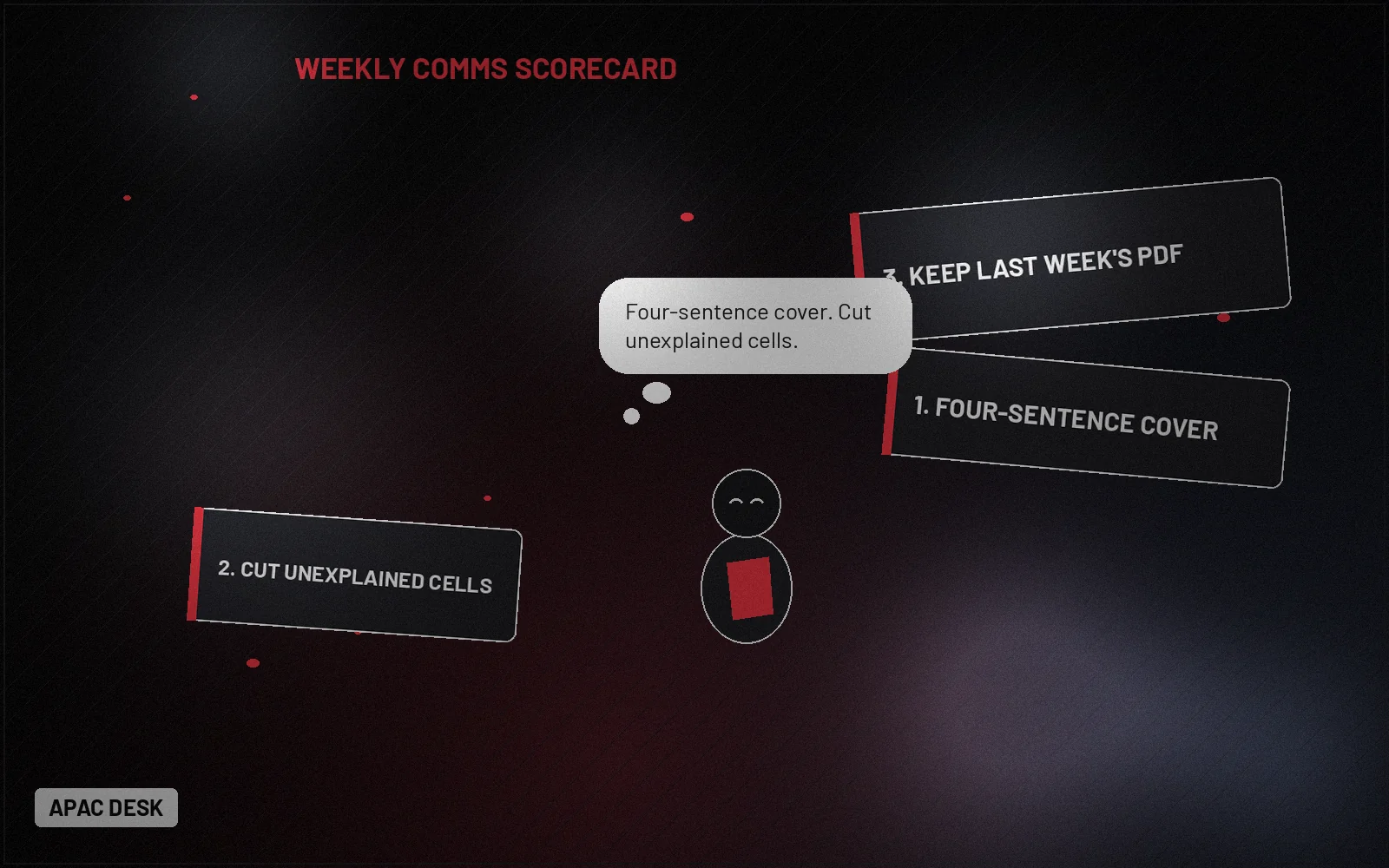
Four sentences. Same order every week.
This week the locked claim was [one line].
Fidelity was [n] of [n] owned posts; the miss was [named asset], now killed.
Distribution that counted was [n partner uses / n desk hits].
Action was [n]. Next clock: [one change by Wednesday].
No “in today’s evolving landscape.” No “we continue to amplify.” If the principal cannot read it in forty-five seconds, cut.
Which scorecard words should you kill?
| Kill | Why it is vanity | Replace with |
|---|---|---|
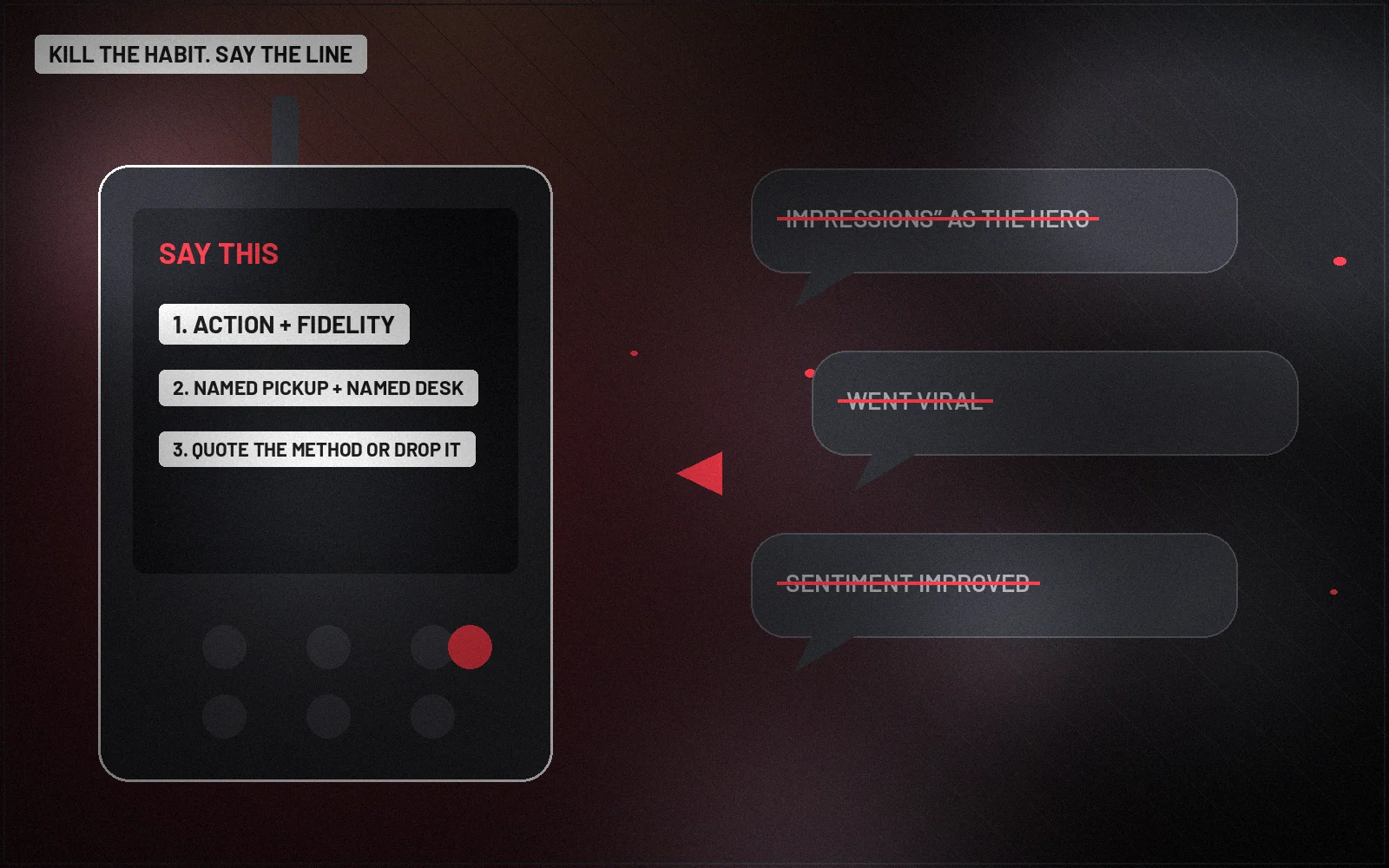
| “Impressions” as the hero | Unrelated to the fight | Action + fidelity |
| “Went viral” | Usually a screenshot | Named pickup + named desk |
| “Sentiment improved” | Undefined unless you say the method | Quote the method or drop it |
| “Brand love” | Not a comms KPI | Repeatable claim + next behaviour |
| “AI Overview wins” with no URL | Fan fiction | Saved query + date + who was cited |
Street-smart English on a scorecard is the same as on a holding line: a verb you can check.
What do you say when a number is bad?
Do not bury it under a chart.
Message fidelity dropped because [asset] used a slogan not on the card.
We pulled it at [time].
Replacement ships [day].
We are not changing the locked claim this week.
Honesty on Monday is cheaper than a principal finding the miss in a group chat on Tuesday.
Monday field kit
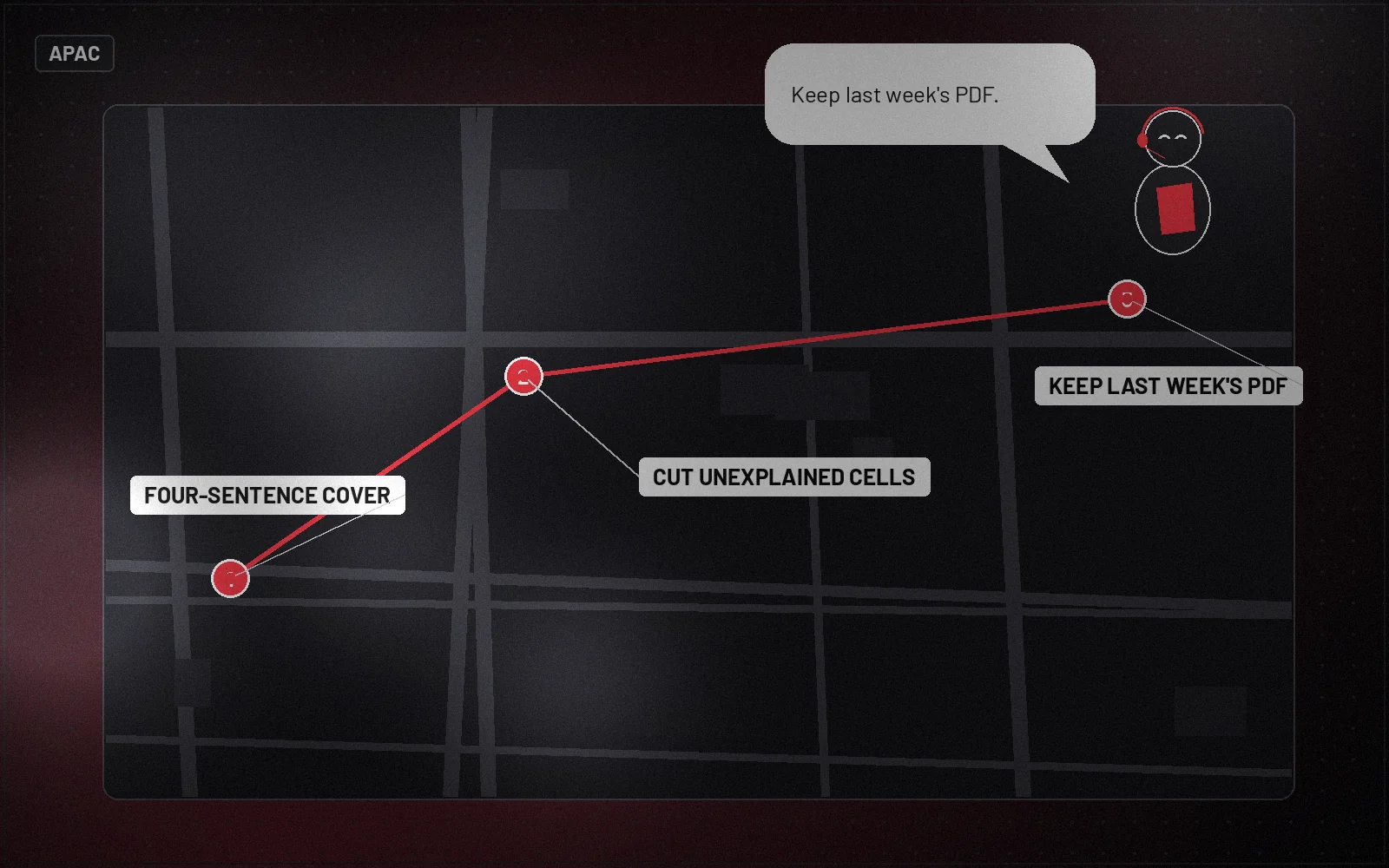
- Read the four-sentence cover note aloud. If you hedge, the number is not ready.
- Delete any cell you cannot explain to finance in one breath.
- Keep last week’s PDF. A scorecard without a trail is theatre.
- If search is in the pack, write the exact query you checked. Do not say “SEO is up.”
FAQs
What is scorecard English?
It is the labels and cover note that make a weekly comms KPI pack speakable. The math lives in the template. The sentences live here.
Can we show vanity metrics at the back?
Yes, as an appendix. Not as Box 1.
Is this an analytics product?
No. Use the measurement stack you already have. Do not invent GSC codes or third-party IDs in the article or the CMS.
What to do this week
Print one page. Four boxes. Four-sentence note. Kill “went viral.” Send it before midnight Monday.
More: Insights · Services · Contact.
Related: weekly communications scorecard template · English spine for multilingual GEO · crisis dark-site English · GEO content engines