
ICanServe Foundation’s Patient Power Summit 2026 (Advocacy to Action) livestreamed on Facebook with session recordings still promoted in mid-September—archive updates around 13 September and BusinessWorld patient-voice follow-through around 14 September. That is a live advocacy case of summit video that must convert to leads, partners, and fundraising—not vanity peak concurrency. A livestream without a conversion path is just an expensive group watch.
Townhall livestream conversion playbook is the system: CTA timing, replay funnels, and partner/volunteer capture that turn peak viewers into pipeline. Neuwark Communications builds those conversion architectures for advocacy and civic brands across PH, ID, and MY. Soft path: Services · Contact. Distinct from the legacy hub townhall livestream conversion playbook.
Peak concurrency vs pipeline: different money jobs
Peak concurrency is a vanity metric until it connects to a next step. Thousands watching a summit feels like success. Empty CRM after the stream is a cost center. The money job is not “how many people tuned in.” It is “how many people took a named action during or after the stream.”
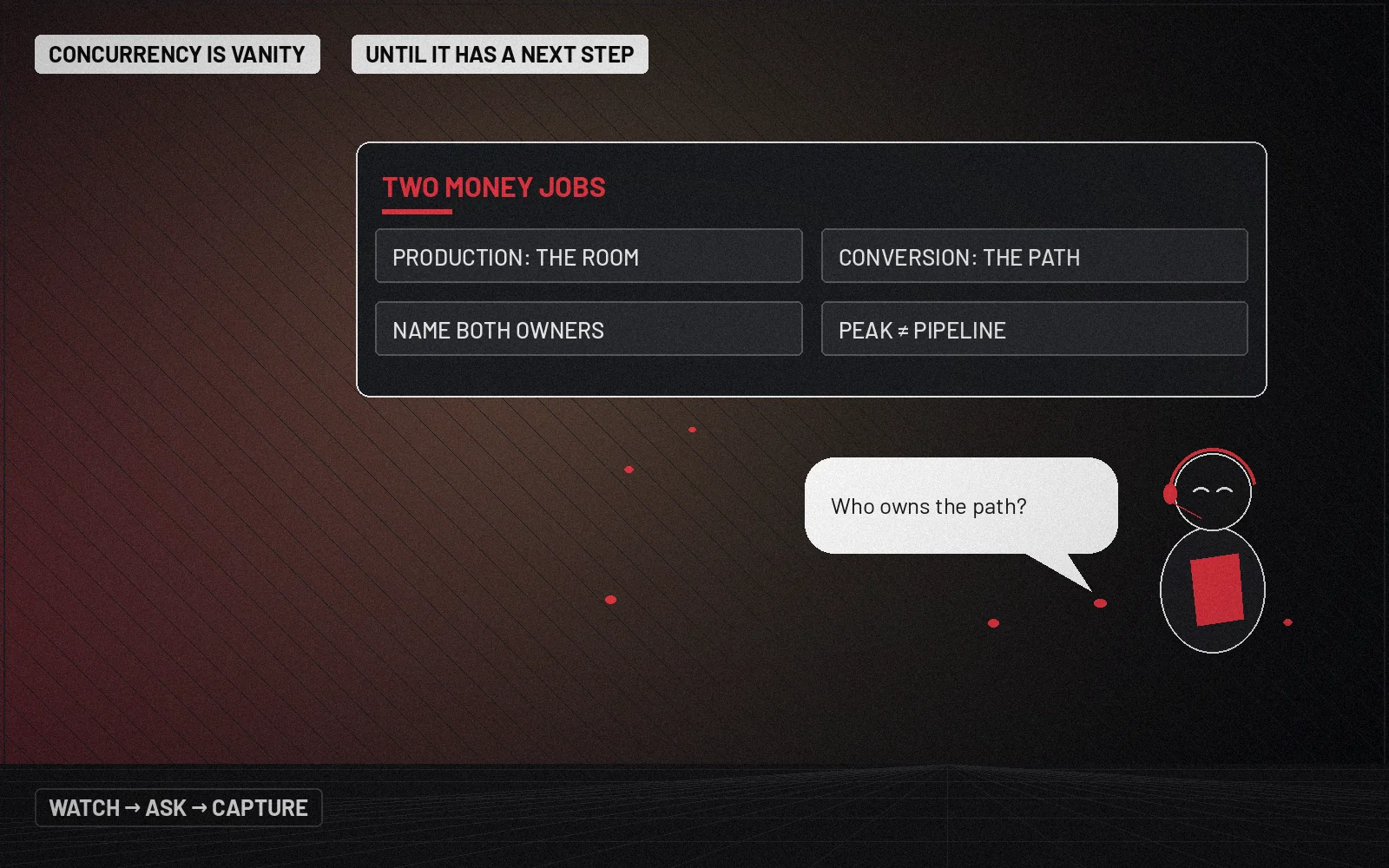
Advocacy livestreams fail when production is treated as the whole product. Lights, speakers, and a Facebook Live URL are not a conversion system. Conversion is timed asks, capture forms, replay chapters, and partner follow-up that still work two weeks later—exactly when Patient Power Summit recordings were still circulating in mid-September.
Separate the jobs in the brief: production owns the room; conversion owns the path. If one agency does both without a named conversion owner, the stream will look beautiful and report “reach,” while development and partnerships report silence. Progressive brands that want retainers renewed should put conversion KPIs in the SOW next to production KPIs. Concurrent viewers are a diagnostic. Qualified actions are the business.
For health and civic summits, peak concurrency also creates a trust test. A room full of patients and caregivers is not a cold e-commerce audience. Hard-sell overlays that would “work” on a product launch can break the room. The townhall livestream conversion playbook must protect dignity while still capturing intent. That balance is the craft—and the retainer differentiator.
CTA timing during live without breaking the room
Timing is the difference between a respectful ask and a tone-deaf interrupt. A practical ladder for advocacy townhalls:
Pre-roll (soft). Before speakers begin, invite viewers to “stay for the resource pack” or “join the partner waitlist.” No hard donate yet. You are framing that this stream has a next step.
Mid-session (warm). After a proof story or patient voice segment, offer a low-friction action: download a checklist, join a WhatsApp briefing list, or book a volunteer orientation. Mid-session CTAs work when they feel like a service, not a shakedown.
Peak / close (clear). Near the end, make one primary ask—donate, partner inquiry, or volunteer signup—tied to what people just heard. One ask. Not a collage of five buttons.
Chat hygiene. Pin one link. Rotate it if needed, but never flood chat with competing URLs. Multiple links train viewers to ignore all of them.
For health and civic streams, trust-safe asks matter. Urgency without panic. Proof without trauma porn. Align with trust-safe fundraising craft in trust-safe fundraising creative monsoon and mid-tier donor ops in second gift mid-tier donor ops. Patient Power Summit energy is advocacy-to-action; your CTA should feel like action, not extraction.
Rehearse the CTA like a speaker cue. If the host stumbles into the ask, the room feels the stumble. Write the sentence. Time the beat. Put it in the run-of-show. Conversion is production discipline wearing a fundraising jacket. Also brief the chat moderator: they are part of conversion, not a volunteer afterthought. A moderator who can answer “where do I sign up?” in one pinned reply saves more gifts than a flashy lower-third.
Replay funnels that keep working mid-September
Live peak is a moment. Replay is a product. Patient Power Summit’s mid-September archive promotions prove the point: conversion architecture must still work after the live room empties.
Build replay as a funnel, not a dump:
- Chapter markers on the recording so viewers can jump to the segment that matches their intent (patient voice, policy panel, partner call-to-action)
- Landing page for the replay with the same primary CTA as live—not a bare Facebook video link with no sink
- Email/WhatsApp sequence for people who registered but missed live: “Here’s the 12-minute chapter + the action”
- Sponsor/partner cutdowns that point back to the conversion URL, not only to vanity highlight reels
Replay funnels also protect SEM and organic search investments. If people search the summit name two weeks later, they should land on a conversion-ready page, not a dead event banner. Tie this to paid and organic destination craft in paid search advocacy landing pages when you run discovery ads against summit keywords.
Measure replay like a campaign, not like a file. Track view-through to CTA on the replay LP, not only Facebook video views. A recording with 10,000 views and zero actions is still a cost center—just a delayed one. Mid-September promotion windows are when that truth shows up in the CRM.
Partner, sponsor, and volunteer capture architecture
Summit conversion is not only donor conversion. Partners and volunteers are pipeline too.
Partner capture. Dedicated form fields: org name, role, partnership interest (venue, funding, distribution, clinical partners). Route to a human within 48 hours. Speed is respect.
Sponsor capture. Separate track from general donors. Sponsors want clarity on deliverables and brand-safety rules—especially in health advocacy. Give them a one-pager and a calendar hold, not a generic newsletter signup.
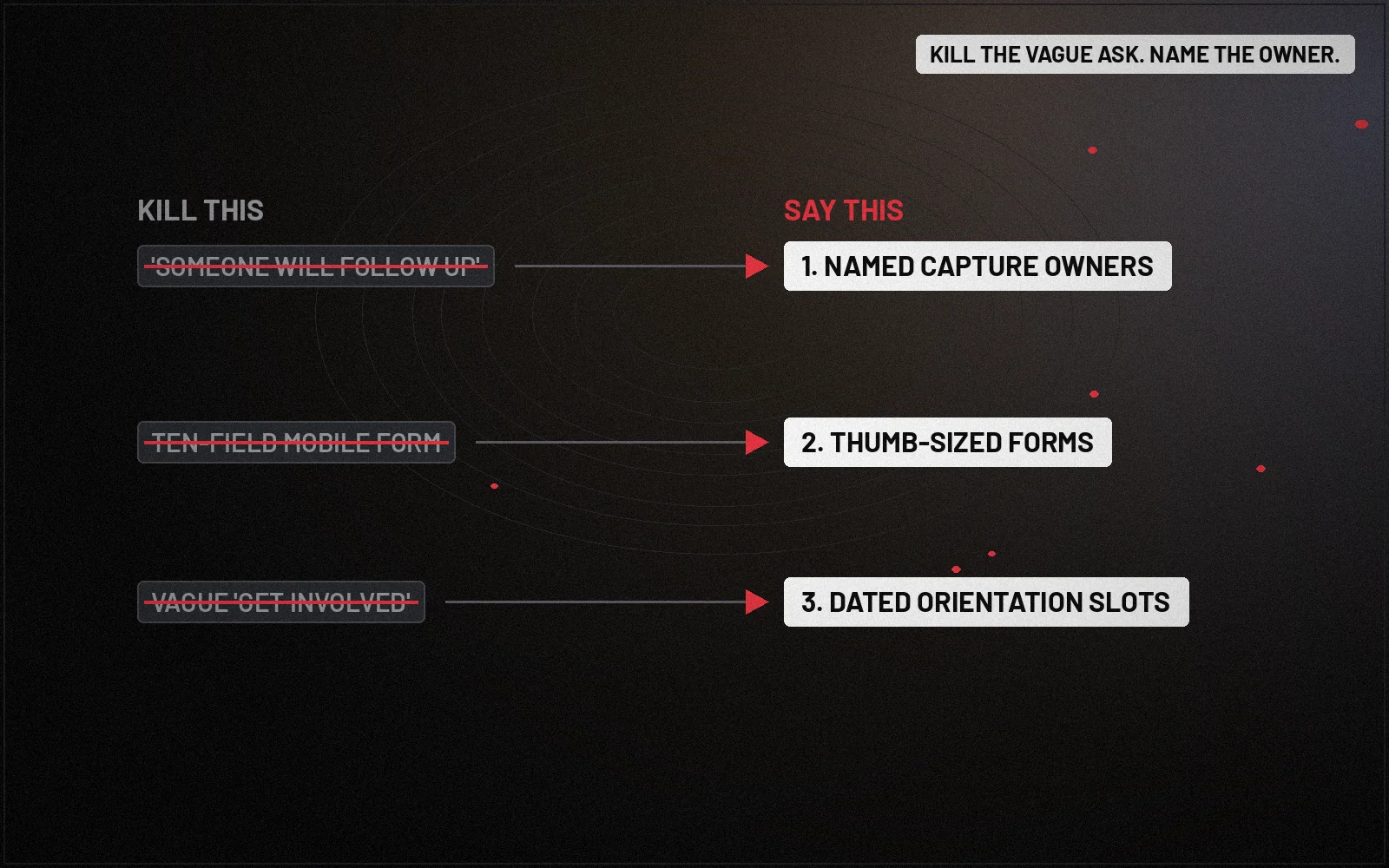
Volunteer capture. Micro-commitments beat vague “get involved.” Offer orientation slots with dates. Align with volunteer microlearning systems in volunteer training microlearning PH when you need post-summit onboarding.
Architecture means named owners. If “someone on the team will follow up,” no one will. Put conversion ownership in the run-of-show next to the livestream producer. Production without ownership is how beautiful streams die in the inbox.
Also design capture for mobile thumbs. Most summit viewers are on phones. Forms with ten fields and tiny checkboxes are partner-repellent. Three fields plus a role dropdown beats a novel. You can qualify later on a call. Capture first, interrogate second.
Trust-safe asks inside health and civic streams
Health and civic livestreams inherit higher trust stakes. Viewers may be patients, caregivers, or community organizers. Conversion must respect that context.
Trust-safe rules of thumb:
- Lead with service and dignity, not fear
- Avoid graphic medical imagery as a pressure tactic
- Make the money path clear (where funds go) without turning the stream into a finance lecture
- Keep compliance quiet: no invented outcome guarantees
This is where many advocacy streams break. They either refuse to ask at all (and leave money on the table) or ask like a late-night infomercial (and burn trust). The townhall livestream conversion playbook sits in the middle: clear asks, timed with care, backed by proof. Soft CTA culture from Neuwark’s progressive voice still allows a firm ask—it just refuses cringe and coercion.
If your summit includes survivor testimony, brief speakers on where CTAs will appear so nobody feels ambushed. Consent is part of conversion architecture. A powerful story followed by a surprise donate overlay can feel like betrayal even when the cause is just. Put the ask map in the speaker packet.
Distinct from the legacy townhall-livestream hub
This piece is the mid-September Patient Power Summit conversion case—CTA timing, replay funnels, partner capture, trust-safe asks. It is not a rewrite of the evergreen townhall livestream conversion playbook hub. The hub is the system overview; this page is the live APAC case that proves peak concurrency is not pipeline. More playbooks on Insights. Credibility on About.
Do: time CTAs without breaking the room; build replay funnels; capture partners and volunteers with named owners; keep health/civic asks trust-safe. Don’t: optimize only for peak concurrency; hard-sell over patient voices; leave a bare video URL with no sink; assume “someone” will follow up.
Run-of-show checklist operators can steal this week
If you are producing an advocacy summit in the next 14 days, paste this into the run-of-show:
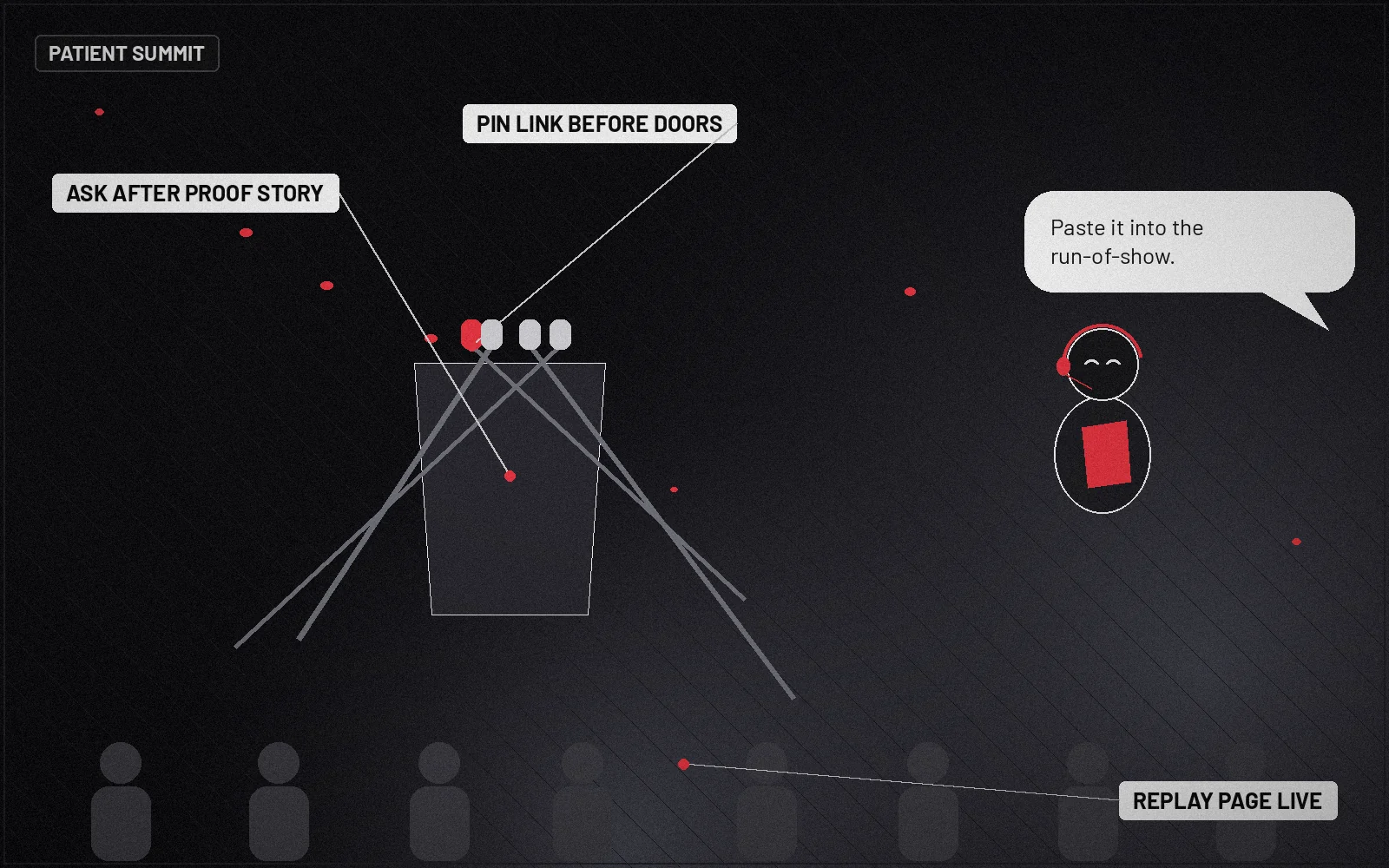
- 1. CTA owner named (not “the social team”)
- 2. Primary link pinned before doors open
- 3. Mid-session warm ask timed after a proof story
- 4. Close ask scripted as one sentence the host can say cleanly
- 5. Replay LP live before you go live (yes, before)
- 6. Partner form tested on mobile
- 7. 48-hour follow-up SLA on the calendar with a human name
- 8. Trust-safe review of any medical or survivor segments
This checklist is the townhall livestream conversion playbook in operator form. Production glamour without these eight lines is how you buy a beautiful empty CRM. Progressive clients should refuse to approve a livestream budget that cannot show the checklist filled. Soft path when you want Neuwark to run the architecture: Services · Contact.
Also add a ninth line for health summits: speaker consent on CTA map. If a patient advocate does not know when the donate overlay appears, you have a dignity problem waiting to trend for the wrong reason. Conversion is ethics with a stopwatch.
Soft CTA: townhall livestream conversion engagement
If your last summit looked full and your CRM looked empty, you do not need a bigger stage. You need a townhall livestream conversion playbook—CTA timing, replay funnels, and partner capture that still work mid-September. Neuwark Communications designs that architecture for advocacy streams that must turn viewers into donors, volunteers, and partners.
Start with one upcoming livestream. Write the CTA ladder into the run-of-show. Build a replay LP before go-live. Name the follow-up owner. Soft path: Services · Contact · Insights.