
Content moderation policy communications Singapore teams lose the argument at the front desk, not on the policy page. The support agent, the account manager and the community lead each explain a takedown differently, and the user screenshots all three. The fix is one repeatable explanation in three parts: name the harm, show the path, point to review. Every employee who touches a moderation decision says those three things in the same order, in plain words, with the same link.
This guide is for corporate affairs, public affairs, communications and regulatory leads at platforms, marketplaces, community apps and any company that runs user spaces for people in Singapore. It is about alignment: what your published rules say, what your staff say out loud, and what a regulator, journalist or user hears. For the first hour after a formal online harm notice, keep Online Safety Act compliance communications for brand page admins open. For the everyday thread on a brand page, use comment moderation English: pin, hide, escalate. Hub: Singapore government relations.
Why moderation explanations break between the policy page and the front desk
Most platforms already have the long version: guidelines, an enforcement page, a transparency report, an appeals form. Nobody inside can say the short version without improvising. The break looks like this:
- Trust and safety writes precise rules in category language that only reviewers use daily.
- Customer support gets a macro that says "your content violated our Community Guidelines" and nothing else.
- Sales and partnerships hear about a removal from an angry advertiser and promise a "manual look" that does not exist.
- Community managers explain the decision in a public thread with a reason the reviewer never gave.
- The spokesperson answers a journalist with a fourth version that sounds like a press release.
Side by side, they read as a company that does not know its own rules, and in Singapore the formal record is public and specific.
What Singapore already expects your explanation to cover
You do not need to invent a framework. Singapore's online safety instruments already describe the explanation your staff should be able to give. The two that most communications teams need to know:
IMDA's Code of Practice for Online Safety for social media services. Issued under the Broadcasting Act 1994 and in effect since 18 July 2023, the Code applies to designated social media services. It requires published community guidelines and standards that address six categories of harmful content: sexual, violent, suicide and self-harm, cyberbullying, content endangering public health, and content facilitating vice and organised crime. It requires a reporting mechanism that is "effective, transparent, easy to access, and easy to use". Where a report is not frivolous or vexatious, both the person who reported and the account holder who was actioned must be told the decision and the action taken, and both may request a review. Designated services also submit annual online safety reports that IMDA publishes, and IMDA's Online Safety Assessment Report 2025 names the six designated services as Facebook, HardwareZone, Instagram, TikTok, X and YouTube.
The Online Safety (Relief and Accountability) Act 2025. The Online Safety Commission began operations on 29 June 2026, covering five harms in its first phase: online harassment, doxxing, online stalking, intimate image abuse and image-based child abuse. MinLaw's page on the duties of online platforms explains that a platform receiving an online harm notice must respond reasonably within a reasonable time. That covers social media, messaging, video-sharing and gaming services, not only the six designated names. For harassment and stalking, the Commission tells victims to report to the platform first, and to come to the OSC if the platform does not respond promptly or adequately within 24 hours.
Read together, they tell you what users must hear: what harm you act on, how a report moves, and how to ask for a second look. If staff cannot say those three things, your published and lived policies have drifted apart. Counsel owns the legal reading; communications owns the sentences.
The one rule: name the harm, show the path, point to review
Every moderation explanation, internal or external, carries three parts in this order. Name the harm: the published category, in the guidelines' own words, never "it broke our rules" or a reviewer's internal code. Show the path: reported or detected, assessed, action taken, who was told, with no timing promises you cannot keep. Point to review: the one official review link and who decides, never a side door ("let me ask someone I know in the team").
That is the whole explanation. A support agent can say it in four sentences. A spokesperson can say it in six. A regional head can say it at a panel without notes.
Three numbered parts you can brief in five minutes
- 1. Name the harm. Use the public category name, word for word.
- 2. Show the path. Reported or detected, assessed, actioned, notified.
- 3. Point to review. One official review link, one decision owner, no side doors.
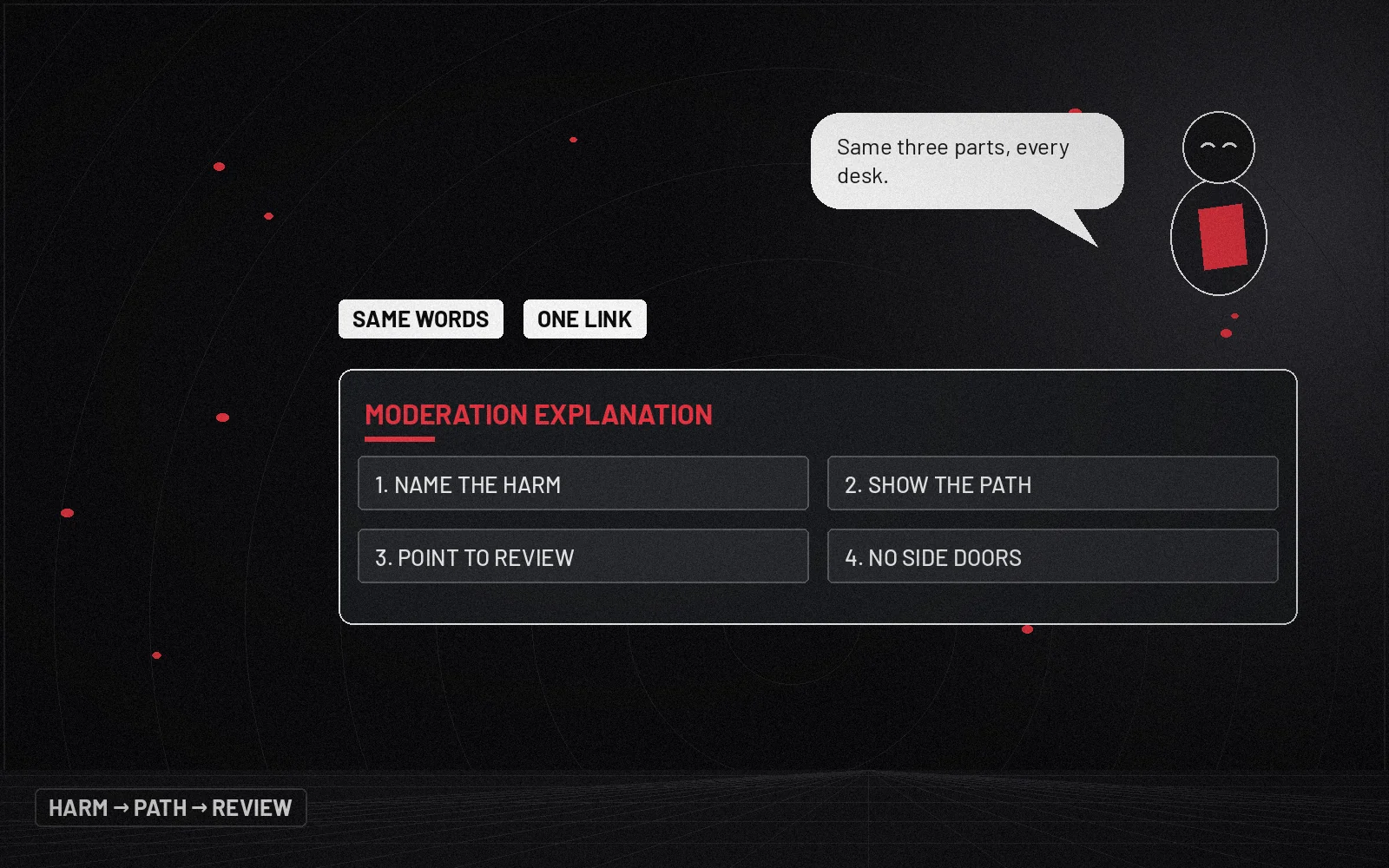
The moderation explanation card (original template)
Build one card per category of your published guidelines. Keep each card to one screen. Every team that touches a decision works from the same card, and nobody writes their own.
| Card field | What goes in it | Who signs it off |
|---|---|---|
| Public category name | Exact heading from your published guidelines | Trust and safety policy |
| One-line harm description | What the rule protects against, in plain English | Policy + communications |
| What we act on | Two or three plain examples, no edge cases | Policy |
| What we do not act on | One or two common misunderstandings | Policy + communications |
| The path | Report or detection, assessment, action options, who is notified | Operations |
| Review route | Official link and who decides on review | Operations + legal |
| Singapore note | Any local escalation route that applies, such as the OSC for covered harms | Regulatory / counsel |
| Kill list | Phrases nobody may use for this category | Communications |
The test: a new support hire reads the card once and explains a removal to an upset user without adding anything.
Repeatability matrix (who may say what)
Alignment is not everyone saying everything. It is everyone saying the same core and routing the rest. Use this matrix to decide what each role may explain on its own.
| Role | Names the harm | Shows the path | Points to review | Must route to |
|---|---|---|---|---|
| Customer support agent | Yes, from the card | Yes, for this case only | Yes, official link | Policy questions, legal threats, media |
| Community manager (public thread) | Yes, category only | General path only, no case detail | Yes, official link | Anything about a named user |
| Sales / partnerships | Yes, category only | No case detail | Yes, same link as users | Advertiser escalations to a named ops owner |
| Trust and safety reviewer | Yes | Yes | Yes | Media, regulator contact |
| Spokesperson | Yes | Yes, at system level | Yes | Case specifics to counsel |
| Regulatory / government affairs | Yes | Yes, with process detail | Yes | New commitments to leadership |
| Senior leaders at panels | Yes, category only | System level only | Yes | Anything numeric not in a published report |
A "No" is not secrecy. That role does not hold enough of the case to explain it without guessing, and a guess becomes the screenshot. If a role has no named owner in the last column, staff will improvise.
Internal and external alignment: one source, four surfaces
Your explanation appears in four places, and they must match.
- The public policy page. The category names and the review route live here first. If staff language and page language differ, change one of them this week.
- The notification to users. The message telling a reporter or an account holder what was decided should name the same category and carry the same review link.
- The staff script. Support macros, community replies and partner FAQs pull from the explanation card, not from a separate document.
- The external record. Transparency or annual safety reports, regulator correspondence and media lines describe the same system the user sees.
When one surface changes, all four change. One owner keeps them in sync and posts the change log to support and communications the day a policy update goes live.
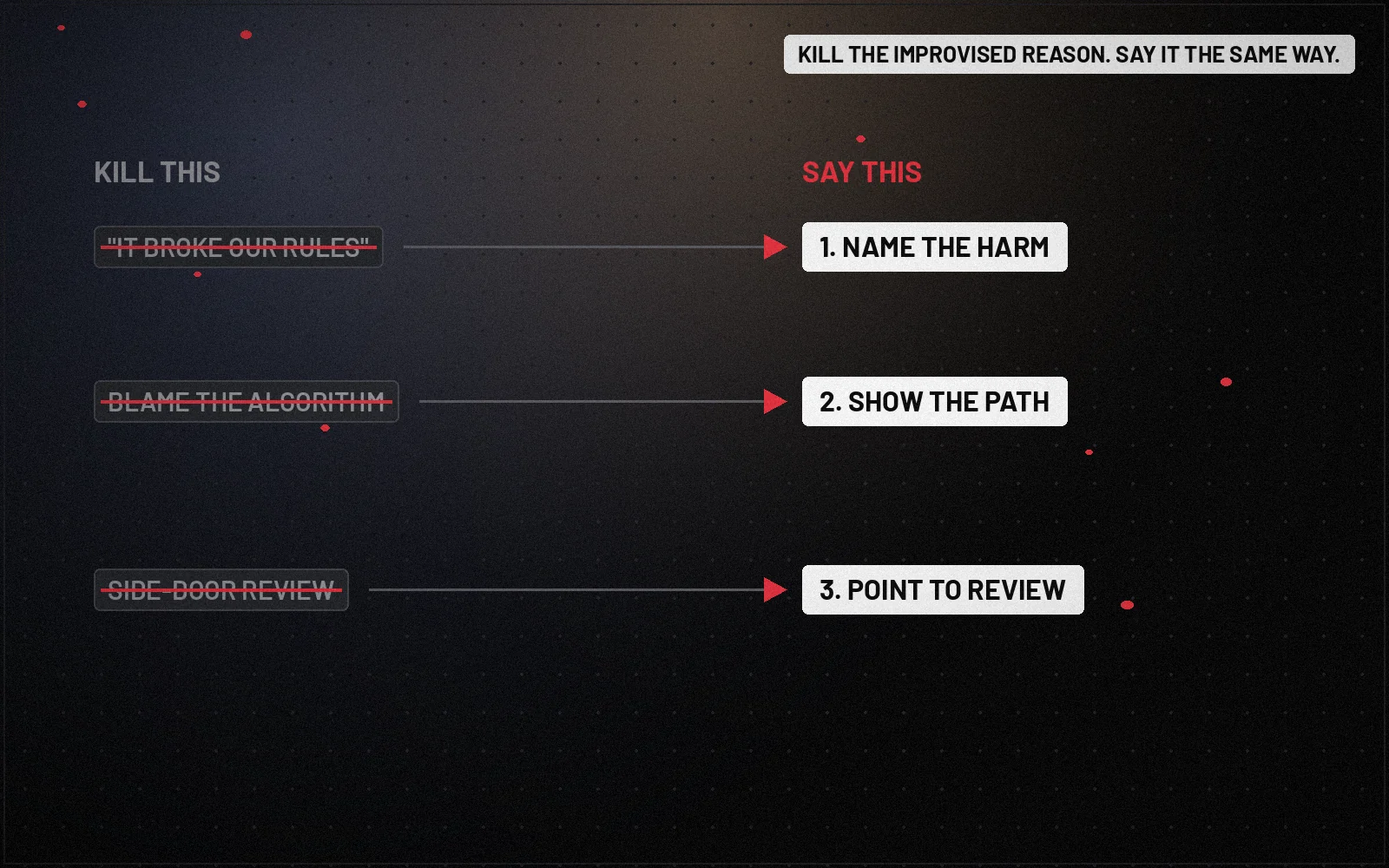
Kill this | Say this (moderation explanations)
| Kill this | Say this | Why |
|---|---|---|
| "It broke our rules." | "This was removed under our [category] rules." | Naming the published category lets the user check it. |
| "The algorithm did it." | "It was reported, assessed against our rules and removed." | Blaming a system sounds like nobody is accountable. |
| "Let me ask someone in the team." | "You can request a review here; the review team decides." | Side doors create a second, unofficial policy. |
| "It should be back in an hour." | "You will be notified when the review is decided." | Timing promises become broken commitments. |
| "Off the record, the rule is vague." | "The rule and examples are on this page." | Staff doubt travels as the company line. |
| "We take safety very seriously." | "Here is what we act on and how to report it." | Slogans answer nothing a user asked. |
Kill the habit of explaining a decision in your own words. Say the three parts out loud before anyone replies: name the harm, show the path, point to review.
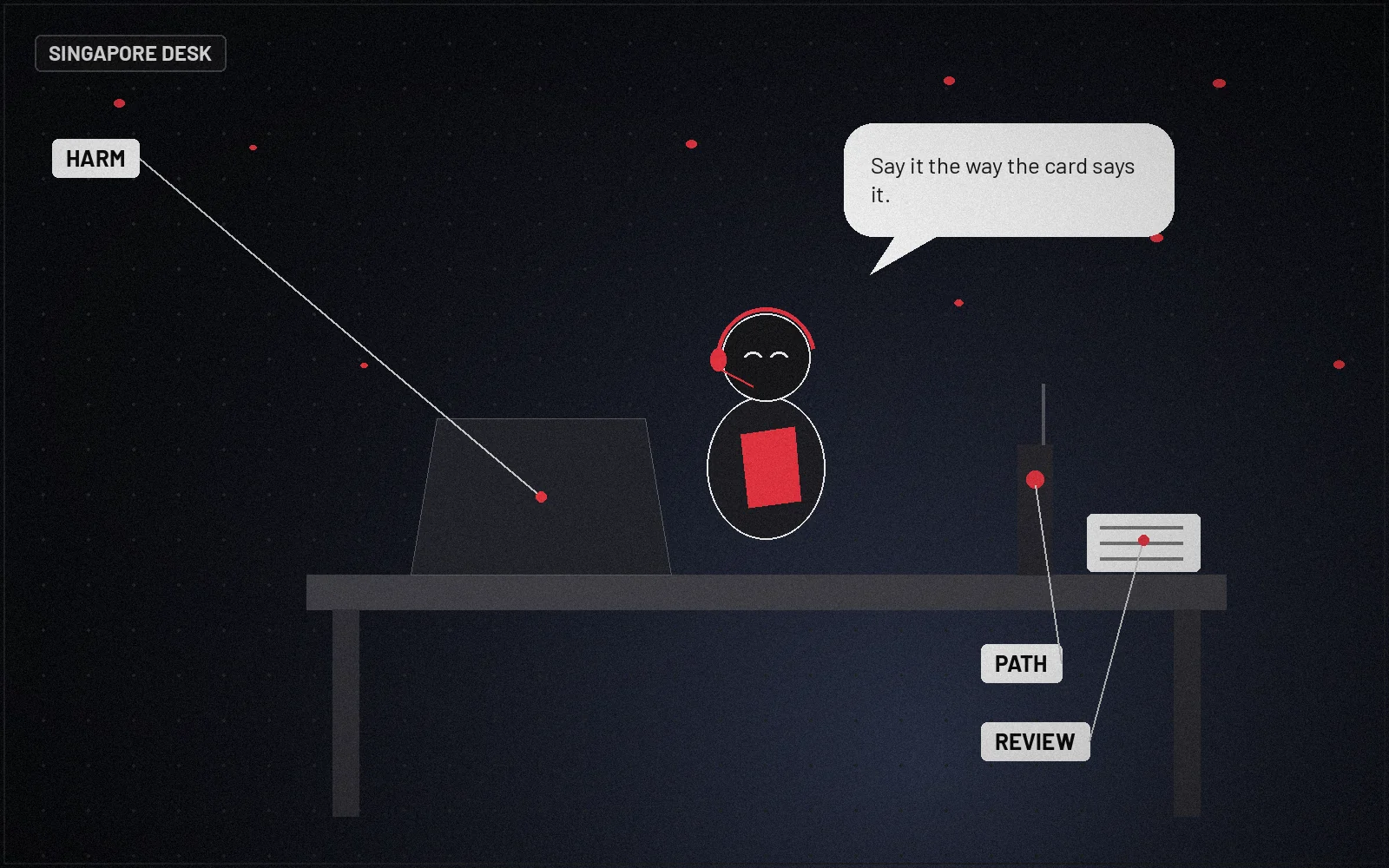
Desk notes: Singapore platform desk (SG-led)
Singapore corporate affairs desk. Own the explanation cards and the kill list. Run a monthly read-through of the support macros against the public guidelines page. If a macro says something the page does not, the macro is wrong until policy says otherwise. Keep the tech platform public affairs narrative stack beside the cards so regulator weeks and moderation weeks use one voice.
Regulatory / government affairs desk. Map each explanation card to the instruments that apply to your service: the IMDA Code if you are designated, the OSRAA duties if you are a platform receiving online harm notices, and any other sector rules. Know which phrases on the card would read as a commitment to a regulator. For the wider regulator landscape, use the Singapore regulator map for communicators.
Trust and safety / operations desk. Make sure the path described on the card is the path that actually runs. If notifications do not tell the user which category applied, the card cannot fix that. Escalate it as a product gap, not a communications problem.
Jakarta / Manila desk (supporting, not leading). When a regional team serves Singapore users from another office, they use the Singapore cards unchanged. Translate the words; do not adjust the rule for local tone.
Monday field kit: the repeat-back drill
Run this every Monday with one person from support, community, sales and communications. It takes 40 minutes.
Card check (10 minutes)
- Pick two explanation cards at random.
- Compare category names with the live public guidelines page, word for word.
- Confirm the review link on each card opens the right form.
Repeat-back drill (15 minutes)
- Give each person a real, anonymised case from last week.
- Each person explains the decision out loud in under 60 seconds.
- Score each answer: harm named, path shown, review pointed. Three out of three or rewrite the card.
Surface sync (10 minutes)
- Check that the newest user notification template carries the same category name and link.
- Check that the partner FAQ matches the support macro.
- Log any drift and name the owner who fixes it by Friday.
Escalation check (5 minutes)
- Confirm the named route for media, legal threats and regulator contact.
- Confirm support knows when an online harm notice must go to the trust and safety lead immediately.
If the same card fails two weeks running, fix the rule with policy before you rewrite the words.
Who this is for / who should skip
For you if you lead corporate affairs, public affairs, communications or regulatory work at a platform or company that moderates user content seen by people in Singapore, and your staff explain the same decision in different ways.
Skip if you need a legal opinion on whether your service is designated, prescribed or covered by a specific duty. That question goes to counsel with MinLaw's OSRAA overview and the IMDA Code in hand. This guide is about the words your people say once that answer is known.
What to do next
Pick your three most common moderation decisions. Write one explanation card for each using the template above. Run the repeat-back drill on Monday with support, community, sales and communications in the room. Any explanation that does not name the harm, show the path and point to review goes back for a rewrite before Friday.
For a Singapore government relations view of how your moderation explanations sit with regulators, start with our Singapore government relations team or go straight to contact.
FAQs
What should a content moderation policy explanation include in Singapore?
Three parts in order: the published category the decision falls under, what happened and what happens next, and the official review route. IMDA's Code for designated social media services expects users to be told the decision and action and to be able to request a review, so your explanation should match that structure.
Do these expectations apply only to the six designated social media services?
The IMDA Code applies to designated social media services. The OSRAA duty to respond reasonably to an online harm notice applies more broadly to online platforms, including messaging, video-sharing and gaming services. Counsel confirms which apply to your service; the explanation discipline works for all of them.