
Cone marks the edge, walk inside, leave it standing.
Street-smart APAC English: short sentences a tired operator can say out loud.
Quick answer: A traffic-cone line English APAC is the site marshal’s rule for temporary edges on event grounds: cone marks the edge, walk inside, leave it standing. Cones show the safe path, people walk inside the line, and nobody kicks a cone aside to cut a corner.
Cebu, an outdoor festival site after lunch, and a line of traffic cones marks the edge of a soft ground patch. Guests kick two cones aside to cut toward the gate. A marshal puts them back, then finds them moved again before the next song.
A cone only marks an edge if people walk inside it and leave it standing. Read it alongside the stanchion reset line English APAC and the crowd barrier line English APAC.
What is a traffic-cone line English APAC?
It is a site marshal’s three-part rule at a temporary edge on event grounds. Edge first, inside second, standing third.
1. Cone marks the edge. Place cones so the edge is obvious. The cone marks where safe ground ends.
2. Walk inside. Tell guests to walk inside the cone line. Do not send them across the marked patch.
3. Leave it standing. Leave every cone standing. If one falls, set it back up before you move on.
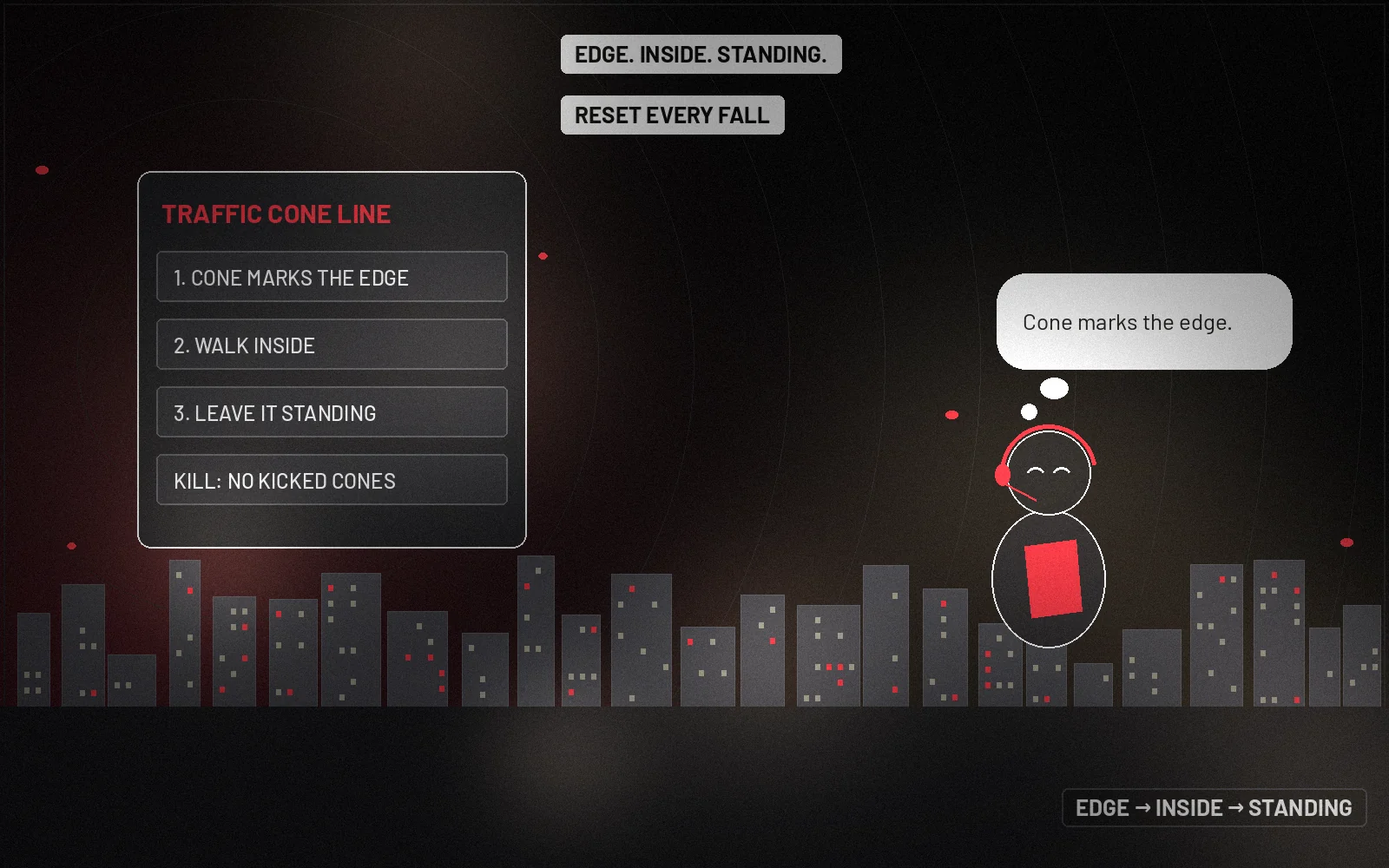
The habit to break is the quiet shortcut. Guests move a cone, marshals shrug, and the edge disappears.
What should a site marshal stop saying at the cone line?
Stop letting people kick cones aside, and stop leaving a fallen cone on the ground. Say the three cone parts when the line goes down instead.
| Kill this | Say this (illustrative) | Why |
|---|---|---|
| Alisin na lang po muna yung cone, daanan natin. | Cone marks the edge. | The cone is the edge people can see (PH Tagalog habit) |
| Just move the cone lah, shortcut to the gate. | Walk inside. | Walking inside keeps feet off the hazard (SG lah habit) |
| Singkirin aja conenya, Pak, biar lewat. | Leave it standing. | A standing cone still warns the next group (Jakarta Bahasa habit) |
Lines in this table are illustrative, not quotes from real people.
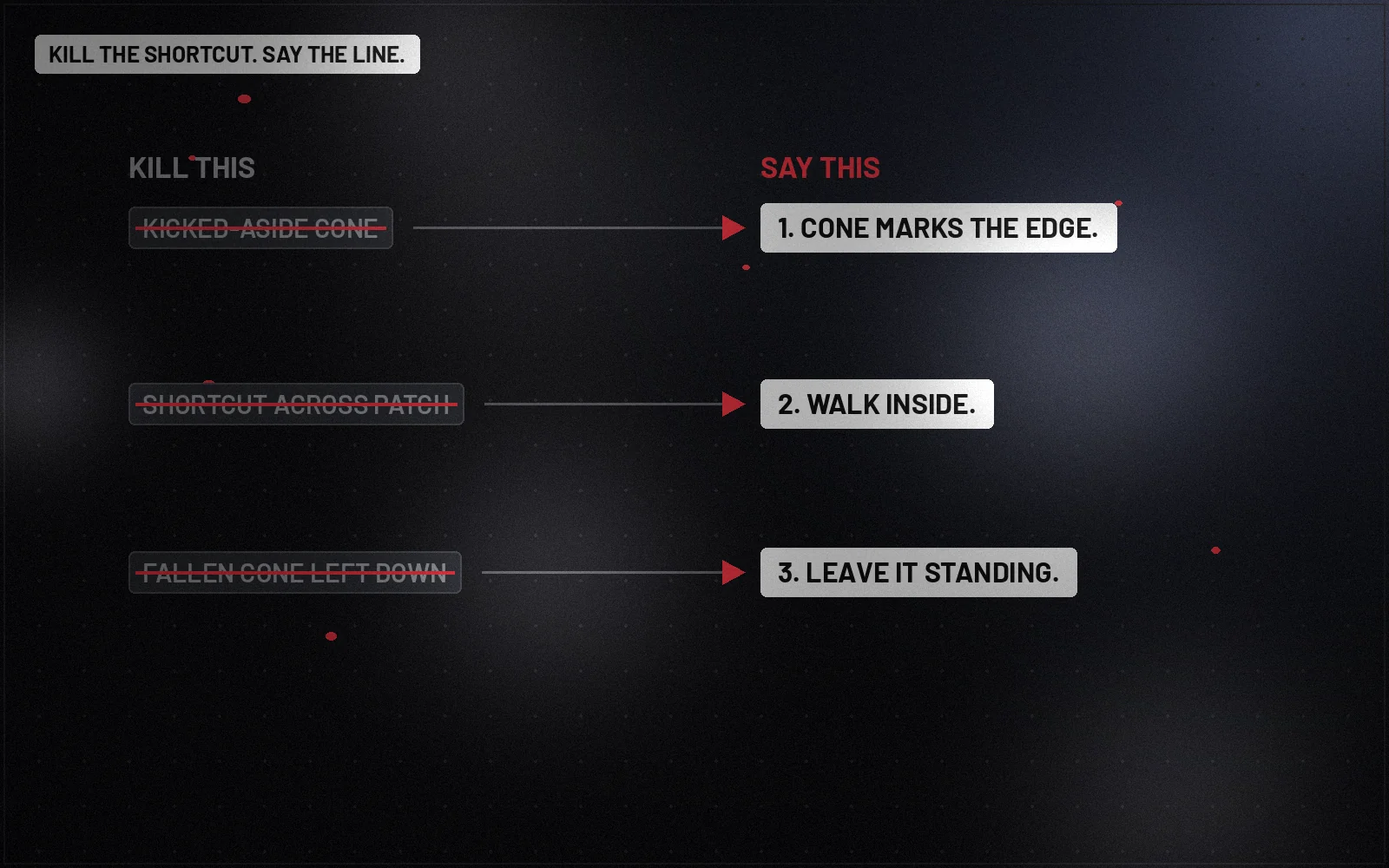
Say the line when the cone line goes down, and again after each break when shortcuts start.
What if a vendor needs to drive across the cone line?
Do not pull a long gap in the cones for convenience. Radio the site lead for an agreed crossing point and a marshal to hold it.
Who plans the traffic-cone edges before gates open?
The site manager plans it with the safety lead, using the ground plan. They mark soft patches, vehicle routes and where cones must stay overnight.
PH / SG / Jakarta desk notes
Same three parts. Different desks.
Philippines desk. Warm and clear. Cone marks the edge po. Walk inside po, sir. Leave it standing po, salamat.
Singapore desk. Brisk and even. Cone marks the edge. Walk inside. Leave it standing. Thank you.
Jakarta desk. Jakarta outdoor crews often mix Bahasa with English radio calls. Keep the three parts in English and use Bapak or Ibu only if the house style asks for it.
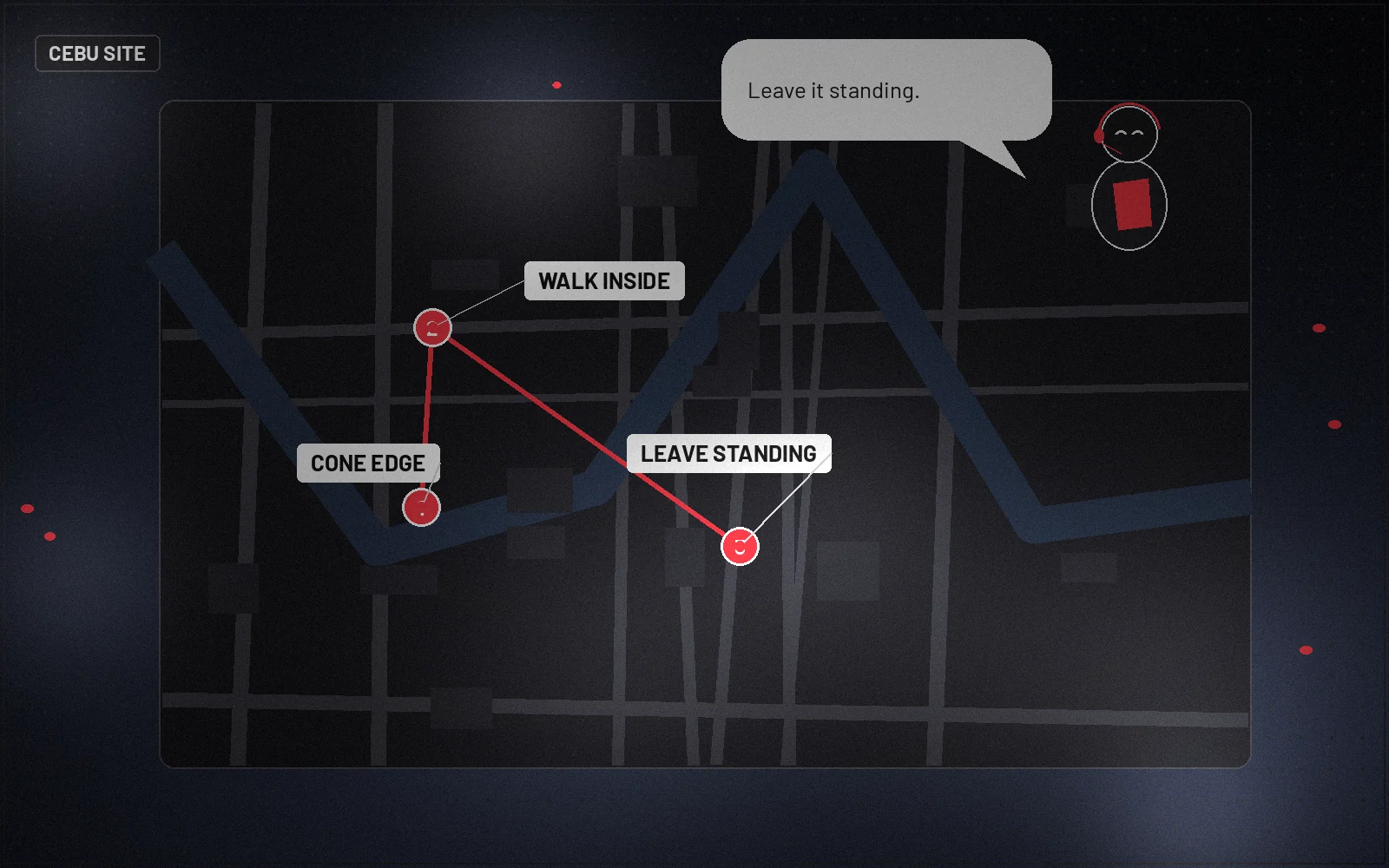
Monday field kit
- Mark cone edges on the ground plan with the site manager.
- Set the line before gates and photograph the pattern.
- Brief marshals on the lock: cone marks the edge, walk inside, leave it standing.
- Practise one vehicle crossing with a held gap and a reset.
- Kill rule: no kicked cones, no shortcuts across the patch, no fallen cones left down.
Illustrative only. Follow the site’s own safety plan; this wording is a template.
FAQs
What is a traffic-cone line English APAC?
A traffic-cone line English APAC is the site marshal’s rule for temporary edges on event grounds: cone marks the edge, walk inside, leave it standing. Cones show the safe path, people walk inside the line, and nobody kicks a cone aside to cut a corner.
What should a site marshal stop saying at the cone line?
Stop letting people kick cones aside, and stop leaving a fallen cone on the ground. Say edge, inside, standing, in that order.
What if a vendor needs to drive across the cone line?
Radio the site lead, open only a held gap, then reset the cones at once. Never leave a long hole in the line.
Who plans the traffic-cone edges before gates open?
The site manager plans cone edges with the safety lead on the ground plan. Marshals brief the line and reset after breaks.
What to do this week
Speakable lock (illustrative): “Cone marks the edge, walk inside, leave it standing.”
Walk the cone line after one programme break with your site manager and count how many cones have moved. Site wording like this starts at our Manila HQ in Makati and gets a second read from the team at MBFC Tower 2 in Singapore before marshals use it.
Neuwark Communications builds event and campaign communications as part of our strategy and messaging work. More street-smart lines live in Insights.
Related: stanchion reset line English APAC · crowd barrier line English APAC
Talk to us about your next event script.
Illustrative lines only. Communications craft, not legal advice.