
Political news becomes brand risk the moment a customer asks your local GM what the company “believes.” On 18 September 2026, Malaysia’s Pardons Board allowed Najib Razak to serve the remainder of his sentence under house arrest (conditional on an RM50 million fine). Transparency International Malaysia and analysts immediately flagged anti-graft credibility and investor-perception risk. Corporates got the group-chat question within hours: where do you stand? Silence versus statement is a revenue decision in MY/SG supply chains. That is the money job behind brand reputation political scandal Malaysia—reputation and public-affairs retainers for spillover weeks, not hot takes.
Neuwark runs reputation and PA retainers for brands in MY, SG, and PH that need sequenced statements and proof discipline without entering the partisan lane. Soft path: Services · Contact.
When national politics becomes a brand question in group chats
Spillover starts small: a WhatsApp from a key account, an employee Slack thread, a partner asking for “just a line for our ESG note.” If you have no decision tree, the loudest person in the chat invents your position.
Treat political shocks as brand-risk events with the same seriousness as a product recall—except you often should not issue a loud public statement. The skill is knowing which.
Use your hubs on public affairs narrative for unpopular policy and opposition research ethics in communications as guardrails. Ethics and narrative discipline matter more when the news is radioactive.
Silence vs statement: a revenue decision, not a mood
Ask four revenue questions:
- 1. Will silence cost renewals, tenders, or bank relationships this quarter?
- 2. Will a statement create a second fight you cannot win?
- 3. Are employees being asked to defend the company in public?
- 4. Do investors need a governance reassurance call—not a press release?
If the answers lean “internal clarity, external quiet,” write internal lines and GM scripts first. Public statements are optional; vacuum inside the company is not.
Stakeholder sequence: employees, customers, investors, partners
Sequence beats volume:
- 1. Employees — what we will and will not say; who answers media.
- 2. Priority customers — private reassurance where contracts require it.
- 3. Investors / lenders — governance language, not political commentary.
- 4. Partners — joint-post rules; no freestyle LinkedIn from local leads.
Skipping employees to chase a media quote is how you get screenshots of confused staff. Sequence is reputation hygiene.
Proof discipline: what you can say without entering the partisan lane
Safe lanes usually include: commitment to lawful conduct, anti-bribery policies, governance processes, and how you handle integrity incidents inside your own house. Unsafe lanes: cheering or condemning specific political actors, memeing the news, or borrowing activist slogans your board never approved.
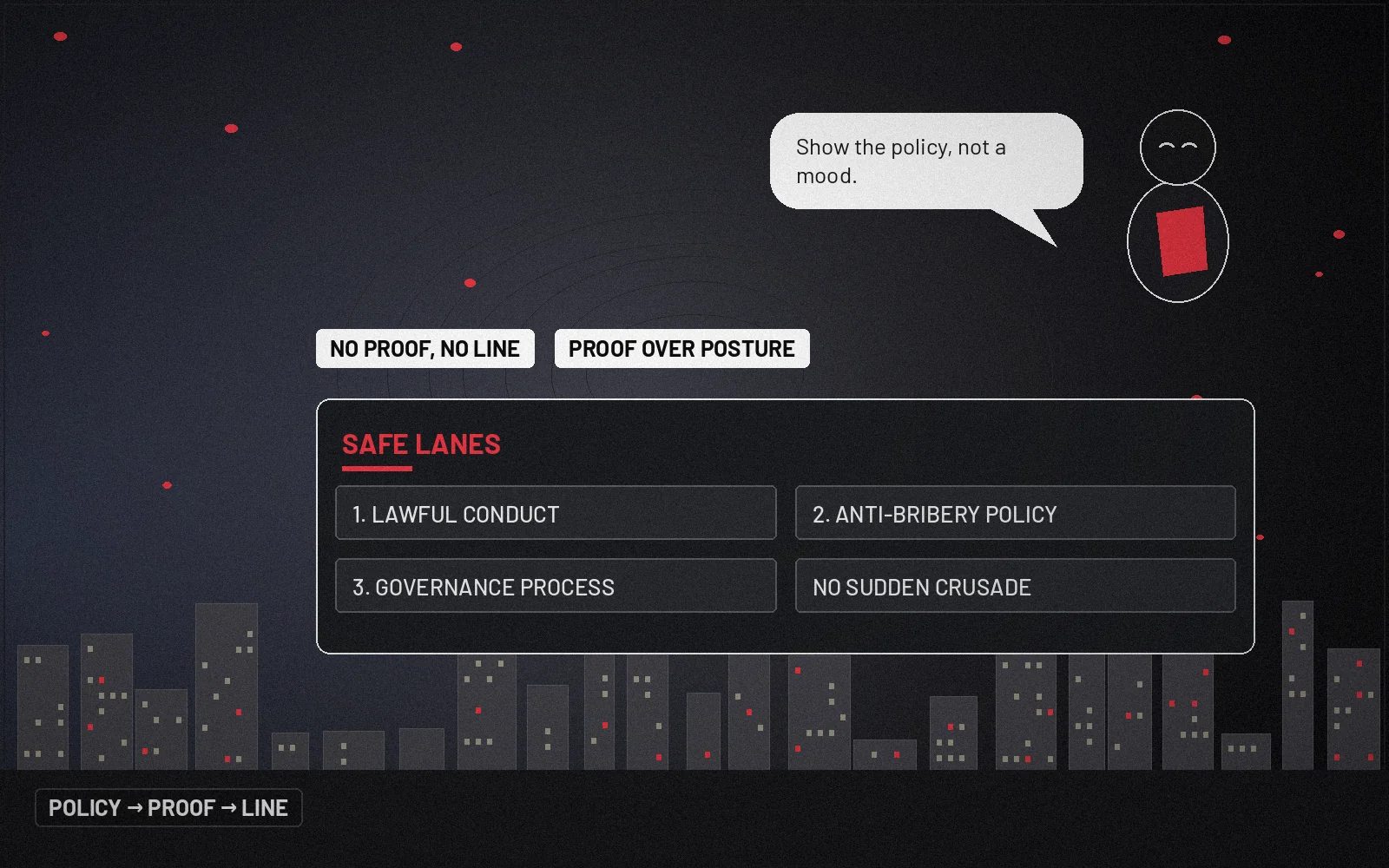
Proof means pointing to policies and behaviors you already run—not inventing a sudden crusade. If you cannot show it, do not say it.
MY/SG supply-chain spillover: local GM scripts that hold
Arm GMs with three cards:
- Customer ask — short, non-partisan, points to company integrity policy.
- Employee ask — same spine, plus “refer media to HQ.”
- Partner ask — no joint statements without clearance.
Scripts should be boring. Boring survives. Clever dies in the next news cycle.
Retainer operating rhythm for political-spillover weeks
A reputation retainer in spillover weeks should include:
- 24–48 hour decision tree workshop (pre-built, then activated).
- Monitoring for brand-adjacent political keywords.
- Internal/external line drafts with legal checkpoints.
- GM script pack for MY/SG.
- After-action: what to keep when the news moves on.
Project-only PR arrives late and loud. Retainers arrive early and quiet—which is usually the point.
Decision tree you can laminate
- 1. Is there a direct operational impact (contracts, licenses, banking)?
- 2. Are employees being pressured to answer publicly?
- 3. Is a key customer demanding a written position?
- 4. Would a public statement create a second front?
If 1–3 are no and 4 is yes → internal clarity only. If 1 or 3 is yes → private stakeholder communications first; public only if required. If 2 is yes → employee pack same day regardless of public posture.
Laminate it. Mood is a bad CMS.
What “proof discipline” looks like in writing
Good: “We enforce our anti-bribery and integrity policies across markets, including training, third-party due diligence, and escalation channels. Questions about political developments are referred to our policy framework—not individual commentary.”
Bad: “We stand with / against [politician]” or meme-adjacent posts from official accounts.
Good writing is dull and defensible. Dull is a feature.
Banking, ESG, and tender spillover
MY/SG supply chains often surface integrity questions through banks and ESG questionnaires before they surface in newspapers. Prep:
- Short governance addendum for RFPs
- Named contact for integrity diligence
- Consistent language with your public policies
Inconsistency between ESG PDF and WhatsApp GM improvisation is how you lose quiet tenders.
Employee mental load and social amplification
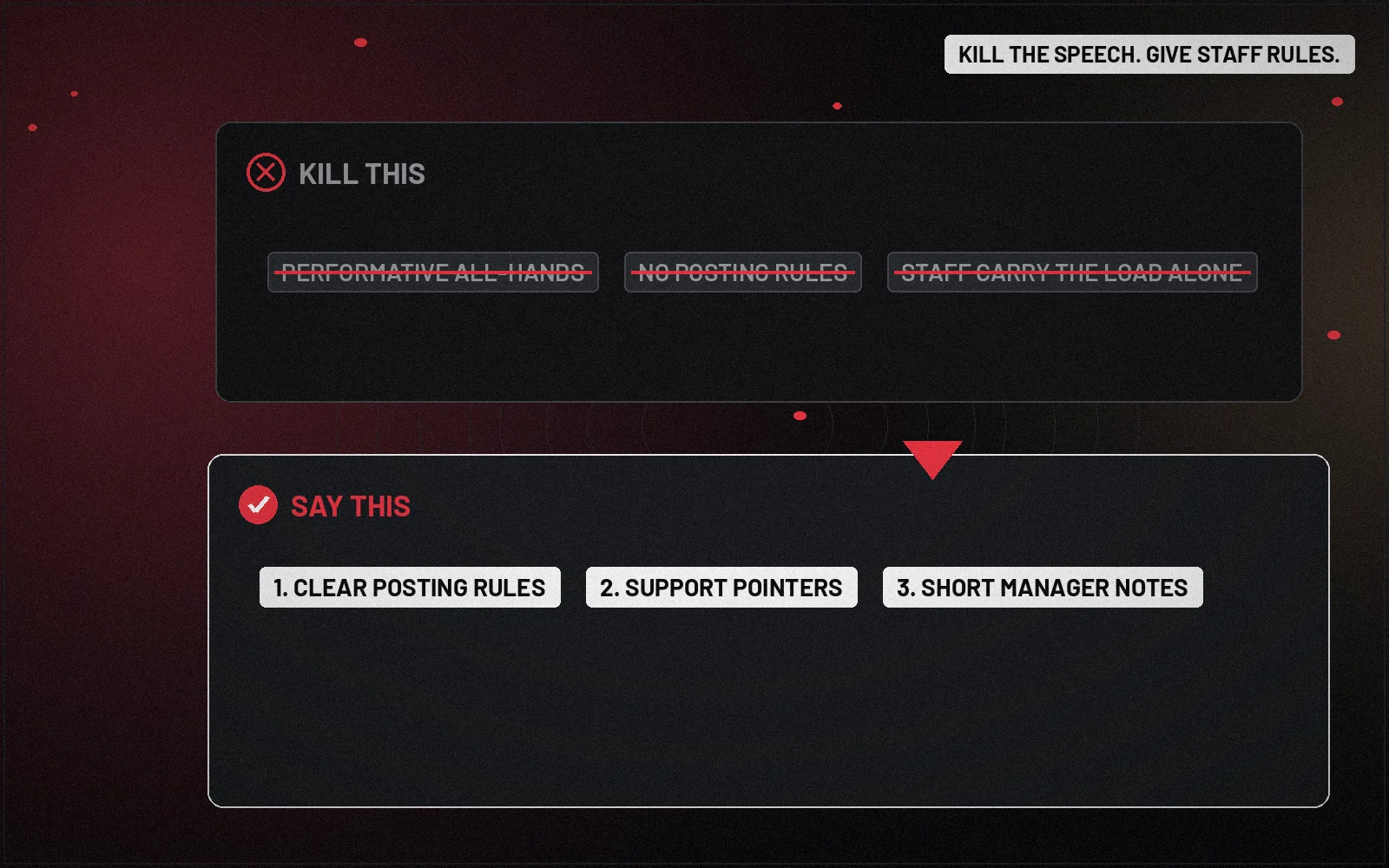
Political weeks exhaust staff. Do not add performative all-hands speeches. Do give clear rules, EAP/support pointers where relevant, and a ban on official-channel freestyle. Social amplification turns one confused post into a brand event. Kill the freestyle path early.
After-action when the news moves on
Within ten days:
- Archive which lines worked
- Note which customers needed private calls
- Update the decision tree
- Decide what stays in the retainer vs what was one-off
Spillover weeks teach. Companies that skip after-action relearn the expensive way next time.
How this connects to broader APAC reputation ops
Malaysia’s week will not be the last political spillover in the region. Pair this playbook with weekly reputation monitoring so you are not surprised twice. Reputation retainers exist so group-chat questions meet a system—not a shrug.
Tabletop: ninety minutes that save a week
Run this before the next shock—or immediately after the first group-chat ask:
0:00–0:15 — Facts sheet: what is known, unknown, and out of scope for brand comment. 0:15–0:35 — Silence vs statement using the revenue questions. 0:35–0:55 — Draft employee note + GM customer card. 0:55–1:10 — Legal/comms clearance simulation (timer on). 1:10–1:30 — After-action: bottlenecks, missing owners, SOW gaps.
If clearance takes forty minutes in a drill, it will take a day in real life. Fix authority, not adjectives.
Channel rules that prevent screenshot disasters
- Official social: freeze political commentary unless pre-cleared.
- Employee advocacy: remind that personal posts ≠ company positions; do not police private life beyond policy.
- Partner co-branding: joint posts require dual clearance.
- Executive LinkedIn: HQ message discipline applies to personal-brand accounts used as de facto corporate channels.
Most spillover crises are screenshot crises. Design for the forward.
Investor and lender language samples
Keep it governance-centered:
“We monitor developments that could affect the operating environment. Our focus remains on compliance, anti-bribery controls, and transparent engagement with stakeholders. We do not issue political endorsements.”
That sentence is reusable across shocks. Reusable is valuable.
When NGOs and media ask for “a stand”
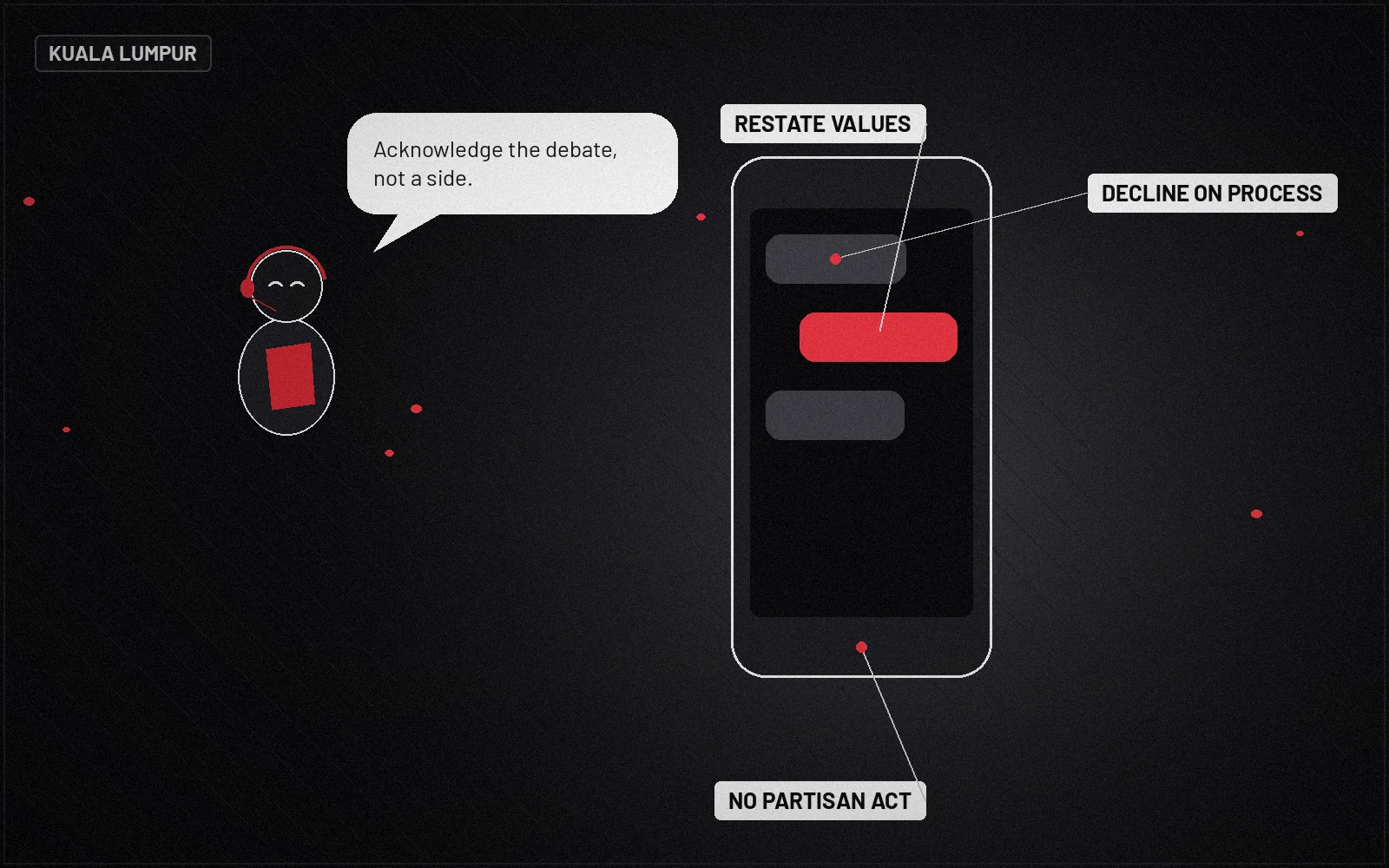
You can acknowledge the public debate without becoming a partisan actor. Options: decline comment on political-legal processes; restate integrity policies; offer process interviews about your own compliance—not commentary on individuals. Train spokespeople to end answers cleanly. Rambling is how brands wander into lanes they cannot defend.
Cross-border MY–SG–PH coordination
If your hub is Singapore and ops are in Malaysia, HQ silence with local freestyle is a classic failure. One spine, local delivery. Time-zone on-call for spillover weeks should include both market leads. PH teams watching the same news cycle need the same “no freestyle” rule even if impact is lighter—screenshots travel.
Retainer artifacts checklist
- Decision tree one-pager
- Employee note template
- GM scripts (customer / employee / partner)
- Monitoring keyword list (brand + integrity + market)
- Approval RACI
- After-action form
If artifacts do not exist before midnight, you will invent them badly after midnight.
FAQ blocks for spillover weeks
Do we need a public statement today? Only if revenue questions and stakeholder pressure demand it. Start with employees and priority customers.
Can local GMs improvise? No. Use cleared cards. Improvisation becomes the screenshot.
Is silence complicity? Not automatically. Silence with internal clarity and policy proof is often the adult path. Silence with chaos inside is negligence.
How do we talk to media? Refer to named spokespeople; stay on governance lanes; decline political commentary cleanly.
Put FAQs in the retainer pack so nobody invents answers under adrenaline.
Soft CTA: Malaysia brand reputation / PA retainer
Brand reputation political scandal Malaysia is not a content theme—it is an operating system for weeks when national politics lands in your group chats. If your MY/SG supply chain can ask “where do you stand?” you need silence/statement rules before the next shock.
Neuwark scopes reputation and public-affairs retainers for that exact job. See Services, About, Contact, and Insights. Map the desk from [home](/) if you are new to the offer set.
Political news will keep spilling. Your brand does not have to spill with it.