
When the ministry scores your model on values, your product page is already a public-affairs document. Around 2 September 2026, Taiwan’s AI Evaluation Center (AIEC) published sovereign-AI results: 188 models scored on language, social-cultural understanding, and Taiwanese values—with domestic models hitting top-10 and full marks on values, and MoDA framing evaluation as a marketing and trust tool. Parameter-count boasts just got less interesting. Taiwan sovereign AI brand communications is now about converting scores into B2B proof buyers can cite—without sounding like a press-release leaderboard.
Neuwark builds corporate PA plus GEO inbound for Taiwan AI and tech brands touching TW, HK, JP, and KR. This playbook is the money rewrite: trust currency, proof stacks, and crisis adjacency when a score slips. Soft CTA: Services · Contact.
Why AIEC scores are trust currency, not a vanity leaderboard
Leaderboards invite swagger. Trust currency invites procurement. AIEC’s framing—language, social-cultural understanding, Taiwanese values—moves the conversation from “how big is your model” to “can we defend this choice to a board, a regulator, and a customer.”
For B2B buyers in Taiwan and the region, scores become short answers in RFPs and answer engines. If your site still leads with FLOPs and parameter poetry, you are speaking last year’s dialect.
Treat scores like audited claims: cite carefully, date them, and pair them with product behavior humans can verify. Vanity screenshots without context die in diligence.
From parameter counts to values: what buyers actually need to hear
Buyers need three sentences:
- 1. What the score measured (in plain words).
- 2. What that means for risk in their use case.
- 3. What you do when performance or values metrics move.
They do not need a victory lap. They need confidence that you will not surprise them with cultural or compliance failure. That is why Taiwan sovereign AI brand communications sits next to public affairs—not only product marketing.
Connect this to your GEO discipline on GEO content engines for political and agency inbound and privacy-adjacent narrative on Japan APPI AI data communications. Trust stories travel across desks.
Product page as public-affairs document: rewrite the proof stack
Rewrite the hero and proof stack:
- Hero — trustworthy AI for Taiwan-context work, not “world-class model.”
- Proof block — AIEC-relevant results with date, scope, and limitations.
- Use-case proof — what a bank, hospital, or public-sector buyer can do safely.
- Governance — escalation, human review, update cadence.
- FAQ — what happens if a score changes; what the score does not mean.
If an answer engine summarizes your page into three sentences, those sentences should still be true. That is GEO hygiene and PA hygiene at once.
MoDA-adjacent narrative without sounding like a ministry release
You can be adjacent to national AI evaluation without cosplaying as MoDA. Rules:
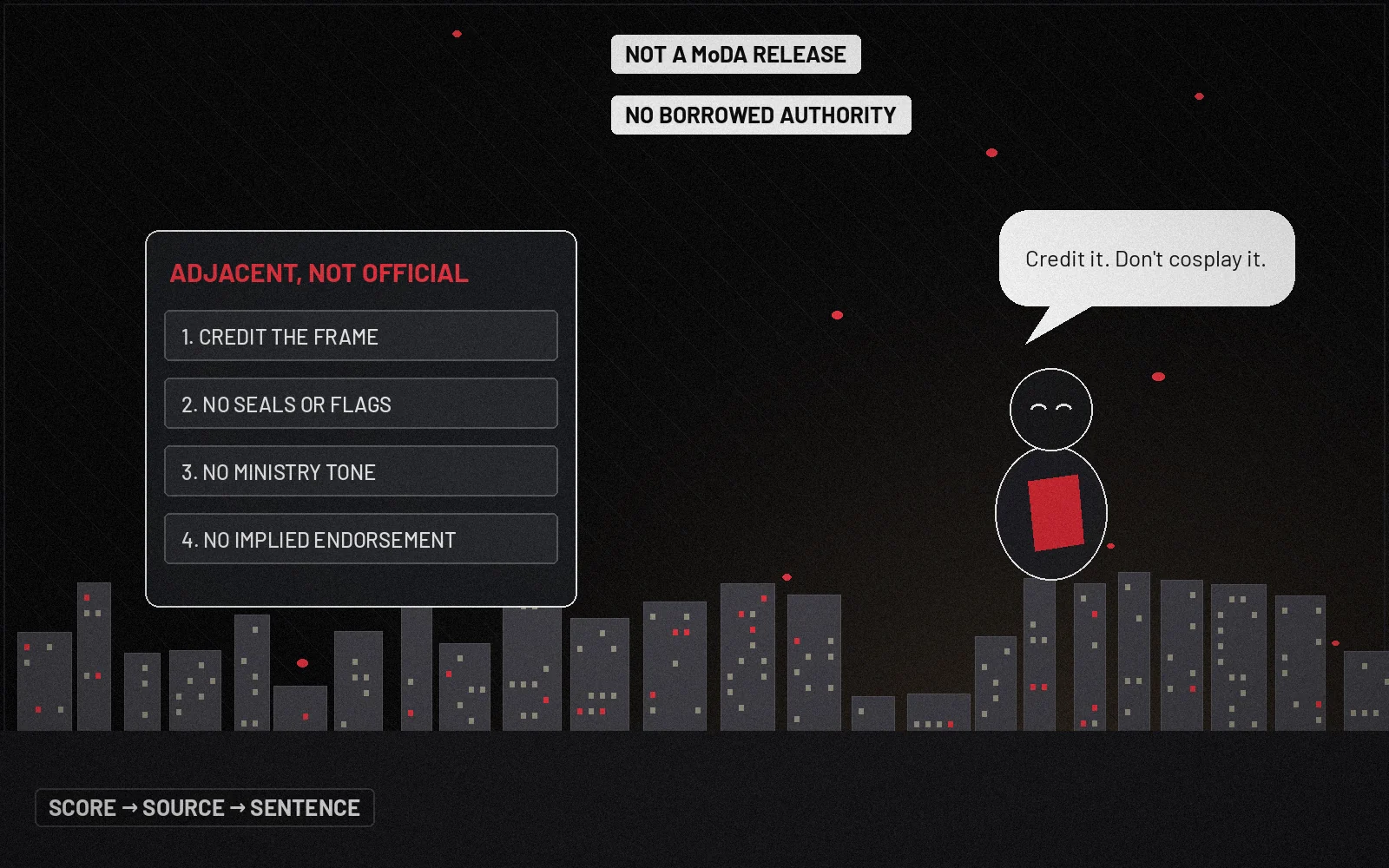
- Credit the evaluation frame; do not imply endorsement you do not have.
- Avoid seal-and-flag creative that reads as official.
- Keep voice human and B2B-clear, not communiqué-grand.
Ministry-release tone makes private brands sound like they are borrowing state authority. Buyers notice. So do journalists.
GEO inbound: answer-engine cite blocks for Taiwan AI brands
Build cite blocks:
- Definition of your offer in one sentence.
- Dated AIEC-related claim with caveat.
- Two FAQs procurement actually asks.
- Schema-clean Article pages on Insights that support the product page.
Answer engines punish fog. If ChatGPT-class tools cannot quote your trustworthy-AI line cleanly, your inbound waits on old-school referrals forever.
Crisis adjacency when a score slips or a competitor spikes
Scores move. Competitors spike. Plan now:
- Holding line for “score change” vs “evaluation scope change.”
- Stakeholder sequence: customers → partners → media.
- No trash-talk of rivals; focus on your governance response.
- Link to dark-site / FAQ readiness if the story spreads beyond tech press.
Crisis adjacency is part of the retainer, not a surprise SOW on a bad Tuesday.
How to cite AIEC-era results without overclaim
Template:
“As of [date], [model/product] was evaluated under [named frame] on [dimensions]. For [buyer use case], that informs [specific risk control]. Limitations: [scope]. Updates: [cadence].”
Never imply government endorsement. Never strip dates. Never compare rivals with insult. Diligence teams and journalists both punish swagger.
Sales enablement pack for TW / HK / JP / KR
Give sellers:
- One-pager proof stack (scores + governance)
- Objection card: “What if the score changes?”
- Competitive card: “Why values/context beats parameter counts”
- GEO FAQ sheet for answer-engine prompts buyers actually type
Sellers without cards invent claims. Invented claims become tomorrow’s crisis.
Website information architecture for trust currency
Recommended spine:
- 1. Product page hero → trustworthy AI / Taiwan-context fit
- 2. Proof section → dated evaluation language
- 3. Governance → human review, escalation
- 4. Insights articles → cite-ready explainers
- 5. Contact → scoped PA / GEO conversation
Orphan blogs that never touch the product page waste the AIEC moment. Interlink aggressively but cleanly.
Working with legal and compliance without freezing the page
Legal should clear claim boundaries, not rewrite marketing into sludge. Bring them:
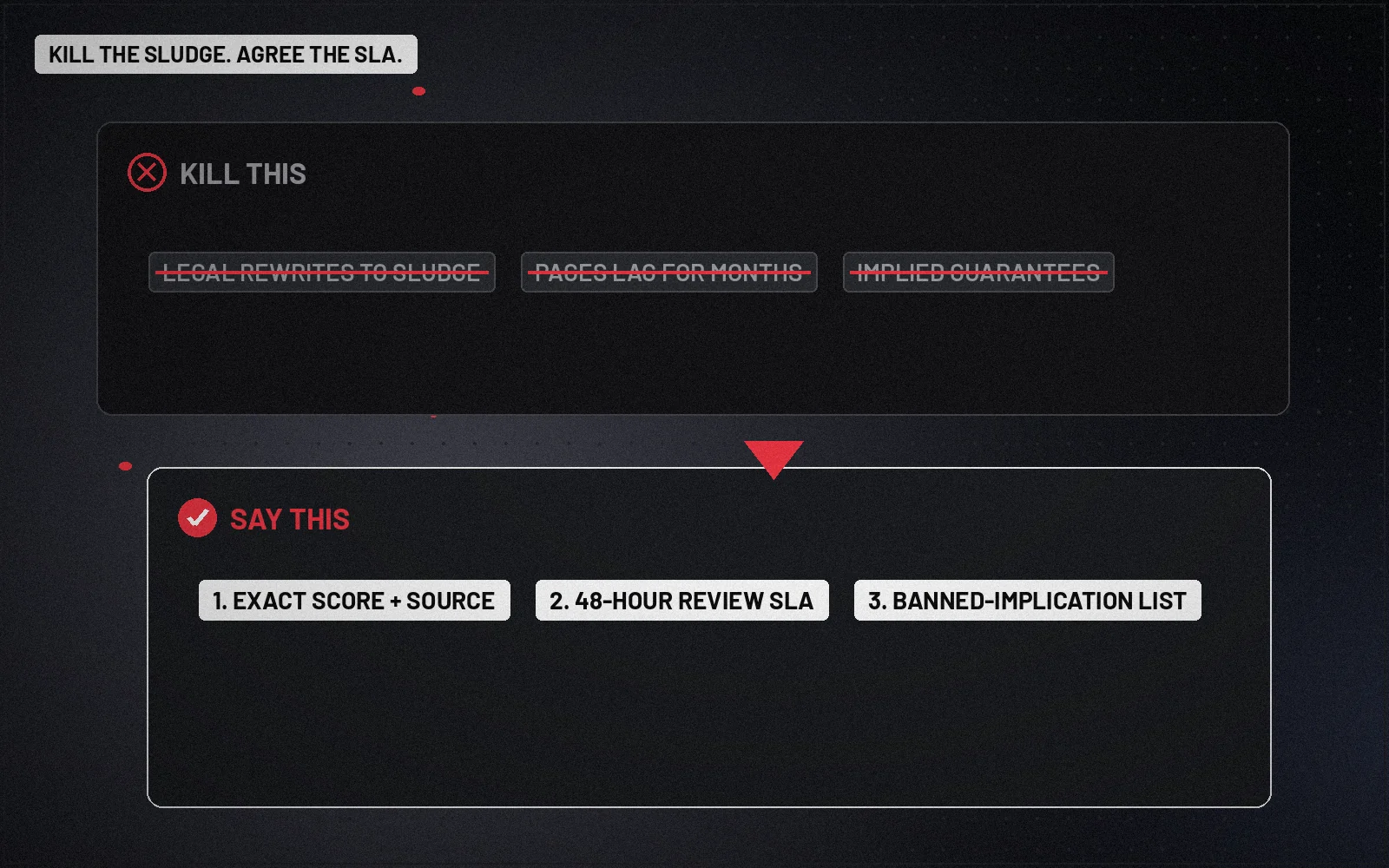
- Exact score language with sources
- Proposed customer-facing sentences
- A list of banned implications (endorsement, guarantees, rival digs)
Agree a 48-hour review SLA for evaluation-related updates. Trust currency decays when pages lag the news by months.
Scenario drills: score slip and competitor spike
Score slip drill (45 minutes): draft holding lines, customer email, FAQ update, internal note. Time the approval path. Fix bottlenecks while calm.
Competitor spike drill: respond with your governance story, not trash talk. Update GEO FAQ. Brief sellers same day.
Drills are cheaper than improvisation after a Tech news cycle.
What “GEO inbound” looks like for Taiwan AI brands
Publish Insights that answer:
- What sovereign AI evaluation means for enterprise buyers
- How to read values/cultural scores without mythology
- How privacy regimes (JP APPI adjacency, KR PIPA lessons) interact with AI trust narratives
Then IndexNow and Rank Math hygiene so discovery systems see freshness. Trust stories that never get indexed are diary entries.
Buyer personas that actually care about AIEC-era proof
Enterprise IT / risk. Wants governance, escalation, and “what breaks if scores move.” Public-sector-adjacent buyers. Wants cultural/context fit without political theater. Regional HQ in HK/SG. Wants a cite-ready paragraph for group diligence. Startups selling into TW enterprises. Wants credibility without fake ministry cosplay.
Each persona needs the same spine with different proof depth. Do not write five contradictory stories.
Content examples that convert without swagger
- “How we read values scores for [industry] buyers” (Insights)
- “Human review steps in our Taiwan-context deployments” (product docs)
- “What our evaluation claims do not cover” (FAQ honesty)
- “Update log when evaluation frames change” (trust calendar)
Honesty sections convert more than trophy shelves. Buyers who fear lock-in reward clarity.
Competitive narrative without trash talk
When a rival spikes on a leaderboard, respond with your governance and use-case fit. Never dunk. Dunking reads insecure and creates quote opportunities against you. Your line: “Buyers should ask every vendor—including us—how scores map to risk controls and update cadence.”
That line is adult. Adult wins diligence.
Internal enablement timeline (30 days)
Week 1: audit product page claims; draft proof stack. Week 2: legal clearance; seller cards; FAQ. Week 3: Insights cite pieces live; Rank Math + IndexNow. Week 4: score-slip drill; competitor-spike drill; after-action.
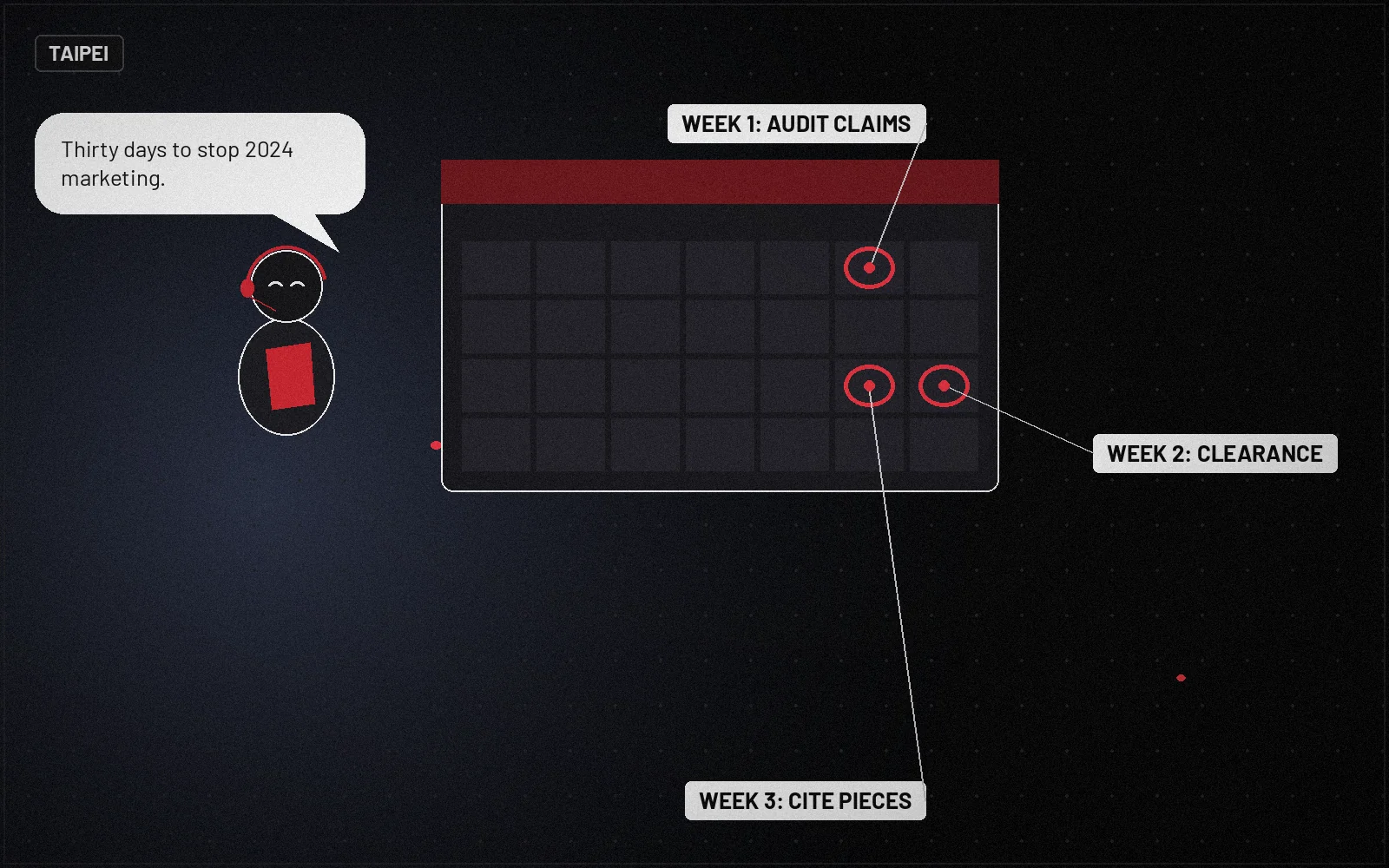
Thirty days is enough to stop sounding like 2024 parameter marketing.
Regional spillover: HK, JP, KR readers
HK buyers often mediate regional diligence—write English cite blocks tightly. JP readers connect AI trust to privacy and data integrity narratives; cross-link carefully to APPI-aware content without mixing regimes. KR buyers bring PIPA-era sensitivity to breach and trust language—do not invent Korea claims from Taiwan scores. Localize humility.
The money sentence for retainers
Taiwan sovereign AI brand communications retainers sell: proof-stack maintenance, GEO cite cadence, seller enablement, and crisis adjacency for score movement. That is billable monthly work with a clear artifact trail—not a one-time press release about a ranking day.
FAQ blocks worth shipping this month
What does an AIEC-related score mean for enterprise risk? It is one input into cultural/context fit and trust evaluation—not a warranty. Pair it with your governance controls.
Can we claim government endorsement? No. Cite evaluation frames carefully; do not imply seals you do not have.
What if a competitor outranks us next quarter? Lead with use-case fit and update cadence. Rankings move; your control story should not panic every cycle.
Where should this live on the site? Product proof stack, FAQ, and at least one Insights explainer with Rank Math hygiene.
Ship these FAQs in plain language. Answer engines and humans both reward them.
Soft CTA: Taiwan sovereign AI brand communications engagement
Taiwan sovereign AI brand communications is trust work with a commercial clock. If AIEC-era buyers are shortlisting on values and cultural fit, your product page and Insights need to speak that language—with proof, not leaderboard theater.
Neuwark scopes corporate PA and GEO inbound for TW-touching AI and tech brands. See Services, About, Contact, and the Insights library. Start [home](/) if you need the full map.
When values get scored, marketing becomes public affairs. Write like it.