

On 17 September 2026, Japan's Personal Information Protection Commission outlined how amended APPI rules will treat consent exceptions for statistical and AI training uses, plus biometric and children's data rules—after July 2026 promulgation, staged through 2028. For brands building content and GEO engines aimed at Japan, that sketch is a communications problem as much as a legal one.
Japan APPI AI data communications means privacy messaging sharp enough for answer engines to quote—without sounding like a GDPR copy-paste that Japanese buyers and partners immediately distrust.
Neuwark Communications sells GEO and content inbound systems paired with privacy-narrative public affairs. Schema will not save you if your Japan privacy story feels imported.
What PPC's APPI AI-data sketch changes for marketers
Marketers who treat APPI as legal's PDF will ship FAQs that answer engines summarize into liability. Marketers who treat it as a trust product will win inbound and partnerships.
Changes that hit communications first:
- Consent exceptions for statistical and AI training uses need human explanation, not buried footnotes
- Biometric rules create narrative landmines for product and campaign creative
- Children's data rules demand clearer pages and harder no lines
- Staging through 2028 means milestones you can message—not a single big-bang panic
Consent exceptions vs public trust: message, don't hide
Legal may celebrate a consent exception. The public hears that you use data for AI. Your job is to bridge those sentences without hiding.
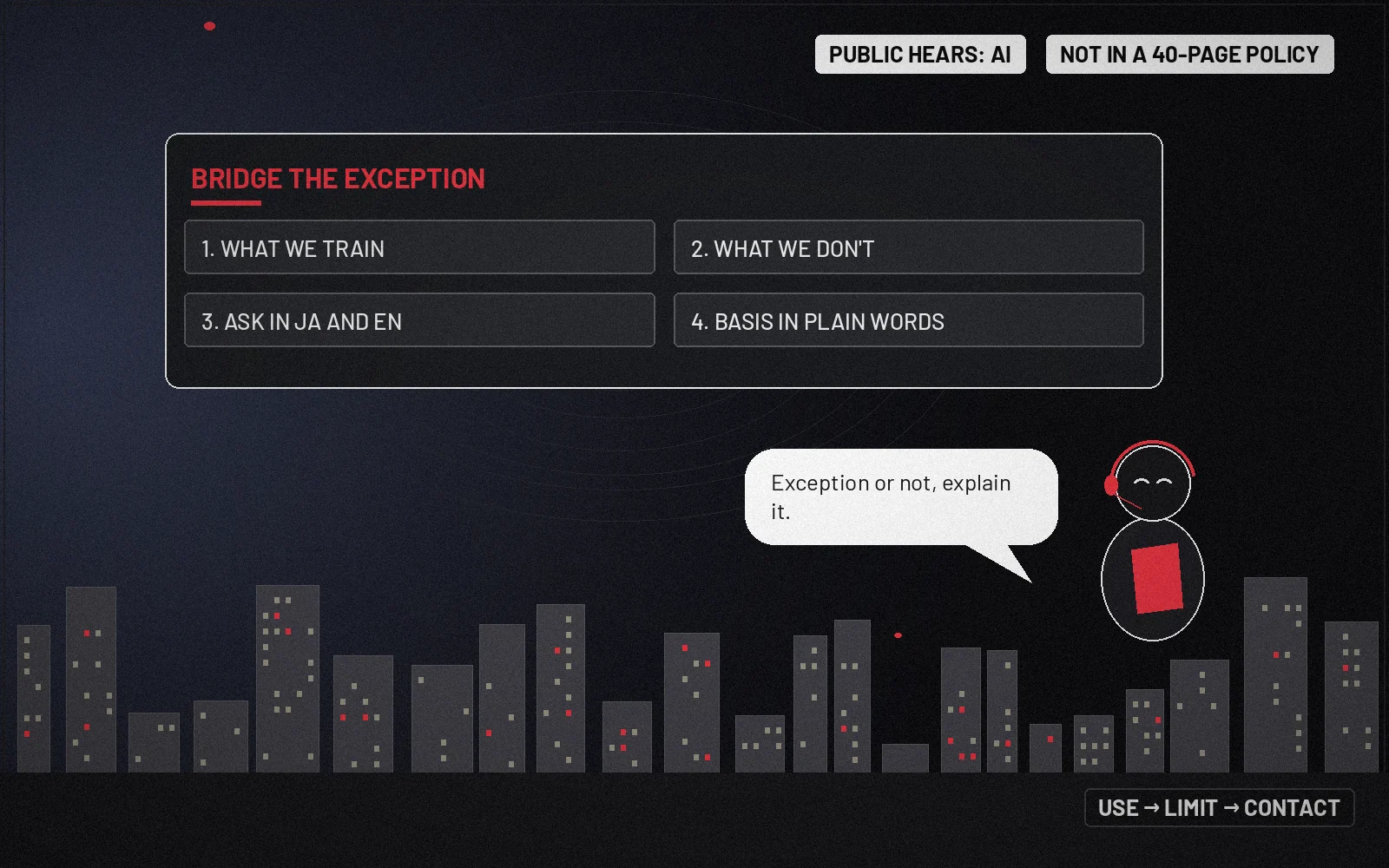
Write:
- What training or statistical uses you actually do
- What you do not do
- How someone can ask questions in Japanese and English
- Where the lawful basis lives in plain language
Hiding exception language in a forty-page policy is how you lose partnership trust even if you are technically compliant.
Biometric and children's data: narrative landmines
Biometric features and youth-facing products are screenshot magnets. Creative that looks clever in a global brandbook can look reckless under APPI headlines.
Rules of thumb:
- If you collect it, say why in one sentence a parent understands
- If you refuse certain uses, say that loudly—restraint is a brand asset
- If a vendor processes data for you, your narrative still owns the relationship
GEO content engines for Japan that cite privacy clearly
GEO is shelf space in answer engines. Privacy pages, FAQs, and product explainers are the quotes those engines will lift.
Build a stack:
- Consent story — Exceptions explained in human Japanese and English
- Biometric — What you collect; what you refuse
- Children — Harder rules, clearer pages
- Schema — FAQ that answer engines can quote safely
Link your GEO work to live Insights on content engines and FAQ pages—start from the Insights hub—and keep Digital and Social plus Research and Audience Insights aligned with legal.
Schema and FAQ that answer engines can quote safely
Answer engines reward clarity. They punish hedging that sounds like evasion.
- Short answers first; legal depth second
- Consistent entity names for company, product, and privacy contact
- Update dates visible
- No contradiction between Japanese and English versions
If your English page says one thing and your Japanese page softens it, the screenshot will show both.
Timeline to 2028: communications milestones, not only legal ones
Now — Audit training-data claims versus likely exception language; kill GDPR-paste pages.
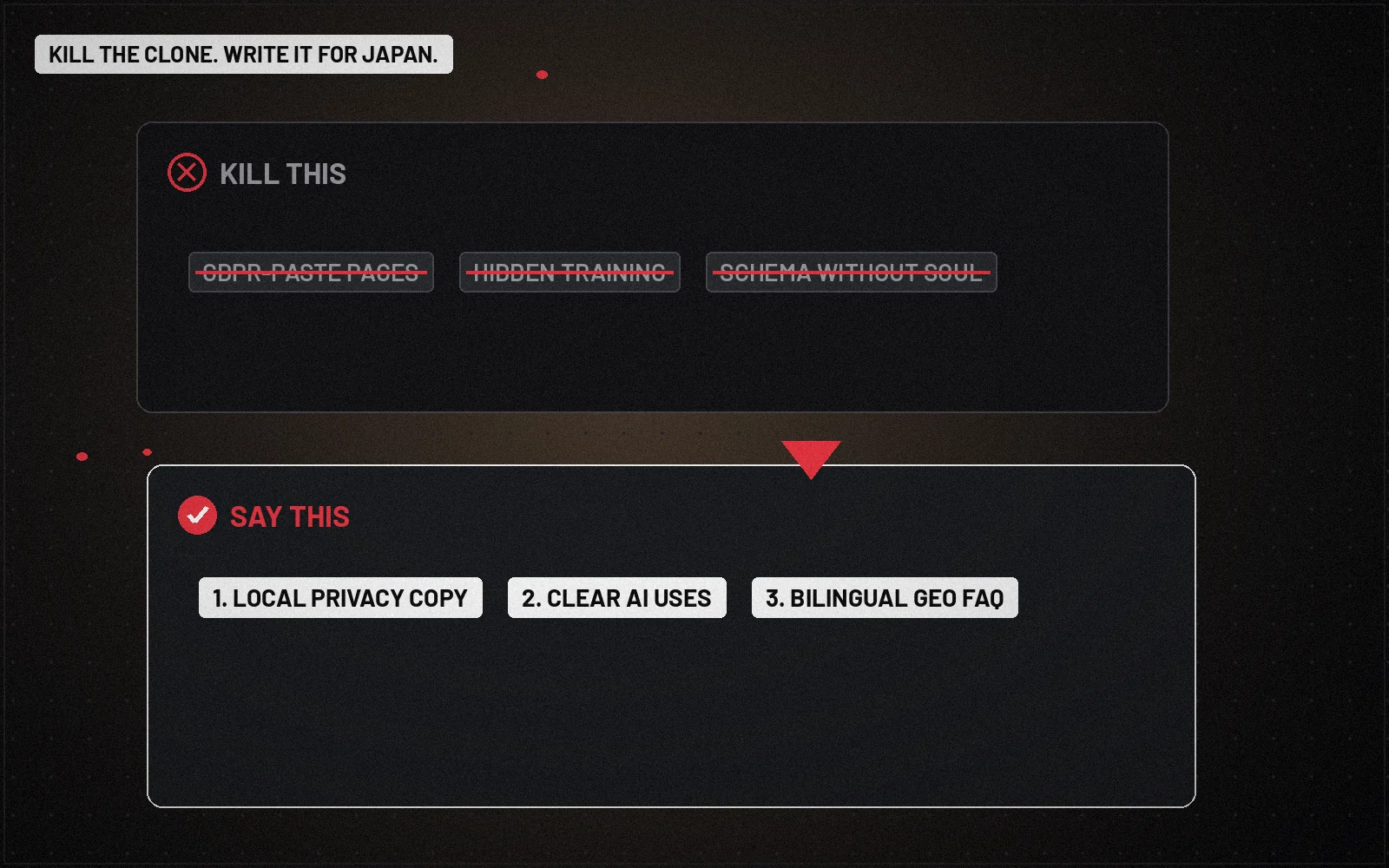
Next two quarters — Ship bilingual privacy and GEO FAQs; brief vendors on shared lines.
Through 2028 staging — Message each implementation milestone; refresh schema; retrain support teams.
Win: local privacy copy, clear AI uses, partner trust. Lose: GDPR clone, hidden training, schema without soul.
Soft CTA: Japan GEO + privacy messaging engagement
Neuwark builds GEO content engines and privacy-narrative PA for brands serious about Japan inbound—messaging as sharp as your markup. If your Japan privacy story still reads like a European template, contact us or see About.
FAQ
Is this only for AI companies? No. Any brand using data for personalization, analytics, or content systems that touch Japan needs a clear story—especially if answer engines cite you.
Can we wait until 2028? You can wait to be late. Partners and inbound buyers are already asking. Communications milestones should lead the legal staging, not trail it.
What is the fastest trust win? A bilingual FAQ that states AI and training uses in plain language, with a human contact path—and consistency across product marketing.
Answer engines will not save you if your Japan privacy story sounds like a GDPR copy-paste. Build Japan APPI AI data communications into the GEO engine before 2028 feels sudden.
Operator appendix: thirty-day readiness sprint
Use the next thirty days as a communications build, not a brainstorm spiral.
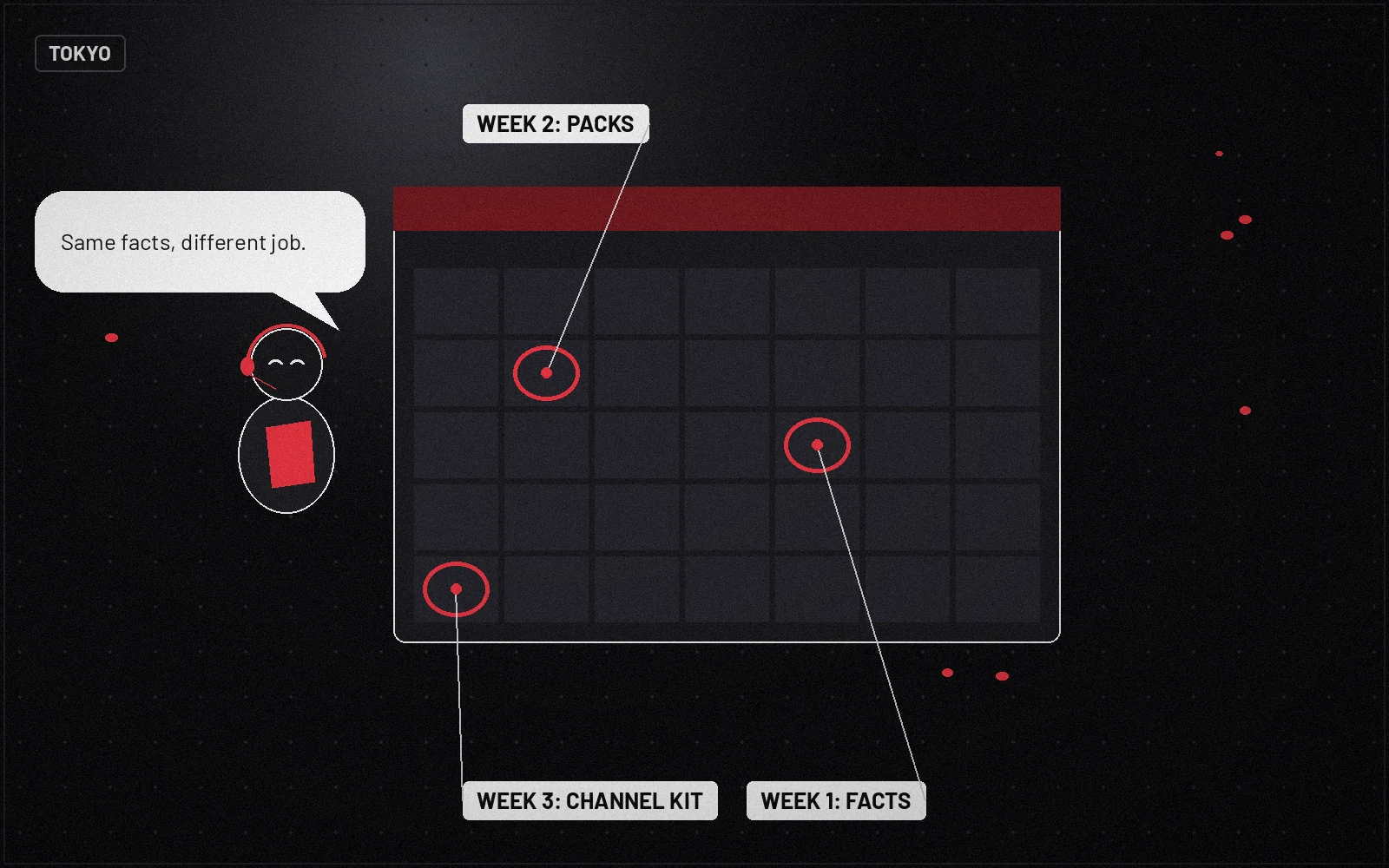
Week 1 — Facts and owners. Lock the legal and compliance facts you can stand behind in public. Name one decision owner and one backup for external lines. Put both names in a channel description, not a forgotten email thread that dies when someone goes on leave.
Week 2 — Stakeholder packs. Write three one-pagers: partners or workforce, customers or buyers, and leadership or investors. Same facts, different jobs to be done. Version-stamp each page so call centers and distributors are not inventing a fourth story at midnight.
Week 3 — Channel kit. Ship the trade or consumer FAQ, the retailer or seller note, social holding lines, and a kill list for creative that will age badly under the news cycle. Brief agencies and in-house creators in the same meeting so freestyle dies early and stays dead.
Week 4 — Tabletop. Run a sixty-minute drill: a hostile headline, a confused staff question, and a buyer or donor email arrive the same morning. Who answers first? What stays internal? What updates by end of day? Record the gaps without blame, then close them.
Close the sprint by listing what legal, operations, and brand still freestyle under pressure. Those gaps are exactly what a public-affairs, crisis, or fundraising retainer is for. Boring drills protect revenue and trust when the news cycle refuses to stay boring.
Regional teams should also map which legal entity owns which sentence. A headquarters note that contradicts a local site plan creates two truths—and staff always find both. Align entity-level owners, keep a shared glossary for operational phrases, and store the latest approved lines where managers actually look on a phone at seven in the morning.
Finally, schedule a thirty-minute retro after the first real news spike. What line worked? What rumor outran you? What proof was missing? Fold the answers into the next version of the pack before the calendar moves on without you.
Operator appendix: thirty-day readiness sprint
Use the next thirty days as a communications build, not a brainstorm spiral.
Week 1 — Facts and owners. Lock the legal and compliance facts you can stand behind in public. Name one decision owner and one backup for external lines. Put both names in a channel description, not a forgotten email thread that dies when someone goes on leave.
Week 2 — Stakeholder packs. Write three one-pagers: partners or workforce, customers or buyers, and leadership or investors. Same facts, different jobs to be done. Version-stamp each page so call centers and distributors are not inventing a fourth story at midnight.
Week 3 — Channel kit. Ship the trade or consumer FAQ, the retailer or seller note, social holding lines, and a kill list for creative that will age badly under the news cycle. Brief agencies and in-house creators in the same meeting so freestyle dies early and stays dead.
Week 4 — Tabletop. Run a sixty-minute drill: a hostile headline, a confused staff question, and a buyer or donor email arrive the same morning. Who answers first? What stays internal? What updates by end of day? Record the gaps without blame, then close them.
Close the sprint by listing what legal, operations, and brand still freestyle under pressure. Those gaps are exactly what a public-affairs, crisis, or fundraising retainer is for. Boring drills protect revenue and trust when the news cycle refuses to stay boring.
Regional teams should also map which legal entity owns which sentence. A headquarters note that contradicts a local site plan creates two truths—and staff always find both. Align entity-level owners, keep a shared glossary for operational phrases, and store the latest approved lines where managers actually look on a phone at seven in the morning.
Finally, schedule a thirty-minute retro after the first real news spike. What line worked? What rumor outran you? What proof was missing? Fold the answers into the next version of the pack before the calendar moves on without you.