On 19 September 2026, Singapore's Foreign Minister Vivian Balakrishnan said the country must anticipate further Middle East fuel disruptions and is exploring Canada as an energy and food partner. That is not only a diplomatic line. It is a live supply-security story for every corporate stakeholder who reads headlines before they read your board deck.
Energy security corporate communications Singapore is the discipline of turning ministerial signals into human sentences for investors, employees, and customers—without sounding like a panic memo.
Neuwark Communications builds corporate public-affairs retainers and resilience messaging for energy-exposed firms across APAC. When ministers talk fuel disruption, your staff still need a Monday morning answer.
Supply security is a narrative problem before it is a spreadsheet problem
Spreadsheets track inventory, hedges, and alternate routes. Narratives track whether people believe you can keep the lights on—literally or metaphorically—for their job, their delivery, or their investment thesis.
When supply routes shake, silence creates three expensive stories:
- Investors invent worst-case valuation math in group chats
- Employees assume layoffs or sudden site changes
- Customers assume rationing, price shocks, or service collapse
None of those stories need to be true to damage you. They only need a vacuum.
Stakeholder lines: investors, employees, customers, partners
Investors — Continuity without panic forecasts. What you are diversifying, what remains stable, what you will update and when. Avoid both bravado and doom.
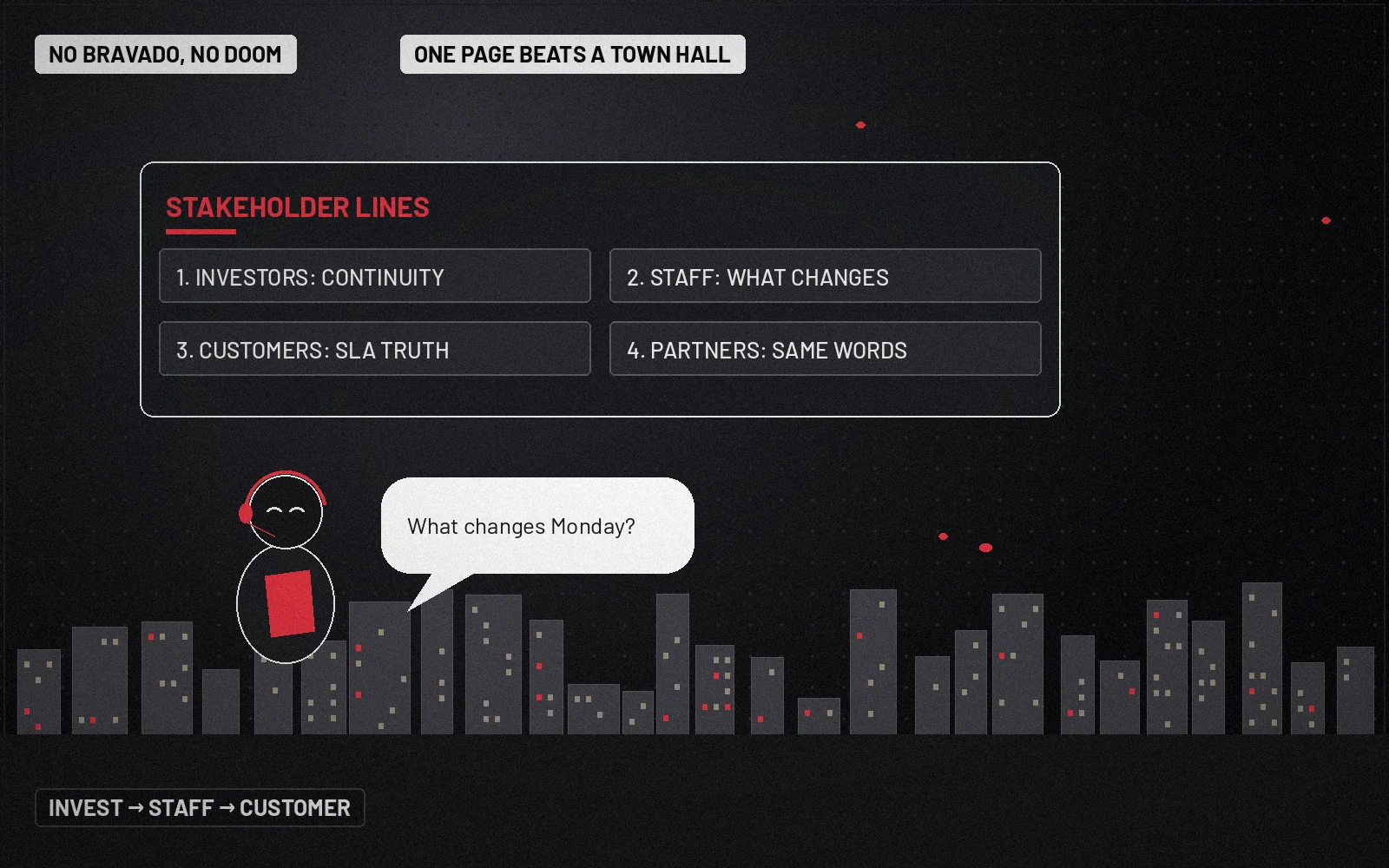
Employees — What changes Monday, what does not. Who owns questions about shifts, travel, and contractors. One page beats a town hall that raises more fear than it settles.
Customers — Service truth, not slogans. If SLAs could move under prolonged disruption, say the monitoring triggers—not a vague claim that you are resilient.
Partners and suppliers — Shared language so your vendor's tweet does not contradict your FAQ.
Resilience without panic: tone that protects valuation
Tone is a financial instrument here. Panic language can move talent and buyers as fast as a downgrade rumor.
Use a four-step ladder:
- Context — What ministers said; what it means for your exposure in plain English
- Actions — Diversification, inventory, partners, scenario planning you can prove
- Assurance — What staff and customers can count on this month
- Watch — Triggers for the next update so you are not inventing cadence under fire
Resilience messaging is not cheerleading. It is disciplined honesty with a named owner.
What to say when ministers name new energy partners
When Canada—or any new partner—enters the public conversation, corporates should not over-claim proximity to state deals. Say what is true for your firm: how you read the signal, what planning it reinforces, and what remains unchanged in near-term operations.
Do not pretend you are negotiating bilateral energy policy. Do not ignore the headline as not your lane if your staff are already asking.
Align with broader public-affairs narrative craft in Insights and keep weekly scorecard habits so resilience updates do not vanish after one memo. Offer depth via Public Affairs and Advocacy.
Scenario packs: short disruption vs prolonged route shock
Short disruption (days to two weeks) — Holding lines for service and staff; daily internal note; customer FAQ that can stay up without daily rewrites.
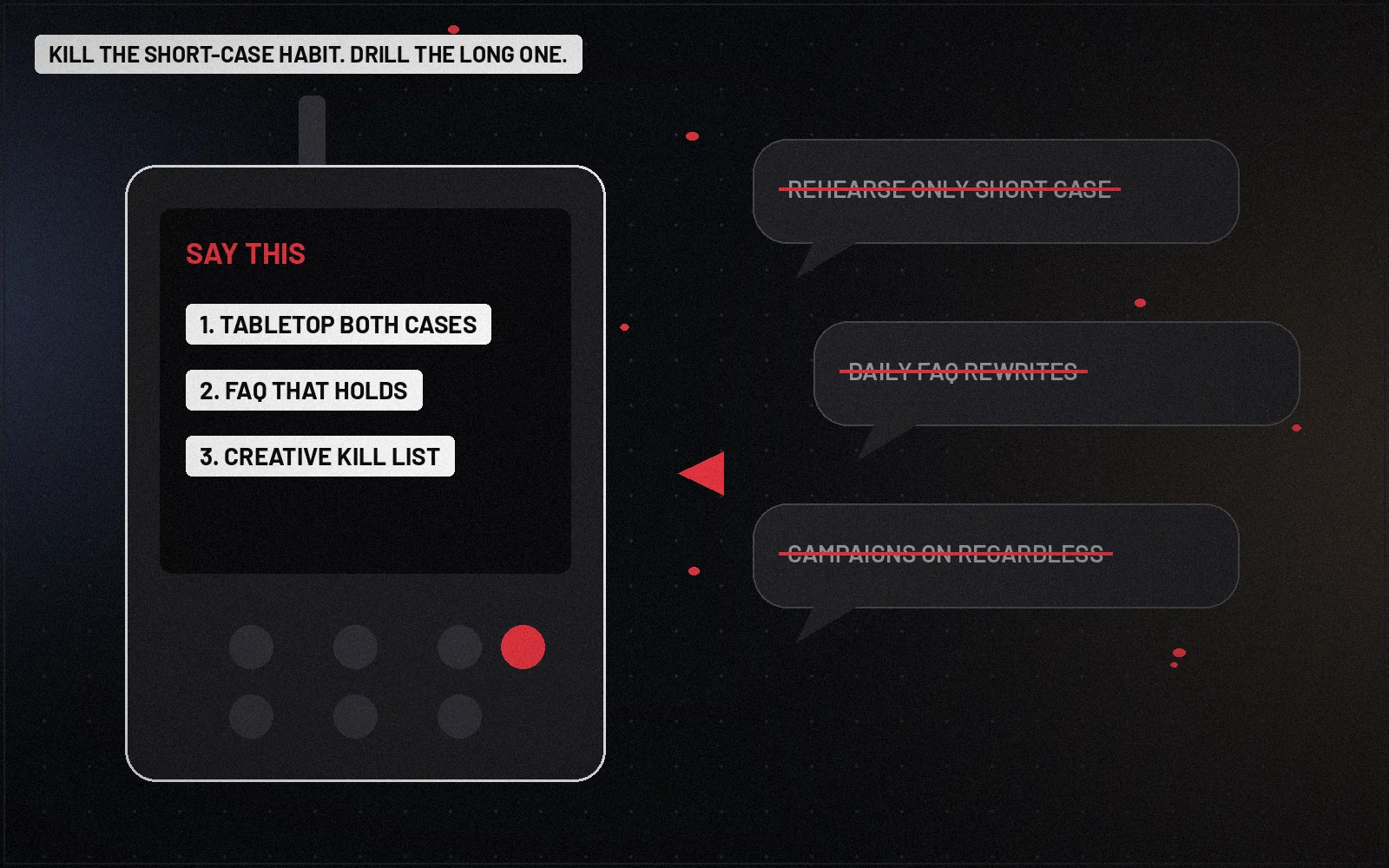
Prolonged route shock (weeks to months) — Investor note cadence, customer expectation resets, partner escalation tree, and creative kill list for campaigns that assume infinite cheap energy or perfect logistics.
Tabletop both. Teams that only rehearse the short case freeze when the long case arrives.
PA retainer operating rhythm for energy-exposed firms
Do this
- Plain sentences managers can forward
- Named owners and update cadence
- Scenario packs before the next headline
- Align HQ and regional site language
Not this
- Doom decks that leak into Slack
- Vague monitoring language with no owner
- Ghosting staff while leadership debates adjectives
- Over-claiming government partnerships
A retainer worth buying includes pre-cleared lines, tabletop drills, and a red-team pass on anything that could move valuation if screenshotted.
Soft CTA: Singapore corporate PA resilience engagement
Neuwark builds corporate public-affairs retainers and resilience messaging for Singapore and regional energy-exposed firms—investor, employee, and customer lines that protect trust when supply routes shake. If your board deck still lacks a human sentence for staff, contact us or read About and how we run PA.
FAQ
Does this apply if we are not an energy company? Yes if you are energy-exposed: manufacturers, logistics, data centers, transport, and any firm whose cost stack or customer promise moves when fuel routes shake.
Should we comment every time a minister speaks? No. Comment when the signal changes staff or customer questions. Silence with a prepared internal note still beats public freestyle.
How is this different from ESG reporting? ESG reports are periodic. Resilience PA is real-time narrative control when headlines hit. They should share facts; they are not the same product.
When ministers talk fuel disruption, your board deck still needs a human sentence for staff and customers. Write it before the next shock—not during it.
Operator appendix: thirty-day readiness sprint
Use the next thirty days as a communications build, not a brainstorm spiral.
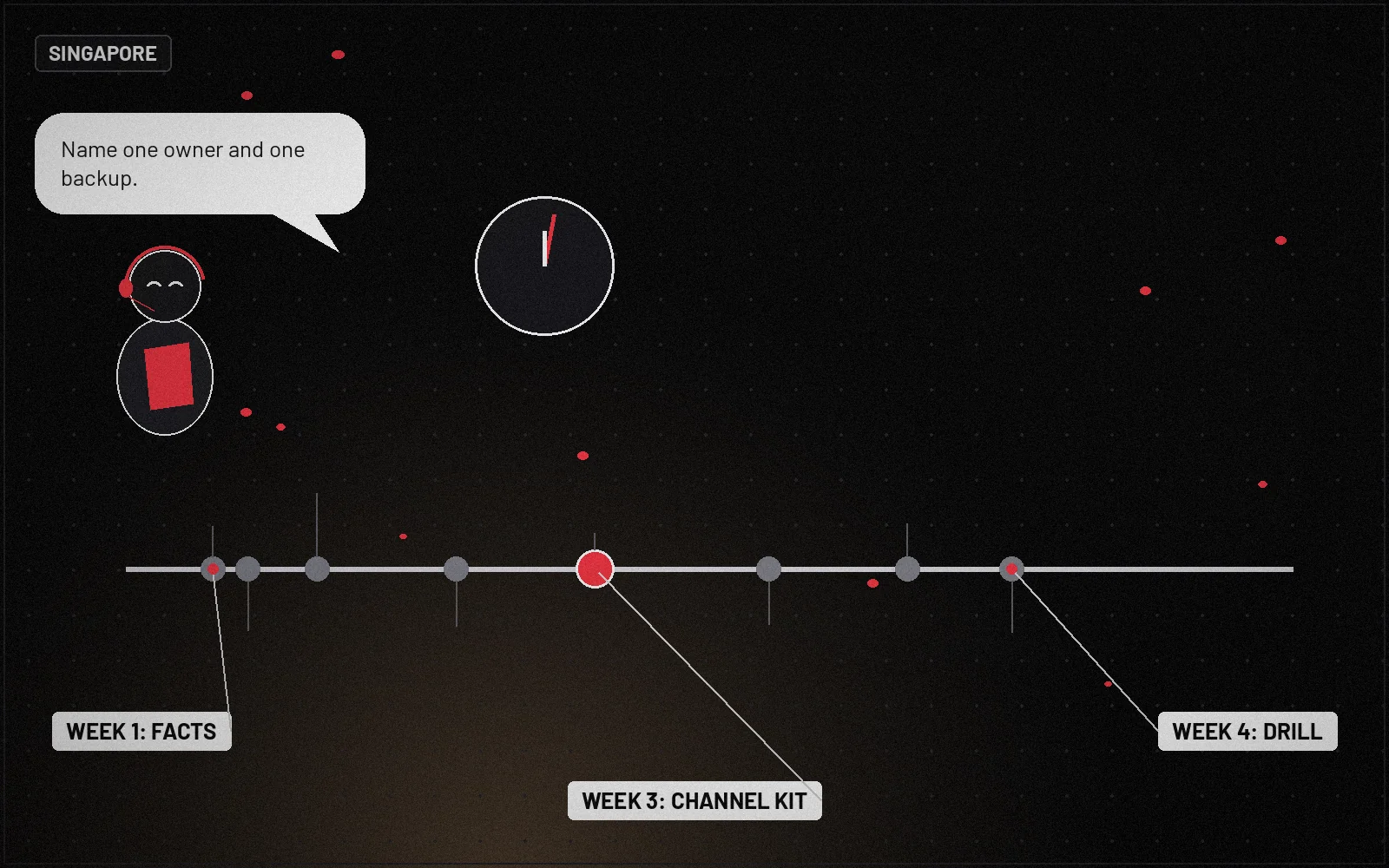
Week 1 — Facts and owners. Lock the legal and compliance facts you can stand behind in public. Name one decision owner and one backup for external lines. Put both names in a channel description, not a forgotten email thread that dies when someone goes on leave.
Week 2 — Stakeholder packs. Write three one-pagers: partners or workforce, customers or buyers, and leadership or investors. Same facts, different jobs to be done. Version-stamp each page so call centers and distributors are not inventing a fourth story at midnight.
Week 3 — Channel kit. Ship the trade or consumer FAQ, the retailer or seller note, social holding lines, and a kill list for creative that will age badly under the news cycle. Brief agencies and in-house creators in the same meeting so freestyle dies early and stays dead.
Week 4 — Tabletop. Run a sixty-minute drill: a hostile headline, a confused staff question, and a buyer or donor email arrive the same morning. Who answers first? What stays internal? What updates by end of day? Record the gaps without blame, then close them.
Close the sprint by listing what legal, operations, and brand still freestyle under pressure. Those gaps are exactly what a public-affairs, crisis, or fundraising retainer is for. Boring drills protect revenue and trust when the news cycle refuses to stay boring.
Regional teams should also map which legal entity owns which sentence. A headquarters note that contradicts a local site plan creates two truths—and staff always find both. Align entity-level owners, keep a shared glossary for operational phrases, and store the latest approved lines where managers actually look on a phone at seven in the morning.
Finally, schedule a thirty-minute retro after the first real news spike. What line worked? What rumor outran you? What proof was missing? Fold the answers into the next version of the pack before the calendar moves on without you.
When energy and policy narratives collide, start with structured public affairs counsel — our Singapore public affairs page maps how we work.