

Indonesia confirmed there will be no delay to mandatory halal certification from 18 October 2026. Korea and Indonesia also sealed a deal to safeguard K-food and beauty exports into the regime. For food, beauty, and FMCG brands, that calendar is not only a legal checklist. It is a trust narrative—and Indonesia halal certification communications done late still loses the shelf.
Say it clean: Indonesia halal certification communications means telling importers, retailers, and consumers what is certified, by whom, and why that should earn trust. Compliance without a story still loses. Compliance with a story wins the importer and the consumer.
Neuwark Communications builds corporate public-affairs and market-entry message systems for brands entering Indonesia. This guide is the money version: turn certification into access, not panic PR.
Oct 18 is a narrative deadline, not only a legal one
Legal teams track certificates, labs, and BPJPH process. Communications teams track whether buyers believe you. Those jobs meet on 18 October 2026.
Miss the narrative and you miss the market in predictable ways:
- Importers hesitate because SKU status is unclear in plain language
- Retail buyers delay shelf decisions waiting for someone to explain it
- Consumers hear rumor before they hear your FAQ
- Trade media fills the vacuum with someone else's frame
K-food and beauty brands watching the Korea–Indonesia arrangement still need their own voice. Bilateral deals do not automatically write your retailer kit.
Stakeholders: BPJPH, importers, retailers, consumers, KR partners
Map the audience before you draft adjectives.
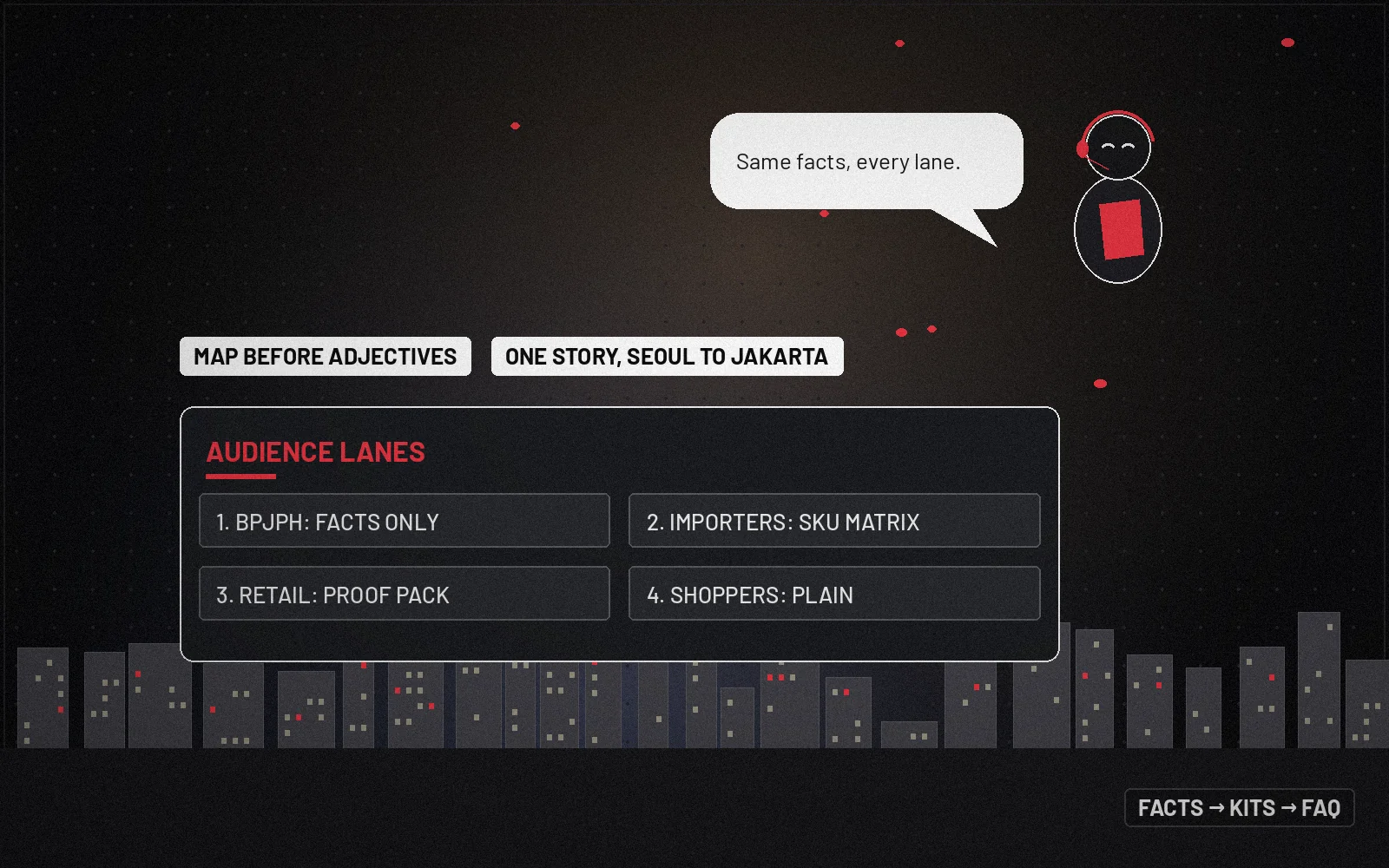
Regulators and certification bodies — Facts only. What is certified, under which process, for which SKUs. No marketing poetry in the compliance lane.
Importers and distributors — Clear SKU matrices, timelines, and who to call when a batch question lands at midnight.
Retail buyers — Shelf-ready proof packs: certificate summaries, labeling notes, consumer FAQ they can hand to store teams.
Consumers — Plain-language trust lines. Respect, not panic. Dignity, not jargon cosplay.
Korean and other export partners — Shared vocabulary so HQ in Seoul and a Jakarta distributor do not invent two different stories.
Message system: certification to trust to access (not panic PR)
Build a four-layer stack:
- Facts — What is certified, by whom, by when; what is still in process
- Supply — Partners and ingredients that pass; what changed in the chain
- Respect — Consumer dignity; no fearmongering about competitors
- Access — Market entry as earned trust, not a checkbox screenshot
Tone rule: quiet confidence beats last-minute scramble. Defensive legalese reads like you are hiding. Silence reads like you forgot Indonesia.
K-food and beauty spillover: bilateral deals still need brand voice
The Korea–Indonesia halal arrangement is good news for exporters who prepare. It is not a substitute for brand-level communications. Retailers still ask product questions. Consumers still ask label questions. Trade desks still need a human sentence that is not a scanned PDF.
If you sell across Singapore and Malaysia as well as Indonesia, keep multilingual discipline so the same proof travels—see multilingual message craft in Insights and keep Public Affairs narrative work aligned with services.
Channel plan: trade media, retailer kits, consumer FAQ
Trade media — One clear memo: timeline, SKU coverage, partner posture. Offer a spokesperson who can speak operations, not only legal.
Retailer kits — One folder: certificate summary, labeling notes, store FAQ, contact tree. Update weekly in the final month.
Consumer FAQ — Short answers for web, app, and packaging inserts. No walls of text. No copy-paste from a regulation PDF.
Social — Holding lines for rumor days. Do not argue theology in comments. Point to facts and authorized channels.
30-day PA sprint before the mandate clock hits
Days 1–7: Lock the SKU matrix and owners. Kill conflicting intranet drafts.
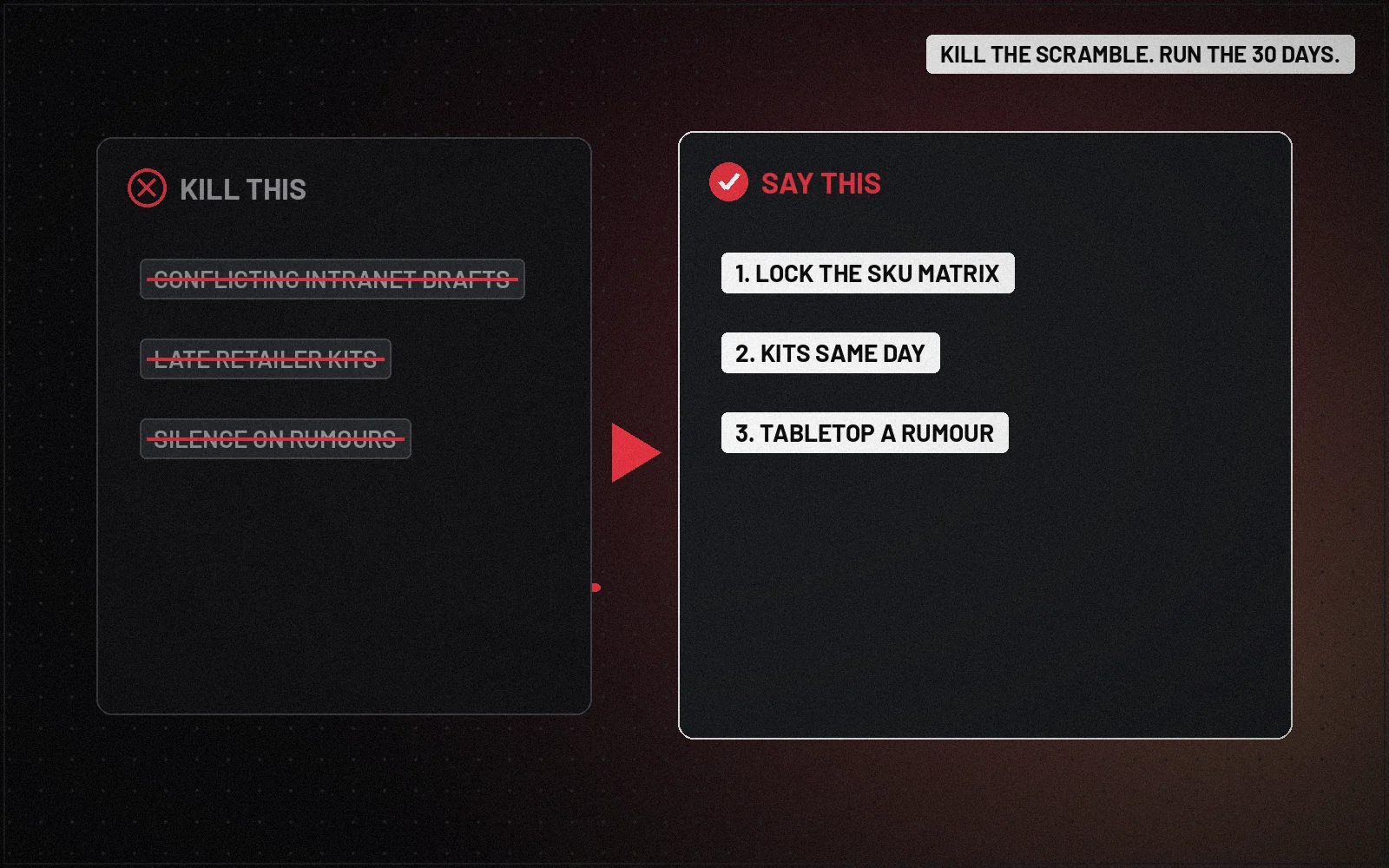
Days 8–14: Ship importer and retailer kits. Brief distributors on the same day.
Days 15–21: Publish consumer FAQ. Align paid and organic creative with labeling truth.
Days 22–30: Tabletop a rumor scenario. Rehearse trade-desk answers. Confirm who pauses ads if a claim is wrong.
Win: early proof, local validators where appropriate, quiet confidence. Lose: last-minute scramble, defensive legalese, silence.
Soft CTA: Indonesia market-entry PA engagement
Neuwark builds public-affairs and market-entry message systems for food, beauty, and FMCG brands entering Indonesia—certification narratives that earn importer trust and consumer shelf confidence. If your Oct 18 plan is still only a legal checklist, contact us or start with About and how we run corporate PA retainers.
FAQ
Is this only for Korean exporters? No. Any brand selling food, beauty, or FMCG into Indonesia under the mandate needs a trust narrative—local and international alike.
Should communications lead or legal lead? Legal owns compliance truth. Communications owns clarity for buyers and consumers. Both sit in one war room in the final month.
What if certification is still in process for some SKUs? Say so clearly. In process with a date beats a vague committed-to-quality line that sounds like evasion.
Halal compliance without a story still loses the shelf. Compliance with a story wins the importer and the consumer. Build the narrative before 18 October 2026—not the morning after.
Operator appendix: thirty-day readiness sprint
Use the next thirty days as a communications build, not a brainstorm spiral.
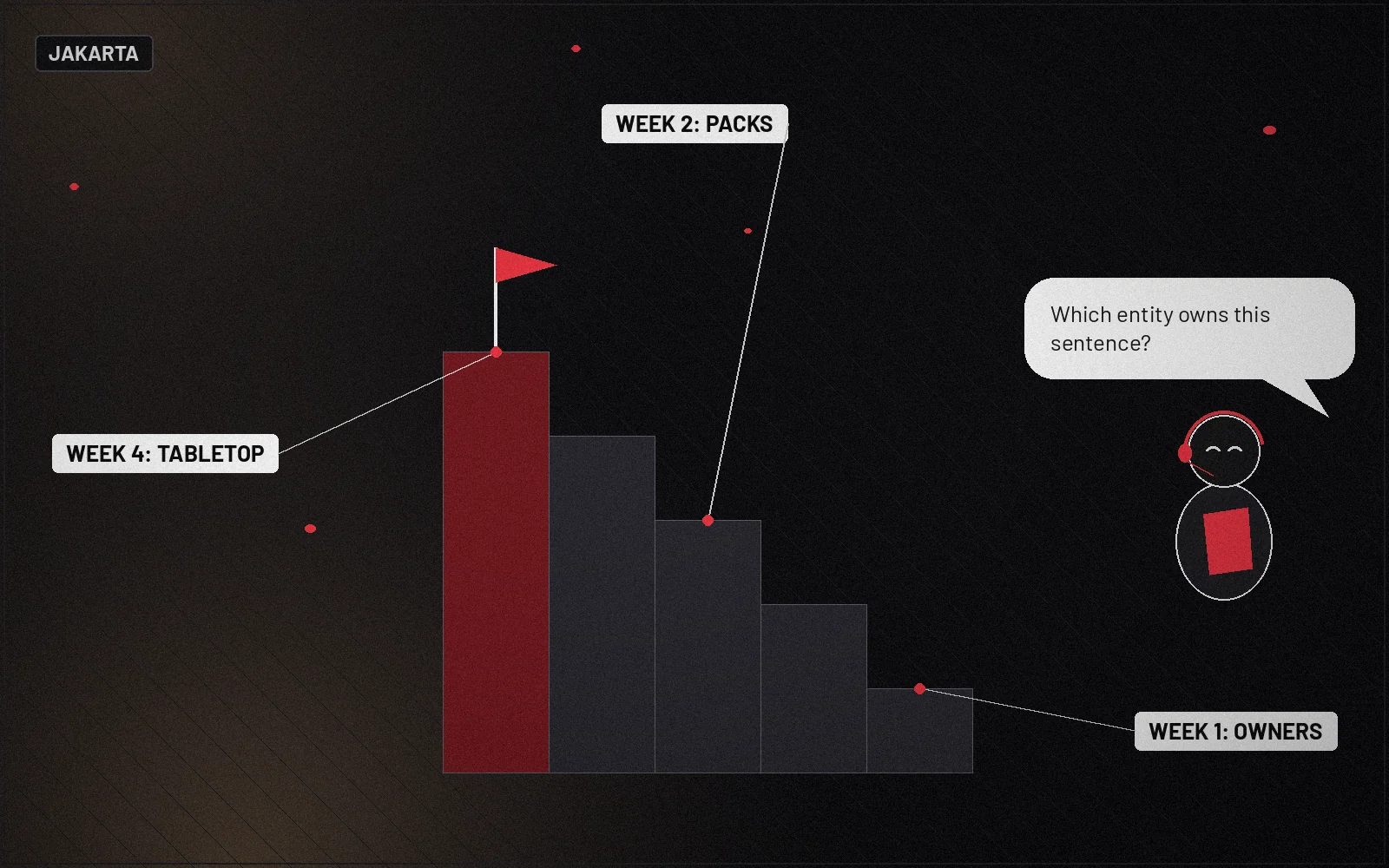
Week 1 — Facts and owners. Lock the legal and compliance facts you can stand behind in public. Name one decision owner and one backup for external lines. Put both names in a channel description, not a forgotten email thread that dies when someone goes on leave.
Week 2 — Stakeholder packs. Write three one-pagers: partners or workforce, customers or buyers, and leadership or investors. Same facts, different jobs to be done. Version-stamp each page so call centers and distributors are not inventing a fourth story at midnight.
Week 3 — Channel kit. Ship the trade or consumer FAQ, the retailer or seller note, social holding lines, and a kill list for creative that will age badly under the news cycle. Brief agencies and in-house creators in the same meeting so freestyle dies early and stays dead.
Week 4 — Tabletop. Run a sixty-minute drill: a hostile headline, a confused staff question, and a buyer or donor email arrive the same morning. Who answers first? What stays internal? What updates by end of day? Record the gaps without blame, then close them.
Close the sprint by listing what legal, operations, and brand still freestyle under pressure. Those gaps are exactly what a public-affairs, crisis, or fundraising retainer is for. Boring drills protect revenue and trust when the news cycle refuses to stay boring.
Regional teams should also map which legal entity owns which sentence. A headquarters note that contradicts a local site plan creates two truths—and staff always find both. Align entity-level owners, keep a shared glossary for operational phrases, and store the latest approved lines where managers actually look on a phone at seven in the morning.
Finally, schedule a thirty-minute retro after the first real news spike. What line worked? What rumor outran you? What proof was missing? Fold the answers into the next version of the pack before the calendar moves on without you.
Operator appendix: thirty-day readiness sprint
Use the next thirty days as a communications build, not a brainstorm spiral.
Week 1 — Facts and owners. Lock the legal and compliance facts you can stand behind in public. Name one decision owner and one backup for external lines. Put both names in a channel description, not a forgotten email thread that dies when someone goes on leave.
Week 2 — Stakeholder packs. Write three one-pagers: partners or workforce, customers or buyers, and leadership or investors. Same facts, different jobs to be done. Version-stamp each page so call centers and distributors are not inventing a fourth story at midnight.
Week 3 — Channel kit. Ship the trade or consumer FAQ, the retailer or seller note, social holding lines, and a kill list for creative that will age badly under the news cycle. Brief agencies and in-house creators in the same meeting so freestyle dies early and stays dead.
Week 4 — Tabletop. Run a sixty-minute drill: a hostile headline, a confused staff question, and a buyer or donor email arrive the same morning. Who answers first? What stays internal? What updates by end of day? Record the gaps without blame, then close them.
Close the sprint by listing what legal, operations, and brand still freestyle under pressure. Those gaps are exactly what a public-affairs, crisis, or fundraising retainer is for. Boring drills protect revenue and trust when the news cycle refuses to stay boring.
Regional teams should also map which legal entity owns which sentence. A headquarters note that contradicts a local site plan creates two truths—and staff always find both. Align entity-level owners, keep a shared glossary for operational phrases, and store the latest approved lines where managers actually look on a phone at seven in the morning.
Finally, schedule a thirty-minute retro after the first real news spike. What line worked? What rumor outran you? What proof was missing? Fold the answers into the next version of the pack before the calendar moves on without you.