
Rapid response is not a personality trait. It is a calendar with teeth—tiers, owners, pre-cleared shells, and rules about what never ships at 1 a.m. just because a group chat got loud.
Progressive campaigns in the Philippines often confuse speed with panic. Someone drops a screenshot. Twelve people draft twelve captions. Nobody knows which line is cleared. By morning you have three contradictory posts and one apology. That is not agility. That is unpaid work for your opponent’s meme page.
Neuwark Communications builds communications infrastructure for campaigns and advocacy coalitions that need to move fast without inventing a new process every news cycle. This is how you design a rapid-response content calendar that stays evergreen as a system—even when the topics of the week change.
Chaos is not a strategy (even when it feels righteous)
News cycles in PH and across APAC social feeds reward first movers. That pressure is real. What is not real is the idea that process equals slowness. Process equals repeatable speed.
Without a calendar system you get:
- Duplicate posts that fragment reach
- Uncleared numbers that become scandals
- Partner freestyle that breaks the coalition spine
- Burnout among the three people who always “just handle it”
- Silence on the stories you should have owned because everyone was fighting the wrong fire
A rapid-response calendar sits beside your planned content calendar. Planned work continues. Response work has lanes. When everything is “dropping everything,” nothing strategic ships.
Define rapid response in operator language
Rapid response is content that:
- Reacts to an external trigger (hearing outcome, opponent claim, viral frame, weather-related service failure, policy leak)
- Must ship inside a defined SLA (30 minutes / 3 hours / same day)
- Uses pre-approved shells where possible
- Has a named owner and a named clearer
- Ends with distribution into field kits and partner packs—not only a main-page post
If it does not have an SLA and an owner, it is just anxiety with a CapCut export.
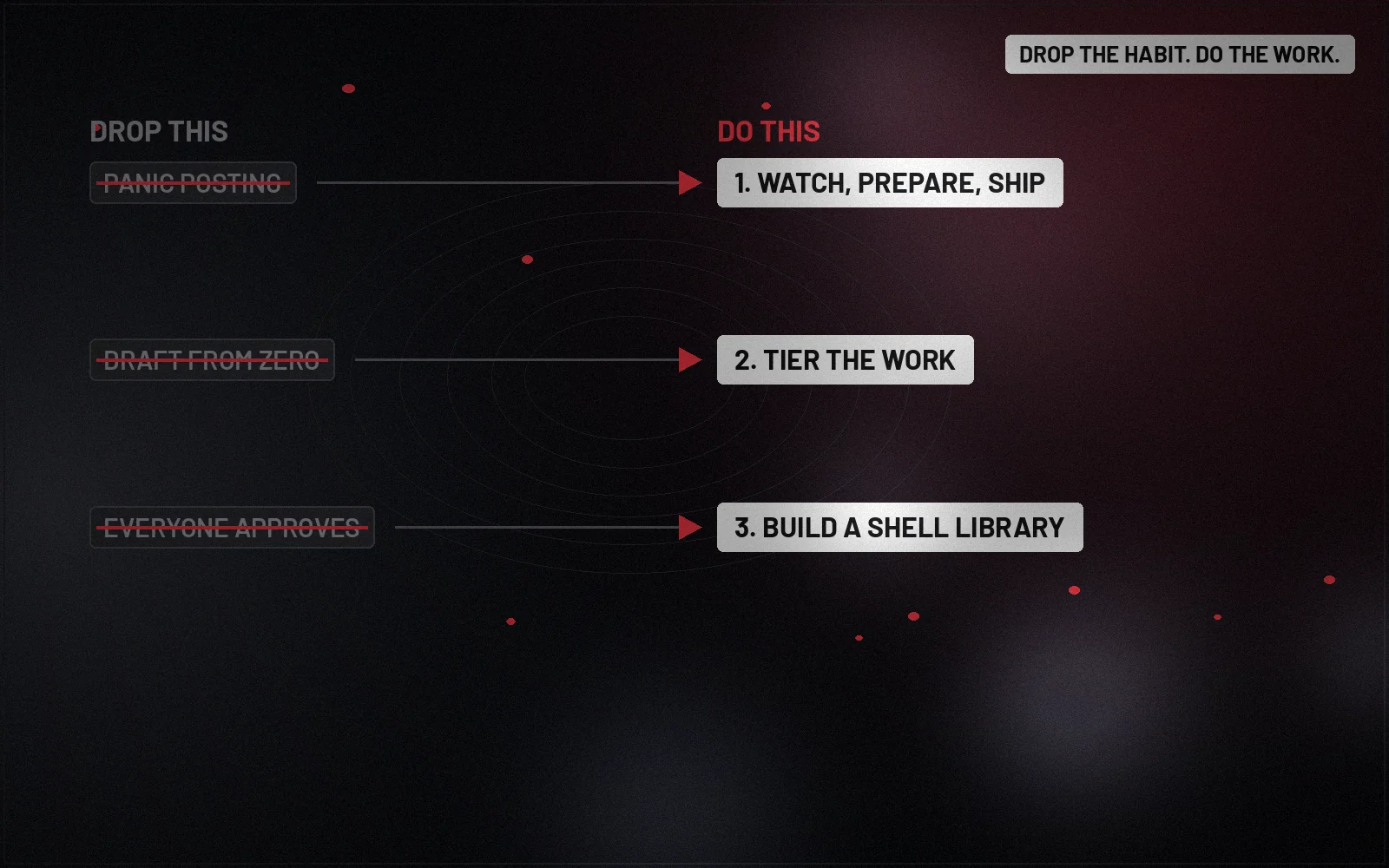
Tier the work: watch, prepare, ship
Tier 0 — Watch
Not everything deserves a post. Build a watchlist of accounts, desks, and keywords. Assign a rotating monitor during surge weeks. The monitor’s job is triage, not freestyle caption writing.
Triage codes:
- Ignore — bait, not signal
- Log — useful for message research; no public response
- Prepare — likely needs content within 24 hours
- Ship — hits an SLA trigger now
Put the codes in the calendar tool you already use. Fancy software optional. Shared discipline mandatory.
Tier 1 — Prepare
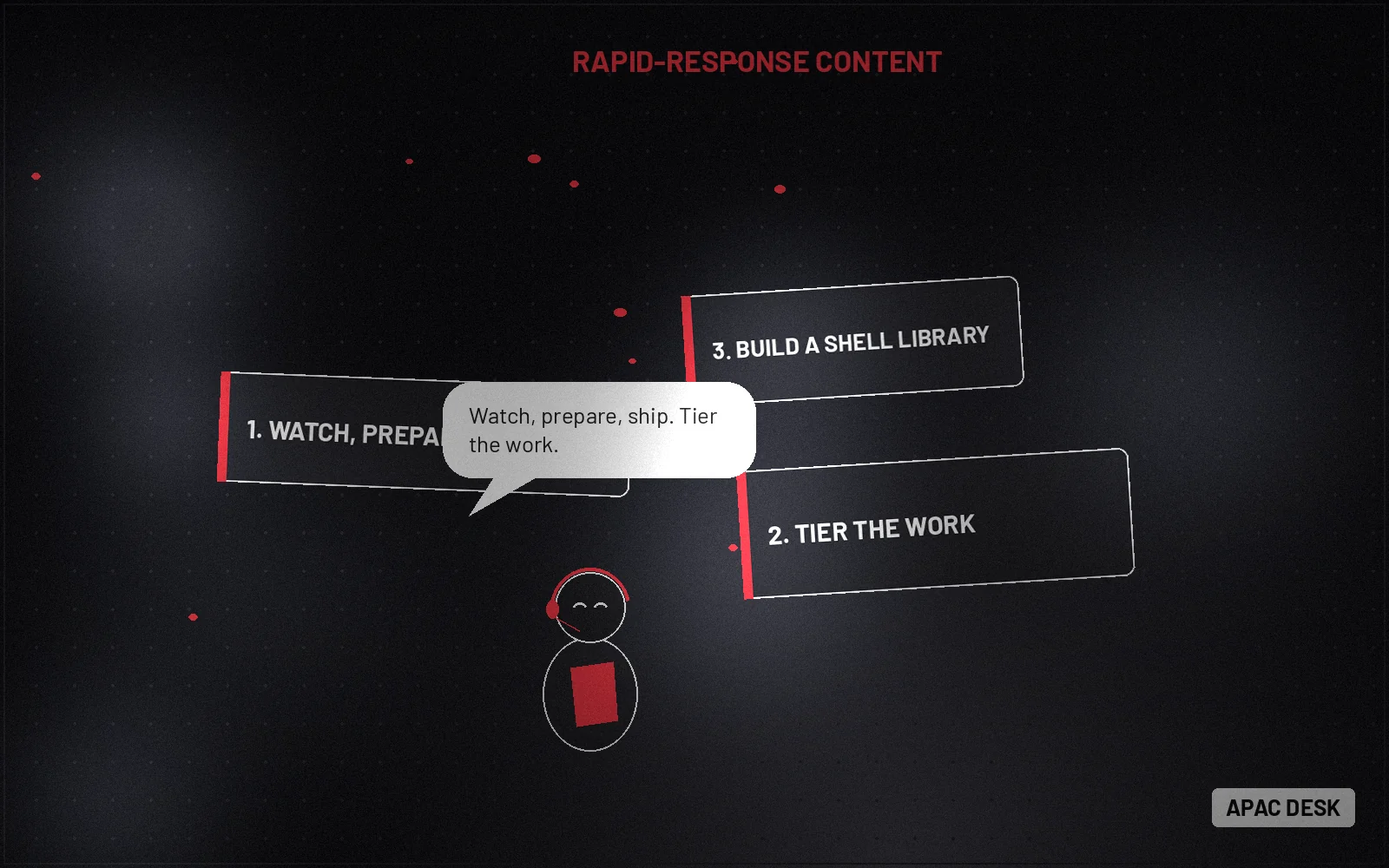
When a trigger is likely (scheduled hearing, known opponent narrative, storm forecast affecting your issue set), load shells and validators in advance. Preparation is how you look fast without being reckless.
Tier 2 — Ship
Execute the SLA. Use the shell. Clear through the named path. Distribute. Debrief the next morning—not in the same adrenaline hour.
Build a shell library before you need it
Shells are half-written assets with blanks for the variable facts. Counsel and message lead clear the spine once. Rapid response fills blanks and re-clears only what changed.
Minimum shells for PH progressive campaigns:
- Opponent claim correction (fact → proof → ask)
- Hearing day reaction (what happened → what it means → next public action)
- Service failure / infrastructure pattern (local proof → pattern → dated ask)
- Coalition joint note (shared spine + partner quote lane)
- Rumor quarantine public FAQ (what we know / what we do not / where to get updates)
- Solidarity without centering yourself (when another org leads)
Each shell includes:
- Caption under a word limit
- Visual template (text-forward, phone-legible)
- Do-not-say reminders
- Distribution checklist (main channels, partners, field pin, paid boost decision)
Checklist: stand up shells in one week
Day 1–2: Inventory last quarter’s panic posts; extract patterns. Day 3: Draft six shells with message lead. Day 4: Counsel pass; remove cute lines that create legal risk. Day 5: Design templates; export light file sizes. Day 6: Train two deputies who can fill blanks. Day 7: Dry-run a fake trigger with a timer.
If your first “rapid” response is also your first time meeting the template, you will miss the window.
Calendar architecture that humans will use
Keep two parallel views:
Planned calendar — townhalls, content series, fundraising beats, training modules. Response board — open triggers, owners, SLA clocks, status.
Rules:
- Response can pause planned posts; it should not silently delete them without a reschedule
- One response captain per day during surge; dual-captain on election-adjacent weeks
- Quiet-hours policy applies unless there is a true safety need—most “emergencies” are ego
- Morning debrief converts last night’s response into updated message cards
SLAs that match platform reality
- 30 minutes: simple correction with a cleared shell and low legal risk
- 3 hours: statement with one new fact check and one validator quote
- Same day: deeper explainer, carousel, or livestream clip package
- Next business morning: anything requiring counsel deep dive—say you are checking, then keep the promise
Publish SLAs internally so staff stop treating every ping as a fire drill.
Distribution is part of the calendar
A main-page post is not distribution.
After ship:
- Pin updated line in WhatsApp/Viber Message channel
- Send partner kit note with quote lane guidance
- Cut a 20-second variant for field phones
- Decide paid yes/no with a one-line reason in the log
- Update GEO FAQ if the public question will recur in search
Progressive campaigns lose half their rapid-response value by forgetting the field layer.
PH and APAC constraints to design for
- Multilingual blanks in shells (approved variants)
- Prepaid-friendly media weights
- Screenshot culture—write every draft as if it will be cropped unfairly
- Coalition time zones and island broadband gaps—async shells beat emergency Zooms
- Platform outages—have SMS/Viber backup paths for critical corrections
Failure modes
Responding to everything. Scarcity of response is a brand.
No owner on weekends. Opponents work weekends. Build a rotation.
Shells that rot. Review monthly; retire dead frames.
Public fighting with trolls. Rapid response is for publics and persuadables, not for ratio addiction.
Skipping debrief. Without learning, you will panic-identical next month.
Roles on a response day
Name humans, not committees:
- Monitor — triage only
- Captain — decides ignore/prepare/ship
- Writer — fills shells in platform voice
- Clearer — message lead / counsel as required by tier
- Distributor — field pins, partners, paid decision log
- Cutter — 20-second cut within the SLA window
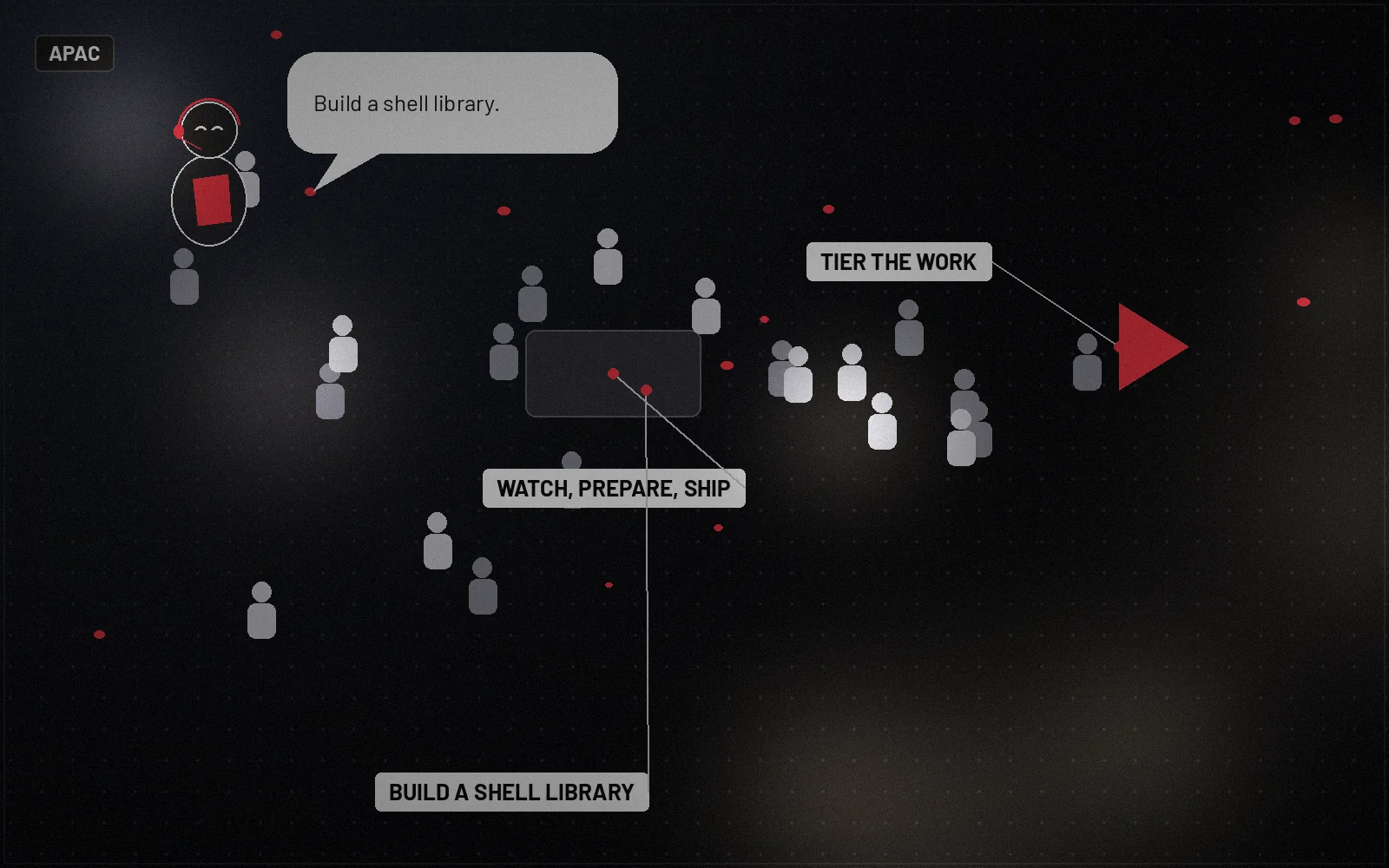
Dual hats are how SLAs die. On thin teams, still write the hats even if one person wears two—and never wear writer + clearer on high-risk legal content.
Sample day board
Morning: planned posts as scheduled; monitor on watchlist. Trigger hits at 11:20: captain codes Ship / 3-hour SLA. 11:35: writer fills correction shell. 12:10: clearer approves with one edit. 12:25: ship + distribute. 12:40: cutter posts vertical. Next morning: debrief—did the shell work? update library.
That rhythm is boring. Boring is how you win weeks.
Integrating planned campaigns with response
Big planned series (policy explainers, volunteer recruitment) should leave “airports” in the calendar—open slots that can absorb response without deleting the month’s strategy. If every day is already maxed with vanity posts, rapid response will always feel like theft.
Also pre-decide which planned content is sacred (e.g., quiet-hours compliant fundraising) and which is flexible. Sacred items get rescheduled, not rage-canceled without a note.
Training the team without fear culture
Run monthly timed drills. Use fictional triggers. Score on SLA, shell fidelity, and distribution completeness—not on who yelled loudest. Celebrate clean ignores as much as clean ships. A team that cannot ignore bait will never have time for the fights that matter.
Document after-action notes in the same place as the calendar. New staff should be able to read three past responses and understand the house style.
Legal and brand rails (evergreen)
Keep a one-page rail:
- What requires counsel always
- What message lead can clear alone
- What never gets speculated in public
- How to pause distribution if facts shift
- How partners are notified
This is process, not a live incident diary. Update when laws or platform rules change. Review each quarter.
Metrics for response health
- Median time from trigger to ship (by tier)
- % responses that used a shell vs freestyle
- Correction rate (how often you had to amend)
- Partner compliance after distribution
- Staff overtime hours on response weeks (burnout is a leading indicator of future mistakes)
If freestyle percentage climbs, your shells are wrong or your training failed.
Soft close: install the system with Neuwark
If your progressive HQ still runs rapid response as group-chat adrenaline, you are paying for chaos with trust. A content calendar with tiers, shells, SLAs, and distribution turns speed into an operating advantage.
Neuwark Communications designs rapid-response systems for Philippine and APAC progressive campaigns—evergreen process, not crisis cosplay. Talk to Neuwark when you want speed that still looks like leadership.