
You do not need a seven-figure media budget to learn what travels. You need discipline about what you are testing, a cheap way to get signal, and the courage to kill pretty work that does not move people.
Advocacy and progressive campaigns in the Philippines often swing between two failures: never testing (vibes forever) or testing like a DTC brand that will say anything for CAC. Both burn trust. The operator path is narrower—protect the spine, vary the packaging, measure like an adult.
Neuwark Communications runs creative and paid systems for coalitions and candidates who cannot afford vanity metrics. This is how you test on small budgets without neutering conviction.
Testing is not betrayal of the message
Progressive teams sometimes treat creative testing as morally suspicious—as if learning from audiences is the same as selling out. That confusion is expensive.
Lock the spine (the argument you will not abandon). Test the packaging:
- Hook line in the first two seconds
- Proof type (number vs story vs document visual)
- Face vs no-face
- Language mix
- Ask type (learn more, sign, volunteer, donate micro)
- Length (9s vs 15s vs 30s)
If you change the spine every test, you are not testing creative. You are shopping for a different campaign.
What “small budget” means operationally
Assume you can spend a little to learn a lot:
- Enough to get directional signal on two to four variants
- Not enough to “let the algorithm cook” for three weeks without reading results
- Enough human time to ship variants without a 20-person creative department
In PH and many APAC markets, cheap learning often happens on Meta placements, short TikTok/Reels organic tests, WhatsApp/Viber sample groups, and barangay hall reactions—not only on polished DSP dashboards.
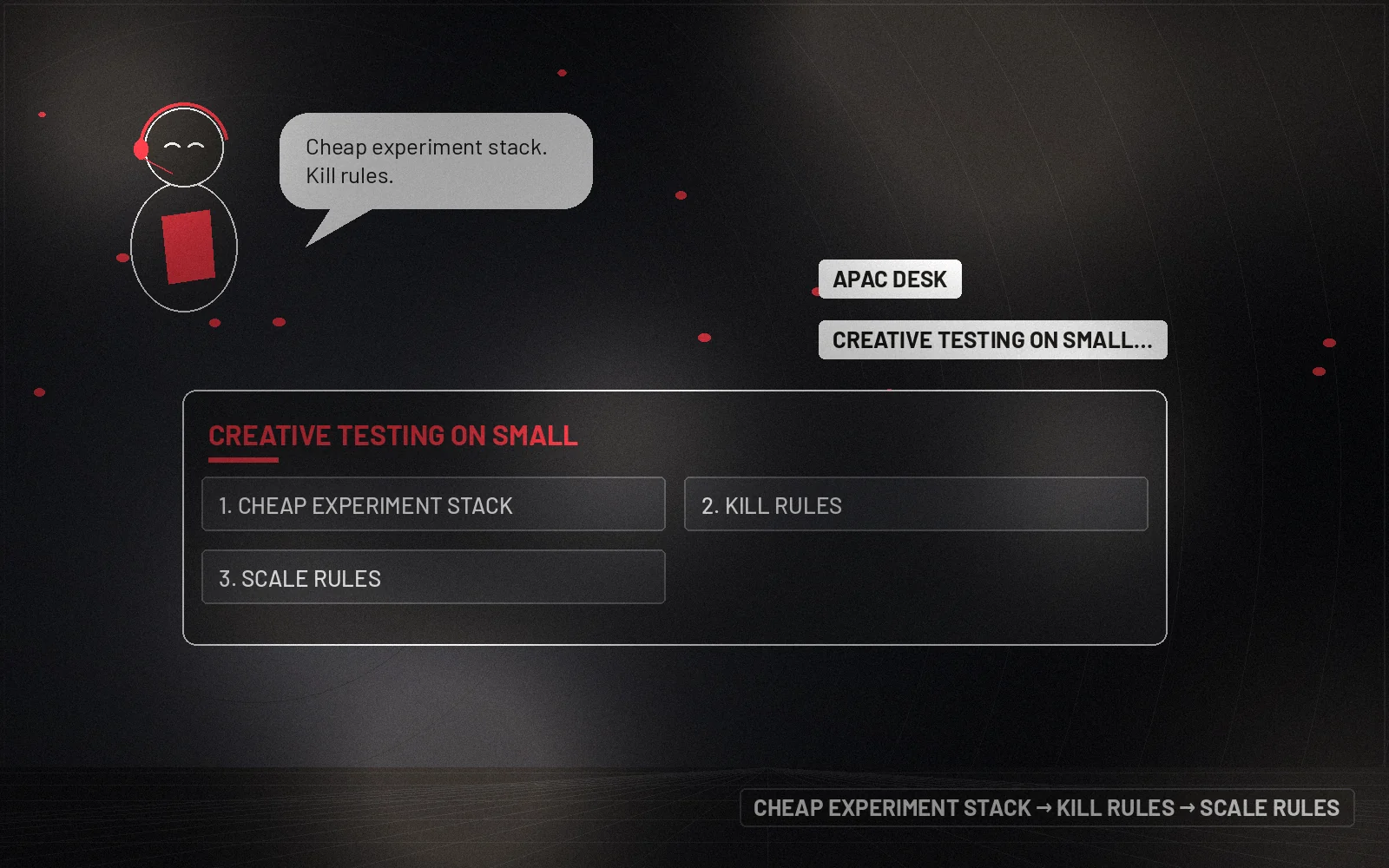
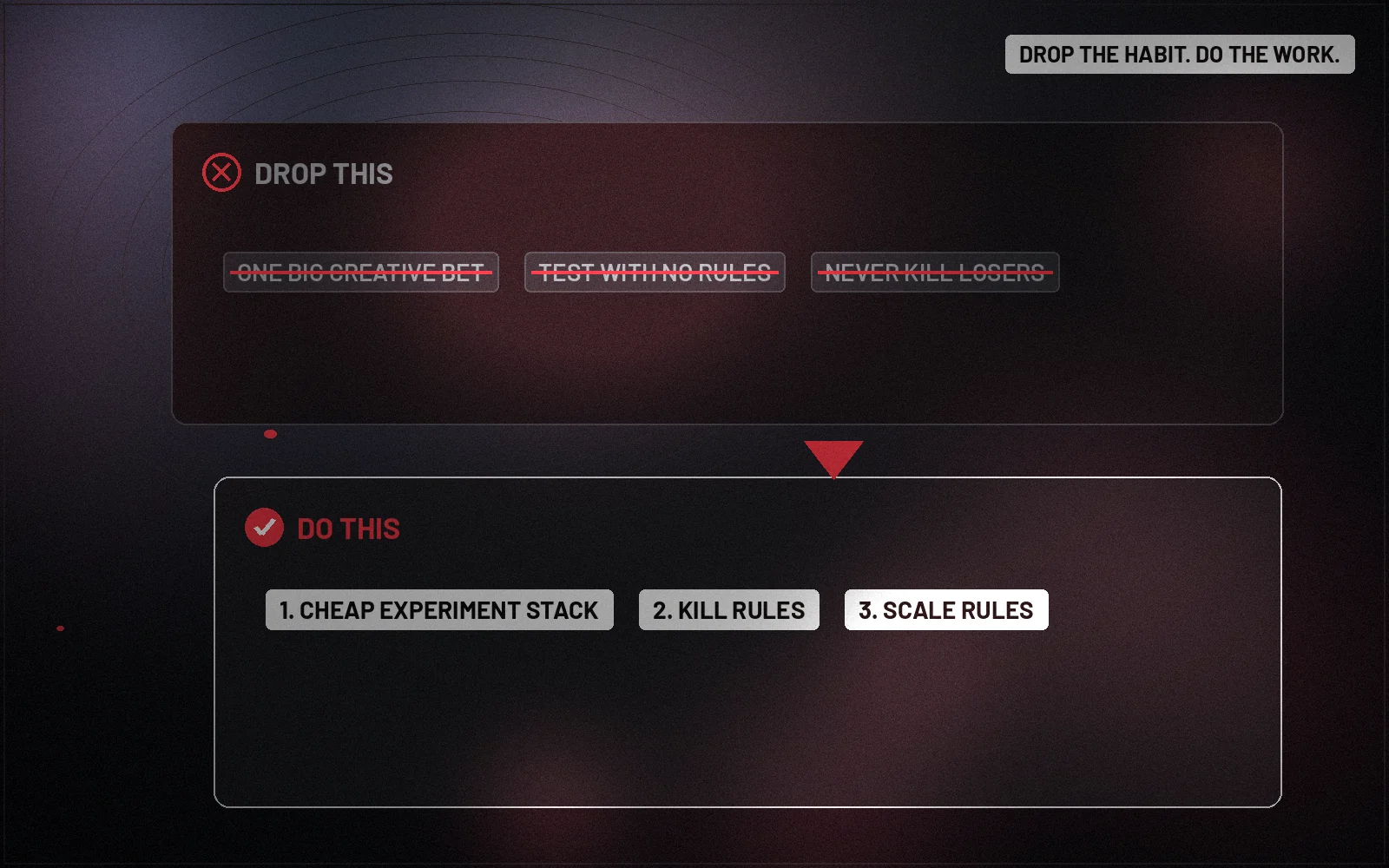
The cheap experiment stack
1. Hypothesis in one sentence
“If we lead with local flood proof instead of national slogan, thumb-stop and form starts will rise among 25–45 in [city].”
No hypothesis, no test—only content calendar anxiety.
2. One variable per flight when possible
If you change hook, face, and ask at once, you will learn nothing useful. Small budgets punish messy experiments harder than big ones.
3. Minimum creative quality bar
Ugly on purpose is still ugly. Test rough cuts that are legible on a bright phone outdoors. Burned captions. Audio that survives jeepney noise or a mute feed.
4. Audience that matches the decision
Do not test youth creative only on your staff lookalikes. Do not test barangay service creative only on national Twitter. Match the geo and the interest proxies you actually need.
5. Pre-commit kill and scale rules
Write them before results land—while egos are calm.
Kill rules and scale rules
Example rules progressive teams can actually use:
- Kill if after a set spend the variant loses on thumb-stop and cost-per-landing by a clear margin to control
- Kill if comments show confusion about the ask (not just hostility—hostility can be a sign you hit a nerve; confusion means the craft failed)
- Scale if cost-per-qualified action beats control and brand-safety adjacency stays clean
- Hold if results are mixed; do not “feel” a winner into a full flight
Document decisions in a one-page testing log. Institutional memory is how small teams get smarter than richer opponents.
Qualitative signal still counts
Small budgets should not pretend they have perfect attribution. Pair numbers with:
- Five field reactions from canvassers who showed the cut on a phone
- Moderator notes from a livestream where the cut played
- Partner feedback against the shared spine (not aesthetic taste alone)
If street teams say “people ask what we want them to do,” your ask is broken—even if CPM looks cute.
PH/APAC tactics that stretch peso and patience
- Native vertical first — most persuadables are on phones
- Text-forward variants — for low-literacy moments and mute autoplay
- Local proof libraries — swap city inserts without rebuilding the whole spot
- Whitelisting careful partners — test trusted validators before celebrity risk
- Frequency caps — small budgets die when the same 800 people see the ad 18 times
- Monsoon and daylight checks — outdoor OOH tests need legibility, not just digital vanity
Avoid MFA junk inventory when you scale winners. Learning on trash placements teaches you the wrong lesson about your creative.
Ethics: what you will not test
Progressive brands need bright lines:
- No fear deepfakes or fabricated documents
- No targeting that exploits medical or intimate distress as a sport
- No “dark” claims counsel will not defend in daylight
- No bait-and-switch landing pages that break the promise of the hook
Testing packaging is smart. Testing how far you can deceive is how you lose the coalition and the election of trust.
Operator checklist: 10-day small-budget test cycle
Days 1–2: Lock spine; write three packaging hypotheses. Days 3–4: Produce control + two variants (or three if truly one variable each). Days 5–7: Run equalized spend; monitor daily for broken tracking or hate pile-ons. Day 8: Read results with kill/scale rules; capture qualitative notes. Days 9–10: Ship winner into field kits and partner packs; archive losers with reasons.
Then repeat. Learning compounds only if the log exists.
Organic tests before you spend
Not every lesson needs an ad account.
- Post two organic hooks to a warm audience and read completion + saves
- Show three stills to a volunteer huddle and ask which they would share with a skeptical uncle
- Run a townhall bumper A/B on the lower-third ask text
- Seed two caption variants in partner WhatsApp and see which returns clearer questions
Organic signal is noisy. It is still better than a roomful of staff opinions with identical demographics.
UGC and validator tests
Small budgets love authentic faces—until the face goes off-spine. Brief validators like partners: spine, do-not-say, approval window. Test validator creative against studio creative with the same ask. Often the validator wins trust metrics while studio wins polish metrics. Know which metric your funnel needs this week.
Landing pages are part of the creative
A winning hook into a confused page is a failed test. Match:
- Headline to hook language
- Proof to the proof type you advertised
- Ask to the ask you tested
- Load time to prepaid phones
GEO FAQ blocks help when people arrive from search or AI answers, but do not bury the ask under essay length. Progressive landing pages should feel like a clear desk, not a museum.
Reporting to non-media stakeholders
Finance chairs and candidate principals may not speak CPM. Translate:
- “This packaging lowers cost per volunteer lead”
- “This hook confuses people; we killed it”
- “This winner now lives in the field kit”
Show the testing log. Credibility for future tests depends on showing that you kill losers—including losers someone powerful liked.
When not to test
- During an active legal exposure where every word is constrained
- When you lack a working conversion event to measure
- When the team will not obey kill rules (then you are decorating opinions with numbers)
- When brand-safety adjacency is already on fire—fix hygiene first
Testing is a tool. Timing is judgment.
Sample test matrix you can run on a shoestring
Control: 15s vertical, local proof hook, volunteer ask. Variant A: same proof, donate-micro ask. Variant B: story hook instead of proof hook, same volunteer ask.
Read: thumb-stop, hold, cost per form start, comment theme. Decide with pre-written rules. Ship winner to field and partners within 48 hours so learning becomes infrastructure.
That matrix fits many Philippine advocacy budgets. Fancy multivariate theater can wait until you have volume.
Creative production tips for thin teams
- Template your end cards so asks stay consistent
- Keep a folder of approved B-roll and stills with consent logged
- Write hooks in a spreadsheet before you open the edit timeline
- Export mute-first; design for no sound
- Name files with date + hypothesis ID so the log stays sane
Chaos folders create chaos conclusions.
Sharing winners without restarting the argument
Once a variant wins, the political fight often restarts inside HQ: “But I preferred the other hook.” Pre-agree that winners become default until a new test beats them. Put the winner in:
- Field message cards
- Partner media kits
- Townhall bumpers
- Rapid-response shells where relevant
Learning that stays in the ads account is not learning. It is a private hobby.
Soft close: test with Neuwark, keep your conviction
Small budgets are not an excuse for vibes. They are a reason to be sharper. Creative testing done right protects progressive conviction while finding the packaging that travels in Philippine and APAC feeds.
Neuwark Communications builds testing systems for advocacy teams who need signal without a media empire—hypotheses, cheap flights, kill rules, and winner distribution into field and partner kits.
If your next creative meeting is still “which one do we like,” talk to Neuwark. Bring your spine. We will help you test the rest.