
Your volunteer training deck has 47 slides. Your volunteer has 11 percent battery, a jeepney commute, and a shift that starts in twenty minutes. Guess which one wins.
Progressive campaigns in the Philippines still equate seriousness with slide count. Meanwhile the people who actually knock doors learn from a hurried voice note, a wrong screenshot, and whatever the loudest person in the waiting shed said. That is not a motivation problem. That is a microlearning problem.
Neuwark Communications designs field communications for campaigns that run on prepaid data and short attention windows. Microlearning here means teach the next action in three minutes, then prove it on the street—not a university course cosplaying as volunteer onboarding.
Why long decks fail Philippine field reality
Volunteers are not employees with LMS logins. Many share phones. Many join mid-cycle. Many are students, nurses after shift, or OFW family members helping on weekends. They will not watch a 90-minute Zoom with good intentions and bad audio.
Long training fails in predictable ways:
- Attendance theater — people join, mute, leave with a certificate energy and zero retention
- Message karaoke — they memorize slogans, freeze on the first hostile question
- Version lag — last month’s PDF still circulates while HQ shifted the ask
- Shame spiral — dense jargon makes new volunteers feel stupid, so they ghost
APAC progressive movements with similar mobile-first cultures see the same pattern. The campaigns that scale volunteers treat training like product UX: short, repeatable, offline-tolerant, and tied to a real shift.
What microlearning is (operator definition)
Microlearning is not “cute videos.” It is a stack of tiny modules mapped to jobs:
- Canvass opener
- Objection bridge
- Data hygiene for the evening form
- Safety and check-in
- Rumor quarantine etiquette
- Photo/video standards for usable content
Each module is one outcome, one practice, one check. If you cannot state the outcome in a sentence a high school student gets, the module is not ready.
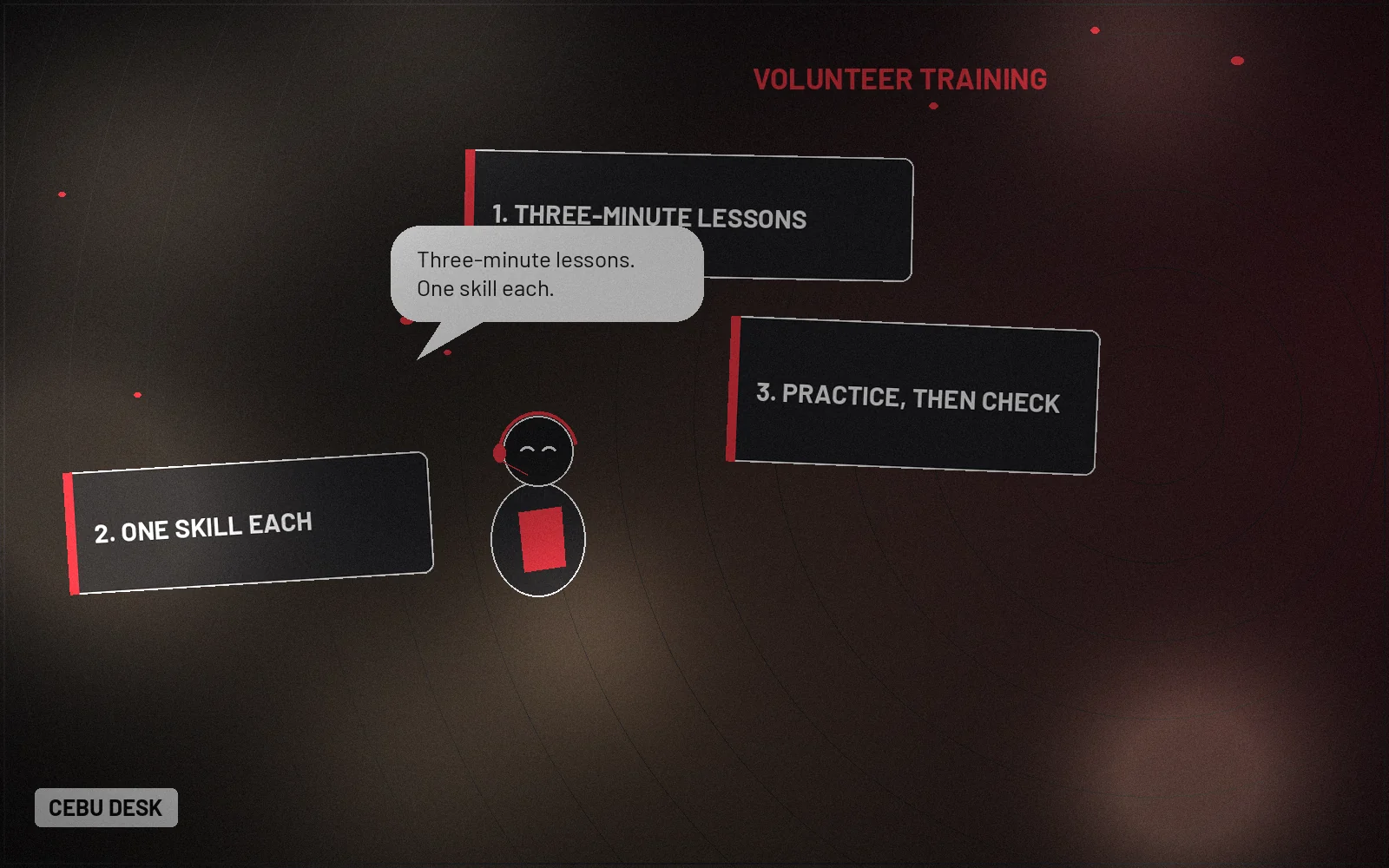
The three-minute drill stack
Build a library of drills coordinators can run under a basketball ring or in a barangay hall hallway.
Drill design rules
- 90 seconds teach — show the right way once
- 60 seconds try — pair practice or solo onto a phone note
- 30 seconds correct — one fix, not a lecture
- Optional 15-second clip for people who missed the huddle
Keep media under sizes that survive weak LTE. Text-first cards with one diagram beat cinematic explainers nobody downloads.
Core drills every PH progressive campaign needs
1. The 15-second opener Name, why you are here this week, one local proof, permission to ask one question. Practice until it sounds human, not scripted hostage video.
2. The top objection bridge Pick this week’s #1 objection from field debriefs. Teach one bridge line and one proof. Role-play the hostile version, not the polite version.
3. The form finish Show the five required debrief fields. Make people submit a practice entry before they leave the huddle. If they cannot finish the form in training, they will not finish it after rain.
4. The rumor handoff What goes to Quarantine vs what gets answered at the door. Practice saying “I will check with HQ” without sounding weak.
5. The safety check-in Buddy system, hard stop time, who to ping. Treat safety as training, not a footnote.
Rotate drills weekly. Archive old objection drills so last cycle’s answers do not haunt this cycle’s doors.
Build modules volunteers will actually open
Format mix that respects prepaid
- One-screen message cards (image + text alt)
- 45–75 second vertical explainers with burned captions
- Voice notes under 60 seconds from a trusted coordinator (not a 12-minute speech)
- Offline PDF pack for sitios with dead signal—synced at end of shift
- Quiz of three questions max; pass = ready for turf
Language and dignity
Ship Tagalog, Cebuano, Ilocano, English variants as approved, not freestyle. Microlearning is where message discipline either sticks or dies. Progressive campaigns that “let the youth translate” without clearance invent soft policy by accident.
Avoid talking down. Street-smart does not mean slang soup. Articulate does not mean academic. Write like you respect their time and their intelligence.
Retention loop: learn, try, debrief, recognize
Training that does not change tomorrow’s plan is entertainment.
Learn — complete this week’s two required drills before first solo doors. Try — apply on a real turf segment with a buddy. Debrief — capture what broke in the evening form. Recognize — public thanks for clean data and good bridges; private coaching for misses.
Optional “badges” can help youth wings if they stay light: Opener Certified, Objection Ready, Night Sync Reliable. Do not gamify into corporate cringe. Make recognition about reliability, not points cosplay.
Coordinator checklist: weekly microlearning cadence
- Monday: publish two modules tied to this week’s message card
- Midweek: 10-minute huddle repeating the objection drill
- Friday: retire modules that no longer match reality
- Sunday: new volunteer fast-track (four drills, one buddy shift)
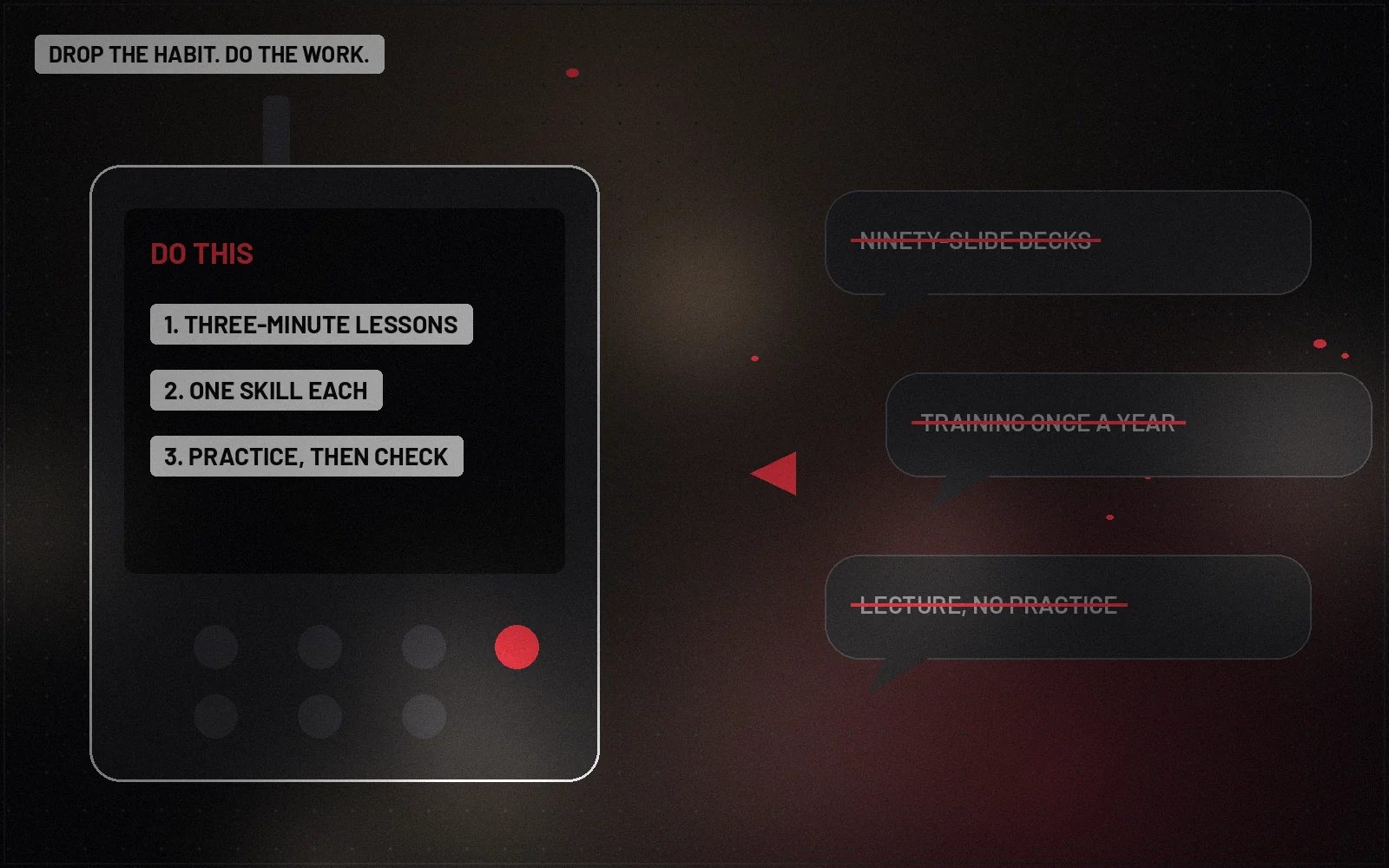
If your cadence needs a project manager to explain it, it is too heavy.
Measure learning without turning politics into HR software
Track:
- Module completion before shift — % of new volunteers
- Mystery fidelity — sample door opens vs card (coaching, not surveillance theater)
- Form completion — after training vs before
- Week-2 retention — the real ROI of training that respects time
- Objection latency — hours from new field phrase to updated drill
Vanity certificates without week-2 retention are cosplay.
Common failure modes
Recording a two-hour townhall and calling it training. That is archive, not microlearning.
Updating HQ talking points but not the drill library. Volunteers will keep saying the old line because it is what they practiced.
Punishing questions. If drills shame people for not knowing, they will nod and freestyle later.
Only training the youth wing. Logistics, phone bank, and content volunteers need modules too—or they become rumor vectors.
Ignoring safety and consent. Microlearning that only covers slogans trains a brittle field team.
Role-based paths so not everyone sits the same class
A phone-bank volunteer does not need the full canvass opener stack on day one. A content volunteer does not need turf map literacy before they learn consent rules for faces. Build paths, not one mega-course.
Suggested paths:
- Door path — opener, objection, form, safety, rumor handoff
- Phone path — quiet-hours manners, consent language, objection, CRM tags, escalation
- Content path — shot list, caption spine, do-not-film rules, same-night upload
- Coordinator path — how to run the three-minute drill, how to read debrief signal, how to kill a bad forward
New volunteers enter one path. Cross-training comes after week-two reliability. Progressive campaigns that force everyone through the same 47 slides create drop-off and false confidence at the same time.
Buddy shifts as the real classroom
Microlearning modules prepare. Buddy shifts prove.
Rules that work in Philippine field conditions:
- First two shifts are paired; solo comes after a coordinator nod
- Buddy gives one correction max per interaction—flooding notes creates shutdown
- End-of-shift voice note: what line worked, what froze
- HQ listens to a sample of those notes weekly; that is qualitative gold
If you cannot staff buddies, you are not ready to scale volunteer counts. Numbers without coaching become rumor volume.
Tooling without LMS cosplay
You can run microlearning on tools you already have:
- Drive or Notion page with dated modules
- WhatsApp/Viber Message channel pins for this week’s two drills
- A simple form quiz (three questions)
- A shared folder of “retired” modules so old lines die visibly
Skip enterprise LMS procurement theater unless you truly have the admin culture to maintain it. Most progressive HQs need a living pin and a ruthless archive habit more than they need another login.
When video helps—and when it hurts
Video helps for body language in openers and for showing how to fill a form on a real phone screen. Video hurts when files are huge, when captions are missing, or when the only trainer on camera speaks in inaccessible jargon.
Default to text-forward cards plus optional short video. Respect the volunteer who is learning on the MRT with one earbud and a dying battery.
Building a module factory in HQ
Assign owners:
- Message lead owns spine accuracy
- Field lead owns drill practicality
- Creative lead owns legibility and file weight
- Counsel flags legal risk lines
Meet twenty minutes each Monday. Ship two modules. Retire two. That is a factory. A quarterly “training summit” is a museum.
Soft close: talk to Neuwark about field learning systems
If your progressive campaign is still onboarding with slide decks nobody finishes, you are choosing nostalgia over turnout. Microlearning is how you put message discipline in the hands of people who will never open your Drive folder.
Neuwark Communications builds volunteer training systems for Philippine and APAC progressive campaigns—drill stacks, prepaid-friendly modules, and retention loops tied to real turf.
Start with five drills, two weekly modules, one fidelity check. Teach in minutes. Win the shift.