
Broken translations do not sound bilingual. They sound untrustworthy.
Progressive campaigns across the Philippines and APAC often treat language as a last-mile chore: English master first, then a late-night paste into Tagalog, Cebuano, Bahasa, or another market language. Meaning snaps. Tone turns cringe. Opponents clip the awkward line. Donors in diaspora notice before HQ does.
Neuwark Communications treats multilingual work as message discipline—same argument, controlled variants, QA that catches harm before publish. This is how you sound local without inventing a second platform.
Translation is message work
If your English spine says one policy boundary and your vernacular softens it into mush, you did not “localize.” You changed the platform.
Message discipline means:
- One master claim set
- Approved equivalents per language
- Named owners for each language desk
- A kill path for freestyle “flavor”
Street-smart still applies. People smell corporate vernacular—the kind that stuffs slang into a press release and hopes youth vote for the effort.
Where PH + APAC campaigns get hurt
- Literal translation of idioms (“move the needle,” “double down”) that mean nothing—or the wrong thing.
- Tone mismatch: English formal, vernacular try-hard.
- Policy drift: translators “helpfully” soften hard lines.
- Name errors: bill nicknames, place names, honorifics.
- Platform mismatch: lines that fit a speech collapse on SMS character limits.
Each failure is preventable with process.
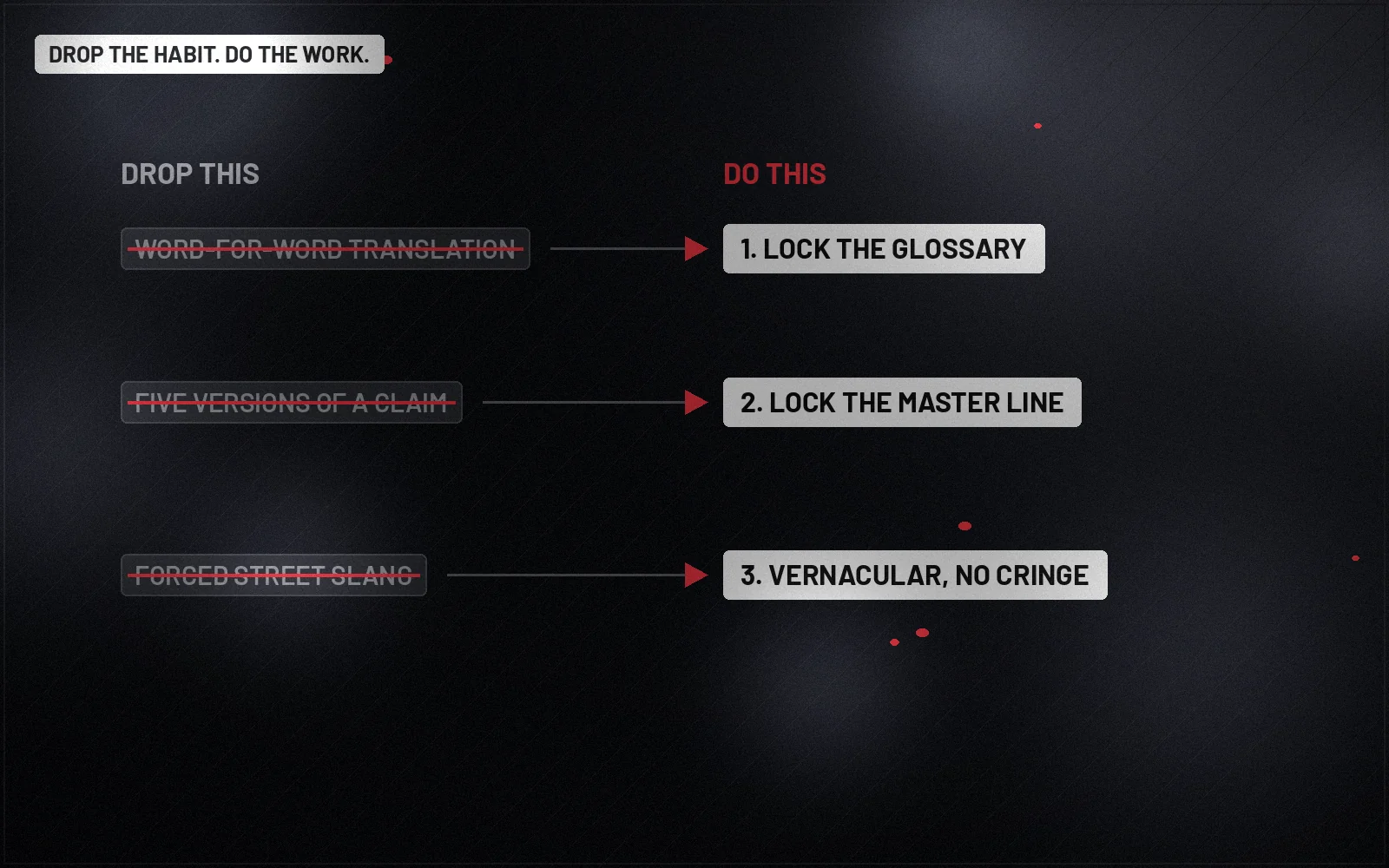
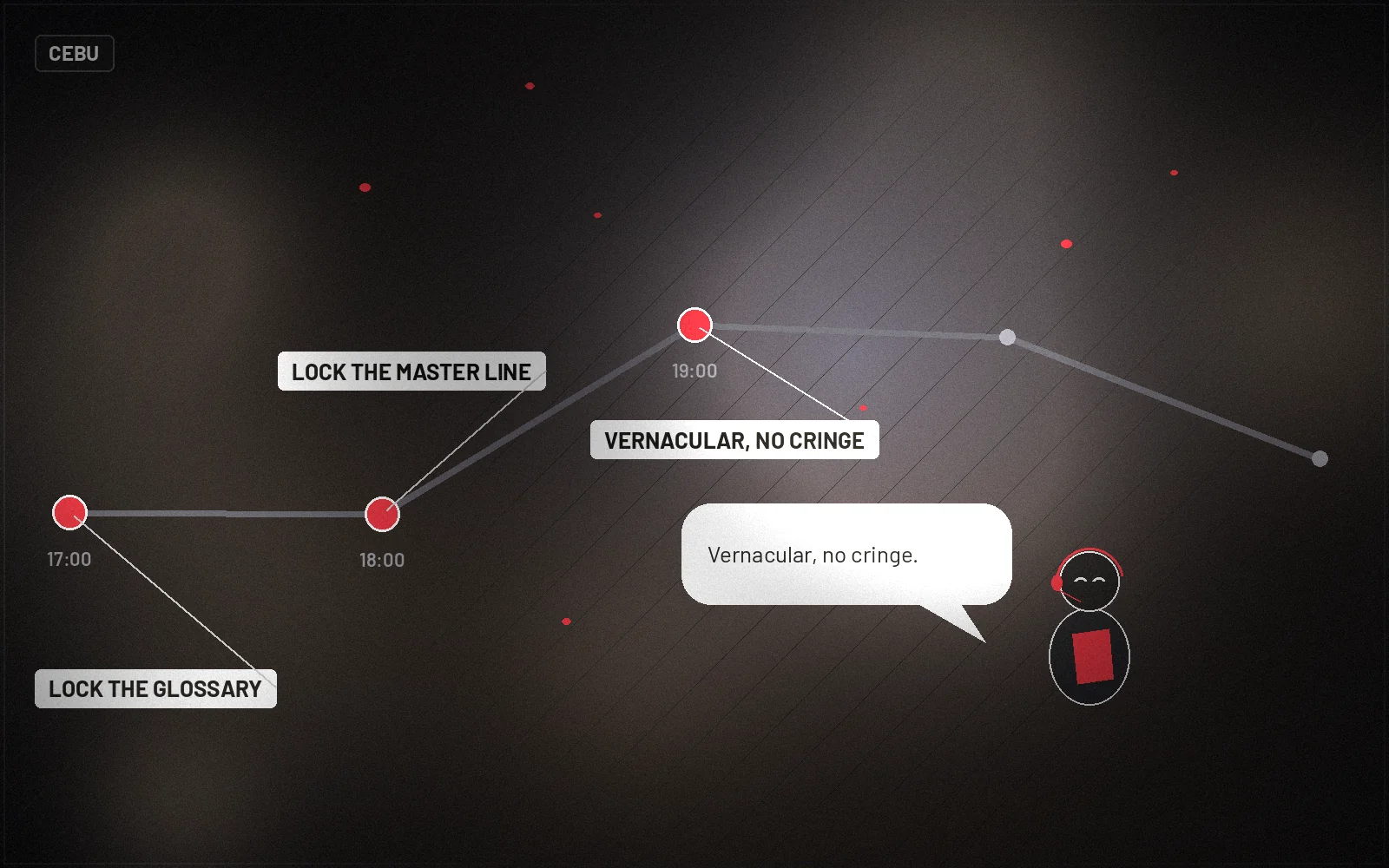
The three locks: glossary, master spine, QA
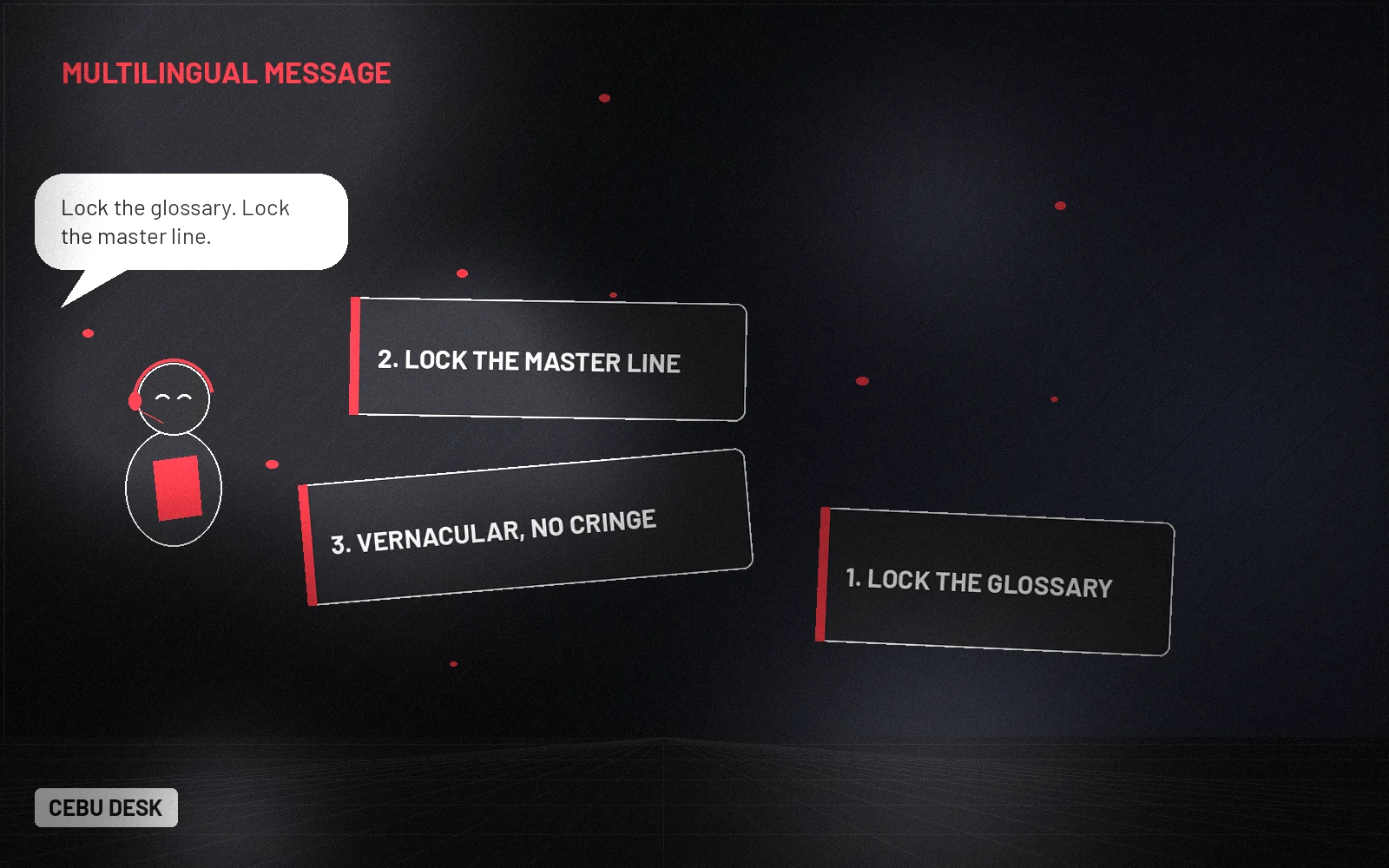
Lock 1 — Glossary before the surge
Build a living glossary for:
- Candidate/org names and banned nicknames
- Policy terms and approved short forms
- Opponent names (neutral forms)
- Numbers and unit conventions
- Words you will never use (slurs, reckless blame, unverifiable superlatives)
Translators and creators consult the glossary first. Arguments about vibe happen in glossary updates, not in the caption box at publish time.
Lock 2 — Master spines, then language variants
Write answer blocks, ads, and SMS as spines:
- Claim
- Proof
- Boundary
- Ask
Translate spines, not vibes. Allow natural syntax changes. Do not allow claim changes.
For priority languages in a PH national or multi-city race, fund real translators who understand politics—not only literary fluency. For APAC cross-border advocacy, add cultural review from people who live the audience.
Lock 3 — QA that reads aloud
Before publish:
- Native-fluent reviewer reads aloud on a phone screen.
- Second reviewer checks claims against master (fidelity pass).
- Counsel spot-checks high-risk topics.
- Field organizer checks whether a volunteer would actually say it.
If it fails the “would you say this at a door” test, rewrite.
Vernacular without cringe
Youth audiences punish try-hard brand voice. Older audiences punish disrespectful slang. Your job is clarity and respect—not cosplay.
Practical rules:
- Use everyday words, not meme costumes, unless the creator is truly of that community and briefed.
- Keep humor gentle and testable; cruelty travels farther than you intend.
- Prefer concrete local proof over borrowed Twitter cadence.
- In mixed-language communities, clean code-switching beats forced purity.
Influencers and validators need the same glossary. A viral creator freestyling policy in “relatable” language can burn months of discipline in one Reel.
SMS and chat deserve their own length discipline
Vernacular SMS is where broken translations shine—badly.
- Write SMS originals to length; do not shrink a speech.
- Avoid ambiguous pronouns that flip meaning.
- Put the ask and the STOP/help path in the clear.
- Respect quiet hours across islands and diaspora zones.
A wrong-tone midnight SMS is both a language failure and a compliance failure.
Operator checklist: multilingual discipline in two weeks
Week 1
- Inventory languages you actually need (not languages that flatter the brochure).
- Assign desk owners and backups.
- Draft glossary v1 with message lead + counsel.
- Select top 20 spines for first controlled translation.
Week 2
- Translate and QA the 20.
- Ship to web FAQ, field cards, and one ad set.
- Brief creators/partners; collect freestyle examples to kill.
- Set a weekly 30-minute glossary triage.
Metrics
- Fidelity flags per week (claim mismatches caught pre-publish)
- Post-publish corrections by language
- Field reports of “nobody says it like that”
- Creator brief compliance rate
- Complaint themes tied to tone/language
If English engages and vernacular confuses, you have a craft problem—not “the audience.”
Working with creators and coalition partners
Give partners:
- Spines + glossary excerpts
- Do/don’t examples
- Escalation contact for policy questions
- Clear rule: when unsure, ask—do not invent
Paid creators should sign brief acknowledgment. Soft culture is not a contract. Progressive campaigns lose when “friendly” freestyle becomes the quote of record.
For multilingual live events, assign a language captain. Do not let simultaneous interpreters invent boundaries under stage lights without a briefing.
Diaspora and cross-border APAC realities
Diaspora donors often read English masters and vernacular social proof. Keep them aligned.
Cross-border APAC advocacy adds legal and cultural constraints—what is sayable in one country may be risky in another. Message discipline includes jurisdiction notes in the glossary: where a line is approved, limited, or banned.
Do not crowdsource legal judgment in group chats.
Failure modes
Google Translate night shifts. Speed without fidelity is self-own content.
Too many languages, zero owners. Shrink scope until quality holds.
English supremacy cosplay. Sometimes the vernacular spine should lead if that is where persuasion lives—then back-translate carefully to English for counsel.
No budget line. Multilingual QA is not free. Fund it like media buying, because it protects media buying.
What Neuwark builds into multilingual systems
We write and systemize progressive communications so language variants stay disciplined under pressure—campaign tempo, crisis holds, donor journeys, and field cards included.
If your argument cannot survive translation, it was not ready for the electorate you claim to serve.
Building a language desk that survives campaign tempo
A language desk is not a volunteer hobby thread. It is a named function.
Staff it like this for a serious PH national or multi-region effort:
- Message lead (owns master spines)
- Language captains per priority language
- Floating QA reviewer who is not the original translator
- Counsel on call for high-risk claims
- Creator liaison who pushes glossary updates into briefs the same day
When tempo spikes, captains need authority to say “not yet” on a cute caption that breaks a boundary. Speed without veto power is how broken lines ship.
Back-translation as a safety rail
For high-stakes spines (crisis holds, policy boundaries, legal claims), run back-translation: vernacular → English by a second person, compare to master.
You are not chasing literary elegance. You are hunting claim drift. If back-translation invents a softer promise, fix the vernacular before publish.
Use this rail selectively. Overusing it slows ordinary proof posts. Underusing it on crisis language is malpractice.
Training organizers to speak the approved vernacular
Field cards should include:
- The bridge line in the language they will actually speak
- One optional proof phrase
- Words to avoid
- Escalation: when to stop and call HQ
Role-play in training beats PDF lectures. Have organizers say the line out loud. If mouths refuse it, rewrite—do not blame “discipline.”
Record a 60-second voice example from a trusted organizer for each priority card. People imitate voice better than they imitate text.
Crisis holds across languages
Holding statements need the same discipline under adrenaline.
- Translate from the approved hold master only.
- Same time window promise across languages.
- Same boundary verbs.
- Publish near-simultaneously when audiences overlap; staggered posts create “which one is real?” fights.
If a language desk is offline at 1:00 a.m., ship the master language first with a note that vernacular follows—then follow. Silence in one language while another speaks can look like avoidance.
Budget lines that make multilingual real
Put money against:
- Translator/QA retainers in surge months
- Glossary maintenance hours
- Creator brief workshops
- Back-translation for crisis and major policy drops
If multilingual is only a wish in the brand book, English will quietly become the only disciplined channel—and your electorate will notice.
Start narrower than your pride wants
Ship two languages with discipline before you announce seven. Pride wants a flag for every tongue. Operators want lines that survive contact with voters. Expand only when captains and QA capacity are real—not when a brochure demands rainbow optics.
A note on “authentic voice” excuses
“Authentic” is not a free pass to contradict the platform. Lived voice can choose diction and rhythm. It cannot invent a different policy. Brief creators on that line early so you are not negotiating meaning after a Reel already spiked.
Closing move
Glossary first. Spines second. QA aloud. Brief creators. Kill freestyle. Measure fidelity.
That is multilingual message discipline for PH and APAC campaigns—local where it counts, unbroken where it matters.
If you need controlled language systems for your campaign or advocacy network, talk to Neuwark Communications. We help operators sound human in every language they actually use.