
Your door teams hear the truth. Your ads invent a prettier one.
That split is how Philippine progressive campaigns waste money and confuse voters. Ground game and digital are treated like rival departments: field “owns reality,” digital “owns reach.” Meanwhile objections travel barangay to barangay while creatives keep testing headlines nobody said out loud.
Neuwark Communications builds the feedback loop—so tonight’s field language becomes tomorrow’s creative, SMS, and FAQ updates. This is operator craft for PH campaigns that need overnight learning, not quarterly slide decks.
Why silos lose mid-cycle
Early campaign weeks forgive disconnects. Mid-cycle punishes them.
Typical failure pattern:
- Canvassers hear a sticky rumor about a bill or a personality fight.
- They invent soft answers or avoid the door topic.
- Digital keeps scaling a brand film that never addresses the rumor.
- Donors ask why “awareness is up” while persuasion stalls.
- HQ discovers the rumor in a journalist’s question—ten days late.
The fix is not more meetings. The fix is a closed loop with owners and timestamps.
What “loop” means in plain language
1. Field captures objections in structured phrases. 2. HQ clusters and prioritizes within hours, not weeks. 3. Message/digital ships a response asset (card, ad, FAQ, SMS). 4. Field uses the new asset next shift. 5. Digital measures whether the objection softens in comments, replies, and search. 6. Repeat.
If any step depends on a hero remembering to forward a Viber screenshot, you do not have a loop. You have luck.
The overnight learning stack
Design for monsoon season and prepaid data—not Silicon Valley fantasy.
Layer 1 — Capture at the door and on the phone
Require the same objection fields every night:
- Verbatim phrase (how the voter said it)
- Theme tag (economy, trust, rumor X, logistics, other)
- Geography (city / district / barangay)
- Intensity (shrug / soft block / hard block)
- Whether a card already exists for it
Keep it fast. Five fields beat a novel. Organizers will not fill a thesis between jeepney rides.
Voice notes from coordinators are fine if someone turns them into structured rows before midnight.
Layer 2 — Cluster before sunrise
A message lead (or trained deputy) spends 30–45 minutes:
- Deduplicate phrases into 3–7 clusters
- Mark anything that needs counsel/facts
- Pick one cluster for next-day creative/SMS priority
- Park the rest on a visible board so they are not forgotten
Do not try to fix every objection every night. Prioritize by frequency × persuadability × risk of spread.
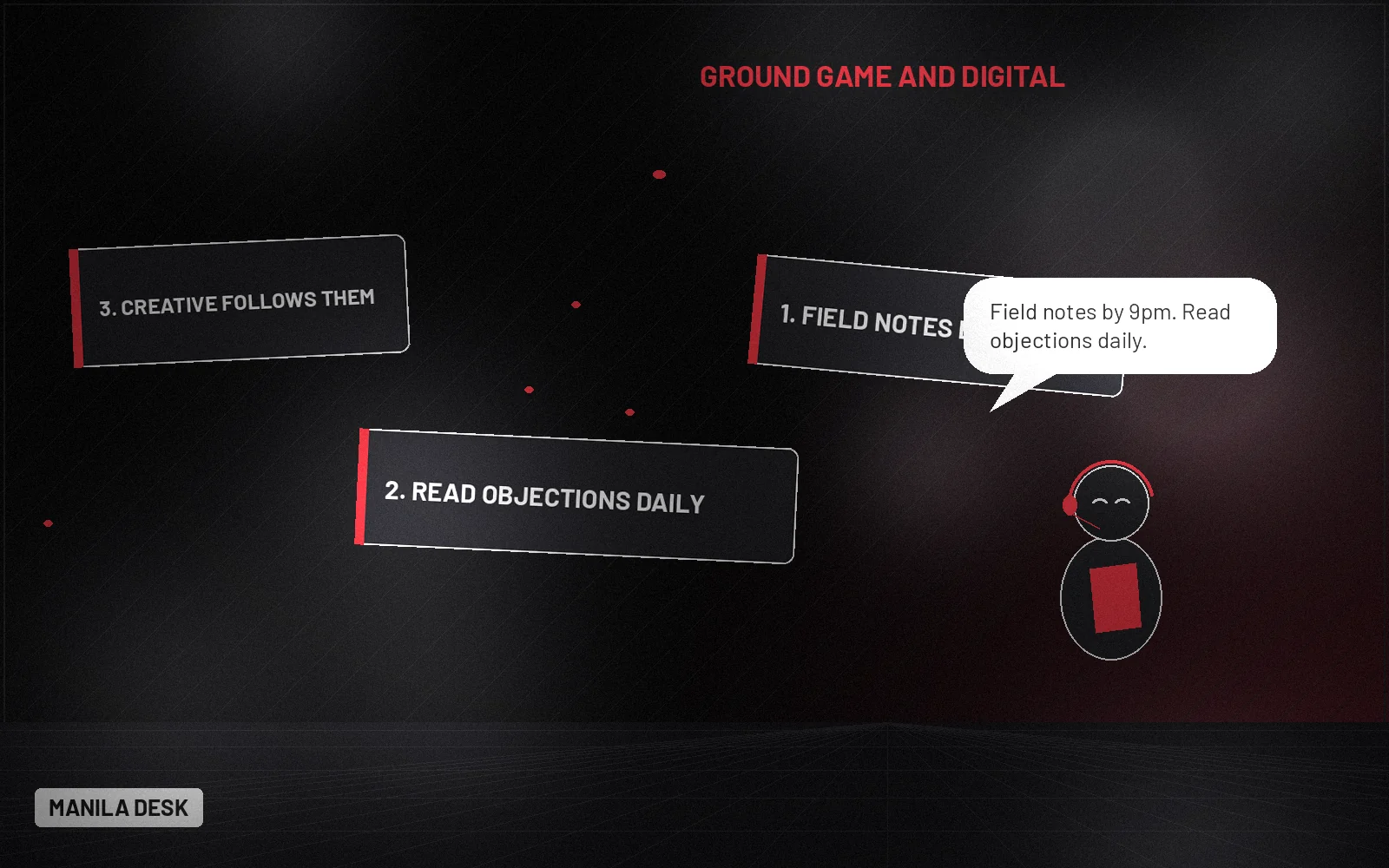
Layer 3 — Ship something small by afternoon
Shipping means a usable asset, not a brainstorm:
- Updated shift card paragraph
- 15–30s creative cut or static with the bridge line
- FAQ answer block
- SMS/Viber snippet for warm lists
- Partner one-pager line
Same spine across channels. Version number on the card. Kill old versions in group chats.
Layer 4 — Feed the result back to field
Morning brief must show:
- Top objections last night
- What asset shipped today
- What to stop saying
- What to listen for next
Volunteers who see their notes change tomorrow’s plan keep reporting. Volunteers who shout into a void stop typing.
Creative should follow objections
Digital teams love novelty. Field teams need bridges.
A bridge line answers the objection without surrendering the argument.
Objection: “They’re all the same.” Bridge: “Here’s the specific vote/program difference in one sentence—and what it means on your street.”
Objection: “That policy hurts workers like us.” Bridge: “Name the protection + the timeline + who already benefits nearby.”
Put bridge lines into ads the way you put them into doors. Test the line, not just the color grade.
Paid media rules inside the loop
- Reserve a slice of budget for objection-response creatives, not only brand lift.
- Cap tests: few variants, clear kill criteria, daily read during hot periods.
- Align landing pages with the bridge line—no bait-and-switch to a generic donate page.
- Pause creatives that field says are backfiring, even if CTR looks cute.
CTR is not persuasion. Field is.
Operator checklist: stand up the loop in 10 working days
Days 1–2
- Name owners: field capture, night cluster, digital ship, morning brief.
- Invent the five-field debrief if you lack one.
Days 3–5
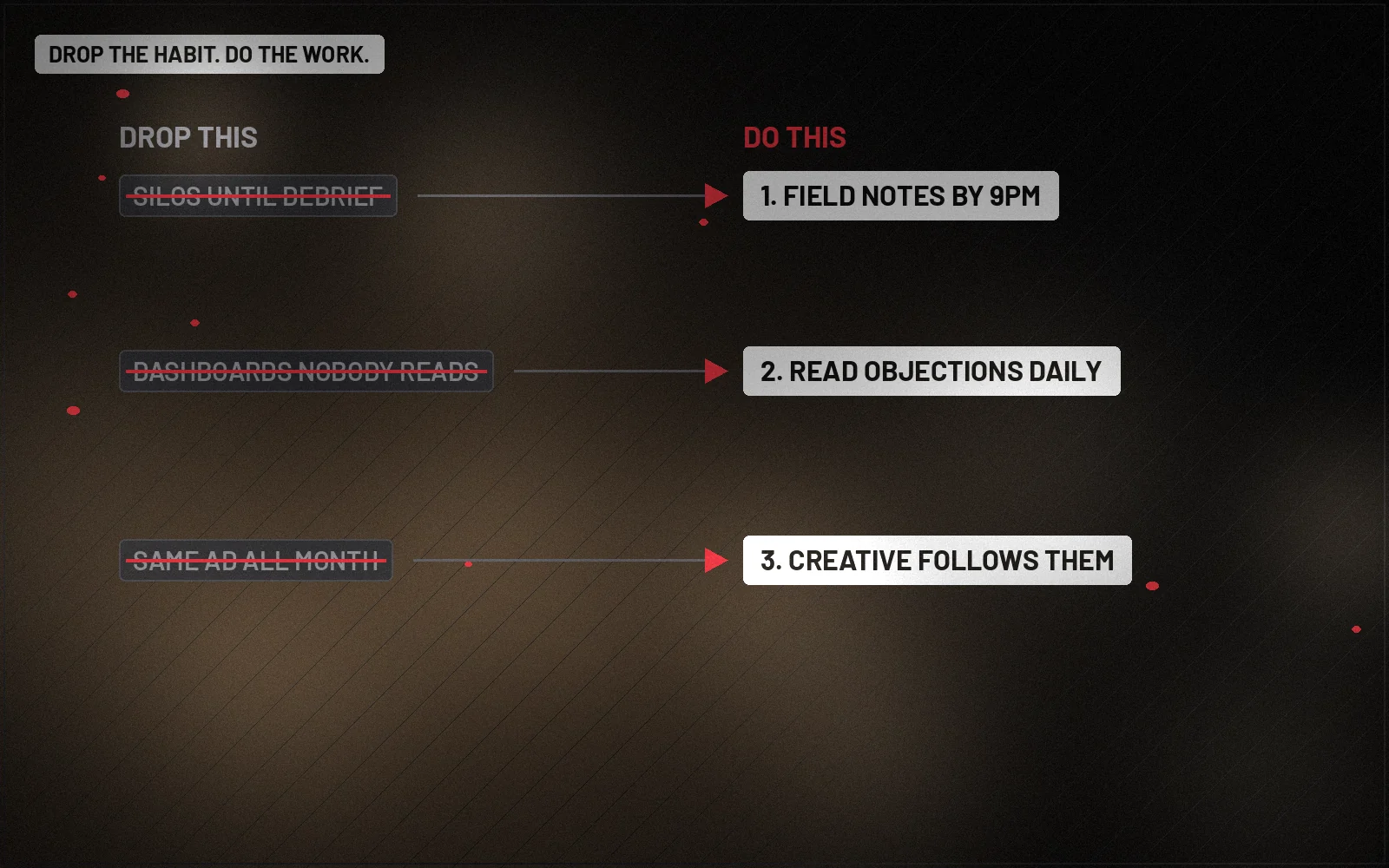
- Pilot in one city/district.
- Force one shipped asset from real objections.
- Kill duplicate chat “official” cards.
Days 6–8
- Connect FAQ + SMS editors to the same spine doc.
- Train coordinators on verbatim capture (no editorializing mid-door).
Days 9–10
- Scale to second geography.
- Add a weekly 45-minute loop review with creative and field in one room (or one call).
Metrics that prove the loop works
- Objection latency: hours from first field phrase to shipped asset
- Coverage: % of shifts with completed objection fields
- Creative refresh tied to clusters (count per week)
- Softening signals: comment themes, reply rates, revisit conversion on hostile segments
- Volunteer reporting retention after week 2
Vanity reach without objection latency is a screen addiction.
PH-specific friction (and how to design for it)
- Signal drops: offline paper capture with end-of-shift sync beats empty digital purity.
- Language mix: capture vernacular verbatim; translate for HQ clustering without “cleaning” meaning.
- Coalition freestyle: partners get the new spine the same day or they will invent their own.
- Transport/safety: if teams cannot revisit a barangay after dark, digital must carry more of the bridge for that pocket—and field must mark it.
- Rumor velocity: treat high-spread rumors as same-day priority even if raw counts are still climbing.
APAC campaigns outside PH can reuse the loop; adjust quiet hours, platforms, and coalition density.
Failure modes to kill early
Screenshot archaeology. Random image forwards are not a database.
Creative theater. Beautiful spots that ignore the top objection cluster.
Over-collection. You do not need life stories to learn the phrase that blocks the vote.
HQ disbelief. When field reports clash with donor mythology, believe the doors—then verify.
No kill switch for old messages. Yesterday’s card in a youth wing chat is how drift spreads.
What Neuwark builds when field and digital finally talk
We design communications systems where paid media, SMS, FAQs, and canvass cards share objection language. Progressive campaigns do not lose because they lack passion. They lose because learning is slower than the rumor.
Close the loop overnight. Make tomorrow’s ad answer last night’s door.
Tooling without the cult
You can run this loop on Google Workspace, a lightweight CRM, or a custom form stack. Tools are not the strategy.
Minimum viable tooling:
- One debrief form (mobile-friendly, low data)
- One clustering board visible to message + digital
- One spine document with version numbers
- One morning brief template
Avoid buying a “campaign OS” before owners exist. Software cannot invent overnight habits.
If prepaid users abandon forms mid-entry, shorten fields again. Capture incomplete rows with a “partial” flag rather than losing the phrase entirely.
Sample overnight timeline (Manila)
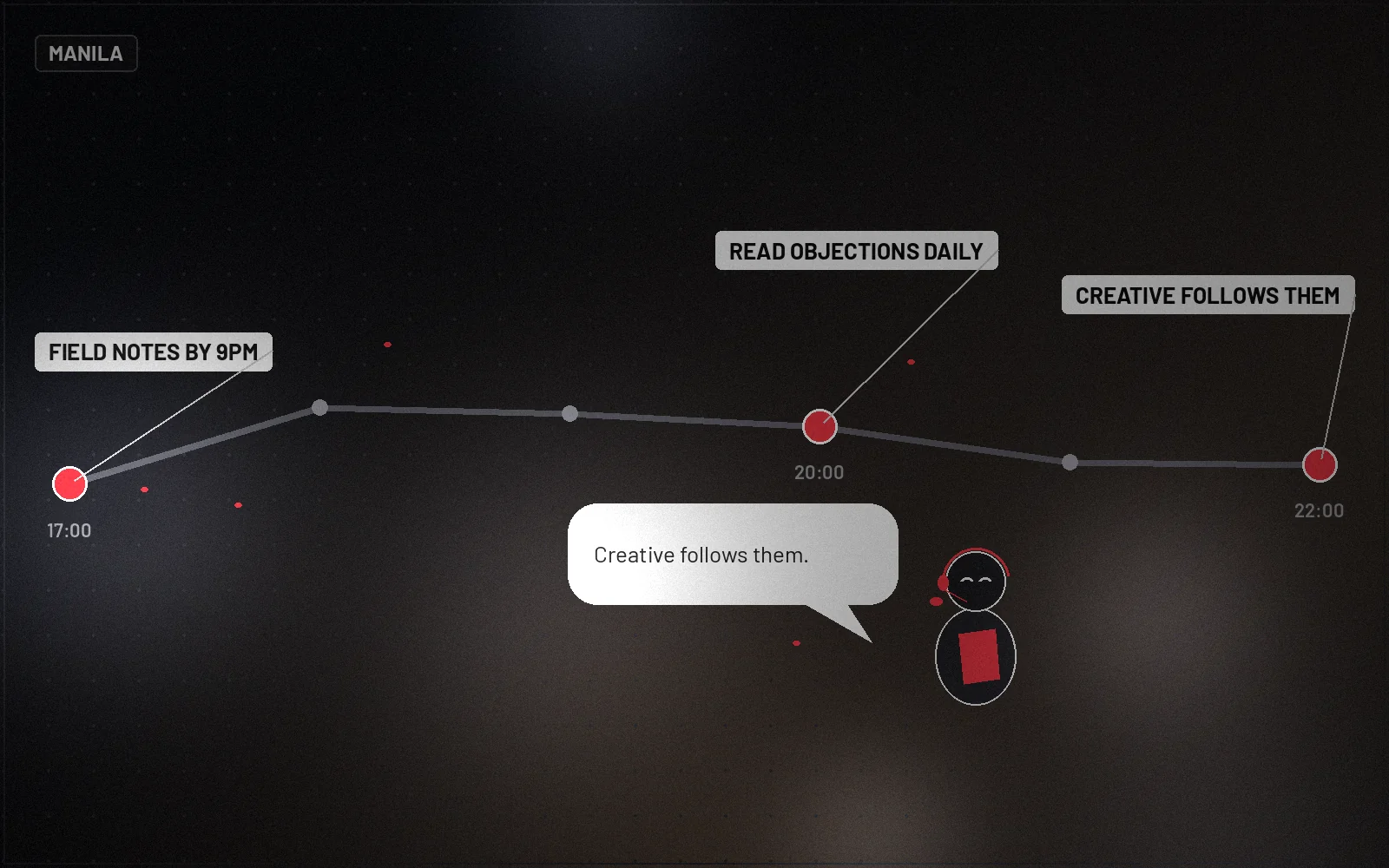
- 6:00–9:00 p.m. — shifts run; debriefs trickle in
- 9:30–10:30 p.m. — coordinators chase missing forms
- 11:00 p.m.–12:00 a.m. — message deputy clusters
- Morning — brief published; creative/SMS tasks assigned
- Afternoon — asset ships; field gets the new card
Adjust for provinces with earlier dark and safety cutoffs. The principle stays: same-day learning.
Supervising quality without surveillance theater
Mystery-shop a sample of doors and calls for message fidelity—not to punish volunteers, but to catch drift early.
Rules:
- Sample, do not stalk.
- Share findings as coaching cards.
- Separate safety incidents from message notes.
- Never publish raw volunteer mistakes into public channels.
Progressive campaigns owe dignity to the people doing the walking. Digitization should protect them, not turn them into content.
Linking donors to the loop (carefully)
Donors like proof. They do not need raw objection databases.
Translate loop outputs into stewardship language:
- “This week doors kept hearing X; we shipped Y response.”
- Show the creative or card spine, not personal voter data.
- Invite mid-tier donors to a short briefing on what you learned—not a voyeur tour of the CRM.
That keeps fundraising honest without leaking field PII.
Security and consent inside the loop
Objection data still contains people. Minimize PII. Restrict board access. Do not paste raw voter names into creative Slack threads. Consent rules for SMS follow the same lists you already steward. A faster loop is worthless if it becomes a leak.
Closing move
Capture verbatim. Cluster before sunrise. Ship one asset. Brief the field. Measure latency. Repeat.
That is the ground game ↔ digital feedback loop Philippine campaigns can actually run—and the difference between spending for noise and spending for persuasion.
If you want help wiring that loop across field and digital, talk to Neuwark Communications. We build operator systems for progressive work that has to learn in public, fast.