
Chaos does not wait for your best writer to wake up.
When something breaks—staff mistake, partner freestyle, hostile clip, operational failure—the first public words either buy time with honesty or dig a hole with spin. Progressive campaigns and advocacy organizations across the Philippines and APAC often improvise under adrenaline. That is how you get contradictions, deleted posts, and a week of explaining the explanation.
This article is evergreen process, not a live incident playbook for today’s headline. Neuwark Communications builds crisis and rapid-response systems so operators rehearse holding statements before midnight needs them.
What a holding statement is (and is not)
A holding statement is a short, approved public line that:
- Acknowledges you know something happened
- States what you can verify now
- Commits to a next update or process
- Avoids speculation, blame theater, and fake certainty
It is not a full apology (unless facts already support one). It is not a manifesto. It is not “no comment” wearing a suit.
Holding statements protect future truth. Say only what will still be true in 48 hours.
Why progressive teams botch the first hour
- Fear of looking weak delays any statement until rumors own the frame.
- Too many approvers. The statement dies in a group chat.
- Writers draft essays. Platforms need six sentences.
- Legal and politics fight in public channels instead of a private lane.
- Nobody pre-cleared who can hit send.
Process beats talent at 1:00 a.m.
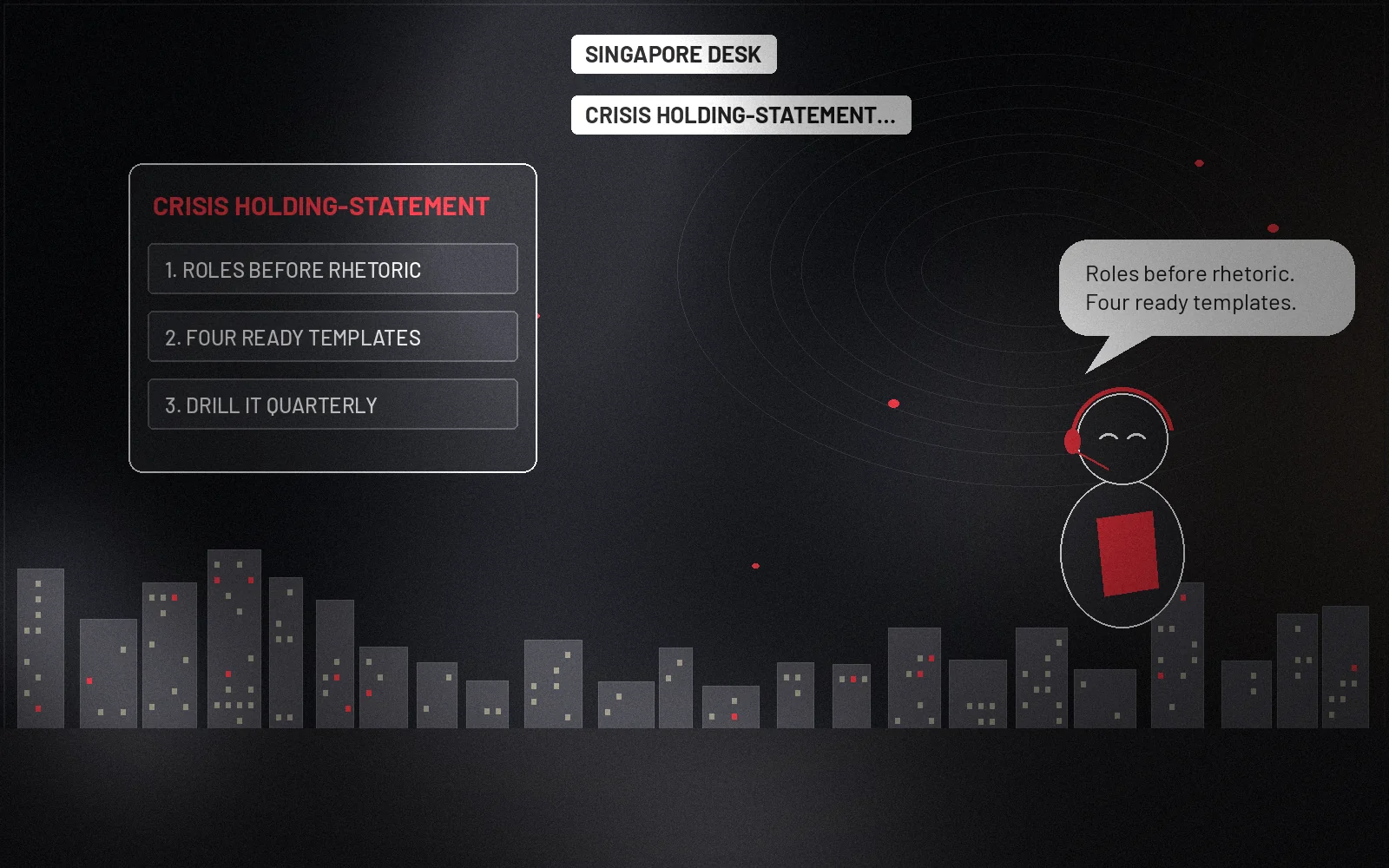
Roles before rhetoric
Name humans before you need them.
- Incident lead — one decision voice for the first cycle.
- Writer — drafts holding + follow-ups in social-native length.
- Checker — facts, legal flags, numbers, names.
- Publisher — has access and authority to post.
- Field/partner liaison — stops freelanced statements from coalition chats.
Dual hats lose minutes. Minutes lose frames.
Set a max approval chain of three for holding statements. Everything else waits for the fuller brief.
Four evergreen templates
Customize language. Keep structure. These are spines, not poetry.
Template 1 — Acknowledge + process
Use when something happened, facts are incomplete, and you must show presence.
“We are aware of [neutral description of situation]. We take this seriously. Our team is gathering verified information now. We will share a further update by [time window] / as soon as key facts are confirmed. We ask the public to rely on official channels for information.”
Rules:
- Neutral description. No loaded verbs you cannot defend.
- Time window you can keep. Missed update deadlines become second crises.
- Point to official channels so rumor mills do less damage.
Template 2 — Acknowledge + care + boundary
Use when people may be harmed or scared, but liability details are unsettled.
“We are aware of [situation] and our priority is [people affected / safety / accurate information]. Support resources: [link or contact if real]. We will not speculate about causes or responsibility until verified facts are available. Update forthcoming by [window].”
Do not invent hotlines. If you list help, it must work.
Template 3 — Correction / cleanup
Use when your side already said something wrong.
“Earlier we stated [wrong claim]. That was incorrect. The accurate information is [correction]. We regret the error. We have updated [channel/page] and will continue to correct the record as needed.”
Corrections should be boring and fast. Drama prolongs the clip.
Template 4 — Scope control when partners freestyle
Use when a coalition ally or surrogate goes off-message.
“[Org/Campaign]’s position is [one-sentence official line]. Statements from partners or supporters that differ from this line do not speak for us. For official updates, follow [channels].”
Do not dunk on allies in the first holding beat unless strategy demands it. Scope control first. Private repair second.
Channel adaptations that still match
Same spine. Different length.
- SMS / Viber: 2–3 sentences max. Link to longer update if needed.
- Social post: 4–6 sentences + link. No thread novels in hour one.
- Website banner / FAQ: hold the canonical version; update in place.
- Press note: add contact for verified inquiries; do not argue in email prose.
- Spokespeople: identical verbs. If TV talent improvises adjectives, you lose.
In multilingual PH/APAC environments, translate from the approved English (or primary) master. Do not let three language desks invent three policies.
Rehearsal: the part teams skip
Run a tabletop every quarter:
1. Draw a realistic scenario type (ops failure, surrogate clip, data mishap, hostile edit)—not a fantasy movie. 2. Start the clock. Draft Template 1 in 20 minutes with your real approval chain. 3. Publish to a private staging channel. 4. Debrief: where did minutes die?
Score the drill on speed, accuracy, and contradiction risk—not vibes.
Keep a one-page crisis card in the war room:
- Role names + backups
- Template spines
- Channel access checklist
- Counsel/message contacts
- “Never say” list (speculative blame, unverified numbers, jokes)
Operator checklist for the first 90 minutes
- Confirm incident lead is awake and sole decision voice.
- Lock facts known vs unknown on one shared note.
- Choose template spine; draft; checker pass; publish.
- Mute unofficial posters; brief partners with scope line.
- Schedule the promised update time; assign owner.
- Start a corrections log if anything already went out wrong.
- Capture screenshots of hostile frames for later analysis—do not quote them into existence if avoidable.
What not to do
- Do not live-tweet your internal debate.
- Do not stack five different apologies across five platforms.
- Do not blame “the algorithm” for a human mistake.
- Do not over-promise investigations you cannot staff.
- Do not wait for perfect certainty when silence is already a statement.
After the hold: the fuller statement
Holding buys time. Use it.
Within your promised window:
- Expand facts that cleared verification
- State actions underway (not aspirational slogans)
- Correct prior errors explicitly
- Offer a next update cadence if the story continues
- Align field, donors, and partners with the same paragraph
If you promised “more by 6 p.m.” and you only have partial facts, publish a process update, not silence: “Verification ongoing on X; confirmed Y; next update by Z.”
Trust is cadence.
PH + APAC notes without crisis-chasing
- Assume screenshots travel faster than your CMS.
- Prepaid users may only see the social hold—make it complete enough alone.
- Diaspora audiences will ask for English clarity even when local vernacular posts exist; keep masters aligned.
- Coalition politics is dense: pre-agree who speaks when the brand is shared.
- Document retention and counsel involvement should be normal ops, not panic inventions.
Again: this is rehearsal infrastructure. It is not instructions to exploit harm or chase a breaking incident for content.
What Neuwark builds into rapid response
We treat holding statements as part of a wider rapid-response calendar: roles, approval SLAs, clip criteria, and message versions that do not freestyle under pressure.
Progressive values do not replace ops. Ops protects values when the feed is on fire.
Building a statement library without becoming a robot
Pre-write spines for categories, not for every imaginary plot twist.
Useful evergreen categories for progressive PH/APAC orgs:
- Operational error (internal process broke)
- Surrogate / partner off-message
- Misleading edit or out-of-context clip
- Data/privacy handling concern
- Event disruption / safety incident (care-first language)
- Premature rumor with no verified event
For each category, store:
- Preferred Template 1–4 spine
- “Known unknowns” prompts for the incident lead
- Channel length limits
- Counsel triggers (when legal must be in the loop before publish)
- Partner notification list
Review the library twice a year. Language ages. Roles change. Access rot is real.
Tone rules that survive progressive scrutiny
Your base will punish cruelty and punish chaos. Holding statements should sound like adults:
- Calm > clever
- Specific > sweeping
- Accountable > theatrical
- Protective of people > protective of ego
Do not use crisis moments to launch unrelated policy essays. Win the hour. Teach later.
Coordination with field and digital
Holding statements fail when field teams and digital teams speak different planets.
Same night:
- Push the approved hold to organizers as a shift card snippet.
- Pause unrelated promotional posts that feel tone-deaf beside the hold.
- Tell paid media operators whether to pause, continue, or swap creatives—silence from HQ creates freestyle.
- Log questions coming in from SMS/Viber; feed them into the next update.
Ground and digital should share one truth document. If they do not, opponents will.
After-action review that improves the templates
Within a week of any real use (even a small one):
- Timestamp every draft and approval
- Note which sentence caused confusion
- Capture media and community misreads
- Update the spine and the “never say” list
- Retrain if a role failed
Treat the library like product. Version it. Do not romanticize “we winged it and survived.”
Metrics for preparedness (not for gore)
- Time from decision to first public hold
- Contradiction count across channels in first 6 hours
- Partner freestyle incidents after scope line
- Update promises kept vs missed
- Staff confidence score after quarterly drill
You are measuring readiness. You are not chasing trauma for content.
Closing move
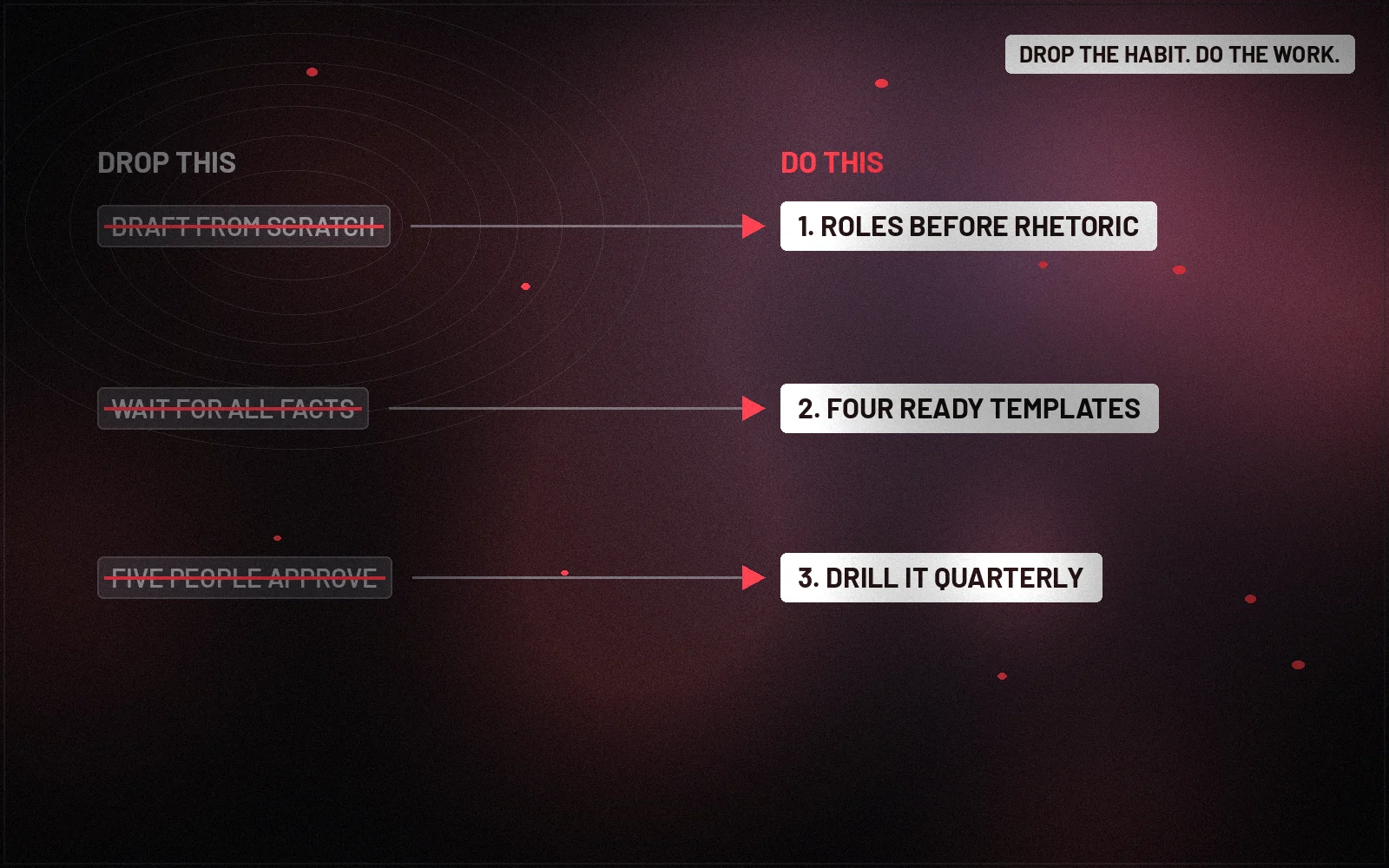
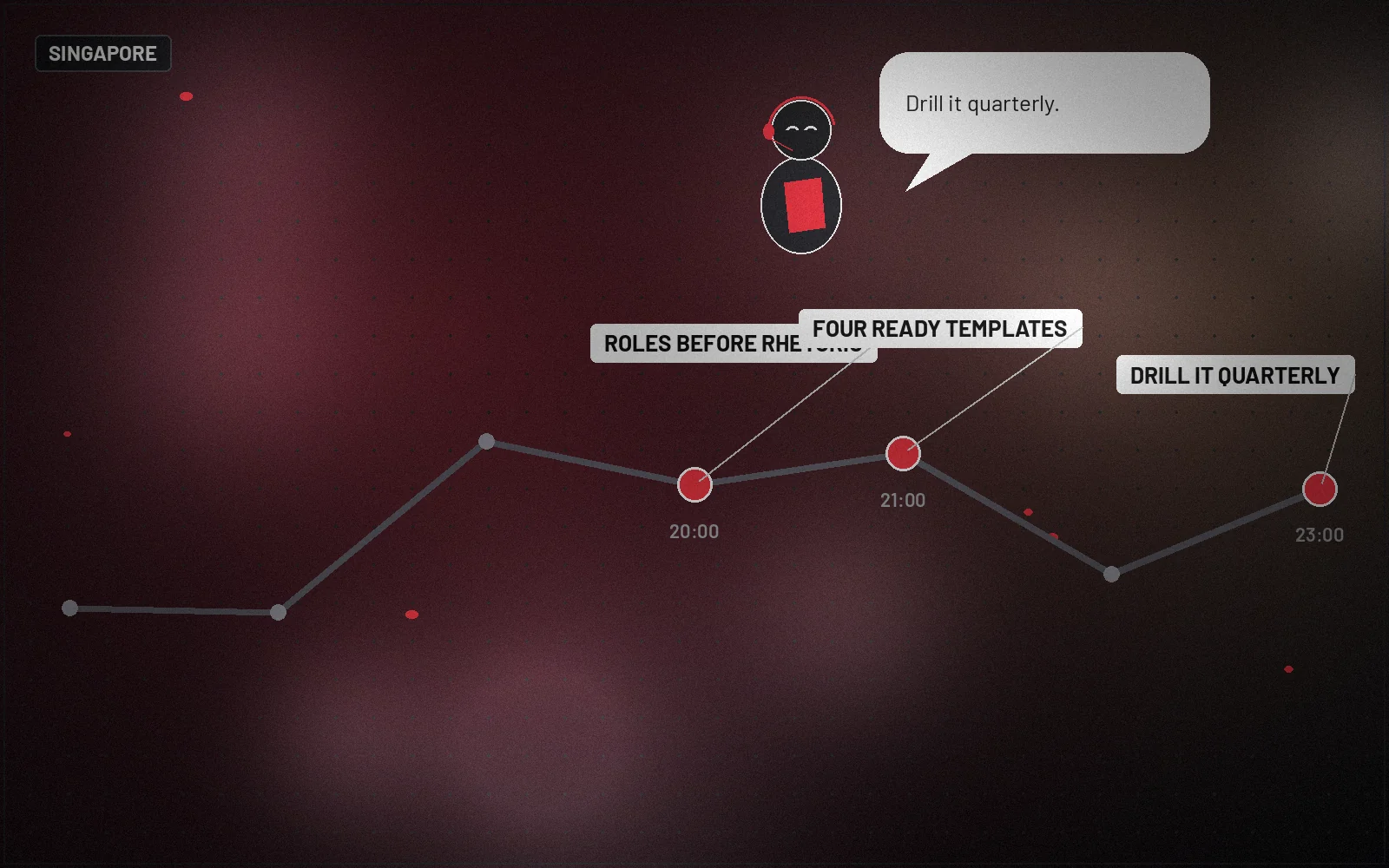
Name the lead. Pre-clear four spines. Rehearse quarterly. Publish short truth fast. Update on time. Correct without theater.
That is how you hold the frame long enough to tell the real story—and how you avoid becoming the story for the wrong reasons.
If you want holding-statement templates and crisis rehearsal built for your team, talk to Neuwark Communications. We help operators prepare before chaos, not perform during it. For Singapore operators, start at our Singapore crisis and issues communications hub — first-72-hours rhythm, retainer vs surge, and counsel-aligned hygiene.