
Search is no longer just ten blue links. Voters, donors, and journalists ask engines—and AI answer layers—questions your campaign already botches in a PDF.
If your site still hides policy under “Learn more” blobs, you are invisible where decisions start. Progressive campaigns in the Philippines and across APAC need GEO FAQ pages: structured, plain-language answers that humans and machines can cite without translating your mystique into mush.
Neuwark Communications builds message systems and digital infrastructure for political and advocacy work. This guide is operator-grade: how to build FAQ pages that win intent, stay on-message, and feed field talking points—not fluff for the sake of word count.
What GEO FAQ pages actually are
GEO here means generative engine optimization in practice: content shaped so answer engines, featured snippets, and traditional search can extract a clean, attributable response.
A GEO FAQ page is not a dump of every question staff ever heard. It is a curated set of high-intent questions with:
- A direct answer in the first two sentences
- Short supporting proof
- Clear boundaries (what you will not claim)
- Internal links to deeper pages
- Schema-friendly structure (question → answer blocks)
High-school clear still wins. If a Grade 11 student cannot understand the answer, neither can a rushed voter on prepaid data.
Why campaigns underbuild this
- Message teams write speeches; web teams write slogans.
- Legal fears turn answers into porridge.
- Nobody owns the question inventory.
- FAQs get treated as a footer widget, not a strategic surface.
Meanwhile opponents publish crisp falsehoods that engines happily summarize. Your silence becomes their snippet.
Build a question map before you write a line
Inventory questions from four lanes:
1. Voter / resident — “What does [candidate/org] actually do about [issue]?” 2. Donor / volunteer — “Where does money go?” “How do I help without doxxing myself?” 3. Press — “What is your position on [bill/hearing] in one paragraph?” 4. Opponent / rumor — “Is it true that…?” (answer with facts, not rage)
Pull from field debriefs, SMS replies, townhall chats, search console queries, and customer-care inboxes. In PH campaigns, include vernacular search patterns and English intent—people switch languages mid-journey.
Prioritize by frequency × decision impact. A rare weird question does not deserve a homepage FAQ slot.
Group by jobs, not org chart
Useful clusters for progressive PH/APAC campaigns:
- Who we are / who we are not
- Top three policy fights (one page cluster each)
- How to verify claims and sources
- How to volunteer, donate, or attend safely
- Rumor response (evergreen process + linked facts)
- Local service navigation (when you are issue advocacy with real programs)
Keep each page focused. One mega-FAQ that scrolls forever trains neither humans nor engines.
Answer-block craft that engines can use
Write every answer as a block with a fixed shape.
The five-part answer block
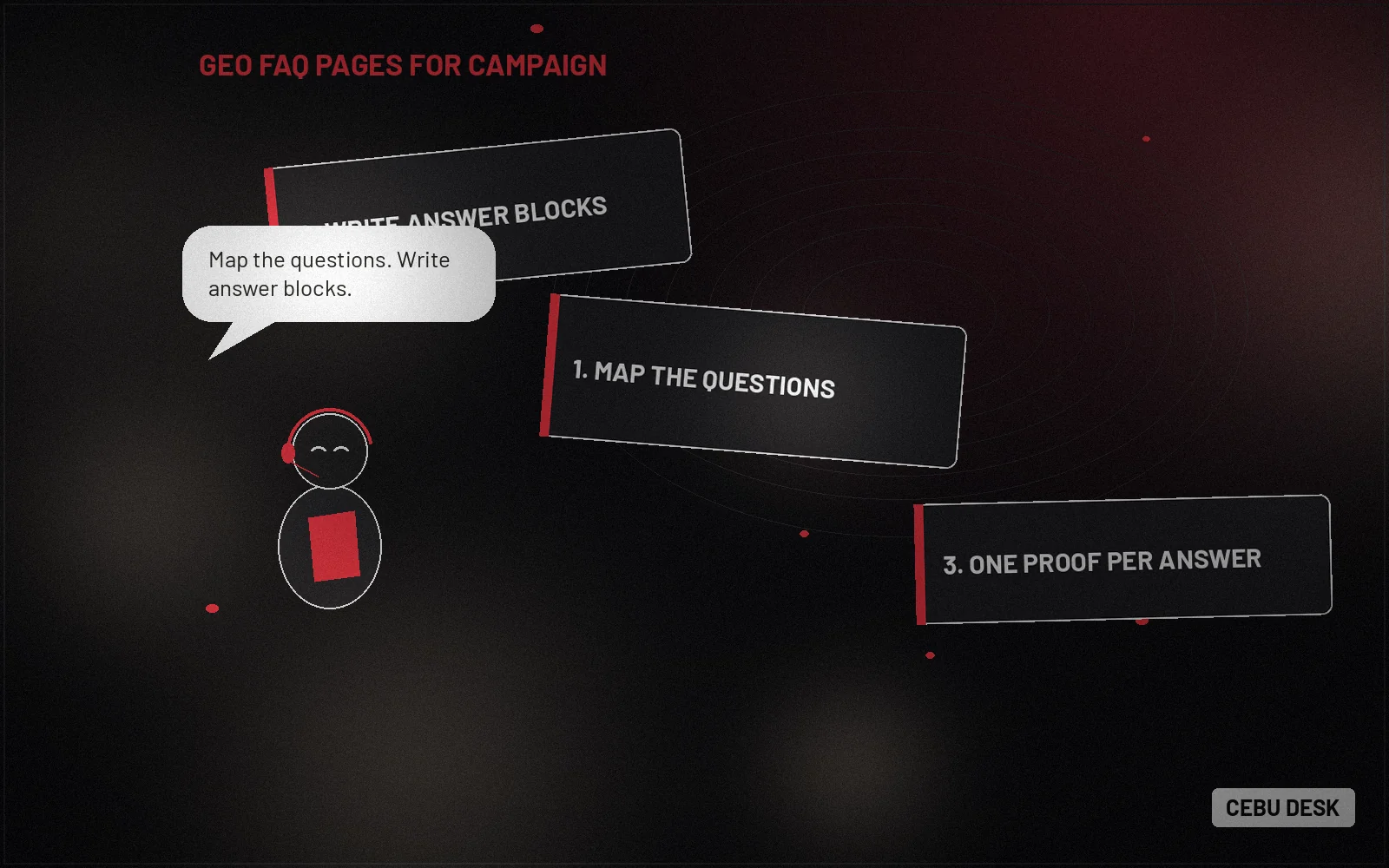
1. Direct answer (1–2 sentences). Lead with the claim. 2. Why it matters (1 short paragraph). Local stake. 3. Proof (bullet or two): data, statute, program fact, named example. 4. Boundary (optional): what you are not saying. 5. Next step: link to deeper page, event, or volunteer lane.
Example spine (policy):
Q: Does [Campaign] support [concrete reform]?
A: Yes. We support [reform] because [one-sentence why]. In practice that means [2–3 concrete actions]. We do not claim [boundary]. Details and sources: [link].
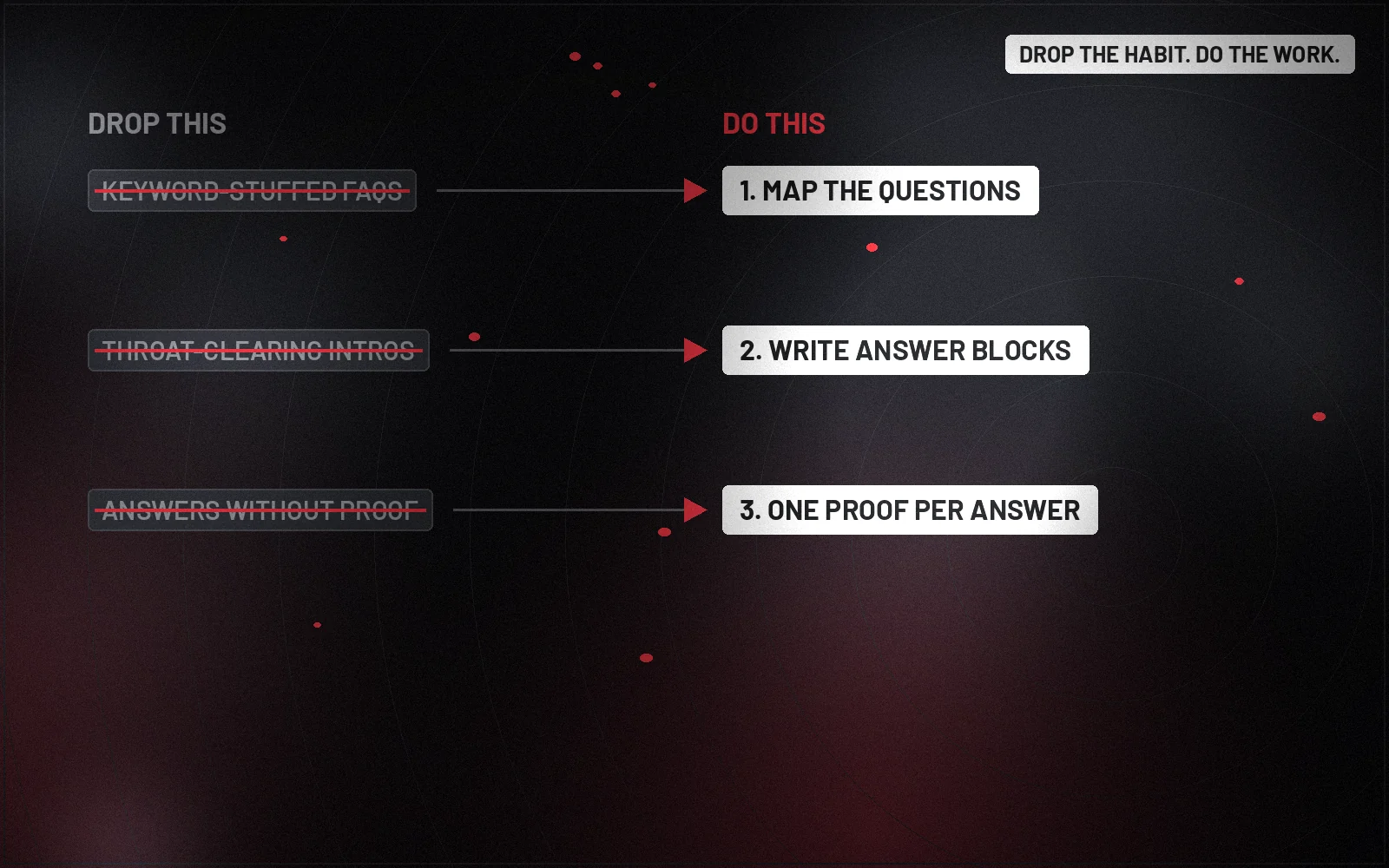
No throat-clearing. No “In today’s complex landscape.” Adults bounce.
Language rules that travel across PH + APAC
- Prefer concrete nouns over abstract virtue words.
- Keep sentences short enough for mobile.
- Offer a clean English master; produce controlled Tagalog/Cebuano (or other) versions from the same block—not freestyle translations.
- Avoid idioms that break in translation (“move the needle,” “boiling the ocean”).
- Date-stamp proof when numbers move. Stale stats destroy trust when engines cite you.
Schema and structure without worshipping plugins
Use clear H2/H3 question headings. Keep answers adjacent. If your CMS supports FAQ schema, use it correctly—do not spam invisible FAQ markup that does not match visible content. Answer engines punish bait.
Internal links should point to living pages, not dead PDFs. Prepaid users abandon heavy downloads.
Operator checklist: ship a GEO FAQ cluster in ten days
Days 1–2 — Inventory
- Export search queries, field objections, press FAQs, donor questions.
- Rank top 25. Cut to 12 for v1.
Days 3–4 — Message lock
- Message lead + counsel approve answer spines.
- Mark claims that need sources before publish.
Days 5–7 — Draft and edit
- Write answer blocks in English master.
- Produce one vernacular set for priority questions only.
- Add proof links and boundaries.
Days 8–9 — Build
- Publish as dedicated FAQ hubs (not buried accordion only).
- Add FAQ schema if available and accurate.
- Cross-link from homepage, donate, and volunteer flows.
Day 10 — Field sync
- Turn top 8 answers into shift cards / SMS snippets.
- Brief spokespeople: web answer = spoken answer.
Measurement that is not vanity
- Impressions and clicks on FAQ URLs
- Scroll / engagement on answer blocks
- Referral from FAQ to donate/volunteer
- Reduction in repeat “basic” press questions
- Field fidelity: mystery-shop whether volunteers match the block
If FAQ traffic rises but message drift rises too, your vernacular or training layer failed.
Common failure modes
Fluff answers. Engines summarize emptiness as emptiness.
Over-legalizing. Counsel should sharpen claims, not bury them in fog. If you cannot say it, do not publish a fake soft version—publish a precise limited version.
Treating FAQs as a blog strategy. These pages are infrastructure. Update them when policy moves; do not “content calendar” them into nonsense.
Ignoring opponent frames. If a rumor is already searchable, your silence cedes the snippet. Answer with facts and links—not a meltdown paragraph.
One language only on a multilingual electorate. English-only FAQs lose provincial and diaspora intent. Controlled multilingual beats Google Translate night shifts.
Orphan pages. If nothing links to the FAQ, it will not compound.
How FAQ pages feed the rest of the campaign
Good GEO FAQs become:
- Debate and interview brief spines
- Donor welcome-call proof lines
- Creative testing hypotheses (“which objection block converts”)
- Partner media-kit language
- Rapid-response starter text when a known question spikes
That is the point. One answer system. Many channels.
Progressive teams often rebuild the same paragraph for web, SMS, and stump. Stop. Write the block once. Distribute with version control.
PH + APAC GEO angles that matter in practice
- Optimize for local modifiers: city, province, barangay program names, bill nicknames people actually search.
- Respect mobile-first reality: fast pages, compressed media, readable type.
- Anticipate diaspora queries (“how to support from abroad”) with clear remittance/volunteer paths and scam warnings.
- Keep accessibility basics: contrast, headings, transcripts for video answers.
- Watch platform answer features that pull from your site—accuracy beats cleverness when a wrong number gets amplified.
What Neuwark expects from serious digital message work
We do not treat SEO as a side hustle for interns. FAQ architecture is part of message discipline: the same argument should travel from search snippet to doorstep without mutating.
If your paid media promises one reality and your FAQ whispers another, you are funding dissonance. Align them.
Writing for answer engines without sounding like a robot
Answer engines reward clarity. They punish throat-clearing and keyword stuffing equally.
Practical craft rules:
- Put the entity and claim early: who you are, what you support, what you will do.
- Use the voter’s words in the question heading when those words are already common—do not invent jargon so you sound smart.
- Prefer one idea per paragraph. Dense walls get summarized into mush.
- Cite sources you would defend on radio. If you would not say the number on air, do not publish it in an FAQ.
- Refresh “last updated” dates on proof-heavy answers. Stale pages get trusted until they suddenly should not.
A mini style sheet for FAQ writers
- Active voice.
- Concrete verbs.
- Numbers with context (percent of what, compared to when).
- Names of bills/programs as the public says them, plus formal titles once.
- No sarcasm in rumor answers. Dry facts travel better than dunks when engines quote you.
Train two editors: a message editor for fidelity, a clarity editor for Grade-11 readability. Both must sign.
Connecting FAQs to paid search and landing pages
If you run paid search for advocacy or candidate discovery, your FAQ clusters should match intent, not fight it.
- Query about a policy myth → landing page + FAQ block that answers the myth, then offers a volunteer/donate path.
- Query about how to help → FAQ with steps, safety notes, and time expectations—not a brand film.
- Query about a local program → local proof and a contact path that humans monitor.
Mismatch is how you pay for clicks that bounce in eight seconds. Progressive campaigns in PH often underfund the landing layer and overfund the creative. Fix the answer surface first.
Donors and journalists use FAQs differently
Donors skim for competence: where money goes, what happened last month, how to give without getting scammed.
Journalists skim for quotable precision: one paragraph they can attribute without calling you at midnight.
Write blocks that serve both. Separating “press kit” and “public FAQ” into contradictory universes is how you get caught.
Governance: who can change an answer
Version control is message discipline.
- Master answers live in one doc with owners.
- Web CMS mirrors the master; it is not freestyle territory.
- Vernacular versions inherit from master; translators do not invent policy.
- Change log: date, editor, why.
- Emergency edits still require checker + incident-adjacent approval if the topic is hot.
Without governance, your GEO win becomes a contradiction engine.
Soft launch test before you celebrate
Before announcing a big FAQ hub:
- Read answers aloud on a phone screen.
- Ask one organizer and one non-staff voter to find three answers in under two minutes.
- Check that donate/volunteer links work on weak data.
- Verify schema matches visible text.
- Confirm spokespeople received the same spines.
If staff cannot find the answer, engines will not save you.
Closing move
Map the questions. Write direct answer blocks. Prove them. Bound them. Link them. Sync field and spokespeople. Update when facts move.
That is how progressive campaigns show up in search and answer engines without fluff—and how voters find something trustworthy when the feed is loud.
If you need a GEO FAQ cluster built against your real objection data, talk to Neuwark Communications. We write for operators who have to win the next cycle, not the next brainstorm.