
A mid-tier gift clears. Finance smiles. Marketing schedules a blast. Nobody calls.
That silence is expensive. Mid-tier donors—professionals, diaspora households, small-business owners, issue-committed couples—are big enough to matter and small enough to get ignored. They funded a fight. You sent a receipt. They ghost. Progressive campaigns and advocacy shops across the Philippines and APAC leave second-gift money on the table because the first human touch never happens.
Neuwark Communications treats the welcome call as revenue infrastructure, not manners. This playbook gives you scripts, timing, and operator rules that earn the next gift without sounding like a call center.
Why the welcome call beats another email
Email scales. Voice proves you are real.
Mid-tier donors test you in the first two weeks. They want to know three things:
- Did a human notice the gift?
- Can you say what the money actually does this week?
- Is there a dignified way to stay close without joining a cult of meetings?
A two-to-four minute call answers all three. A polished film nobody asked for answers none.
In PH and APAC contexts, the call also carries cultural weight. Many mid-tier givers still treat a personal thank-you as proof of seriousness—especially older professionals, church-network donors, and diaspora households who already get spammed by every platform. Voice cuts through.
Who gets the call (and who does not)
Define a threshold band, not vibes.
- Always call: gifts at or above your mid-tier floor (set it; write it down).
- Optional call / voice note: just under the floor if the donor is a known organizer, alumni, or referral source.
- No call required: micro-digital gifts—thank by SMS/Viber with a real name, then steward by sequence.
If everyone gets a “personal” call, nobody gets one. Protect the band so your organizers can keep quality high.
Timing: when the script actually works
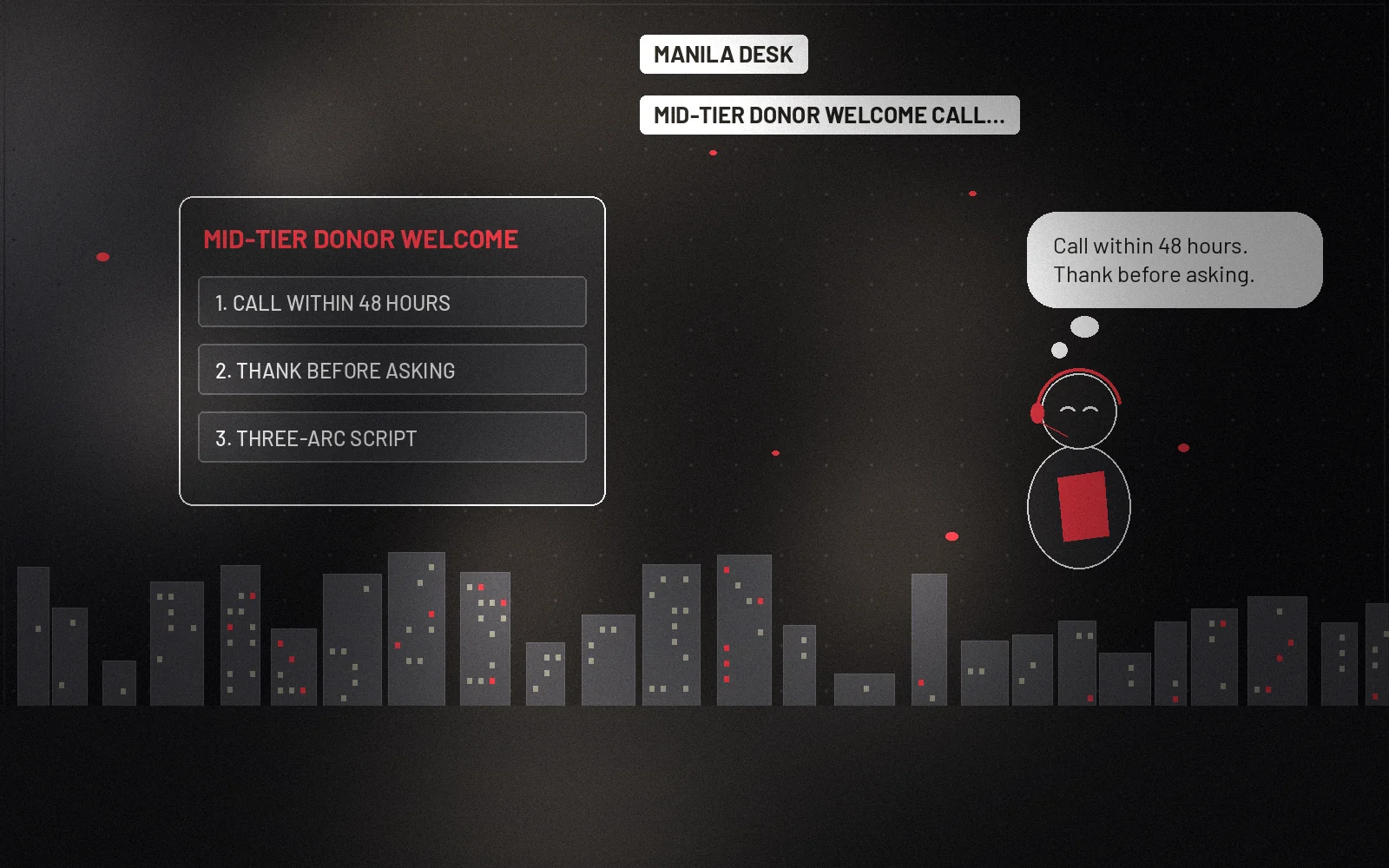
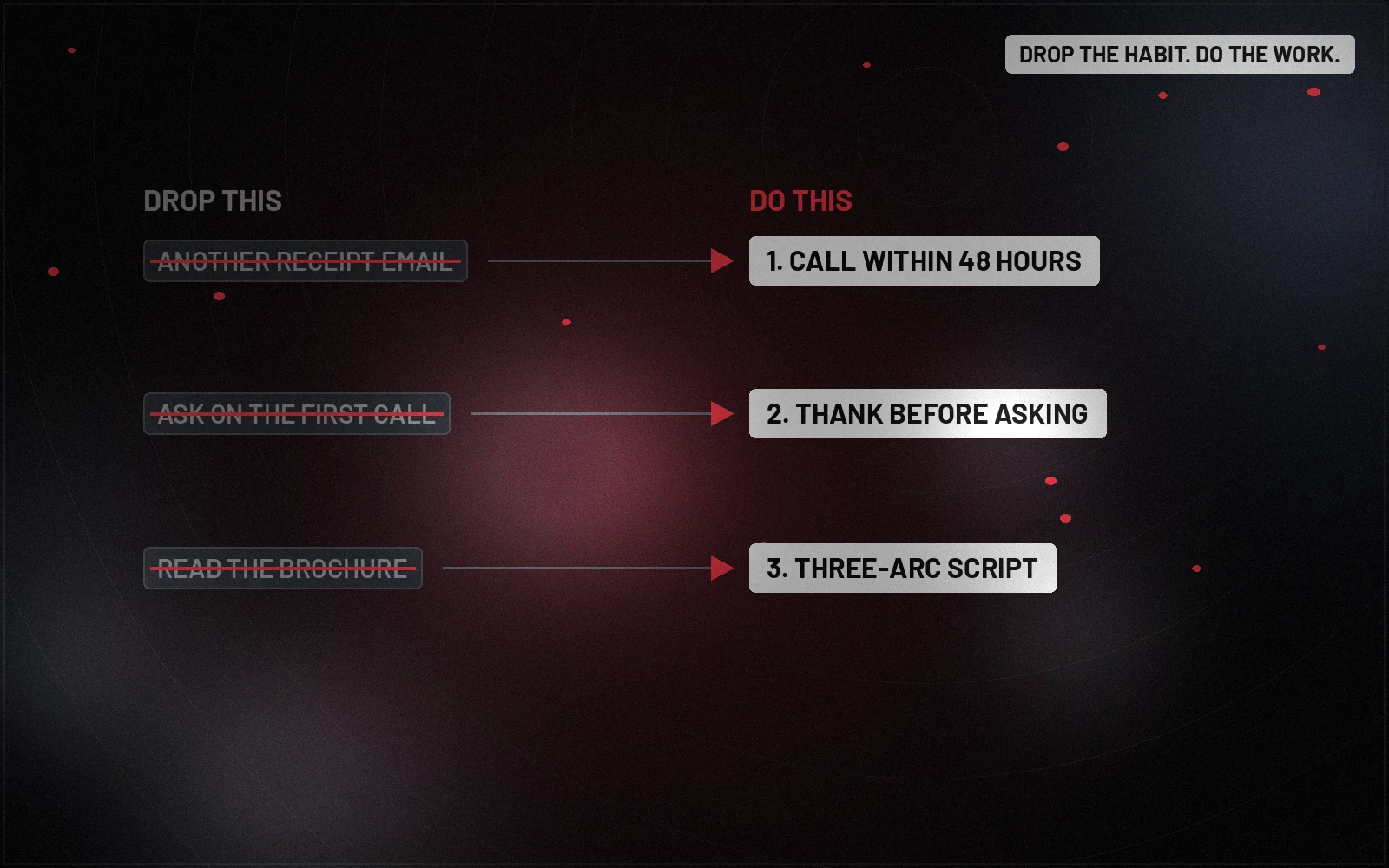
Call within 24–48 hours of the gift posting—not “when the week calms down.”
- Hour 0–2: automated SMS/Viber thank-you with organizer first name + what the gift fuels this week.
- Day 0–1: human welcome call (or scheduled callback if they miss).
- Day 3–4: proof ping (photo, short clip, field note)—no ask.
- Day 7–14: soft invitation (briefing, micro-task, or specific second-gift lane).
Miss the first window and the call becomes awkward catch-up. Hit the window and it feels inevitable.
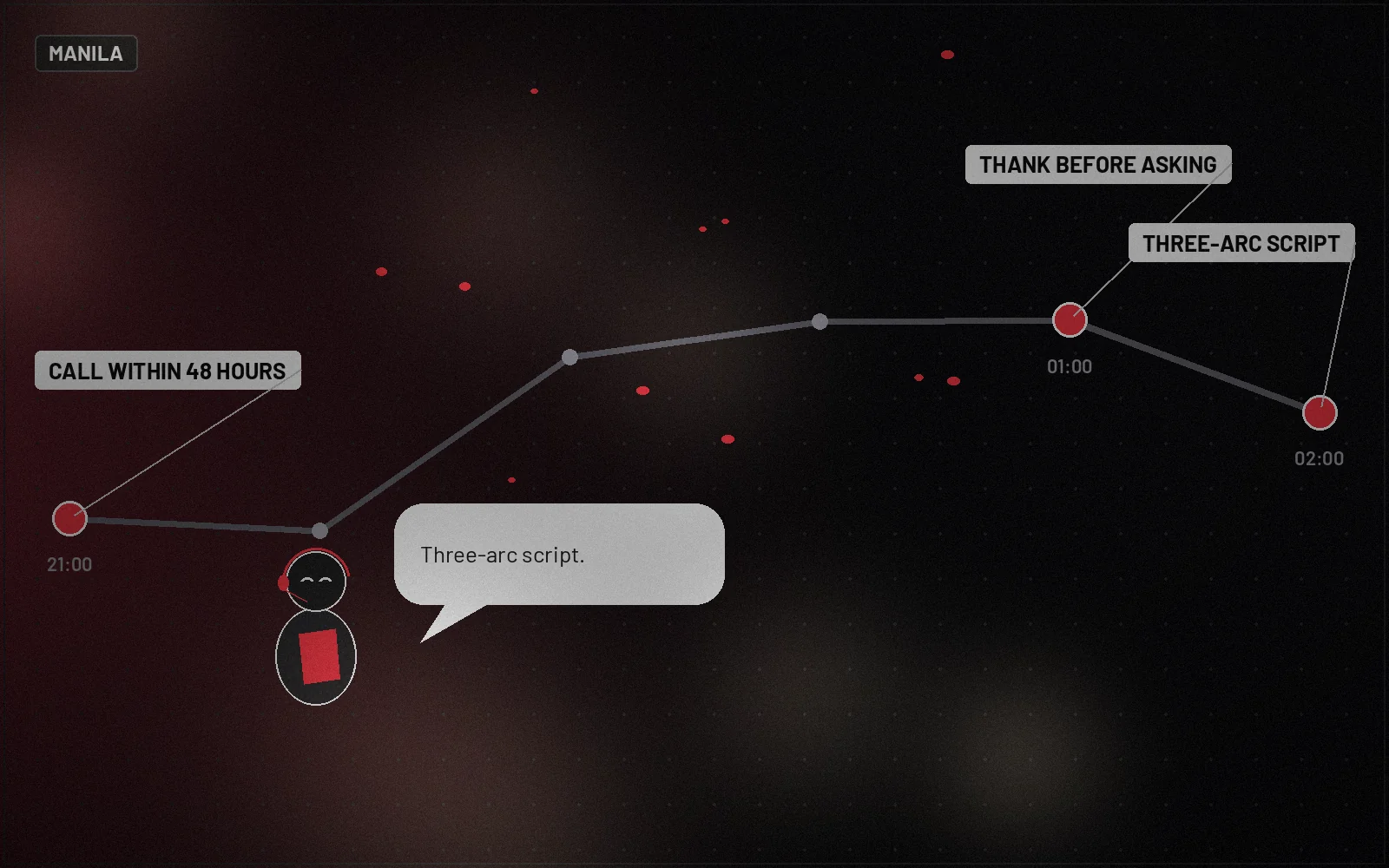
Quiet hours still apply. Respect local evenings, shift workers, and diaspora time zones. A thank-you at 10:40 p.m. Manila time is not gratitude. It is disrespect wearing a smile.
The three arcs every welcome call needs
Do not freestyle. Run three short arcs. Then stop.
Arc 1 — Thank without theater
Open with recognition, not a monologue.
Script spine:
“Hi [Name], this is [Your name] with [Org/Campaign]. I’m calling to thank you personally for your gift of [amount or ‘your recent gift’]—it helps us [one concrete weekly use]. Do you have two minutes?”
Rules:
- Say the org name once. Do not brand-lecture.
- Name a concrete use (“keep the rapid-response desk staffed through Friday’s hearing,” “print 2,000 sample ballots for [city]”).
- Ask permission for two minutes. Adults notice.
If they say they are busy: “Totally fair—can I text a 30-second note and a good time to call back?” Then do it.
Arc 2 — Prove without a TED Talk
One proof beat. One. Not your origin story.
Script spine:
“Quickly—what your gift is fueling right now is [proof]. Last week we [outcome]. This week the pressure point is [named fight].”
Proof must be true, recent, and local enough to feel real. Vague “fighting for change” language fails mid-tier donors who already read the news.
If they ask a hard question, answer briefly or book a follow-up with the right person. Do not invent numbers on the call.
Arc 3 — Invite without trapping
Offer proximity. Do not force it.
Script spine:
“If it’s useful, I can send a 15-minute briefing invite, or a short update thread on [channel they prefer]. No obligation—just a way to stay close to the work you funded.”
Then pause. Silence is fine. Mid-tier donors hate being walked into a funnel.
Close clean:
“Thank you again, [Name]. If anything ever feels off in our messages, reply STOP or tell me directly—I’ll fix it. Take care.”
Full script templates you can actually use
Customize language. Keep structure.
Template A — First-time mid-tier giver (PH local)
“Hi [Name], this is [You] from [Org]. Thanks for trusting us with your gift—this week it helps us [concrete use in city/region]. Got two minutes?
Great. One thing you should know: [one proof / milestone]. We’re not asking for anything else today. If you want a short briefing or volunteer lane later, I can send options. Either way, we’re grateful. Any question I can answer now?”
Template B — Diaspora / APAC time-zone giver
“Hi [Name], [You] with [Org] calling from [city]. Catching you at a decent hour, I hope. Calling to thank you for your gift—it funds [concrete use] back home this week.
I’ll keep this short. [One proof]. If updates by WhatsApp/email work better than calls, tell me your preference and we’ll honor it. Thanks again for backing the work.”
Template C — Recurring mid-tier (upgrade path later)
“Hi [Name], [You] from [Org]. Quick thank-you for your ongoing support—your monthly gift is what keeps [specific function] stable when the news cycle spikes.
No ask today. I wanted you to hear that [proof tied to continuity]. If you ever want a deeper briefing with our [policy/field] lead, say the word. Grateful for you.”
Template D — Missed call → voice note (60–90 seconds)
“Hi [Name], [You] from [Org]. Missed you—just a personal thank-you for your gift. It’s going to [concrete use] this week. I’ll text a one-line update and my number. No pressure to call back unless you want to. Salamat / thank you.”
Voice notes beat robotic IVR. Keep them human and short.
Operator rules that protect trust
One owner per call. Shared “fundraising seats” create duplicate calls and shame.
Log the call the same day. Fields: reached / left note / preferred channel / questions asked / risk flags / follow-up owed.
Never pitch a second gift on the welcome call unless they explicitly ask how to do more. The welcome call earns the right. The day-10–14 sequence exercises it.
Suppress blasts for 72 hours after a welcome call so your human moment is not buried by a newsletter asking for money again.
Train objection manners. If they say “I already gave,” answer: “Exactly—that’s why I’m calling to thank you, not to ask again today.”
Protect PII. Do not discuss gift amounts in shared rides, cafés, or loud war rooms. Mid-tier donors notice professionalism.
Second-gift pathway after the welcome call
The welcome call is not the ask. It sets up a specific second-gift lane.
Between day 7 and day 21:
- Send one proof touch with a named gap (“clinic supplies shortfall,” “200 more sample ballots,” “legal monitor shift coverage”).
- Offer a clean link or instructions. No maze.
- Reference the prior conversation lightly: “As I mentioned on our thank-you call…”
- Cap frequency. Two proofs per ask remains a useful ratio after the welcome window.
Specificity raises. “Give again if you can” begs.
For PH progressive campaigns, tie second gifts to visible field or hearing moments—not abstract brand love. Mid-tier donors fund continuity between viral spikes. Show the continuity.
Checklist: stand up welcome calls in five working days
Day 1
- Set mid-tier floor and owner names.
- Pull last 14 days of gifts above floor; clear backlog with short calls or voice notes.
Day 2
- Lock Templates A–D with counsel/message lead.
- Build a one-screen call log (sheet or CRM).
Day 3
- Train callers for 45 minutes: arcs, quiet hours, kill phrases, escalation.
- Practice one hostile question each.
Day 4
- Go live on new gifts only; review first ten calls as a group.
Day 5
- Wire suppression so welcome-call donors are not double-blasted.
- Schedule weekly 20-minute QA: conversion to second gift, complaint rate, callback quality.
Metrics that matter
- % of mid-tier gifts receiving a human touch in 48 hours
- Second-gift rate within 45 days for called vs not-called cohorts
- Preference capture rate (channel + language)
- Complaint / “do not call” rate (should stay near zero if manners hold)
Vanity (“we called 200 people”) without second-gift movement is theater.
Failure modes progressive teams repeat
Reading a paragraph. Mid-tier donors hear scripts. Use spines, not teleprompters.
Turning thanks into a town hall. Two to four minutes. Book a briefing if they want depth.
Calling without a concrete use. If you cannot say what the gift does this week, fix finance/comms before you dial.
Ignoring language preference. Offer Tagalog, Cebuano, or English cleanly. Broken “vernacular flavor” insults people who gave real money.
Letting interns freestyle policy. Welcome callers need a one-page fact card and a escalate-to-human path.
What Neuwark builds into donor ops
We design fundraising creative and donor communications for political, advocacy, and public-interest work across the Philippines and APAC. Welcome calls sit inside a wider stewardship system: consent, quiet hours, proof cadence, and second-gift architecture that does not spam adults.
If your stack can blast but cannot thank, you are running a vending machine. Mid-tier donors fund movements between spikes. Treat the first call like infrastructure.
Closing move
Set the floor. Name the owners. Use three arcs. Log the call. Suppress the blasts. Offer a specific second-gift lane later.
That is how progressive teams earn the next gift without sounding like a boiler room—and how mid-tier trust becomes durable money.
If you want help standing up welcome-call scripts and stewardship sequences for your campaign or advocacy shop, talk to Neuwark Communications. We build the operator layer, not the vibe deck.