
A blast at 10:47 p.m. does not look like urgency to the recipient. It looks like disrespect.
That is the quiet-hours problem progressive campaigns keep learning the hard way. SMS and RCS still convert for advocacy—reminders, GOTV, hearing alerts, donor micro-asks—but timing compliance decides whether you earn a reply or a block.
Neuwark Communications treats quiet hours as strategy infrastructure, not legal garnish. In the Philippines and across APAC, prepaid users, shift workers, and family group-chat culture make late-night political texts feel invasive faster than Western playbooks admit.
Quiet hours are not bureaucracy. They are conversion hygiene.
You can win the policy argument and still lose the phone.
People forgive a strong message. They do not forgive a buzz that wakes a child, interrupts night shift sleep, or lights up a shared family phone during dinner prayers. Progressive brands already fight “out of touch” attacks. Late SMS hands opponents the screenshot.
Compliance here is three things at once:
- Legal / platform rules where they apply
- Carrier and vendor policies that can throttle you mid-flight
- Audience norms that decide whether your next ask gets opened
Ignore any one layer and your “efficient” blast becomes a trust tax.
What quiet hours mean in PH/APAC practice
Do not copy a US 8 a.m.–9 p.m. rule and call it done.
Build windows by audience reality:
- Default public window: roughly 8:00–20:00 local, tightened for weekends.
- Shift-aware segments: nurses, BPO, transport, security—offer opt-in for alternate windows.
- Religious and family peaks: Friday evenings, Sunday mornings, major holidays—throttle, do not carpet-bomb.
- Election / hearing days: earlier starts are fine; late nights still need a documented exception and a human owner.
Quiet hours without timezone discipline fail diaspora lists. Tag Asia/Manila (and other zones) at intake—or do not SMS them.
The operator stack: consent, window, content, kill switch
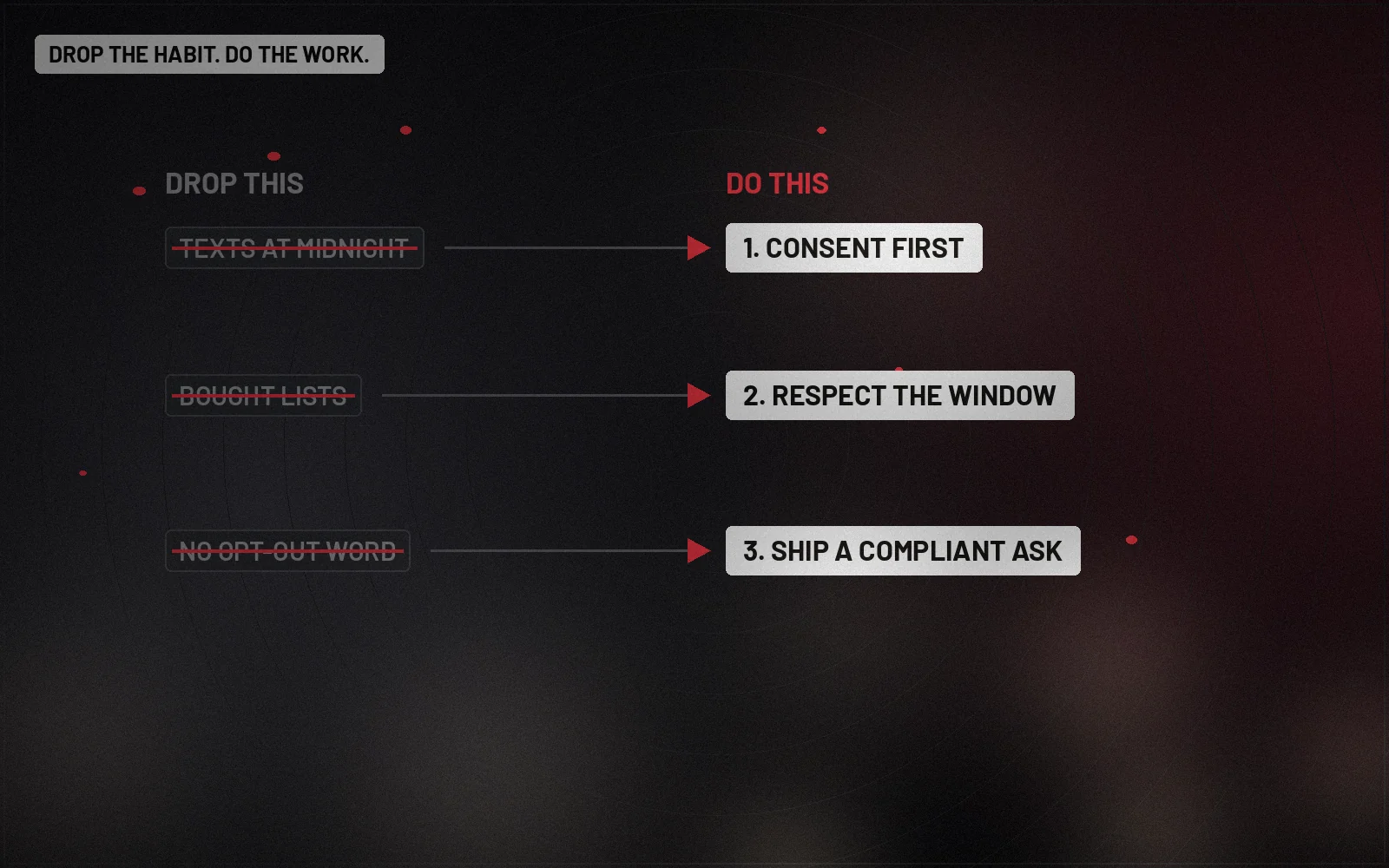
If your SMS program cannot explain these four controls in one slide, pause sending.
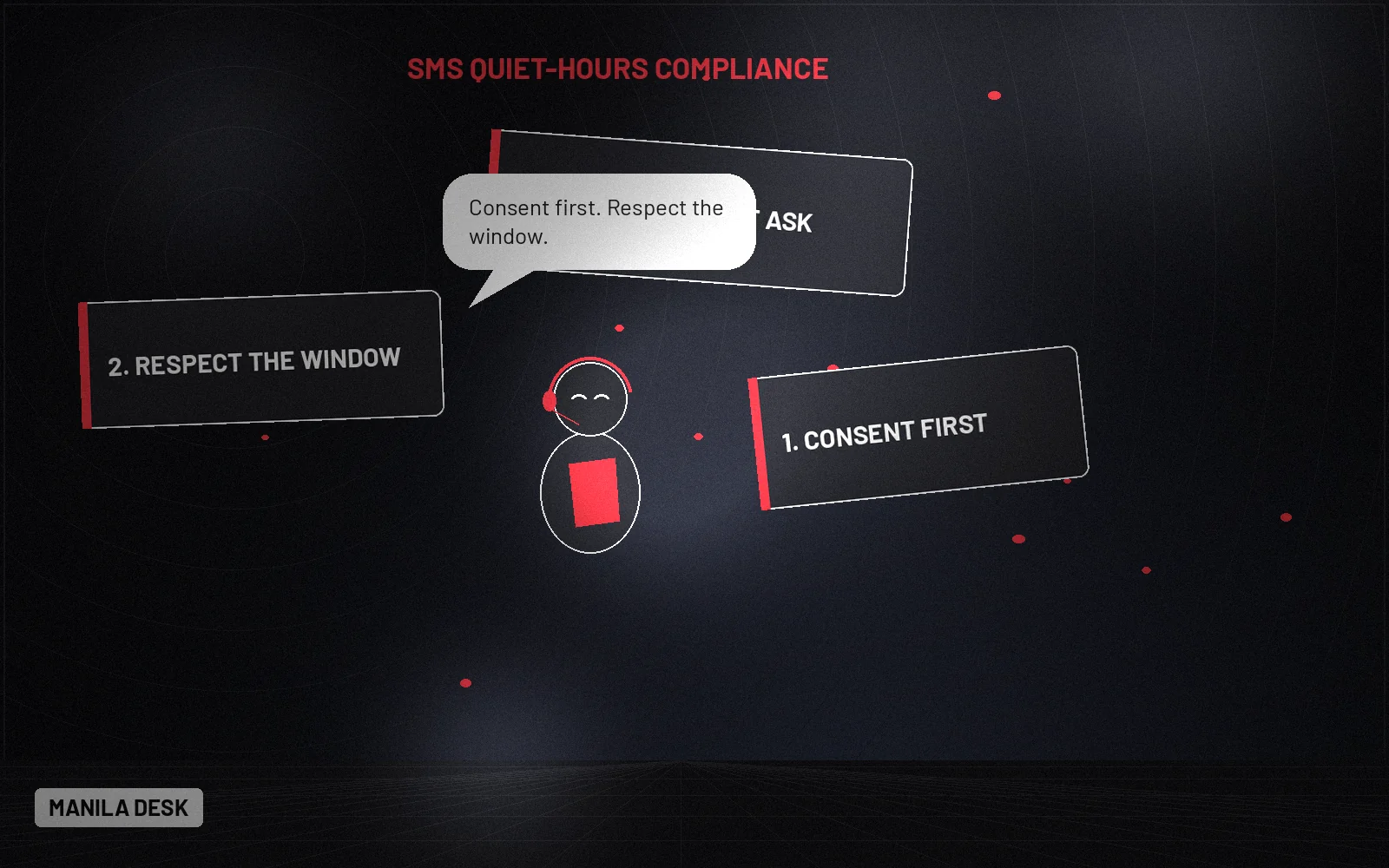
1. Consent that survives a complaint
Consent is not a buried checkbox from 2022.
- Record how and when someone opted in (web form, canvass QR, event keyword, donor flow).
- Store purpose tags: GOTV, issue alerts, events, fundraising.
- Make STOP / AYAW / UNSUB real—and honor them in minutes, not “next business day.”
- Separate advocacy alerts from fundraising when your list expects policy news.
Progressive campaigns often mix lists after a viral moment. That is how you SMS a climate petition signer a midnight dinner ask.
2. Send windows with owners, not vibes
Put quiet hours in the tool—not in a Slack reminder.
- Hard lock sends outside the window unless a named role overrides.
- Log every override: who, why, segment size, message ID.
- Cap frequency: a compliant hour still fails if you text four times in two days.
Vendors love “schedule now.” Your brand needs schedule only if compliant.
3. Content that respects the hour even inside the window
Quiet hours are necessary. They are not sufficient.
Inside the window, still write like a guest:
- Lead with why this matters today—not a mystery link.
- Keep length human. Prepaid users pay attention taxes.
- Match urgency to reality. A hearing at 2 p.m. does not need 7 a.m. panic tone.
- Localize cleanly. Bad Tagalog at breakfast feels like spam with a flag.
4. Kill switch before the thread goes viral
Pre-assign:
- Who can pause the queue in five minutes
- Who drafts the apology if a bad batch escapes
- How you suppress the same creative from retargeting SMS and paid social
Quiet-hours compliance without a kill switch is a PDF.
Checklist: ship a compliant advocacy SMS program in one week
Day 1 — Map the risk
- Inventory lists, vendors, keywords, and legacy “broadcast” access.
- Flag any list without proof of consent.
Day 2 — Write the window policy
- Default hours by market
- Exception types (GOTV day-of, disaster service alerts if in scope, security)
- Diaspora timezone rules
Day 3 — Configure the tool
- Hard quiet-hours locks
- STOP handling
- Frequency caps
- Override audit log
Day 4 — Segment for respect
- Split by consent purpose
- Tag shift-worker opt-ins
- Suppress recent complainers and hard bounces
Day 5 — Creative and QA
- Two lengths: standard and short-data
- Link redirects that work on cheap Androids
- Test on prepaid SIMs, not only office Wi-Fi
Day 6–7 — Soft launch
- Small segments first
- Watch complaint rate, STOP rate, click-to-action—not vanity delivery
Metrics that matter more than “sent”
Track weekly:
- Complaint / STOP rate by hour-of-day and by segment
- Reply quality (questions, commitments) not just CTR
- Override count — high overrides mean your window is fiction
- Repeat contact without consent refresh — silent debt
A program that cuts late sends often raises next-day conversion. People reward brands that behave like adults.
Failure modes we see in progressive shops
“It’s urgent.” Urgency is not a compliance exemption. Plan the reminder earlier.
Shared vendor seats. Interns with blast rights are an incident waiting for a screenshot.
Copying commercial flash-sale patterns. Advocacy is not a 11:59 p.m. sneaker drop.
Ignoring household phones. In many PH households, one handset serves multiple adults. Your “personalized” text is a family announcement—write accordingly.
Treating quiet hours as only legal. Even when the letter of the law is fuzzy, reputation law is not.
How this connects to the rest of the campaign
SMS should rhyme with WhatsApp/Viber field kits, email stewardship, and paid reminders—not contradict them.
If field teams promise “we won’t bother you at night” and HQ blasts at 21:30, you trained the public to distrust every channel. Quiet hours are part of message system integrity.
Neuwark builds advocacy communications where compliance is visible in the calendar, the CRM, and the creative briefing—not only in a counsel memo nobody opens during GOTV week.
Vendor reality check before you scale
Ask your SMS vendor five questions in writing:
- Can quiet hours be enforced at the account level with no intern override?
- How fast do STOP requests propagate across short codes and sender IDs?
- What is the complaint threshold before carriers throttle the whole account?
- Do you support purpose-based suppression, or only global opt-out?
- Will you export audit logs our counsel can read without a sales call?
If answers are vague, you do not have a compliance partner. You have a blast cannon.
Closing move
Set the window. Prove consent. Lock the tool. Name the kill switch.
Then send messages people can respect enough to answer.
That is how SMS quiet-hours compliance makes money for progressive campaigns: fewer blocks, cleaner lists, higher trust per impression.