The first gift feels like a win. Dashboard lights up. Finance exhales. Then silence. The mid-tier donor—big enough to matter, not famous enough for a gala table—gets a generic receipt, three blast emails, and a SMS that sounds like a telecom promo. They ghost. Your pipeline treats them like a spent match. That is how advocacy organizations and progressive campaigns leave second-gift money on the table while chasing colder lists.
Neuwark Communications builds fundraising creative and donor communications for political, advocacy, and public-interest work across the Philippines and APAC. Our view is practical: stewardship is not manners. It is revenue infrastructure. Mid-tier donors fund continuity between viral spikes. If your only relationship tool is the ask, you are running a vending machine, not a movement treasury.
Who “mid-tier” is—and why they disappear
Definitions vary. For many PH advocacy orgs and candidate committees, mid-tier sits above impulse digital gifts and below major-donor cultivation—think recurring or one-off gifts that hurt a little to give, often from professionals, diaspora households, small business owners, and issue-committed couples. They will not demand a private briefing every month. They will notice if you treat them like a random email.
They ghost for predictable reasons:
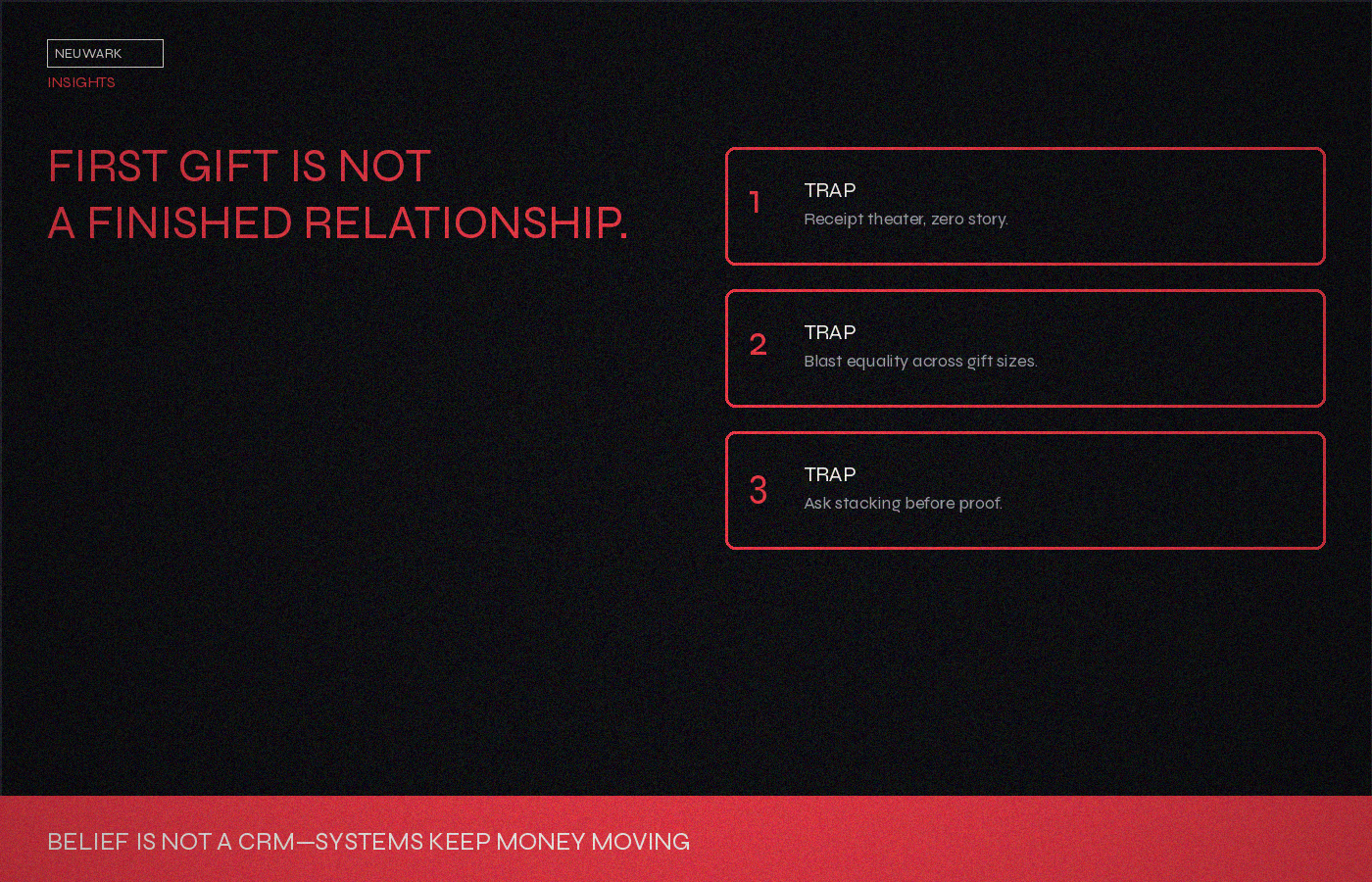
- Receipt theater, zero story. They funded a fight; you sent a tax line.
- Blast equality. Same newsletter as someone who gave pocket change once in 2021.
- Ask stacking without proof. Three asks before one outcome update.
- Channel mismatch. Email novels to people who live on Viber and WhatsApp; SMS spam to people who wanted a quiet thank-you call.
- No human on-ramp. Nobody offers a 10-minute briefing, a volunteer lane, or a named organizer contact when the gift clears.
Progressive brands sometimes moralize this: “If they believed, they would stay.” Belief is not a CRM. Systems keep money moving.
The first 14 days decide the second gift
Design a welcome-to-proof sequence that starts the hour the gift posts—not “when marketing has time.”
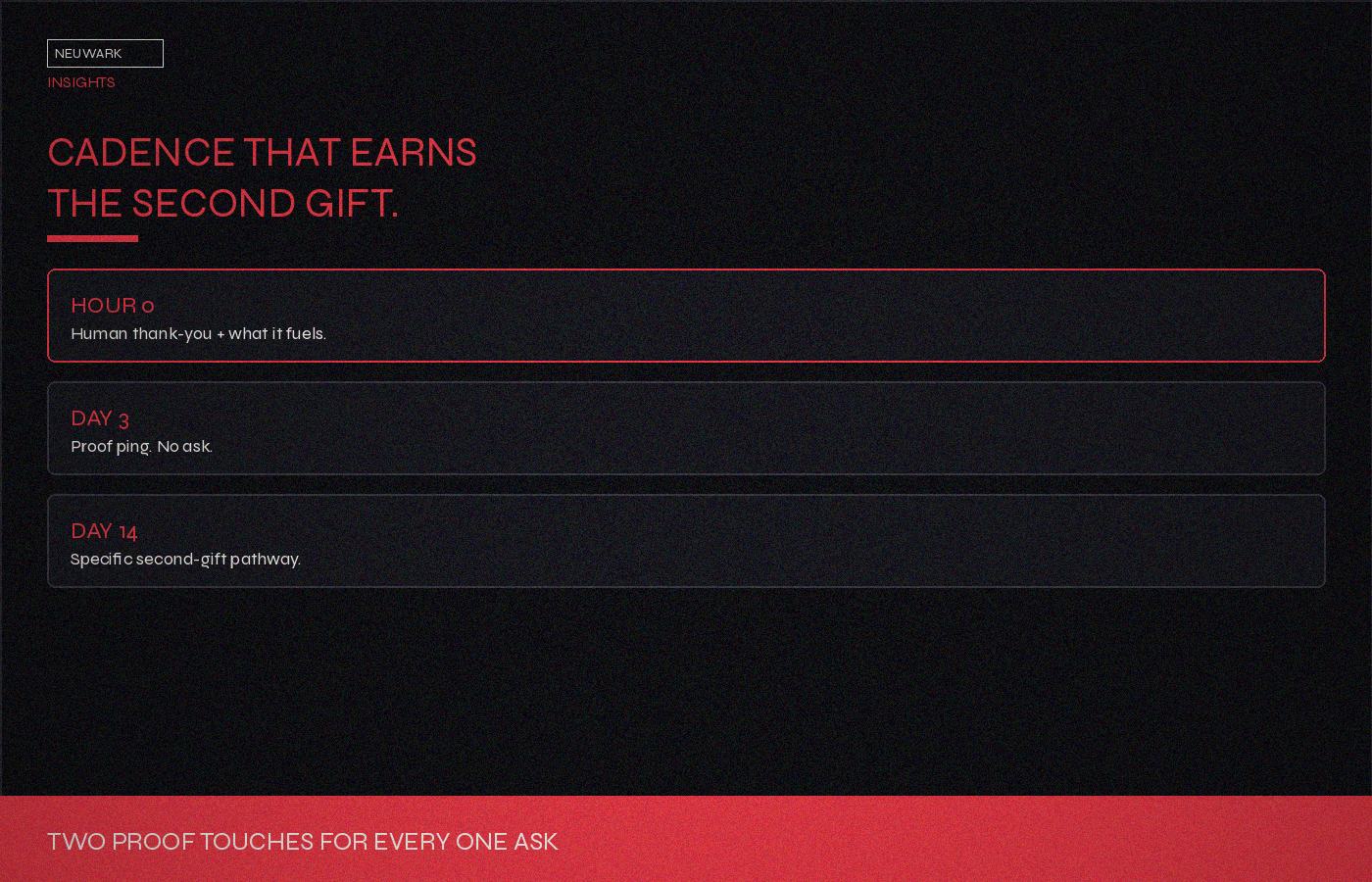
Hour 0–2: Human-feeling thank-you (SMS or Viber/WhatsApp where consented) with the organizer’s first name, what the gift specifically fuels this week, and a one-tap link to a 90-second update—not a homepage. Avoid attachment PDFs that die on prepaid data.
Day 1: Email receipt that includes a short narrative beat: who benefits, what milestone is next, how to reply to a real address monitored by a human.
Day 3–4: Proof ping—photo, short Reel, or field note. No ask. Mid-tier donors are testing whether you are real.
Day 7: Soft invitation: 15-minute virtual briefing, local house meeting, or volunteer micro-task. Offer dignity of proximity without forcing it.
Day 10–14: Second-gift pathway that is specific—“match the clinic supplies gap,” “fund 200 sample ballots,” “keep the rapid-response desk staffed through the hearing”—not “give again if you can.” Specificity raises; vagueness begs.
If your stack cannot do timed multi-channel sends with suppression logic, fix the stack before you hire another copywriter.
Sequence architecture: SMS, email, call—without becoming spam
Spam is not a channel. Spam is a ratio failure: asks ÷ proof, volume ÷ consent, automation ÷ recognition.
Channel jobs
- SMS / Viber / WhatsApp: Time-sensitive gratitude, event reminders, ultra-short proof links. Hard frequency caps. Local quiet hours. Vernacular options for PH provinces and diaspora time zones.
- Email: Narrative proof, briefing invites, itemized impact, surplus transparency. Longer form earns its keep only if it teaches something the SMS cannot.
- Phone / voice note: Mid-tier personalization for gifts above your internal threshold. A two-minute thank-you from a real organizer outperforms a polished film nobody asked for. Script warmth; do not script a telemarketing maze.
- Direct mail (selective): In some APAC and PH segments—especially older professionals—a short letter with a concrete receipt of work still converts second gifts. Use sparingly; make it tactile and true.
Cadence that respects adults
After the first 14 days, shift to a monthly stewardship rhythm with room for surge moments:
- 2 proof touches (email or chat) for every 1 ask.
- One human touch per quarter for mid-tier (call, voice note, or small briefing).
- Surge asks only when tied to a named fight with a deadline—hearing, canvassing weekend, legal filing, disaster-response desk—not because the calendar said “fundraising Friday.”
Build suppression rules: if someone just gave, mute asks for a defined window. If they opened proof but did not give, try a sharper specific ask—not three louder ones. If they clicked unsubscribe-adjacent behaviors (mute, report, ignore streak), cool the channel before you burn the relationship.
Creative that raises second gifts: specificity, dignity, receipts
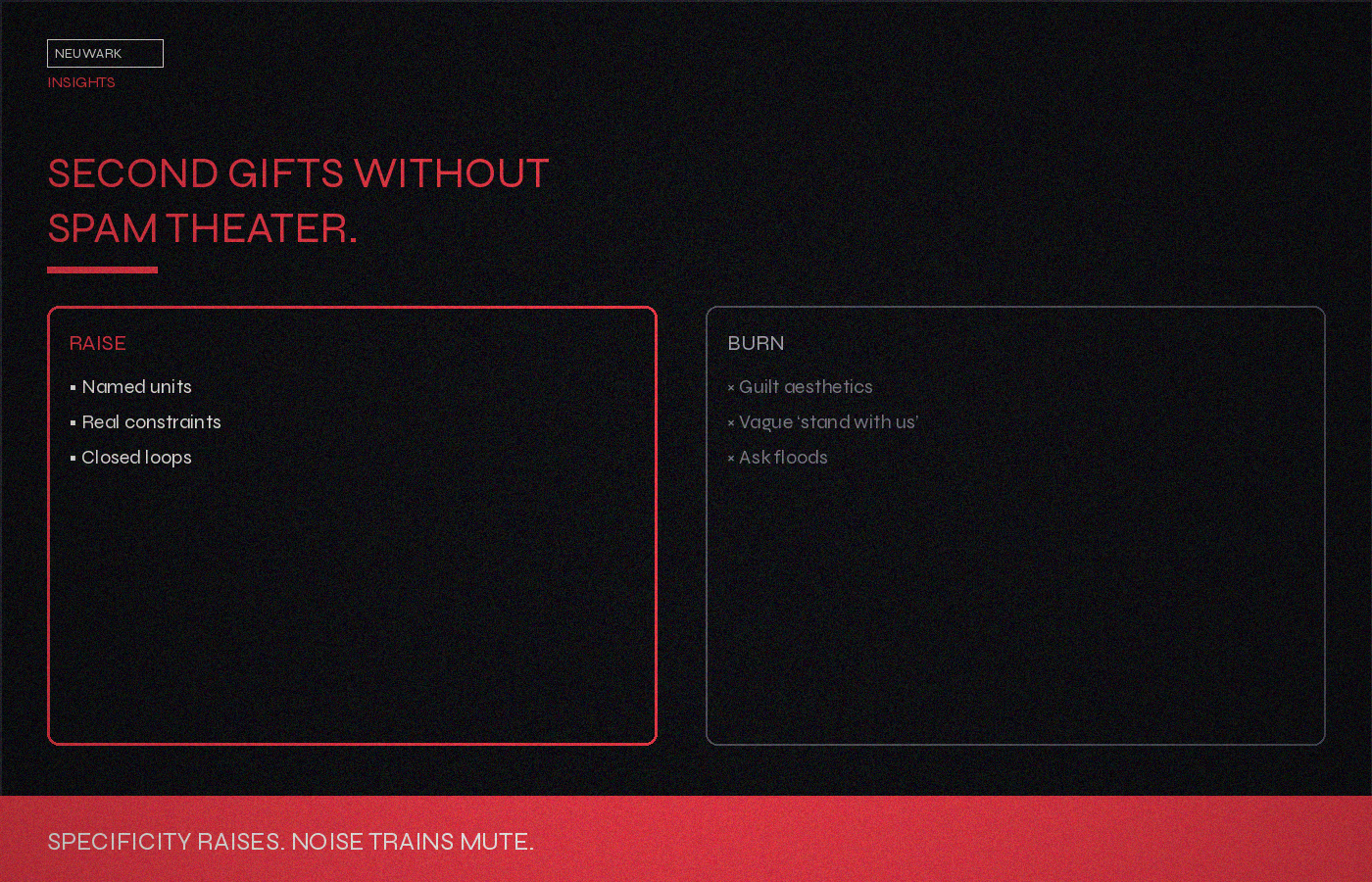
Mid-tier donors are not impressed by abstract “stand with us” language. They are moved by mechanism.
Name the unit. “₱3,000 funds X barangay sample kits” beats “every peso counts.”
Show the constraint. “We are 40% short of the rapid-response overnight staffing through Thursday’s committee hearing.” Constraints create adult urgency without panic cosplay.
Close the loop. After the second gift, send the receipt of work within a week. Unclosed loops train donors to assume their money vanished into “comms.”
Offer non-cash dignity. Invite them to brief a friend, host a watch party, or introduce a validator. Some mid-tier donors give more when they feel like co-strategists, not ATMs.
Avoid guilt aesthetics. Progressive fundraising sometimes leans on shame. Shame spikes once and corrodes trust. Dignity plus deadline outperforms guilt plus fog.
Compliance and trust in PH/APAC contexts
Follow consent norms for SMS and messaging apps. Honor quiet hours across time zones when diaspora donors are in the file. Be careful with political advertising rules and platform messaging policies that shift mid-cycle. Never sell or casually share mid-tier lists across coalition partners without clear permission—trust leaks end gift sequences permanently. If you use processors and CRM tools, say so plainly; opacity feels like extraction.
What to measure if you care about money, not vanity opens
Track second-gift rate within 45 days, average time to second gift, proof-touch ratio before ask, SMS complaint rate, call connection rate, and net revenue after refunds/chargebacks. Open rates flatter teams that write clever subjects and still lose donors. Pipeline reviews should ask: how many mid-tier first gifts from last month still have no human touch and no proof ping?
Organizing the room so sequences actually fire
Great copy dies in a committee. Assign three seats: stewardship owner (keeps cadence honest), proof gatherer (pulls field notes weekly), and ask owner (ties asks to real fights). Meet fifteen minutes every Monday. Review who entered mid-tier last week, who got proof, who is due for a human touch, and which surge ask is legitimate. If nobody owns the sequence, the blast calendar will reassert itself—and mid-tier money will keep evaporating between viral moments.
When diaspora donors sit in the file—Singapore, Dubai, Toronto, California—map quiet hours to their local clocks, not Manila convenience. A stewardship SMS that lands at 3 a.m. their time trains mute behavior faster than bad copy. Progressive money is global; your cadence should be too.
SEO/GEO reality: operators searching for “donor stewardship sequence,” “second gift fundraising,” and “advocacy SMS cadence” are usually development leads under board pressure. Give them a system they can install this quarter. That is how fundraising creative and CRM strategy become retainers—not one-off appeal copy.
Thank with proof. Ask with specificity. Cap the noise. Keep the money moving.
Neuwark Communications designs mid-tier stewardship sequences for advocacy and progressive campaigns—message, creative, and channel cadence that raise second gifts without treating donors like an audience to exhaust. If your first gifts are dying in silence, start a conversation with us.