
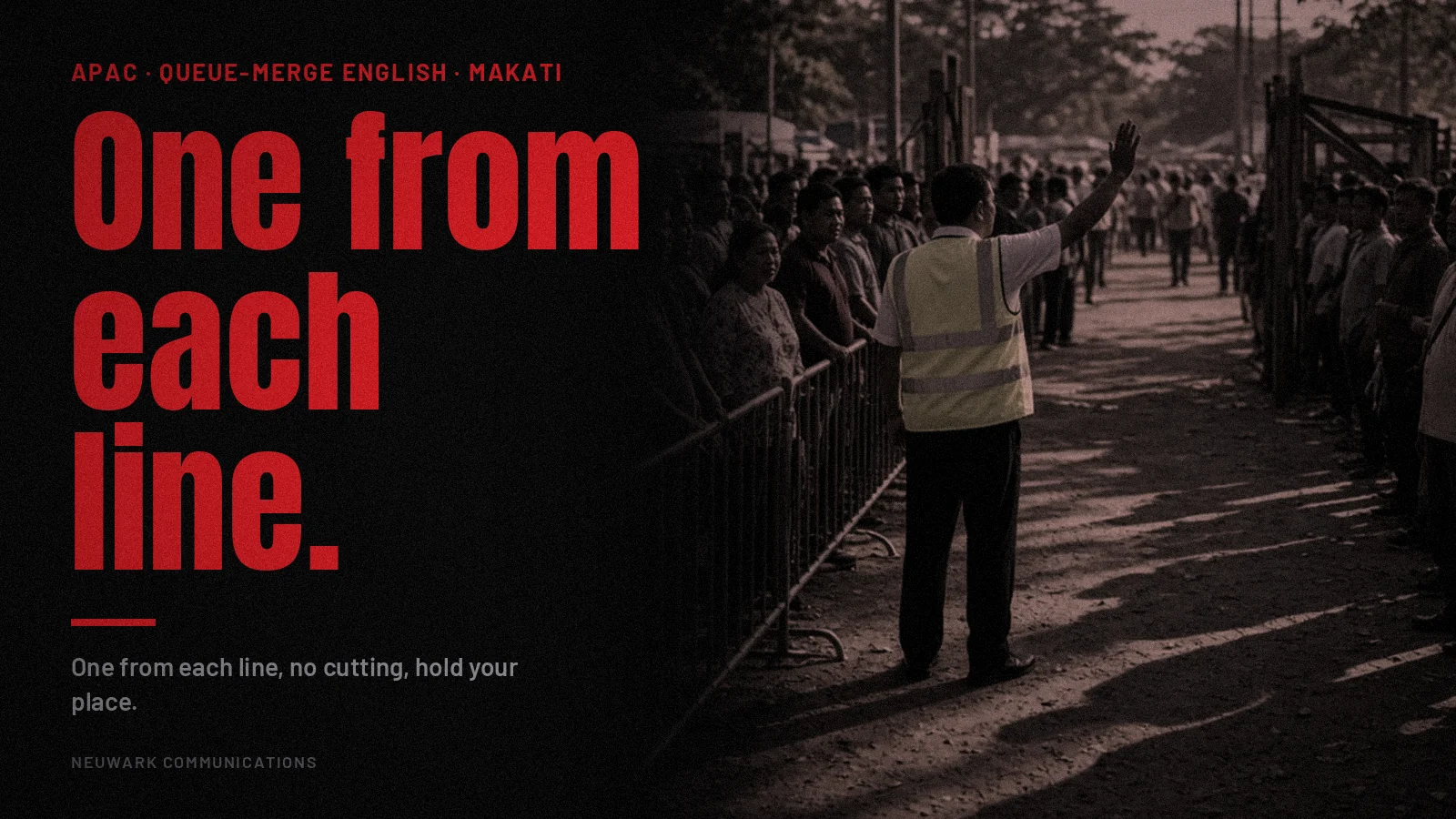
One from each line, no cutting, hold your place.
Street-smart APAC English: short sentences a tired operator can say out loud.
Quick answer: A queue-merge line English APAC is the gate marshal’s rule where two lines become one: one from each line, no cutting, hold your place. The marshal waves left then right, one hand only, and guests keep their spot until called.
A Manila rally ground at gates, two queues meeting at one lane.
The marshal waves both lines at once. Guests push in from both sides and the lane jams.
Pair it with the queue merge line English APAC for a related floor moment and the queue jump line English APAC for the next step on the same floor. Same craft: one short rule, said early and said the same way.
What is a queue-merge line English APAC?
It is a gate marshal’s three-part rule at an event gate. One from each line, no cutting, hold your place. Said early, said the same way.
1. One from each line. Wave one from the left, then one from the right, with one hand only.
2. No cutting. No cutting from the sides or the back.
3. Hold your place. Everyone holds their place until the hand points to their line.
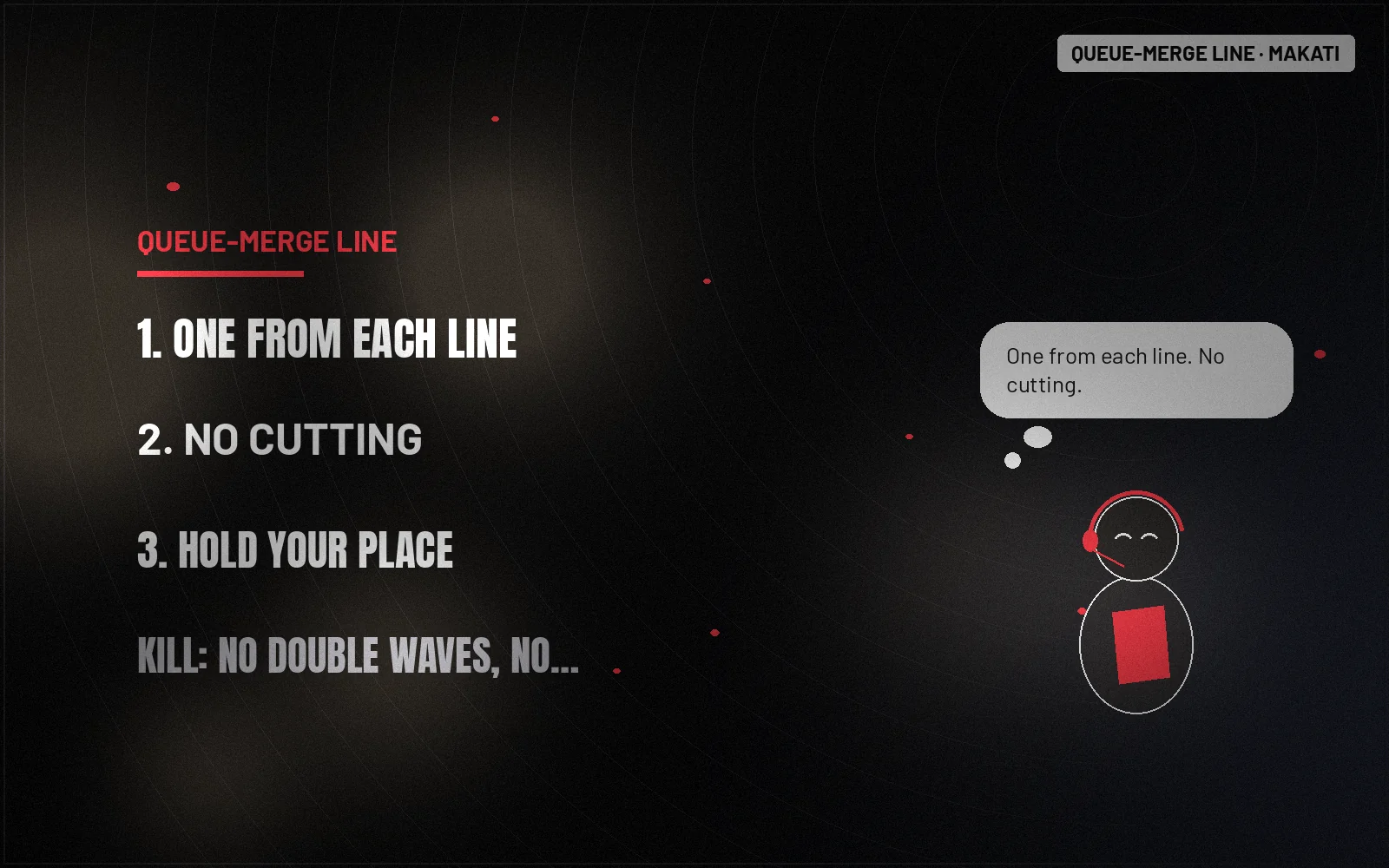
The habit to break is the double wave. Both arms up looks helpful, but it tells both lines to go at once.
What should a gate marshal stop saying?
Stop waving both lines together, and stop letting the loudest guest through. Say the three parts in order.
| Kill this | Say this (illustrative) | Why |
|---|---|---|
| Sige po, sabay-sabay na kayo, bilisan. | One from each line. | Alternating is fair and visible (PH Tagalog habit) |
| Just push in lah, whoever fast. | No cutting. | Cutting breaks trust in the line (SG lah habit) |
| Langsung masuk aja, Mbak, siapa cepat. | Hold your place. | Holding place keeps the lane calm (Jakarta Bahasa habit) |
Lines in this table are illustrative, not quotes from real people.
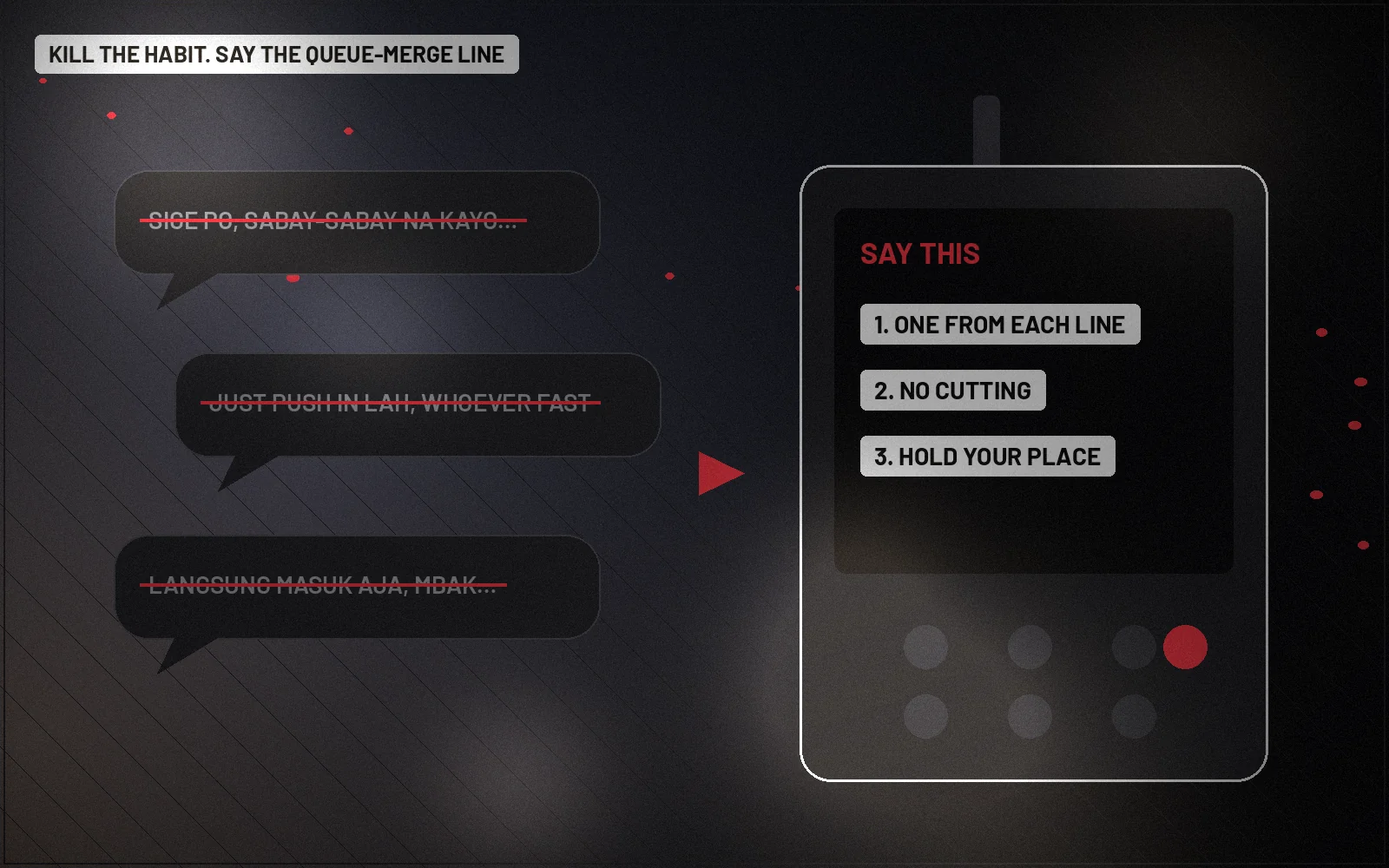
Say the line before the moment, not after the mistake.
Who decides the queue merge rules?
The gate lead decides where the merge sits and who marshals it. One marshal owns the hand signal.
One failure mode: the marshal swap
A new marshal takes over mid-flow and starts with a different signal. Guests read it as a free-for-all. Hand over the line with the same words and the same hand.
PH / SG / Jakarta desk notes
Same three parts. Different desks.
Philippines desk. Firm and kind. One from each line po. Walang singitan po. Hold your place po.
Singapore desk. Even and clear. One from each line. No cutting. Hold your place.
Jakarta desk. Jakarta gates can see big merges at once. Keep the English short and the hand signal identical across marshals.
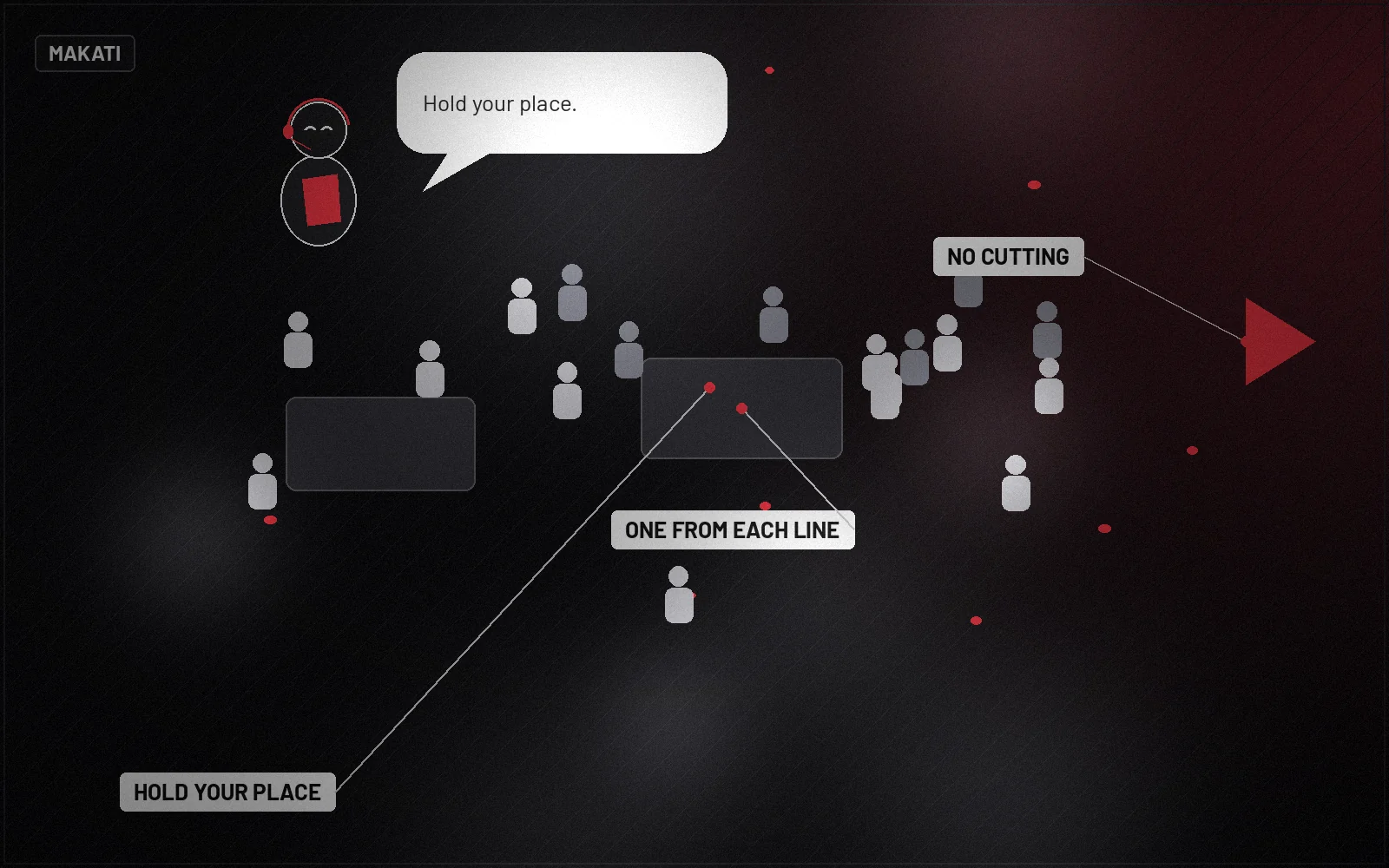
Monday field kit
- Agree the merge point and marshal with the gate lead.
- Mark both lines so each is easy to see.
- Brief marshals on the lock: one from each line, no cutting, hold your place.
- Practise the left-then-right signal and one marshal handover.
- Kill rule: no double waves, no side entries, no loudest-first.
Illustrative only. Adjust the brief to your venue rules.
FAQs
What is a queue-merge line English APAC?
A queue-merge line English APAC is the gate marshal’s rule where two lines become one: one from each line, no cutting, hold your place. The marshal waves left then right, one hand only, and guests keep their spot until called.
What should a gate marshal stop saying?
Stop waving both lines together, and stop letting the loudest guest through. Say the three parts in order.
Who decides the queue merge rules?
The gate lead decides where the merge sits and who marshals it. One marshal owns the hand signal.
What to do this week
Speakable lock (illustrative): “One from each line, no cutting, hold your place.”
Stand at the merge with your gate lead and agree the one-hand signal. Floor wording like this is drafted at our Manila HQ in Makati and checked with the teams who will say it.
Neuwark Communications builds event and campaign communications as part of our strategy and messaging work. More street-smart lines live in Insights.
Related: queue merge line English APAC · queue jump line English APAC
Talk to us about your next event script.
Illustrative lines only. Communications craft, not legal advice.