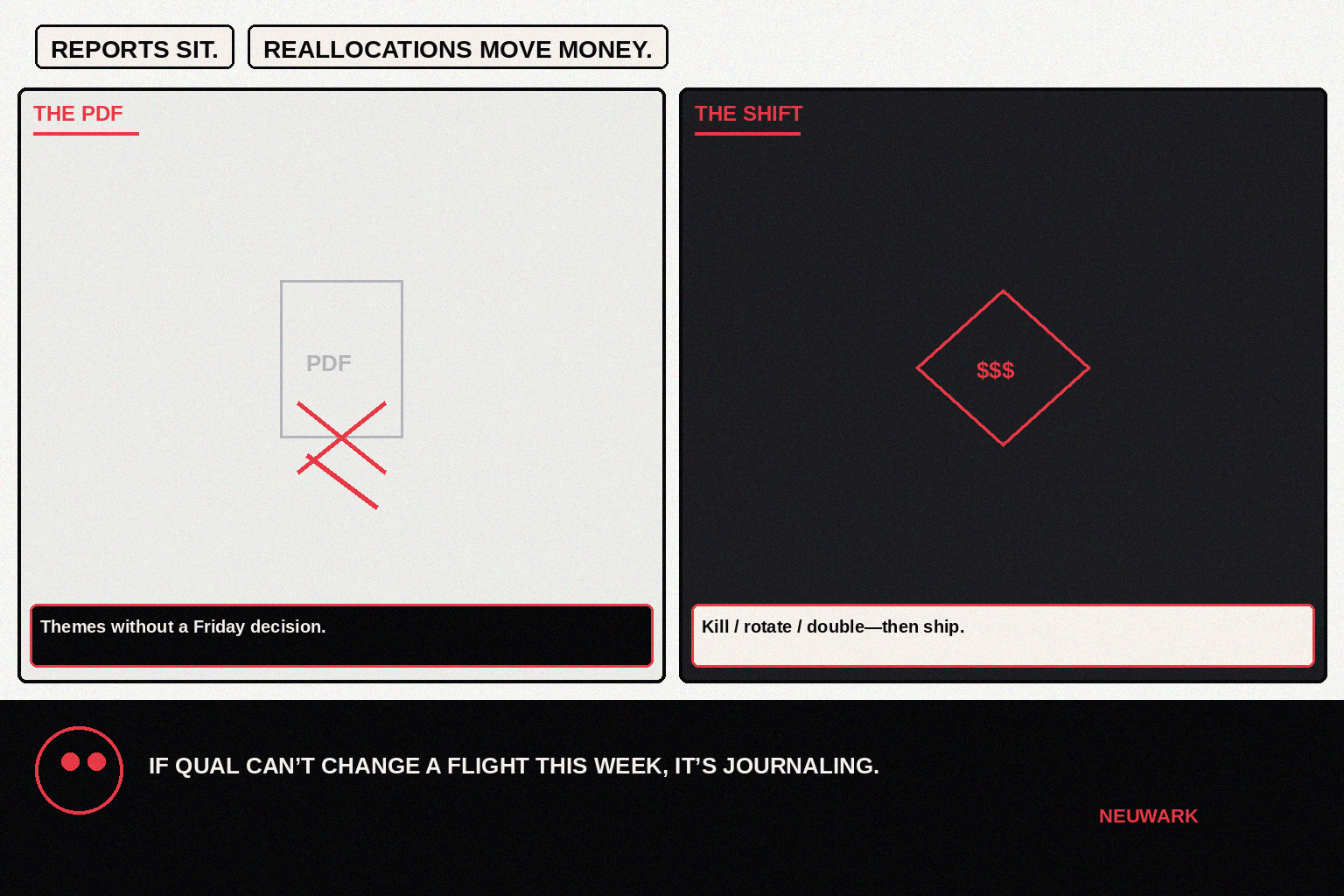
Most campaigns commission qualitative research the way they commission a commemorative plaque: late, decorative, and unread by the people spending money. Focus groups become a PDF. Ethnography becomes a quote wall. Then media keeps buying last month's best guess while the public has already moved. In Philippine and APAC persuasion environments—fast rumor cycles, vernacular mutation, algorithm weather—qual that cannot reallocate a flight this week is expensive journaling.
Neuwark Communications treats research as an operating input for belief engineering. We don't decorate agendas. We engineer belief. That means qualitative work must produce decisions: kill a cut, rotate a proof, shift weight to radio, pause a validator, or harden an ask—mid-cycle, not after certification.
The mid-cycle problem: dashboards without meaning
Paid media dashboards tell you what delivered. They rarely tell you why a story stopped landing. CTR can rise while trust falls. Frequency can look efficient while message fatigue makes your base sneer. A Reel can rack saves among friendlies and still leave persuadables cold.
Qualitative research fills the meaning gap—if you design it for operators:
- Door and chat echoes: what volunteers hear repeated, resisted, or laughed at.
- Creative post-mortems with strangers: not "do you like this?" but "what is this asking you to believe, and who benefits?"
- Validator interviews: why a captain will or will not put their name on a clip.
- Rumor mapping: which hostile frames are sticky in Tagalog, Cebuano, or local slang *this week*.
Operator rule: if your qual report has no "therefore we will change X by Friday," it is not research. It is literature.
Design for decision speed, not academic completeness
A usable mid-cycle qual pack is short:
1. Decision question on page one (e.g., "Should we keep economic contrast Cut A as primary in NCR digital?"). 2. Five verbatim moments that changed your mind—not fifty pages of themes. 3. Three creative implications tagged kill / rotate / double. 4. One media implication with a percentage shift recommendation. 5. One field implication for scripts and surrogates.
Anything else goes to appendix. Leadership should be able to act after a twelve-minute stand-up.
The weekly listening loop that actually moves money
Build a loop that closes every seven days:
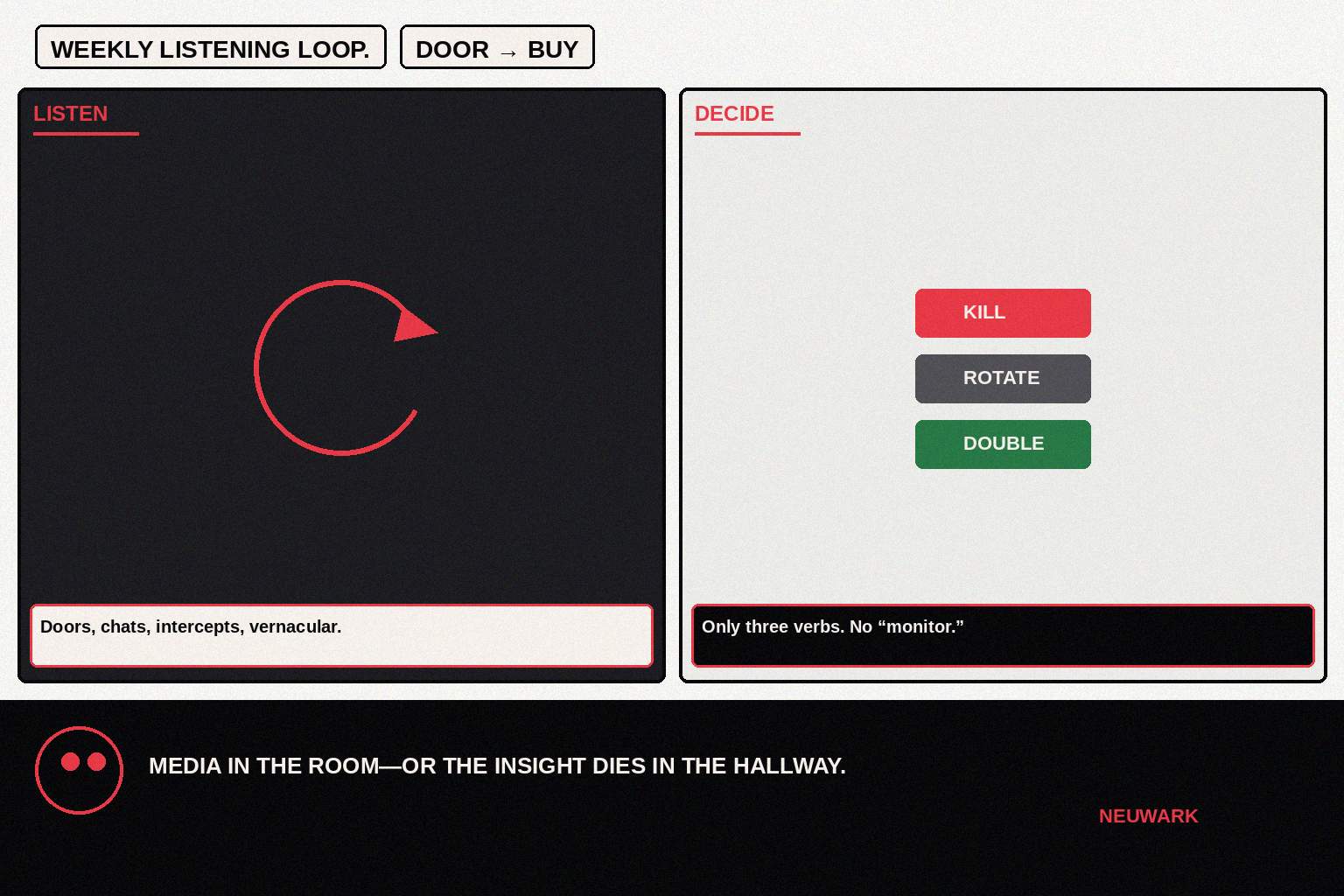
Listen. Sample door notes, community admin feedback, hotline themes, comment clusters, and 6–10 rapid intercepts or mini-groups in priority geographies. Mix Metro and provincial; mix vernaculars. Avoid elite-only rooms that flatter your frame.
Interpret with media in the room. Strategy alone will intellectualize. Creative alone will defend the cut. Paid alone will protect the plan. Force a shared sentence: what belief is failing, for whom, on which channel.
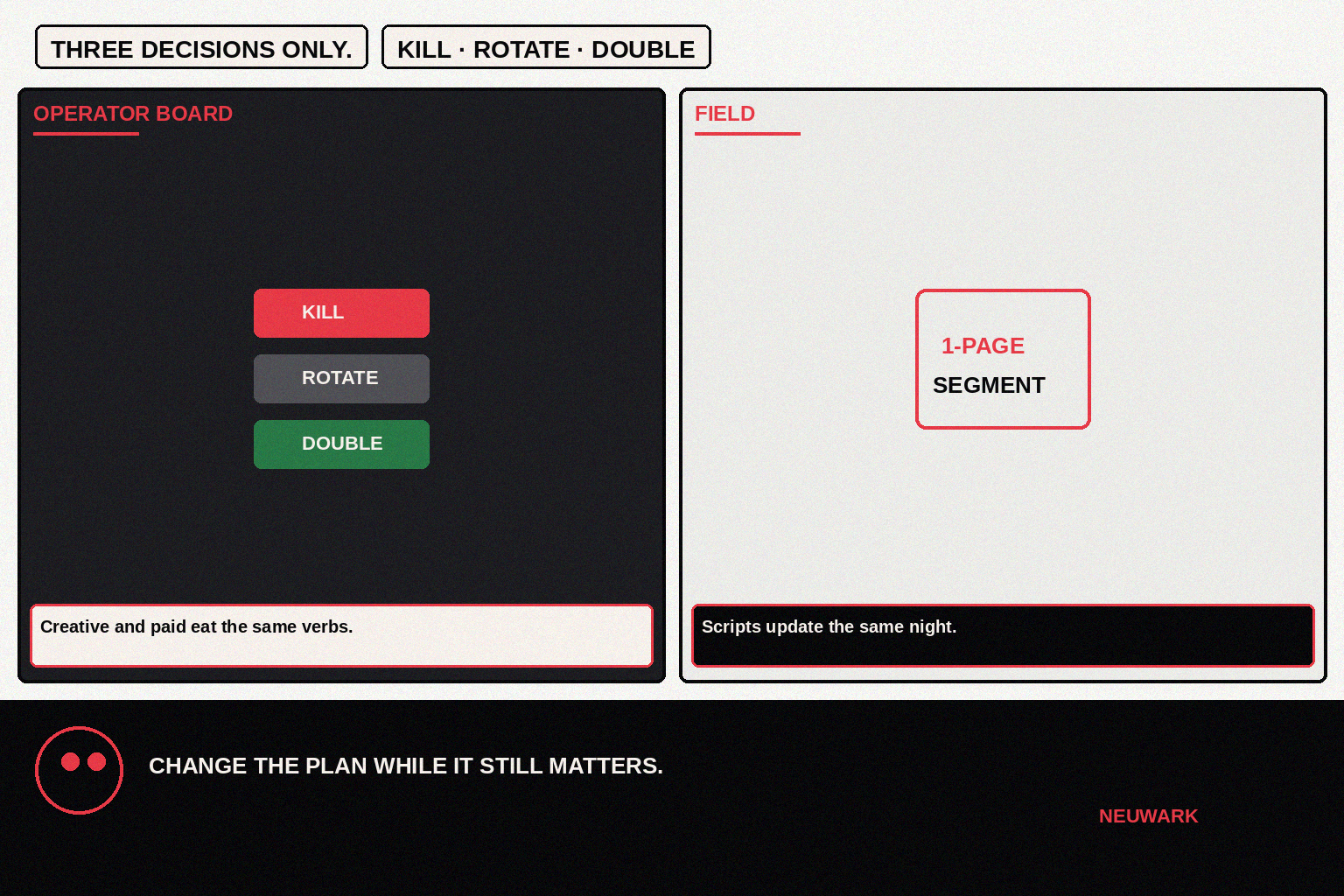
Decide only three verbs. Kill. Rotate. Double. If you invent a fourth—"explore," "monitor," "socialize"—you are delaying.
Ship. Update the message one-pager, swap creative in-flight, rename ad sets to match the new job, brief field the same night.
Prove. Next week, check whether the verb worked: door friction down, save rate among persuadables up, validator willingness up, or cost-per-meaningful-action improved.
In APAC campaigns, this loop must respect civic rhythm: typhoon weeks, holidays, hearings, debates, wage cycles, school calendars. Qual timed to those shocks beats a quarterly "brand tracker" that arrives after the money is gone.
What good mid-cycle findings sound like
Useful: "Persuadable moms accept the wage story but reject our messenger as Manila-distant; rotate proof to provincial nurse validator; cut English-only hook; shift 15% NCR digital to vernacular radio adjacency this week."
Useless: "Voters care about the economy and want authenticity."
If your findings could apply to any campaign in any year, you learned nothing actionable.
Ethics and craft: listening without manufacturing consent
Qualitative power can be abused. Progressive and public-interest work should refuse dark patterns:
- Do not use listening sessions to coach respondents into your line, then cite them as "organic proof."
- Do not cherry-pick one emotional story to override systematic field signal.
- Do not extract trauma for a tear-jerker spot without care, consent, and follow-through.
- Do not treat vernacular communities as raw material for English creative.
Ethical speed is still speed. You can move money Friday and still treat people as ends, not props. In fact, respect shows up as better insight: people tell the truth faster when they do not feel harvested.
Field kit: make qual edible for buyers and captains
- A red / yellow / green creative board updated weekly with the three verbs.
- A rumor card for surrogates: hostile frame → our contrast → proof → exit.
- A media shift memo in plain language: from/to, why, what success looks like in 7 days.
- A vernacular note: which phrases died, which landed, which must never return.
When buyers and captains eat the same research, the public hears one campaign.
Case pattern: when a single vernacular objection should move 20% of budget
A familiar mid-cycle failure in Philippine digital-heavy plans: English national creative outperforms among friendlies in Metro comment sections, while provincial volunteers report a repeated objection—"ang layo niyo" / "parang ad ng korporasyon." Dashboards still look fine because friendlies click. Qual done right treats that objection as a media event, not a soft insight.
Action pattern we recommend:
1. Tag the objection to a segment job (soft persuadables outside NCR; validator captains). 2. Pull two vernacular proof units already in the library—or shoot a 24-hour interceptor with a local nurse, teacher, or jeepney-route worker if the library is empty. 3. Cut digital frequency on the English hero in those geos; do not "pause all learning" in panic. 4. Buy adjacency where comprehension is higher: community radio reads, local page whitelists, group-chat seeding with captains before paid amplification. 5. Re-brief field with the same proof line so door and feed stop arguing with each other.
That is qualitative research changing a media plan: money moves because meaning moved. If your vendor needs three weeks to schedule the group while the objection mutates into a meme, you do not have a mid-cycle capability—you have a museum.
Change the plan while it still matters.
Postmortems are for historians. Operators need qualitative truth while flights are live, volunteers are tired, and opponents are already remixing your weakest line. Build listening that reallocates. Build reports that decide. Build weeks that compound belief instead of documenting its decline.
Neuwark Communications runs research-to-media loops for candidates, coalitions, and institutions that need persuasion to adapt under fire. If your last qual deck never touched a media plan, start a conversation with us—before the next cycle writes your spend for you.
[Start a conversation →](https://neuwarkcommunications.com/contact)