
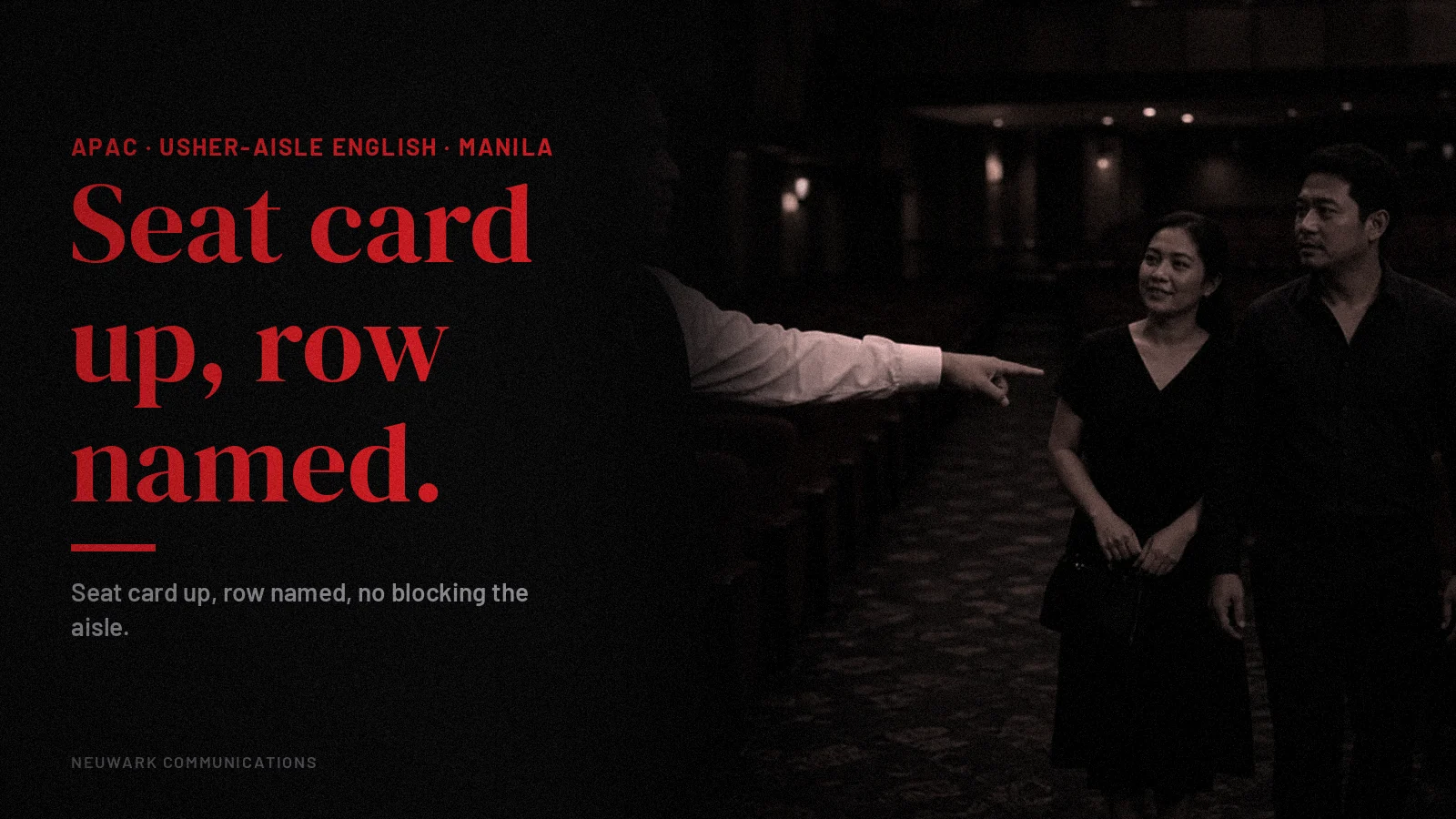
Seat card up, row named, no blocking the aisle.
Street-smart APAC English: short sentences a tired operator can say out loud.
Quick answer: An usher-aisle line English APAC is the theatre usher’s seating rule: seat card up, row named, no blocking the aisle. Show the card, say the row, and keep the aisle moving.
A Manila theatre, fifteen minutes to curtain, house lights still up.
Guests arrive with drinks and friends they have not seen in months.
The aisle fills with people who are almost seated.
Pair it with the usher-torch line English APAC for seating after the lights go down and the aisle-rope line English APAC for holding a section closed. Same craft: one short rule, said early and said the same way.
What is an usher-aisle line English APAC?
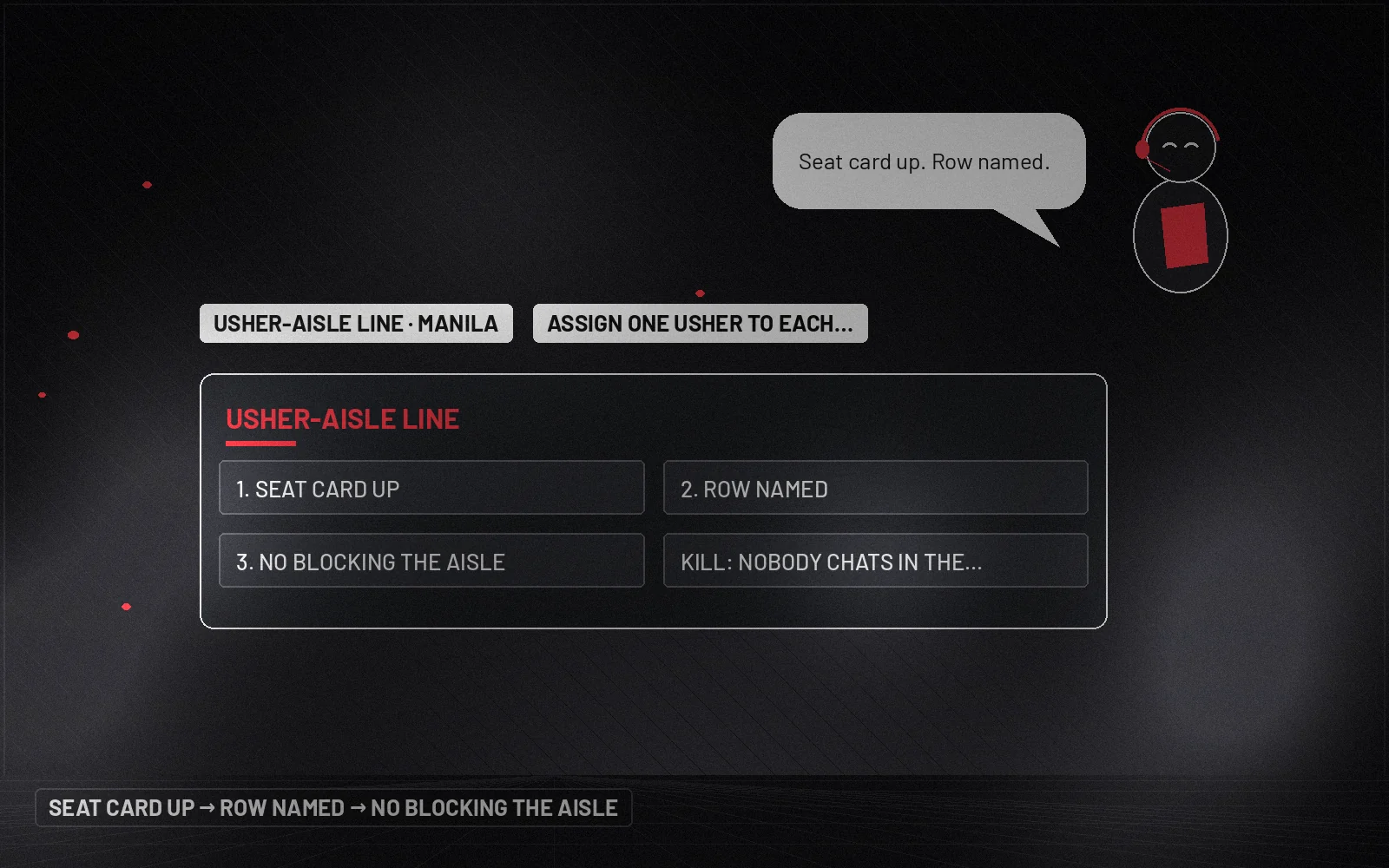
It is the usher’s three-part rule for seating while the lights are up. Seat card up, row named, no blocking the aisle. Ushers say it at the top of each aisle as guests arrive.
1. Seat card up. The usher holds the guest’s ticket or seat card up where both can see it. No squinting at a phone in the dark later.
2. Row named. The usher says the row and the side out loud: Row F, on your left. Guests hear it once and walk straight there.
3. No blocking the aisle. Guests chat in their row, not in the aisle. The aisle is the route for everyone behind them and the exit route once the show starts.
The habit to break is the polite wait. Ushers stand behind chatting guests and say nothing. The queue at the top of the aisle grows and the curtain goes up late.
What should an usher stop saying in the aisle?
Stop saying sit anywhere and stop letting the aisle become a lobby. Both make the next fifty guests slower. Say the three parts, guest by guest.
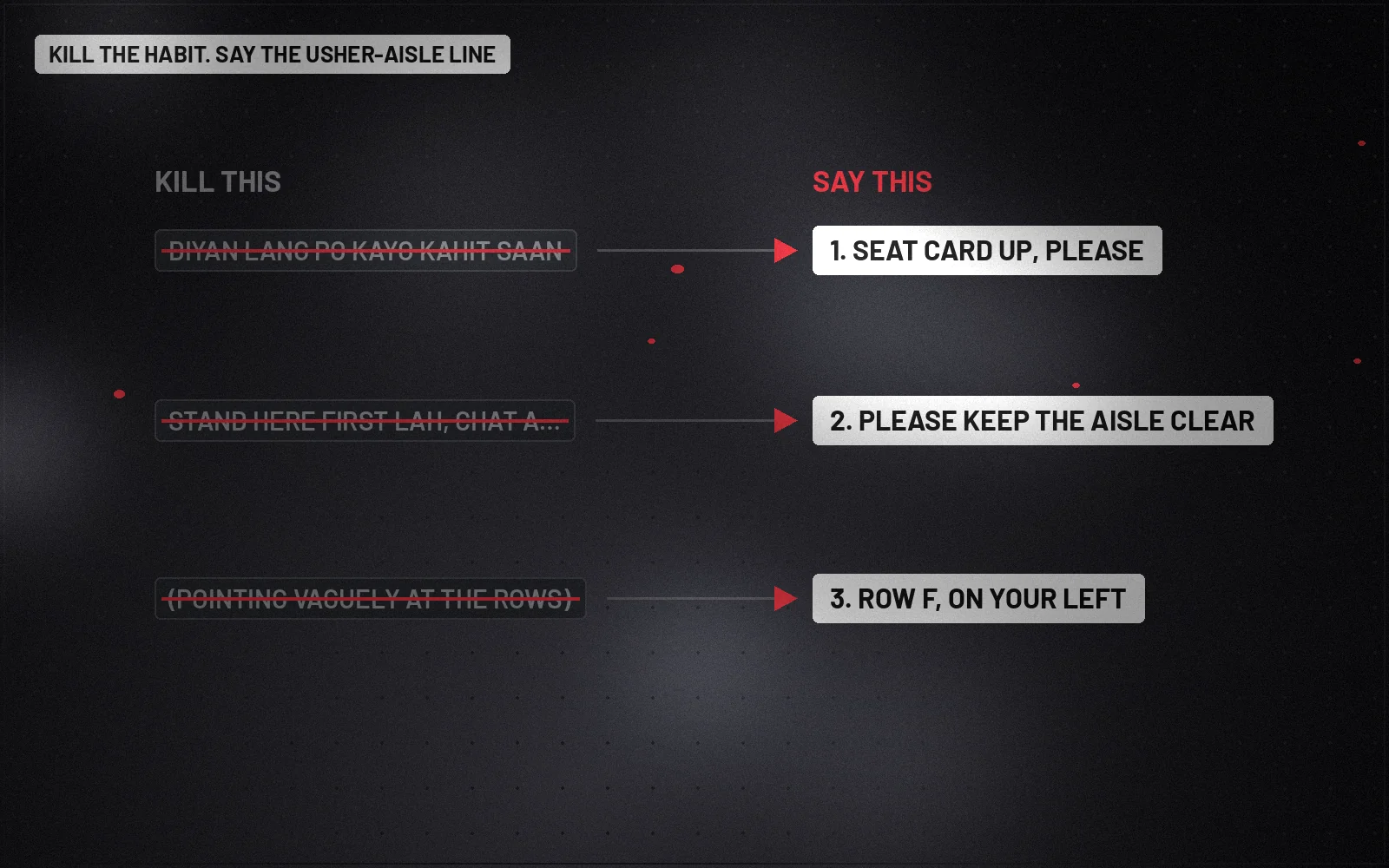
| Kill this | Say this (illustrative) | Why |
|---|---|---|
| Diyan lang po kayo kahit saan. | Seat card up, please. | One seat, one guest |
| Stand here first lah, chat a while. | Please keep the aisle clear. | The aisle is a route |
| (pointing vaguely at the rows) | Row F, on your left. | Guests walk straight there |
Lines in this table are illustrative, not quotes from real people.
Say it at speaking volume, beside the guest, with the card in your hand.
Who clears the aisle before the show starts?
The usher for that aisle clears it, on the house manager’s call. The house manager calls five minutes and the ushers walk their aisles. Anyone standing is shown to their row.
Guests do not clear it on their own, and neither does the stage manager from backstage. One usher owns one aisle, so nobody is missed.
What if guests keep standing in the aisle after the call?
Say the row again, then ask them to take their seats before the house manager holds the show. Keep it calm. Most guests sit once they hear their row named.
This is the uncomfortable rung. Some guests are senior, some are sponsors, and some just do not want to stop talking. The usher stays polite and repeats the line. If the show must hold, that is the house manager’s call, not the usher’s.
PH / SG / Bangkok desk notes
Same three parts. Different desks.
Philippines desk. Theatre crowds expect warmth. Use po and sir, ma’am: seat card up po. Row F on your left, ma’am. Please keep the aisle clear, sir.
Singapore desk. Keep it brisk and clear. Seat card, please. Row F, left side. Please keep the aisle clear. No small talk on the stairs.
Bangkok desk. A small wai before the line keeps it gracious. Then the three parts in plain English, with the card held up so the guest can read the row.
Paste-ready lock
Speakable lock (illustrative): “Seat card up, row named, and no blocking the aisle.”
Monday field kit
- Assign one usher to each aisle for the whole of house open.
- Check row letters are visible from the aisle before doors.
- Brief every usher on the lock: seat card up, row named, no blocking the aisle.
- Agree the house manager’s five-minute call and what ushers do on it.
- Kill rule: nobody chats in the aisle once the five-minute call goes.
Illustrative only. The venue’s house rules and the house manager come first.
FAQs
What is an usher-aisle line English APAC?
An usher-aisle line English APAC is the theatre usher’s seating rule: seat card up, row named, no blocking the aisle. Show the card, say the row, and keep the aisle moving.
What should an usher stop saying in the aisle?
Stop saying sit anywhere, and stop letting the aisle become a lobby. Say the three parts guest by guest.
Who clears the aisle before the show starts?
The usher for that aisle clears it on the house manager’s call. One usher owns one aisle.
What if guests keep standing in the aisle after the call?
Say the row again and ask them to take their seats. Holding the show is the house manager’s call.
Neuwark Communications builds event and campaign communications as part of our strategy and messaging work. More street-smart lines live in Insights.
Related: usher-torch line English APAC · aisle-rope line English APAC
Talk to us about your next event script.
Illustrative lines only. Communications craft, not legal advice.