Unpopular policy is where public affairs either becomes adult work or becomes theater. A fuel subsidy phase-down. A land-use reform that hits a loud minority. A tax administration fix that screenshots as “new burden.” A climate adaptation rule that raises costs before it saves lives. In the Philippines and across APAC, these fights arrive wrapped in monsoon politics, patronage reflexes, and feed cycles that reward the simplest resentment. If your narrative strategy is “wait until it polls better,” you are not doing public affairs. You are waiting for permission that never comes.
Neuwark Communications works with political, advocacy, and institutional clients who still have to move policy when the topline is cold. Soft CTAs do not change the physics: belief is engineered before ballots and before comfort. The job is not to invent fake popularity. The job is to build a narrative system that can carry a hard truth without sounding like contempt for the public.
Polls are a weather report. Narrative is infrastructure.
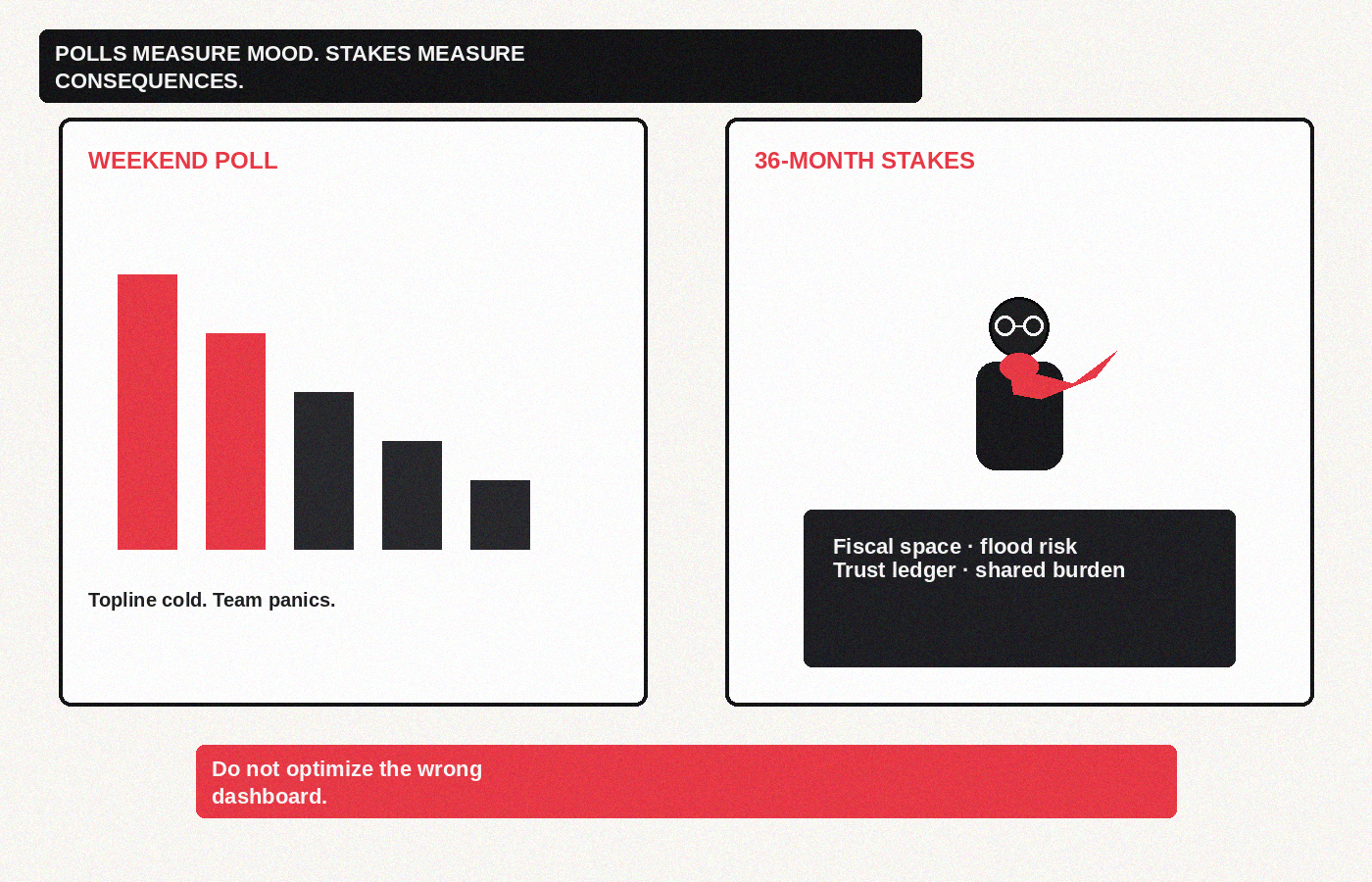
Polling tells you the temperature of a frame you may have already lost. It does not tell you whether the policy is necessary, whether the opposition frame is sticky, or whether your silence is being filled by a more disciplined enemy. In Philippine public life especially, overnight anger can be real and still incomplete: jeepney modernization debates, power-rate spikes, flood-control skepticism, rice price politics—each mixes legitimate household pain with opportunistic narrative capture.
Operator rule: separate three ledgers on one page before you write a single line.
1. Consequence ledger. What breaks in 12–36 months if you fold? Be specific—hospital wait times, fiscal space, climate risk in coastal LGUs, supply chain failure—not “national interest” wallpaper. 2. Cost ledger. Who pays first, in what currency (cash, time, dignity, identity), and how visible is that cost on TikTok? 3. Trust ledger. Which institutions and validators still have permission to explain hardship without being laughed out of the room?
Public affairs teams that only track approval ratings keep optimizing the wrong dashboard. Mood moves. Infrastructure of meaning has to be built while mood is bad.
The trap of “educating the public”
When a policy polls badly, elites often reach for pedagogy: explainers, infographics, a secretary on morning television with a flowchart. Education matters. Education is not a strategy if the public already understands the cost and rejects the trade. Many voters are not confused. They are unconvinced that the pain is shared, time-bound, or worth it.
In APAC contexts—Manila, Jakarta, Bangkok, Taipei issue fights share this pattern—technocratic tone reads as distance. Vernacular clarity reads as respect. Your narrative must answer, in one breath: What do we protect, who shares the burden, what proof will we show in 90 days, and what happens if we do nothing?
Build a narrative for hard policy without lying about popularity
1. Name the villain correctly. If the villain is “the public’s ignorance,” you have already lost. Better villains for necessary policy: capture, delay, free-riding, deferred maintenance, imported price shocks, institutional cowardice. Contrast against a status quo that is already hurting people quietly.
2. Make the timeline legible. Unpopular reforms die when pain is front-loaded and benefits are abstract. Publish a dated proof calendar: what households should see by month one, month three, month six. If you cannot name proofs, you do not have a communications problem—you have a policy design problem.
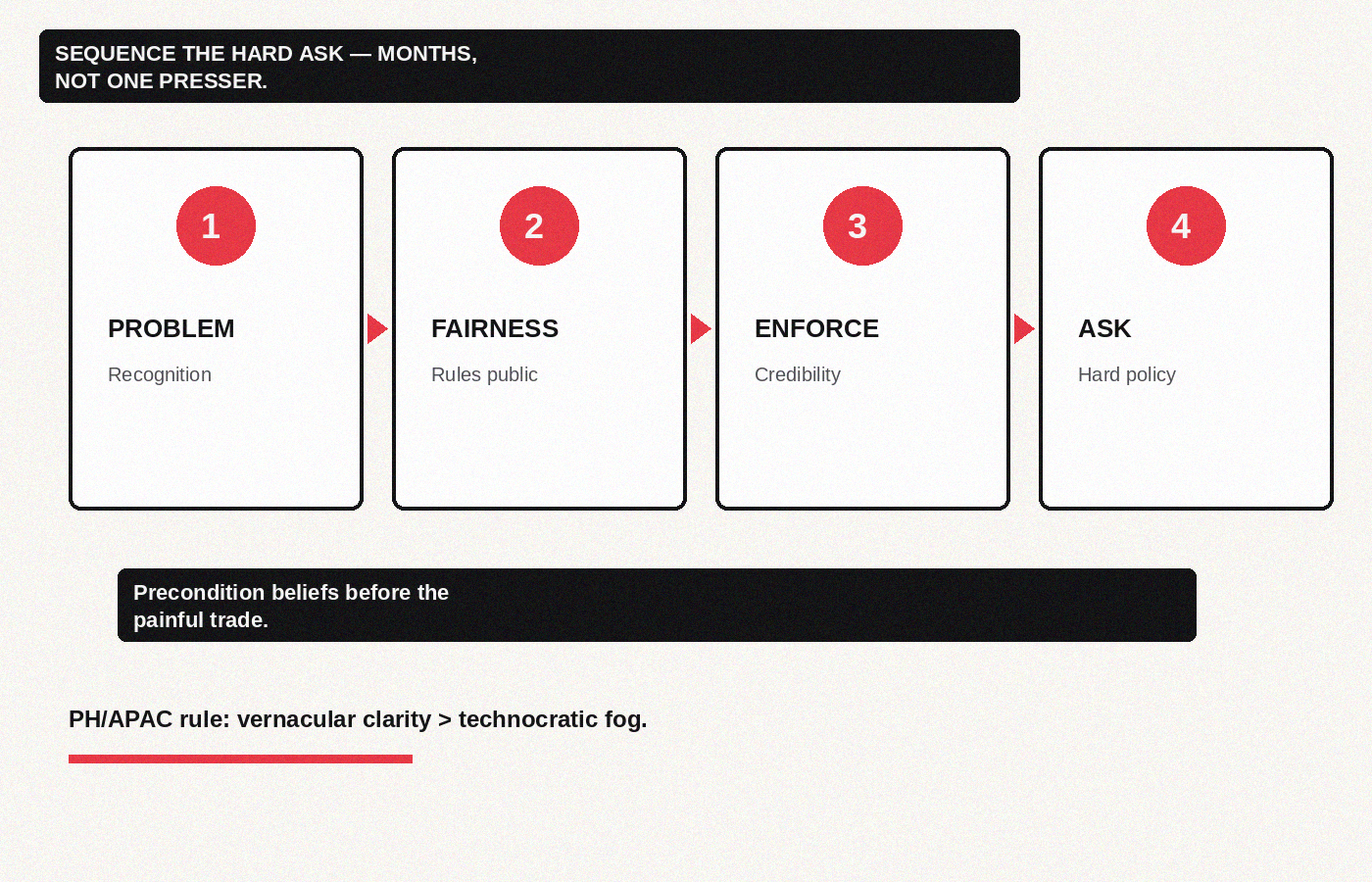
3. Sequence the fight. Do not launch the hardest ask on the worst news week. Build precondition beliefs first: problem recognition, fairness rules, enforcement credibility. In PH campaigns and agency work, that often means barangay-level proof and sector validators before the national slogan.
4. Price the opposition narrative in advance. Assume your opponent will frame the policy as elite cruelty, foreign imposition, or anti-poor theater. Pre-write the contrast sheet. Rapid response should remix proofs—not reinvent the moral claim every Tuesday.
5. Offer a behavioral ask that is not “appreciate us.” Soft asks create soft coalitions. Hard asks—join a briefing, submit a comment, attend a hearing, share a cost calculator, enroll in a transition benefit—create measurable movement and force your creative team to design for action.
Field kit: the unpopular-policy one-pager
Hand this to speech, digital, legislative affairs, and partners:
- Frame paragraph a field organizer can memorize
- Three contrasts that fit in one breath
- Cost acknowledgment lines that do not apologize for the goal
- Proof calendar with owners
- Validator list ranked by trust for the hurt audiences (not by who is easiest to book)
- Red lines: phrases that sound like contempt, blame-shifting, or “there is no alternative” fatalism
If any of those artifacts are missing, you are improvising under fire. Improvisation feels brave on a podium. Systems win in a monsoon of resentment.
Validators, vernacular, and the dignity problem
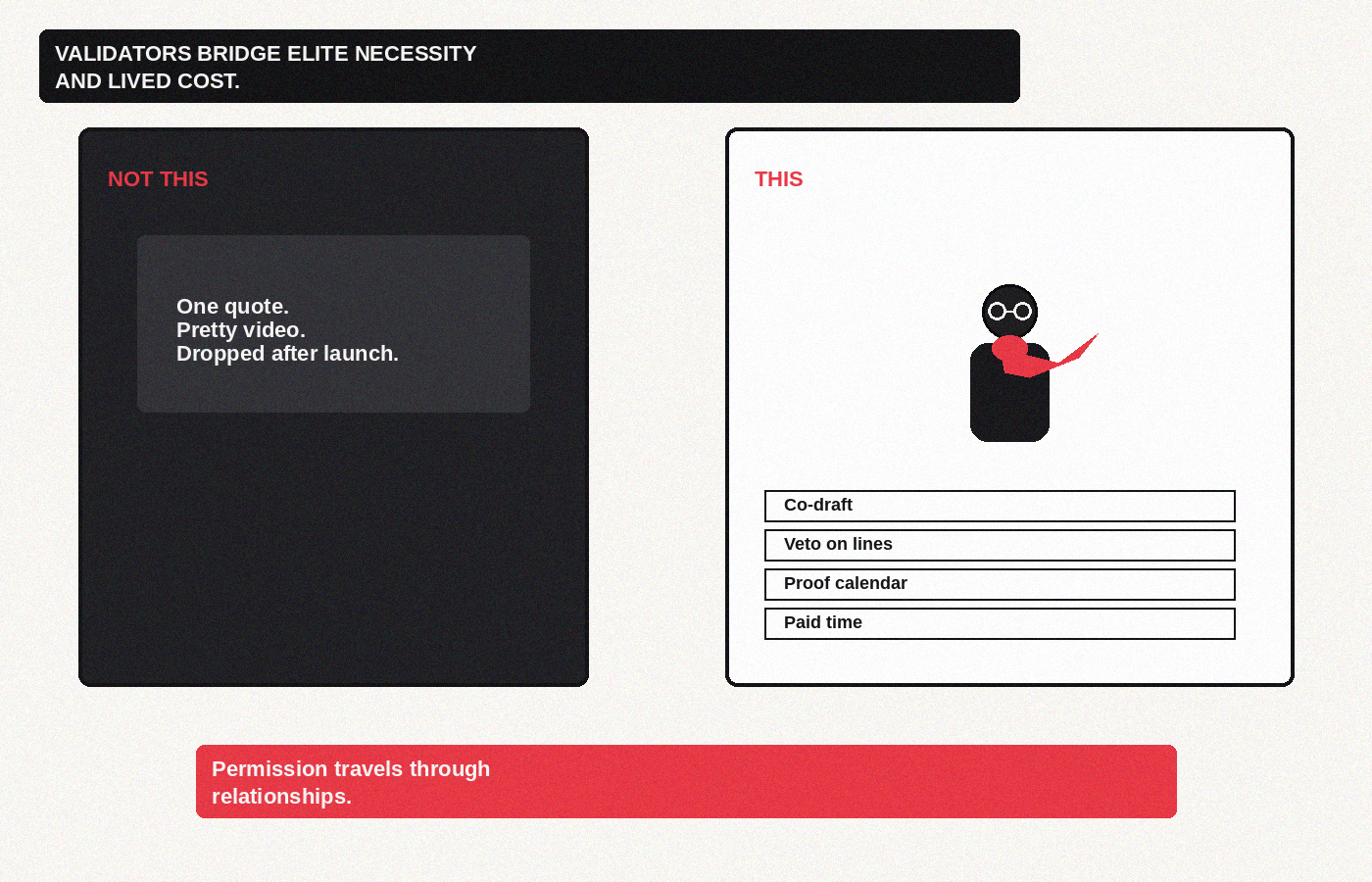
Hard policy needs bridges, not megaphones. A finance official explaining fiscal space is necessary and insufficient. Pair with labor economists who will tell the truth about transition pain, faith leaders who can speak sacrifice without sacralizing the state, local executives who already ran a pilot, and households who gained from a prior phase. In Philippine coalitions, permission travels through relationships more reliably than through national TV hits.
Watch for tokenism. One fisherfolk quote under a polished agency video is not a validator strategy. A validator strategy is early co-drafting, paid time for community spokespeople, veto power over language that misstates their lives, and a public record that their ask changed the policy design—not only the caption.
Vernacular variants matter. Tagalog, Cebuano, Ilocano, and English registers should keep the same hierarchy: frame → proof → ask. Different languages are not different campaigns. Diaspora chats will remix your line overnight; give them a spine or they will invent one.
Ethics without sacralizing polls
Progressive and public-interest communicators sometimes treat popularity as moral proof. It is not. Majorities can demand cruelty; minorities can block necessary repair. Your ethical obligation is clarity and shared burden—not cosplay that the hard thing is already beloved. Fog is a luxury of the already comfortable. Clarity is respect.
That still leaves persuasion. You cannot bully a country into trust. You can refuse to abandon a true frame because a weekend poll blinked red.
Operating rhythm when the topline is cold
- Weekly: refresh cost acknowledgment + proof calendar; kill two weak metaphors; add one lived proof.
- Biweekly: surrogate drill on the five nastiest questions; record vernacular answers that sound like people.
- Monthly: public proof drop tied to the calendar—even small, dated, boring receipts beat abstract hope.
- Always: keep paid, organic, and legislative language on one spine so the public does not hear three policies.
Unpopular and necessary is a narrative problem with a spine—not a branding problem with a smile. Polls will move, if they move, after people can see fairness rules, shared pain, and dated proof. Until then, your job is coherence under pressure.
Neuwark Communications builds public affairs narrative systems for policy fights that will not wait for perfect numbers—across Philippine and APAC institutions, campaigns, and coalitions. If your current plan is “announce harder,” start a conversation with us before the opposition finishes writing your story.
[Start a conversation →](https://neuwarkcommunications.com/contact)