
Headset-check line English APAC is the show caller’s short roll call on crew comms before doors: name, channel, I hear you.
Street-smart APAC English: short sentences a tired operator can say out loud.
A Quezon City arena, forty minutes before a youth forum opens.
The show caller keys the headset, and two stations stay silent.
Follow spot and stage left find out they were never on comms.
Quick answer: A headset-check line English APAC is the show caller’s roll call on crew comms: name, channel, I hear you. Run it at the same minute before every show, so no station finds out mid-cue that nobody can hear them.
Pair it with the standby-cue line English APAC once the show is running and the runner-radio line English APAC for runners off comms. Good event language on headsets means every cue lands on a station that is actually listening.
What goes in a headset-check line English APAC?
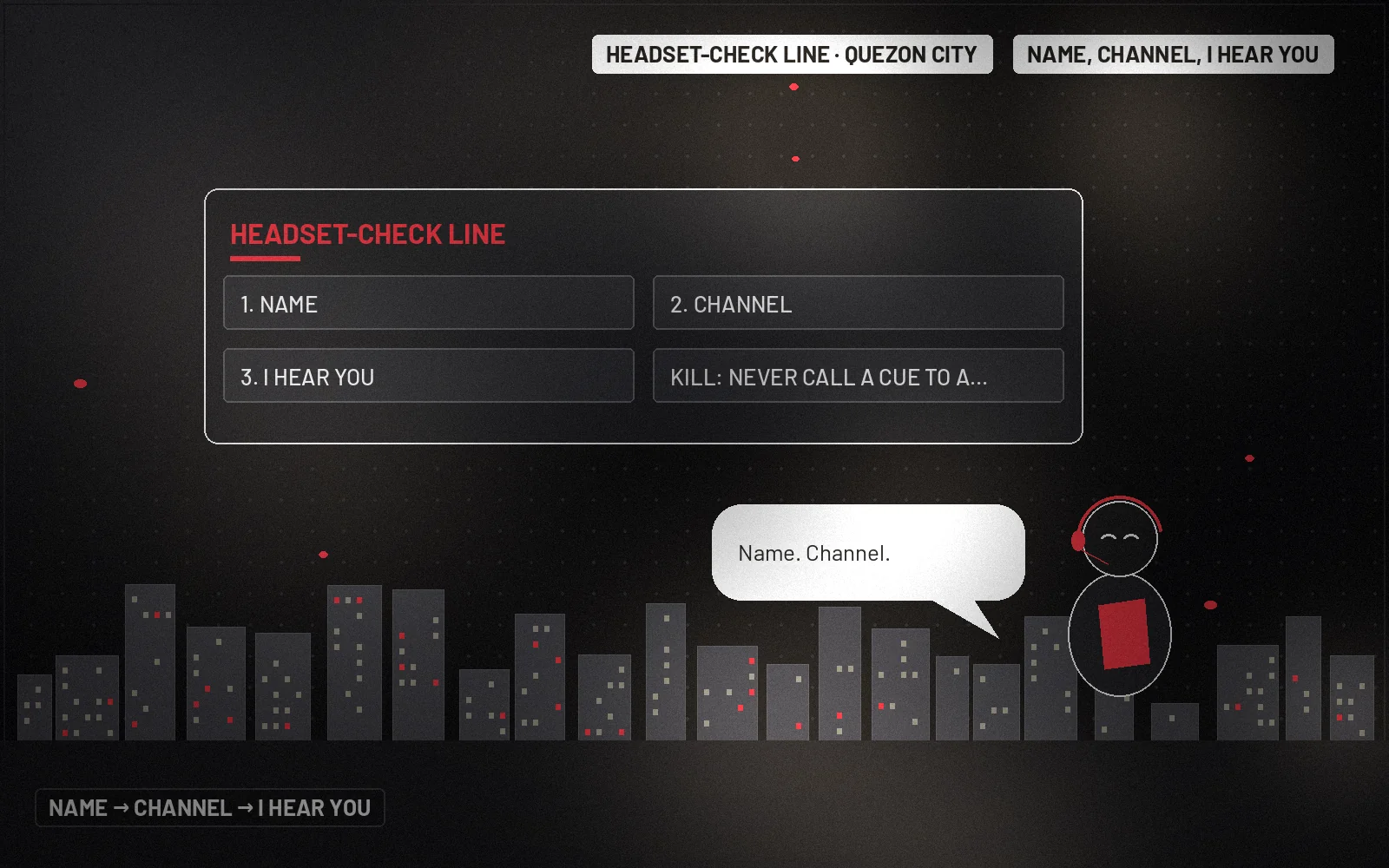
Three parts. Name, channel, I hear you.
Headset-check line (illustrative):
“Call each station by name: stage left, sound, follow spot one.”
“Give the channel: you should be on channel A, crew comms.”
“Station answers: stage left, channel A, I hear you.”
Speakable lock (illustrative): “Call the station by name, give the channel, and wait for I hear you.”
I hear you matters most. A green light on the beltpack proves power, not hearing, and only a spoken answer proves the station is on the right channel.
What should the show caller stop saying on a headset check?
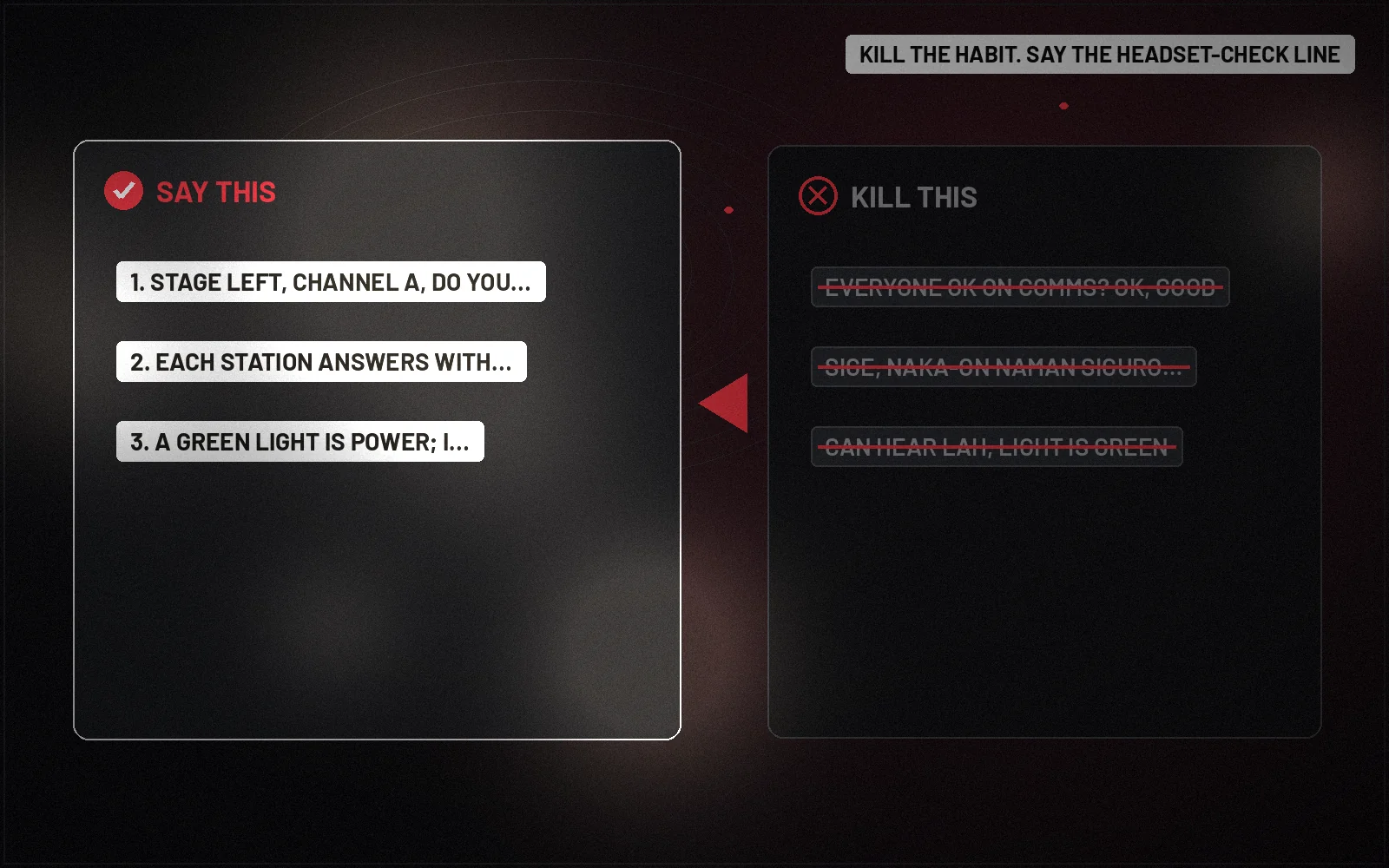
Stop saying everyone ok and start calling stations one by one. Everyone ok gets silence, and silence sounds like yes. Name the station, give the channel, and wait for the words I hear you before you move on to the next post.
| Kill this | Say this (illustrative) | Why |
|---|---|---|
| Everyone ok on comms? Ok, good. | Stage left, channel A, do you hear me? | A named station |
| Sige, naka-on naman siguro lahat. | Each station answers with name, channel, and I hear you. | A spoken answer |
| Can hear lah, light is green. | A green light is power; I need your voice. | Proof, not lights |
| Ay, wala si spot, sige na lang. | Follow spot one is silent; runner, walk to the spot now. | Walk to silence |
| Whatever channel also can, we switch later. | Crew comms on channel A; stage manager on B. | Fixed channels |
Lines in this table are illustrative, not quotes from real people.
When should the headset check happen before a show?
At a fixed minute before doors, and again after any break or crew swap. Put the time on the run sheet. If a crew member changes beltpacks or swaps with a relief, the new person answers the same roll call before the next cue.
What if a station stays silent on the headset check?
Walk to it; do not shout louder on the channel. Send a runner or go yourself. Check the beltpack channel, the cable and the volume knob, then rerun that one station’s call until it answers I hear you.
How does this play out on PH, SG and Bangkok desks?
Same three parts. Different desks.
Philippines desk. In Quezon City and across the Philippines, crews are often mixed: venue staff, freelancers and volunteers on borrowed beltpacks. Brief with po and names: stage left po, channel A po, sabihin I hear you. Keep the answer in English on the channel so every station knows the same words.
Singapore desk. In Singapore, crews usually know comms protocol, so the check is fast. Keep the line in plain English, run it on the minute, and do not skip a station because it answered at rehearsal.
Bangkok desk. In Bangkok, brief the roll call in Thai and English together, then keep the on-channel answer in English. Add khrap or kha when you thank each station, and walk to any silent post before doors.
Monday field kit
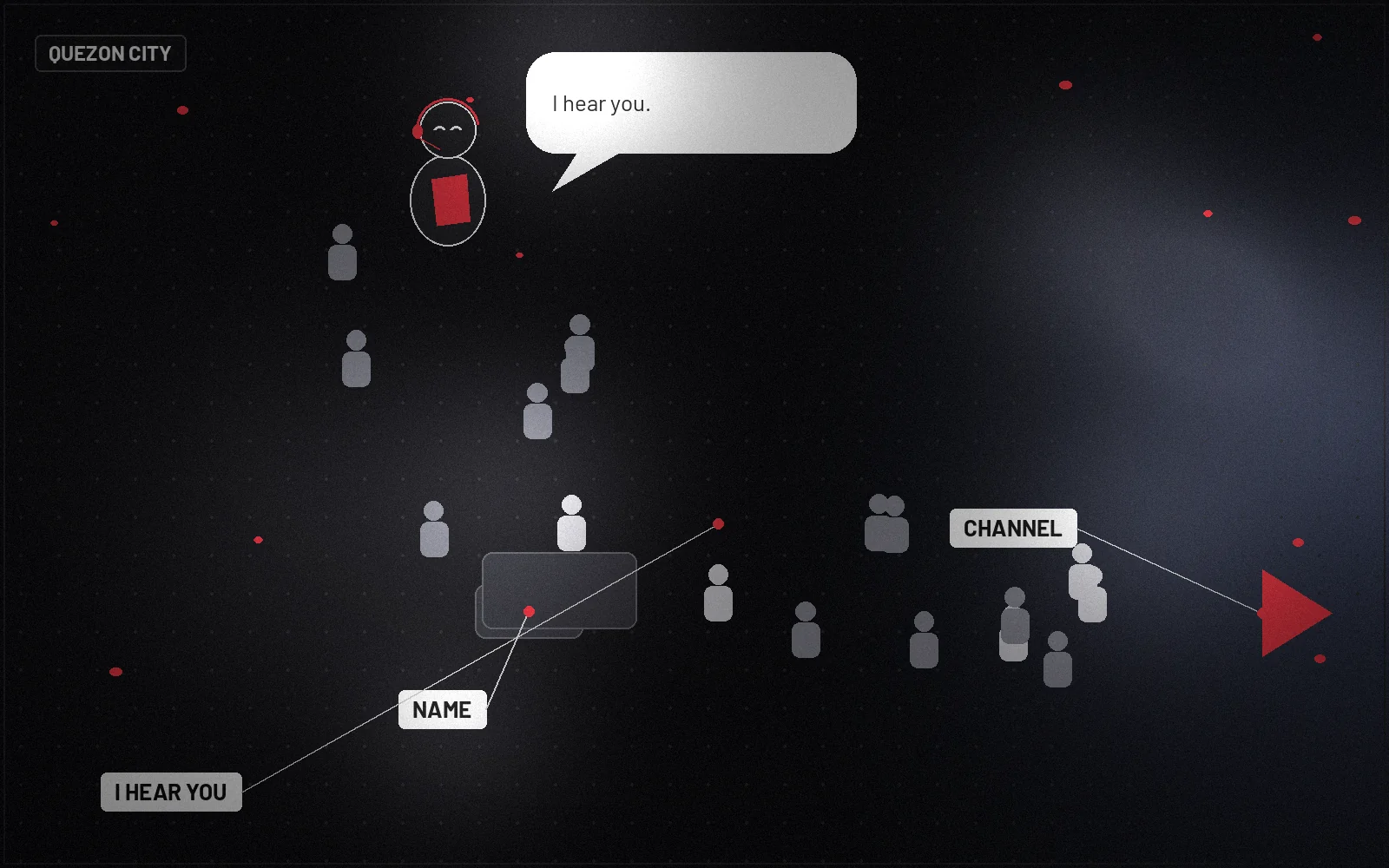
- Name, channel, I hear you.
- Station list and channel plan taped at the caller’s desk.
- Roll call at a fixed minute before doors and after breaks.
- Runner ready to walk to any silent station.
- Kill rule: never call a cue to a station that has not said I hear you.
FAQs
What is a headset-check line English APAC?
A headset-check line English APAC is the show caller’s roll call on crew comms: name, channel, I hear you. Every station answers in the same words.
How do you run a crew headset check before an event?
Call each station by name, state the channel, and wait for the spoken answer I hear you. Walk to any station that stays silent.
Why is a green light on a headset not enough?
A green light proves the beltpack has power, not that the person hears the right channel. Only a spoken reply proves it.
Neuwark Communications builds event and campaign communications as part of our strategy and messaging work. More street-smart lines live in Insights.
Related: standby-cue line English APAC · runner-radio line English APAC
Talk to us about your next event script.
Illustrative lines only. Communications craft, not legal advice.